-
-
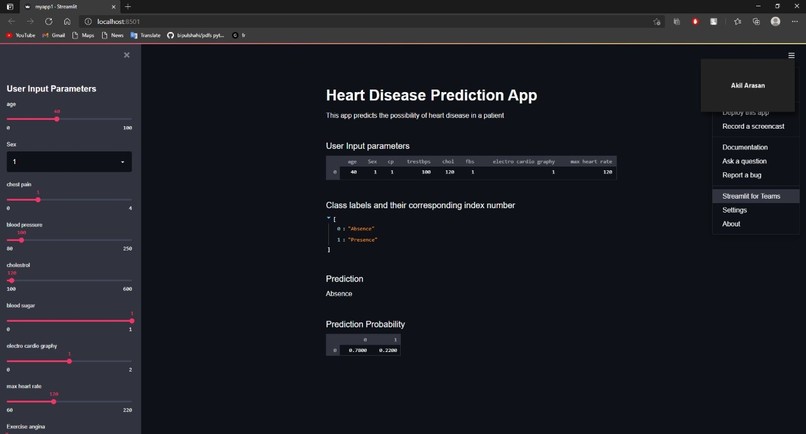
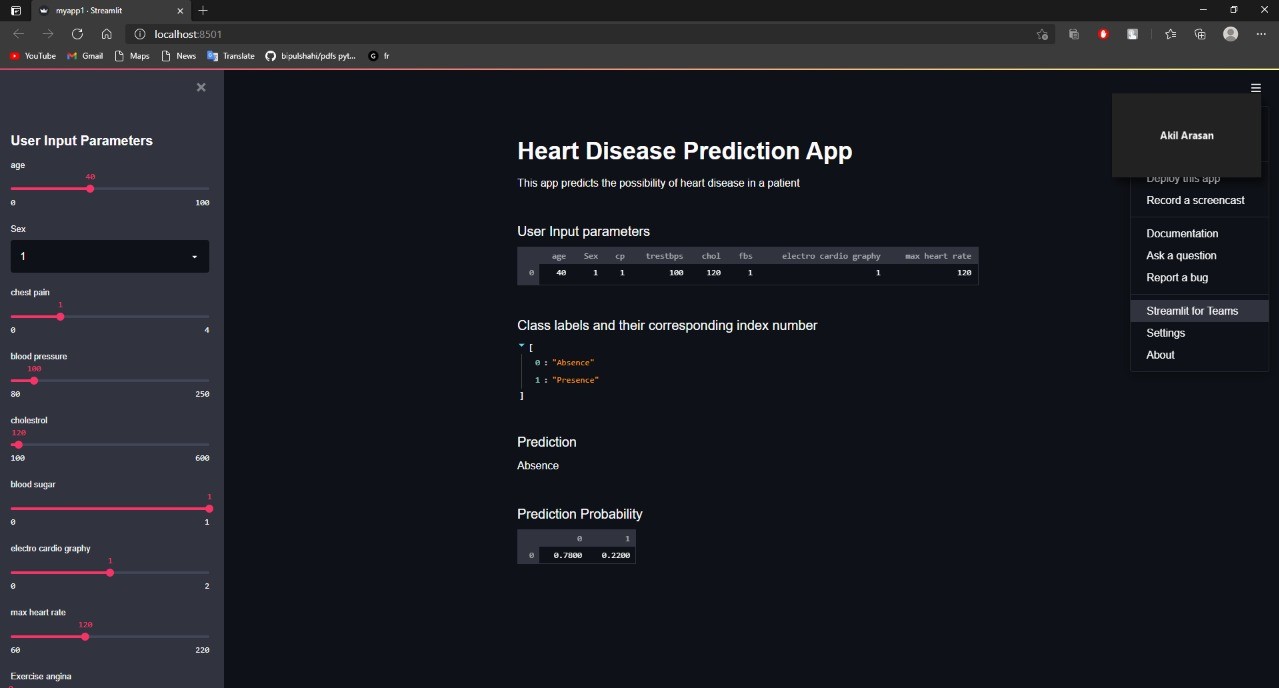
Demo Run 1 where the out-put is Absent
-
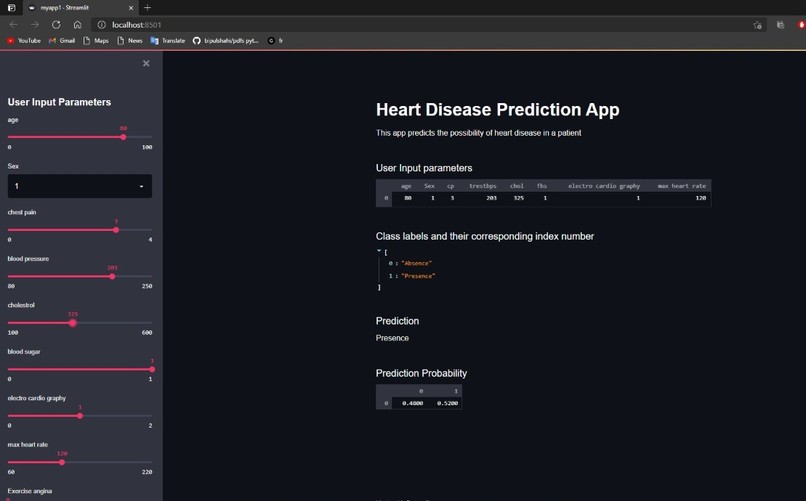
Demo Run 2 where the out-put is Present

Inspiration
Heart disease is the leading cause of death for men, women, and people of most racial and ethnic groups all around the world. In 2019, around 189 out of 100,000 Canadians died from major cardiovascular diseases. In 2000, the death rate stood at over 247 deaths per 100,000. By determining and predicting heart patience at an earlier stage we can save this life by giving proper treatment and create a healthy society.
What it does
Our app uses a RandomForestClassifier to classify our data set as it the most efficient classifier for our data set. Our classifier classifies based on the following 13 factors and gives an output whether the patient has heart disease or not with the percentage of risk.
• Age - age in years
• Sex - (1 = male, 0=female)
• Chest pain type - ( 1 = mild pain, 2 = normal pain, 3 = severe pain , 4 = extreme pain )
• Cholestrol - serum cholestrol in mg/dl.
• fbs over 120 - if greater than 120 - 1 , else -0 in mg/dl.
• EKG results - It is a graph of voltage versus time of the electrical activity of the heart using electrodes placed on the skin.
• Max HR – maximum heart rate achieved
• Exercise angina - An exercise stress test is used to determine how well your heart responds during times when it's working its hardest
• ST depression- Exercise tolerance testing is an important diagnostic and prognostic tool for assessing patients with suspected or known ischaemic heart disease
• Slope of ST - It is concluded that the maximal ST/HR slope can be used reliably to predict the presence or absence and the severity of coronary artery disease in individual patients with anginal pain, whether they are on beta-blocker therapy or not.
• Number of vessels Fluro - Fluoroscopy is a study of moving body structures--similar to an X-ray "movie." A continuous X-ray beam is passed through the body part being examined. The beam is transmitted to a TV-like monitor so that the body part and its motion can be seen in detail. Fluoroscopy, as an imaging tool, enables physicians to look at many-body systems, including the skeletal, digestive, urinary, respiratory, and reproductive systems.
• Thallium - A thallium stress test is a nuclear imaging test that shows how well blood flows into your heart while you're exercising or at rest. This test is also called a cardiac or nuclear stress test.
How we built it
1) We started analyzing our data set using Weka. 2) And build our prototype in Python using spider. 3) We used streamlit to host our web locally on our computer. 4) We build our application user-friendly by installing sliders to get user's inputs. 5) We used a RandomForestClassifier() to classify our data set.
Challenges we ran into
1) Collaborate with each other on our first online hackathon. 2) To Combining both of our code files and cleaned the data set. 3) To collect/Find the correct Dataset.
Accomplishments that we're proud of
Finally, we were able to build an efficient machine-learning algorithm to predict heart disease
What we learned
1) We learned how to use streamlit to host our application locally on our computer. 2) We learned to collaborate with other team members through an online platform.
What's next for Heart Disease Prediction App.
To add more attributes and input variables to predict heart disease more accurately. Our future plan includes a machine learning algorithm that takes heartbeat sound as input to predict heart diseases.
Built With
- python
- streamlit
- weka


Log in or sign up for Devpost to join the conversation.