


Inspiration
PROBLEM: Homeless veterans frequently struggle with mental health issues
The inspiration behind HEART (Homeless Engagement and Response Team) AI came from the pressing need to address the challenges faced by homeless veterans. As engineers, we recognized the power of technology and AI in transforming lives, and we wanted to leverage these tools to make a meaningful impact on the lives of those who served our country. Due to their experiences during military service and homelessness. However, accessing timely and appropriate mental health support can be difficult due to limited resources, stigma, and the complexity of navigating the healthcare system. Homeless veterans often face challenges in accessing essential resources such as shelters, healthcare services, employment opportunities, and educational programs. Homeless veterans frequently struggle with mental health issues resulting from their experiences during military service and homelessness. Homeless veterans often encounter significant barriers when trying to secure stable employment. These barriers include a lack of relevant job opportunities, difficulty in translating military skills to the civilian job market, limited access to training and career development programs, and a lack of support networks for job placement and mentorship.
HEART differentiates itself by combining the features of resource discovery, personalized mental health support, and tailored job placement into one comprehensive platform. It leverages AI-powered technology to provide a user-friendly experience, personalized recommendations, and real-time updates. By offering an integrated and holistic solution, HEART aims to address the limitations and fragmentation present in existing alternatives, providing a more effective and efficient support system for homeless veterans.
The motivation to create HEART was to provide a comprehensive and user-friendly platform that connects homeless veterans with the essential resources they need, such as mental health support, job placements, housing assistance, and educational programs. Our goal was to build a solution that goes beyond simple resource discovery and fosters a supportive online community where veterans can connect, share experiences, and uplift each other.
STEMIST Hacks: Code for good
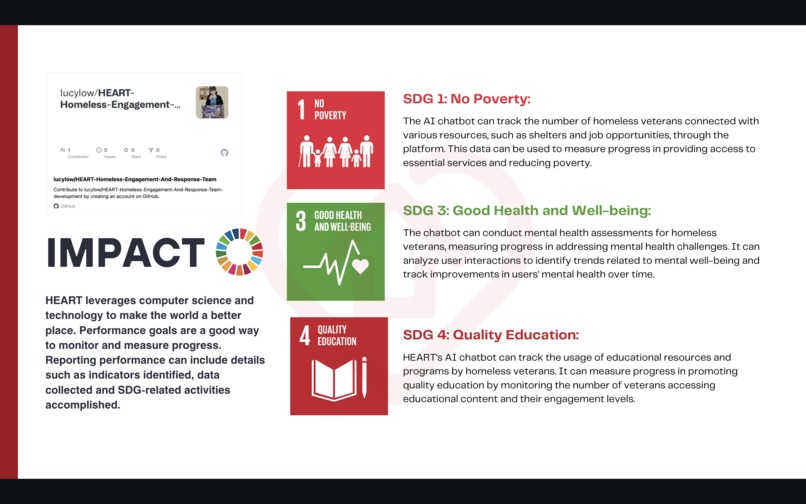
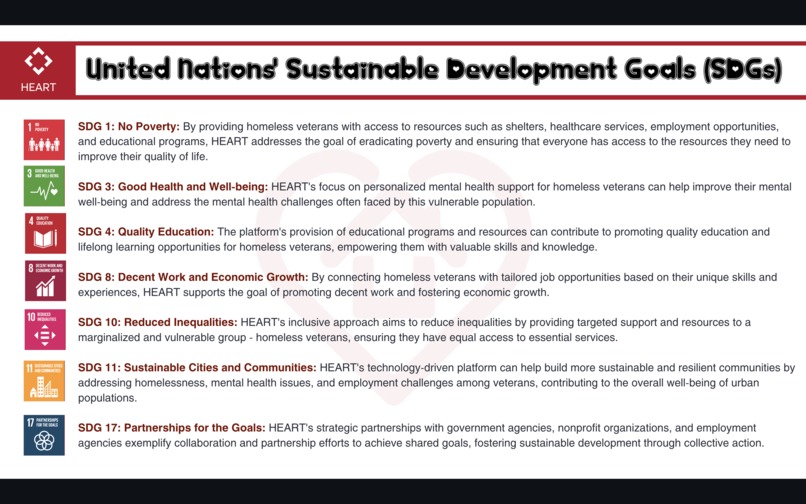
SDG 1: No Poverty: By providing homeless veterans with access to resources such as shelters, healthcare services, employment opportunities, and educational programs, HEART addresses the goal of eradicating poverty and ensuring that everyone has access to the resources they need to improve their quality of life. The AI chatbot can track the number of homeless veterans connected with various resources, such as shelters and job opportunities, through the platform. This data can be used to measure progress in providing access to essential services and reducing poverty.
SDG 3: Good Health and Well-being: HEART's focus on personalized mental health support for homeless veterans can help improve their mental well-being and address the mental health challenges often faced by this vulnerable population. The chatbot can conduct mental health assessments for homeless veterans, measuring progress in addressing mental health challenges. It can analyze user interactions to identify trends related to mental well-being and track improvements in users' mental health over time.
SDG 4: Quality Education: The platform's provision of educational programs and resources can contribute to promoting quality education and lifelong learning opportunities for homeless veterans, empowering them with valuable skills and knowledge. HEART's AI chatbot can track the usage of educational resources and programs by homeless veterans. It can measure progress in promoting quality education by monitoring the number of veterans accessing educational content and their engagement levels.
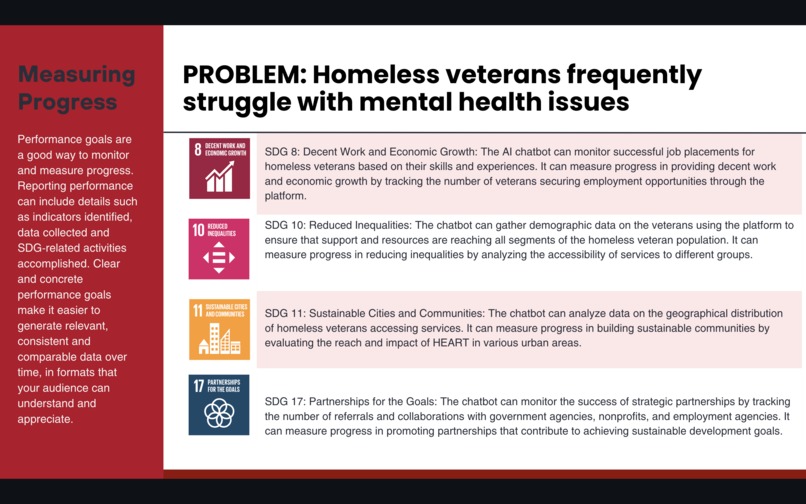
SDG 8: Decent Work and Economic Growth: By connecting homeless veterans with tailored job opportunities based on their unique skills and experiences, HEART supports the goal of promoting decent work and fostering economic growth. SDG 8: Decent Work and Economic Growth: The AI chatbot can monitor successful job placements for homeless veterans based on their skills and experiences. It can measure progress in providing decent work and economic growth by tracking the number of veterans securing employment opportunities through the platform.
SDG 10: Reduced Inequalities: HEART's inclusive approach aims to reduce inequalities by providing targeted support and resources to a marginalized and vulnerable group - homeless veterans, ensuring they have equal access to essential services. SDG 10: Reduced Inequalities: The chatbot can gather demographic data on the veterans using the platform to ensure that support and resources are reaching all segments of the homeless veteran population. It can measure progress in reducing inequalities by analyzing the accessibility of services to different groups.
SDG 11: Sustainable Cities and Communities: HEART's technology-driven platform can help build more sustainable and resilient communities by addressing homelessness, mental health issues, and employment challenges among veterans, contributing to the overall well-being of urban populations. SDG 11: Sustainable Cities and Communities: The chatbot can analyze data on the geographical distribution of homeless veterans accessing services. It can measure progress in building sustainable communities by evaluating the reach and impact of HEART in various urban areas.
SDG 17: Partnerships for the Goals: HEART's strategic partnerships with government agencies, nonprofit organizations, and employment agencies exemplify collaboration and partnership efforts to achieve shared goals, fostering sustainable development through collective action. SDG 17: Partnerships for the Goals: The chatbot can monitor the success of strategic partnerships by tracking the number of referrals and collaborations with government agencies, nonprofits, and employment agencies. It can measure progress in promoting partnerships that contribute to achieving sustainable development goals.
What it does
HEART leverages computer science and technology to make the world a better place.
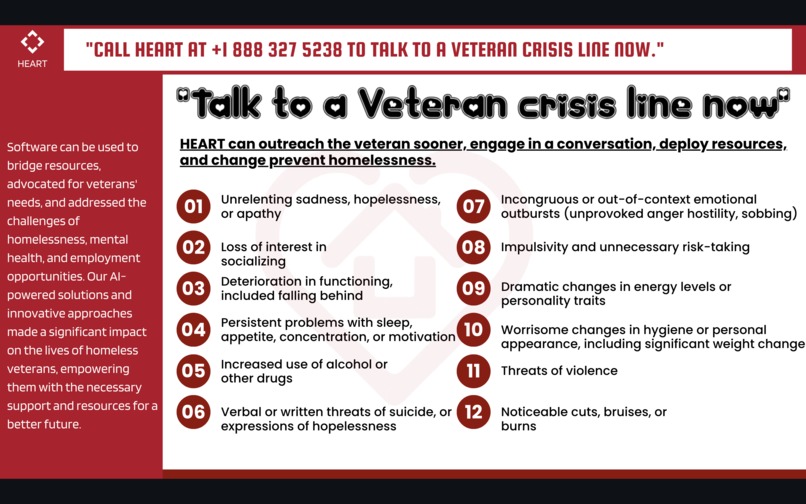
"Call heart at +1 888 327 5238 to Talk to a Veteran crisis line now."
HEART AI is an AI-powered web and mobile application that offers a range of services to homeless veterans. It utilizes natural language processing (NLP) and machine learning algorithms to assess the mental health of veterans and offer personalized support. The platform allows veterans to easily find and access various resources such as shelters, healthcare services, educational programs, and tailored job opportunities based on their unique skills and experiences. Software can be used to bridge resources, advocated for veterans' needs, and addressed the challenges of homelessness, mental health, and employment opportunities. Our AI-powered solutions and innovative approaches made a significant impact on the lives of homeless veterans, empowering them with the necessary support and resources for a better future. HEART fosters an inclusive and supportive online community, enabling homeless veterans to connect and provide peer support. The AI chatbot guides veterans through their journey, providing real-time updates and recommendations to ensure each veteran receives the assistance they need.
- HEART Resource Finder: An AI-powered web and mobile application that allowed homeless veterans to easily find and access various resources such as shelters, healthcare services, employment opportunities, and educational programs.
- HEART Collaborative Job Placement: Connects homeless veterans with tailored job opportunities based on their unique skills, experiences, and rehabilitation targeted physical and cognitive abilities such as mobility, coordination, and decision-making skills.
- HEART Mental Health Assessment and Support: We built an AI-driven platform that utilized natural language processing (NLP) and machine learning algorithms to assess the mental health of veterans and offer personalized support.
- HEART Peer Support Network: We established a dedicated online community and communication platform where homeless veterans could connect, support each other, and share experiences.
AI-Powered Sentiment Analysis : Impact Measurement and Evaluation
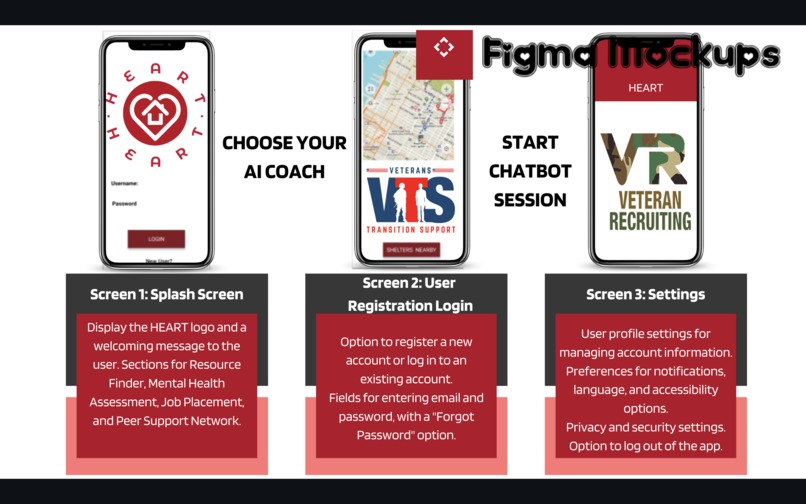
HEART is an AI-powered web and mobile application designed to provide comprehensive support for homeless veterans. Our platform analyzed text-based inputs and voice analysis to identify indicators of distress, providing appropriate resource suggestions and interventions to support veterans' well-being. HEART has implemented robust impact measurement and evaluation methodologies, allowing it to track and demonstrate the tangible outcomes and effectiveness of its solutions. This data-driven approach not only ensures accountability but also provides valuable insights for continuous improvement and optimization of services.
Twitter Data
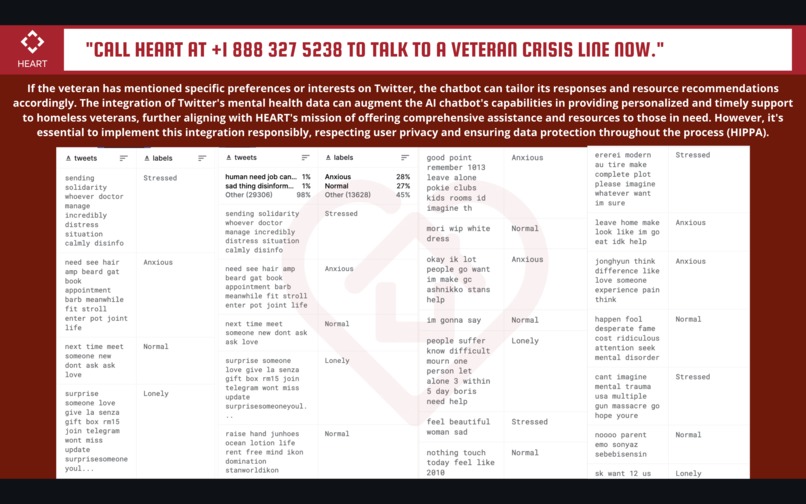
AI to help identify veterans at risk of suicide early using artificial intelligence as a homeless prevention tool for veterans picking up on distress indicators enabling us to target specifically the veterans in need and deploy resources Through advanced AI technology, Integration with Twitter's Mental Health Data: Integrating Twitter's mental health data into HEART's AI chatbot can add another layer of support and personalization. Twitter's mental health data could refer to publicly available information, such as tweets or profile details that provide insights into a user's mental well-being. By integrating this data, the AI chatbot can have a more informed conversation with the user. For example, if the chatbot detects that a veteran has tweeted about mental health challenges, it can proactively offer mental health resources and helpline numbers.
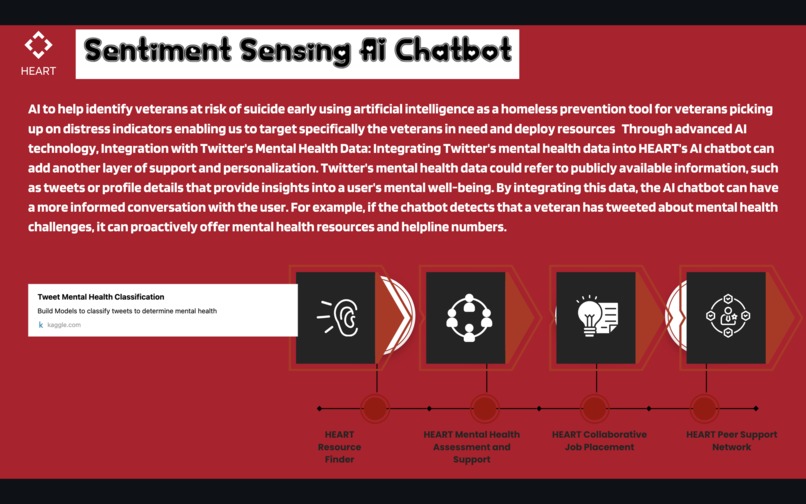
If the veteran has mentioned specific preferences or interests on Twitter, the chatbot can tailor its responses and resource recommendations accordingly. The integration of Twitter's mental health data can augment the AI chatbot's capabilities in providing personalized and timely support to homeless veterans, further aligning with HEART's mission of offering comprehensive assistance and resources to those in need. However, it's essential to implement this integration responsibly, respecting user privacy and ensuring data protection throughout the process (HIPPA).
Mobile and Web Accessibility The platform offers a user-friendly interface, personalized mental health assessments, resource discovery, tailored job placement services, and an online community for peer support. HEART Mental Health Assessment and Support ("Talk to a Veteran crisis line now"): We built an AI-driven platform that utilized natural language processing (NLP) and machine learning algorithms to assess the mental health of veterans and offer personalized support. Key features include real-time updates, access to healthcare services, educational programs, employment opportunities, and personalized recommendations. The platform is designed to be accessible across various devices and internet speeds, catering to the unique needs of homeless veterans.
HEART Figma Mockups
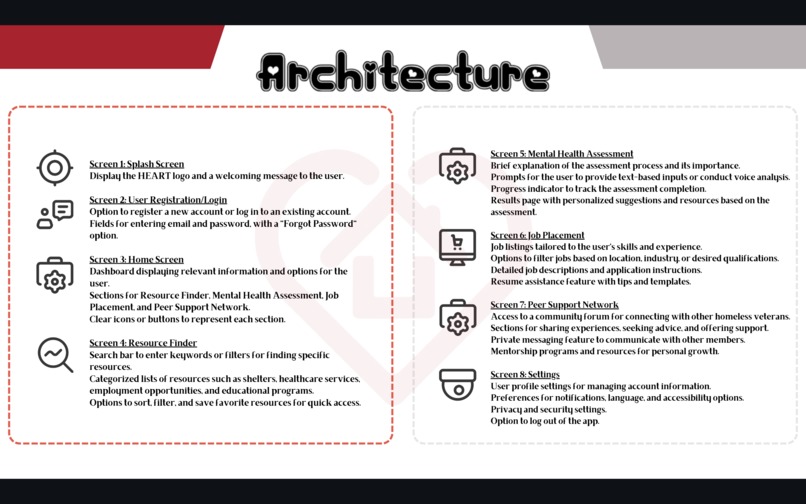
Screen 1: Splash Screen Display the HEART logo and a welcoming message to the user.
Screen 2: User Registration/Login Option to register a new account or log in to an existing account. Fields for entering email and password, with a "Forgot Password" option.
Screen 3: Home Screen Dashboard displaying relevant information and options for the user. Sections for Resource Finder, Mental Health Assessment, Job Placement, and Peer Support Network. Clear icons or buttons to represent each section.
Screen 4: Resource Finder Search bar to enter keywords or filters for finding specific resources. Categorized lists of resources such as shelters, healthcare services, employment opportunities, and educational programs. Options to sort, filter, and save favorite resources for quick access.
Screen 5: Mental Health Assessment Brief explanation of the assessment process and its importance. Prompts for the user to provide text-based inputs or conduct voice analysis. Progress indicator to track the assessment completion. Results page with personalized suggestions and resources based on the assessment.
Screen 6: Job Placement Job listings tailored to the user's skills and experience. Options to filter jobs based on location, industry, or desired qualifications. Detailed job descriptions and application instructions. Resume assistance feature with tips and templates.
Screen 7: Peer Support Network Access to a community forum for connecting with other homeless veterans. Sections for sharing experiences, seeking advice, and offering support. Private messaging feature to communicate with other members. Mentorship programs and resources for personal growth.
Screen 8: Settings User profile settings for managing account information. Preferences for notifications, language, and accessibility options. Privacy and security settings. Option to log out of the app.
How we built it
The engineering team at HEART worked collaboratively to bring the vision to life. We began by designing the platform's architecture and user interface, ensuring it is intuitive and accessible to homeless veterans with varying levels of technology literacy. The development process involved building the AI chatbot using Twilio Autopilot, incorporating natural language processing capabilities to handle user queries and understand intents accurately.
Twilio Chatbot implementation
HEART can utilize sentiment analysis to assess the emotional tone of the user's responses during the conversation with the virtual agent.
The sentimentAnalysis attribute is a boolean that indicates whether you want to enable or disable sentiment analysis in Dialogflow for HEART. When enabled, Dialogflow will perform sentiment analysis on the user's intents, providing a numerical score between -1.0 (indicating negative sentiment) and 1.0 (indicating positive sentiment). Additionally, Dialogflow will provide a non-negative magnitude value in the [0, +inf) range, representing the absolute magnitude of sentiment, regardless of the score being positive or negative. Twilio sends data related to the conversation between the user and the virtual agent to an absolute URL provided by you. This data includes information about intents, transcripts, and sentiment analysis (if enabled). By enabling sentiment analysis, HEART can evaluate the emotional sentiment of the user's responses, which can be useful for understanding the veterans' emotional state and tailoring responses accordingly.
Question 1: How can we assist you best? Reply with the corresponding number: Mental health support Job placement Housing assistance Educational programs Community connection Other (Please specify)
Question 2: Are you currently experiencing homelessness? Reply with: Yes No
Question 3: Which city or region are you currently located in? Reply with your city's name.
Question 4: On a scale of 1 to 5, how would you rate the availability of resources for homeless veterans in your area? (1 - Very limited, 5 - Abundant)
Question 5: Have you accessed any support services for homeless veterans in the past month? Reply with: Yes No
-Question 6: If you've accessed support services, please share your experience briefly.
-Question 7: What specific challenges do you face in accessing support services? Reply with your response.
-Question 8: Would you be interested in joining an online community of homeless veterans for peer support and sharing experiences? Reply with: Yes No
-Question 9: Is there any specific type of job or career you are interested in? Reply with your response. -Question 10:
Are you interested in educational programs or training opportunities? Reply with: Yes No
-Question 11: How did you hear about HEART's services? Reply with your response.
- Question 12: Would you like us to contact you for additional support or follow-up? Reply with: Yes No Remember to include instructions in each question, specifying the reply format (e.g., "Reply with the corresponding number," "Reply with Yes or No," etc.). Keep the language simple and clear, and ensure that respondents can easily provide their answers through SMS.
Additionally, consider including an opt-out option (e.g., "Reply STOP to opt-out") and privacy information to assure respondents that their responses will be handled with confidentiality and in compliance with data protection regulations.
Connect Virtual Agent with HEART's Sentiment Analysis (Whether sentiment analysis should be enabled or not.) Defaults to the sentiment analysis setting in the Dialogflow ES connector configuration.
send_and_reply_1: Welcome to HEART - Homeless Engagement And Response Team. Our "Talk to a Veteran crisis line now" helpline. Please reply with one of the following: mental health support, job placement, housing assistance, community connection, or educational programs.
send_and_reply_2: Thank you for reaching out to HEART. We're here to help. Please provide more details about your needs so we can connect you with the right support. Options include mental health support, job placement, housing assistance, community connection, or educational programs.
split_order: widgets.send_and_reply_1.inbound.Body
send_and_reply_connecting: We want to ensure you receive the support you need. Let us connect you with our team of experts. Is now a good time to talk?
split_confirm: widgets.send_and_reply_connecting.inbound.Body
call_vet_crisis_helpline: NUMBER TO CALL {{contact.channel.address}} NUMBER TO MAKE CALL FROM
To use sentiment analysis in Dialogflow CX, ensure that you have selected a language that supports the "Sentiment" filter, and consider the language settings for the Dialogflow CX connector configuration in Twilio. This way, you can gain valuable insights into the users' emotions and continuously improve the chatbot's interactions for HEART's mission. When designing an SMS survey for homeless veterans, it's essential to be sensitive to their needs and circumstances. HEART' survey is concise, respectful, and focused on gathering valuable insights that can help improve HEART's services for veterans.
Remember to include instructions in each question, specifying the reply format (e.g., "Reply with the corresponding number," "Reply with Yes or No," etc.). Keep the language simple and clear, and ensure that respondents can easily provide their answers through SMS. Additionally, consider including an opt-out option (e.g., "Reply STOP to opt-out") and privacy information to assure respondents that their responses will be handled with confidentiality and in compliance with data protection regulations.
TWILIO -> Programmable Voice → Sentiment Analysis
The statusCallback attribute is an absolute URL provided by you to Twilio. Twilio will send HTTP requests to this URL during the Dialogflow agent interaction. Each time an intent matches in the Dialogflow agent's conversation, Twilio will trigger an HTTP request to the statusCallback URL, providing information about the interaction. The request's body will contain data related to intents, transcripts (text exchanged between caller and the virtual agent), sentiment analysis (if enabled), and custom parameters sent to Dialogflow for custom logic. For personalized mental health support, we integrated Dialogflow CX, enabling sentiment analysis to assess the emotional tone of veterans' responses. The job placement and resource discovery functionalities were implemented using advanced machine learning algorithms that match veterans' skills and experiences to suitable opportunities.
Twilio Tasks

task_greeting: Description: This task handles the initial greeting and welcome message for the chatbot. Use Case: It initiates the conversation, introduces the chatbot as HEART, and asks how the bot can assist the user.
task_mental_health_support: Description: This task provides resources and support for mental health assistance. Use Case: It offers helpline numbers, crisis intervention, and connects veterans to mental health professionals or counselors.
task_job_placement: Description: This task assists veterans in finding tailored job opportunities based on their skills and experiences. Use Case: The chatbot can gather information about the veteran's background and preferences to recommend suitable job options.
4.task_housing_assistance: Description: This task provides information and resources related to housing assistance and shelter options. Use Case: It can offer details about local shelters, transitional housing programs, and how to access housing support services.
task_educational_programs: Description: This task offers guidance and information about educational programs and training opportunities. Use Case: It can help veterans explore educational resources, grants, or scholarships to enhance their skills and career prospects.
task_community_connection: Description: This task focuses on building connections and facilitating peer support among homeless veterans. Use Case: It encourages veterans to join HEART's online community to share experiences and support each other.
Throughout the development, we followed best practices in data security, ensuring that sensitive information is handled with utmost privacy and in compliance with regulations like HIPAA.
Challenges we ran into
Creating HEART came with its share of challenges. One significant hurdle was ensuring that the platform caters to the diverse needs and preferences of homeless veterans. We needed to strike a balance between providing personalized support while also maintaining user privacy and data security.
Integrating sentiment analysis was another challenge, as it required fine-tuning the NLP models to accurately detect emotional sentiment in veterans' responses.
Moreover, ensuring the platform's accessibility across different devices and internet speeds for homeless veterans posed technical challenges that we had to address diligently.
Accomplishments that we're proud of
One of our proudest achievements was building a cohesive platform that addresses multiple aspects of homeless veterans' well-being. HEART provides holistic support, connecting veterans with mental health resources, job opportunities, housing assistance, and educational programs.
We are proud of creating a safe and supportive online community for homeless veterans to connect, share experiences, and uplift one another.
The successful integration of AI technologies like natural language processing and sentiment analysis to deliver personalized assistance was a significant accomplishment for our engineering team.
What we learned
During the development of HEART, we learned the importance of empathy-driven design. Understanding the unique challenges faced by homeless veterans was crucial in building a platform that truly caters to their needs.
We also gained valuable insights into integrating AI technologies into real-world applications. Fine-tuning NLP models and leveraging sentiment analysis taught us how to interpret and respond to users' emotional states effectively.
The project emphasized the significance of collaboration between engineers, mental health experts, and social workers. Combining different expertise was instrumental in creating a robust and user-focused platform.
What's next for HEART AI
As we move forward, we have ambitious plans for HEART AI. We aim to expand our reach to more cities and regions, ensuring that homeless veterans across the country can access the platform's comprehensive support.
We will continuously enhance the AI chatbot's capabilities to provide even more personalized and timely assistance to veterans. This includes improving the recommendation system for job placements and educational programs, making it even more tailored to individual skills and preferences.
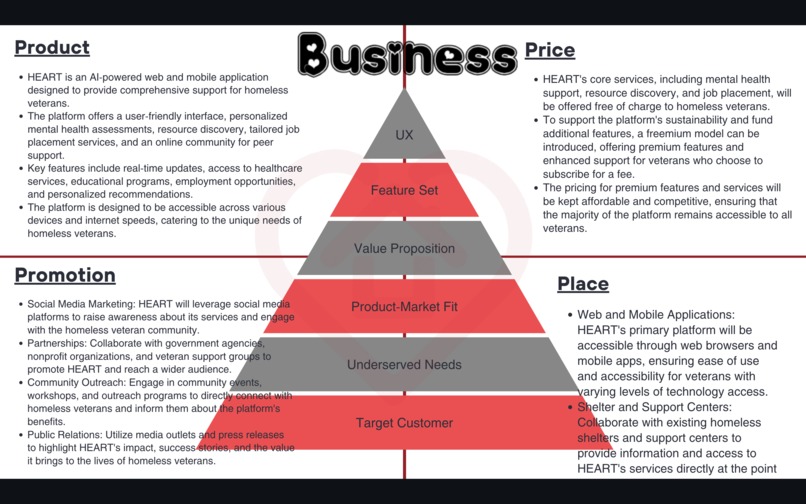
- Social Media Marketing: HEART will leverage social media platforms to raise awareness about its services and engage with the homeless veteran community.
- Partnerships: Collaborate with government agencies, nonprofit organizations, and veteran support groups to promote HEART and reach a wider audience.
- Community Outreach: Engage in community events, workshops, and outreach programs to directly connect with homeless veterans and inform them about the platform's benefits.
- Public Relations: Utilize media outlets and press releases to highlight HEART's impact, success stories, and the value it brings to the lives of homeless veterans.
Additionally, we will focus on forging more strategic partnerships with government agencies, nonprofits, and employment agencies to broaden the range of resources available to homeless veterans.
Cost Structure
- Development and maintenance of the web and mobile applications.
- AI technology and infrastructure costs for providing personalized mental health support.
- Skilled staff salaries, including AI specialists, counselors, and support personnel for the helplines with security and privacy rules for keeping chat data safe.
- Budget for marketing, engagement campaigns and community outreach to promote app.
Revenue Stream
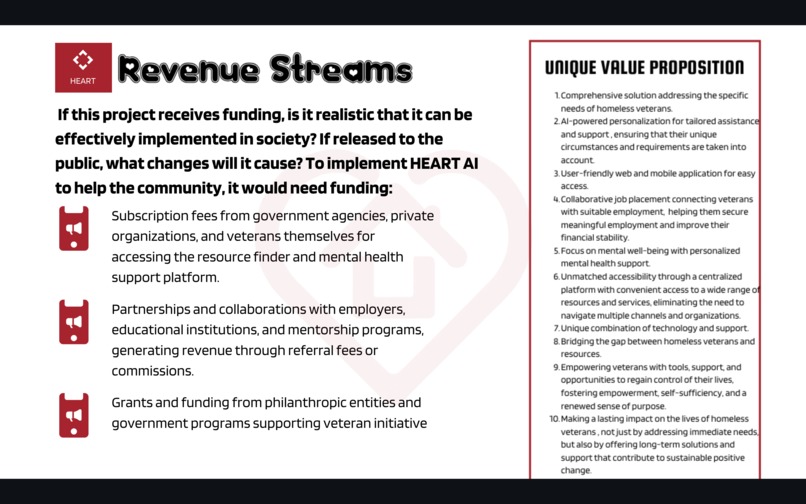
- Grants and funding from local, state, and federal government agencies and philanthropic organizations that share a mission of assisting homeless veterans.
- Corporate partnerships with private companies for job placement services looking to hire veterans like Uber/Accenture
- Premium features or subscription plans to veterans who wish to access additional benefits, personalized support, or specialized resources.
Ultimately, our vision for HEART AI is to be at the forefront of using cutting-edge technology to create a lasting positive impact on the lives of our nation's heroes – homeless veterans.

Log in or sign up for Devpost to join the conversation.