-
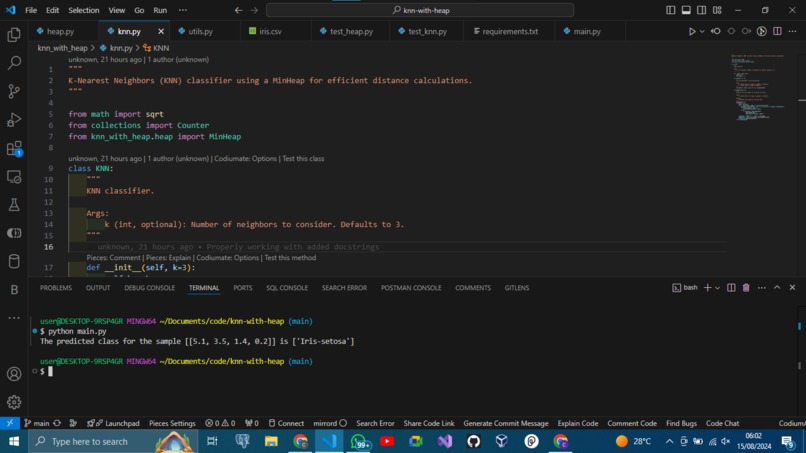
Page showing the heap algorithm working

K-Nearest Neighbors (KNN) Classifier with MinHeap
Inspiration
The idea for this project stemmed from a desire to deepen my understanding of how fundamental data structures can enhance the efficiency of machine learning algorithms. I was particularly intrigued by the challenge of optimizing the K-Nearest Neighbors (KNN) algorithm, a simple yet powerful classifier, by incorporating a MinHeap data structure to manage the nearest neighbors more efficiently.
What it does
This project implements a K-Nearest Neighbors (KNN) classifier that leverages a MinHeap data structure to efficiently identify the k closest neighbors to a given data point. The classifier calculates the Euclidean distances between the test point and all training points, then uses the MinHeap to maintain the smallest k distances. The most frequent label among these neighbors is then predicted as the class for the test point.
How we built it
- Initial Development: We started with a basic implementation of the KNN algorithm, calculating Euclidean distances between points and identifying the nearest neighbors through a straightforward approach.
- MinHeap Integration: To optimize the neighbor selection process, we implemented a custom MinHeap. This heap dynamically maintains the smallest
kdistances during the prediction phase, ensuring that the most relevant neighbors are considered. - Testing and Refinement: The implementation was rigorously tested using the Iris dataset. We encountered and resolved several issues related to heap management, ensuring that the algorithm performed accurately and efficiently.
Challenges we ran into
- Heap Management: One of the main challenges was ensuring that the MinHeap correctly handled the insertion and deletion of elements while maintaining the smallest
kdistances. Debugging and refining the heap operations required careful attention to detail. - Algorithm Optimization: Balancing the complexity of the heap with the overall performance of the KNN algorithm was a significant challenge. We needed to ensure that the integration of the MinHeap did not introduce unnecessary overhead.
- Debugging: Several subtle bugs, particularly related to the heap’s behavior, had to be meticulously debugged. This required a deep dive into both the KNN algorithm and heap operations to ensure everything worked seamlessly together.
Accomplishments that we're proud of
We are proud to have successfully implemented a KNN classifier that efficiently leverages a MinHeap for neighbor selection. This project not only improved our understanding of data structures but also resulted in a robust and optimized machine learning algorithm. The final product is an efficient classifier that accurately predicts class labels while maintaining computational efficiency.
What we learned
- Data Structures and Algorithms: This project solidified our understanding of how data structures like heaps can be applied to optimize machine learning algorithms.
- Algorithm Optimization: We learned the importance of balancing algorithm complexity with performance, especially when working with large datasets.
- Debugging Complex Systems: The process of integrating and debugging the MinHeap within the KNN algorithm taught us valuable lessons in troubleshooting and refining complex systems.
What's next for KNN with MinHeap
Moving forward, we plan to explore the integration of other data structures to optimize different machine learning algorithms. Additionally, we aim to test this KNN implementation on larger and more complex datasets to further evaluate its performance. Expanding the project to include hyperparameter tuning and scalability improvements are also on the horizon.
Built With
- collections
- math
- python


Log in or sign up for Devpost to join the conversation.