-
-
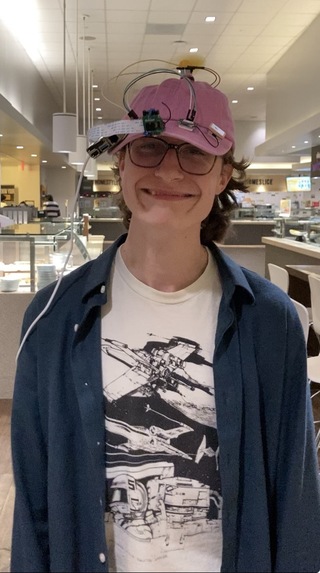
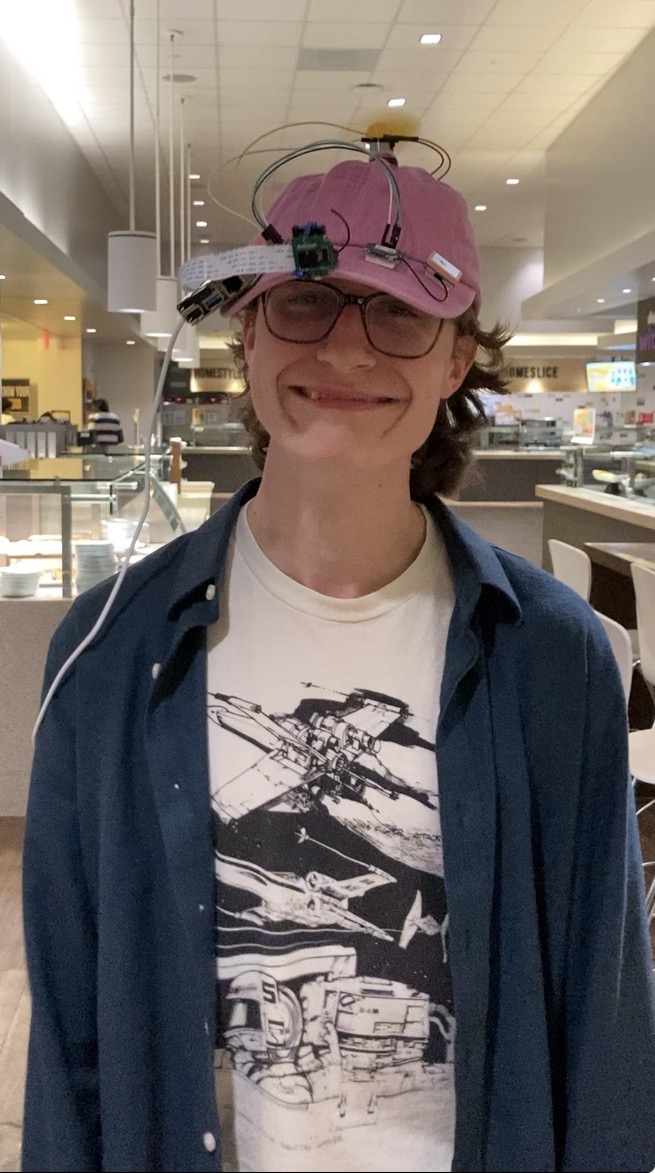
Our Cute Teammate Wearing The Healthy Hat !
Inspiration
Corner stores and bodegas are staples of our communities, but they are often packed with highly processed, sugary options that make healthy eating difficult. We wanted to tackle the hackathon prompt—reimagining the corner store as a healthy food hub—but we knew that lecturing people about nutrition doesn't work. We wanted to make health education interactive, joyful, and completely unavoidable. We asked ourselves: What if making a healthy choice were a game? That led us to the Healthy Hat—a wearable, gamified nutritionist that literally cheers you on when you make good choices.
What it does
The Healthy Hat is a smart wearable that acts as your personal guide through the aisles of a corner store. Using an onboard GPS tracker, the hat automatically activates when it detects you have entered a local store. As you browse, the built-in camera acts as your eyes. If you stare at a bag of chips or a candy bar, the onboard AI processes the image, flags the item as unhealthy, and suggests a nutritious, store-available alternative. If you take the advice and pick up the healthy swap—like an apple or a bag of nuts—the AI registers your choice and triggers the hat's propeller to spin in a celebratory victory lap!
How we built it
We built the physical prototype by mounting a Raspberry Pi to a hat to serve as the "brain" of the operation. We wired a camera module to the brim to capture a first-person view of the store shelves, and connected a GPS module to handle the location-based activation. For the software, we used Python and integrated a computer vision model to perform real-time food item recognition. We also wired a small motor to the Pi's GPIO pins to control the propeller, writing a script that triggers the motor to spin whenever the AI detects a "healthy" classification.
Challenges we ran into
Integrating hardware and software is always tricky under a time limit. One of our biggest hurdles was getting the AI image recognition to run smoothly and quickly on the Raspberry Pi without lagging. We also had to figure out power management—balancing a battery pack that was strong enough to power the Pi, the camera, and the motor, without making the hat too heavy to wear. Finally, calibrating the motor so the propeller spun at a safe, fun speed took quite a bit of trial and error!
Accomplishments that we're proud of
We are incredibly proud of getting the full hardware-software loop functional. Bridging the gap between code on a screen and a physical action in the real world is a great feeling. The first time the camera successfully recognized a piece of fruit and caused the propeller to spin on its own was a massive victory for the team. We are also proud of how perfectly the project addresses the prompt through a fun, positive-reinforcement angle.
What we learned
We learned a massive amount about hardware integration, specifically how to manage power and GPIO pins on a Raspberry Pi. On the software side, we gained hands-on experience optimizing computer vision models for edge devices with limited computing power. Most importantly, we learned that tackling serious problems (like food deserts and nutrition) with a sense of humor and gamification can result in highly engaging solutions.
What's next for Healthy Hat
In the short term, we want to miniaturize the hardware to make the hat lighter and more stylish. In the long term, we would love to connect the software to the live inventory databases of local corner stores. This way, the hat wouldn't just suggest any healthy alternative, but specifically map you to an item that is currently in stock in aisle three. We also want to add an audio component—perhaps a small speaker that reads out the healthy suggestions so you don't even need to look at a phone screen!


Log in or sign up for Devpost to join the conversation.