-
-
Home
Healthy Eating Helper
Inspiration
We were inspired by the growing need for accessible nutrition awareness and the challenge of making healthy eating decisions in our fast-paced world. Many people struggle to understand the nutritional value of their meals, especially when eating out or trying new foods. We wanted to create a tool that democratizes nutrition knowledge by making it as simple as taking a photo.
What It Does
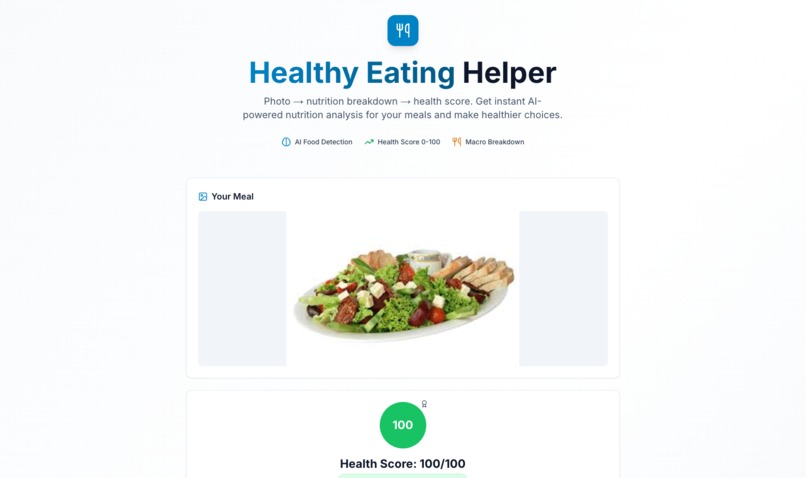
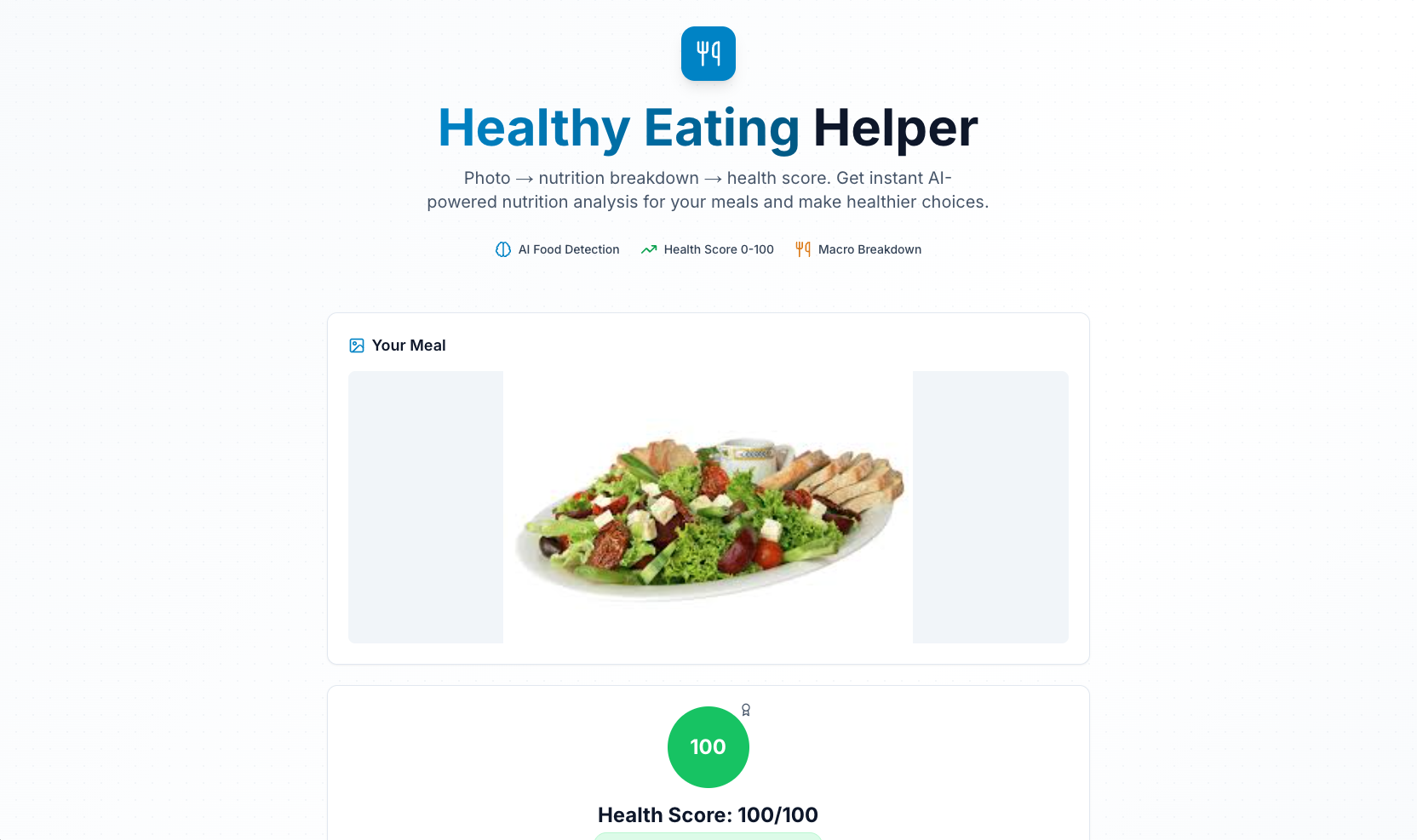
Healthy Eating Helper is a web application that transforms food photography into actionable nutrition insights. Users simply upload a photo of their meal and instantly receive:
- AI-powered food detection identifying the top 1–3 items in the image
- Comprehensive nutrition breakdown including macronutrients (carbs, protein, fat) and calories for each detected item
- Aggregate nutritional totals for the entire meal
- Health Score (0–100) using a scientifically-based algorithm that considers calories, saturated fat, added sugars, fiber, and protein
- Friendly guidance to help users make informed dietary choices
The app provides educational estimates to help users develop better nutrition awareness and make more informed food choices.
How We Built It
- Frontend: Next.js 15 with React 18, styled with TailwindCSS for a responsive, modern interface. React Query for efficient state management and API caching.
- Backend: FastAPI service leveraging Hugging Face Transformers for AI-powered food recognition with multi-label detection.
- Database: Supabase (PostgreSQL) for storing nutritional data, user interactions, and food information.
- AI Integration: Custom food-focused image classifier that processes uploaded photos and identifies food items with confidence scoring.
- Architecture: Clean separation between web frontend, API service, and database schema — modular and scalable.
Challenges We Ran Into
- AI Model Accuracy: Training and fine-tuning the model to recognize diverse foods across cuisines, preparations, and lighting.
- Nutrition Data Consistency: Aggregating reliable nutrition data, handling portion sizes, and preparation variations.
- Real-time Performance: Balancing model accuracy with smooth user experience.
- Health Score Algorithm: Designing a scientifically sound yet simple scoring system.
- Cross-platform Compatibility: Ensuring consistent uploads across devices, browsers, and formats.
Accomplishments We’re Proud Of
- Seamless User Experience: Intuitive interface for photo-based nutrition insights without manual logging.
- Scientific Accuracy: Health scoring algorithm based on established nutritional science.
- Scalable Architecture: Robust, modular system ready for expansion.
- Educational Impact: Made nutrition data accessible and actionable.
- Technical Integration: Successfully merged AI with modern full-stack practices.
What We Learned
- AI in Production: Deployment, optimization, and handling edge cases.
- Nutrition Science: Translating macronutrient and health data into user-friendly insights.
- Full-Stack Development: Responsive design and advanced state management with React Query.
- User-Centered Design: Simplifying complex data into intuitive outputs.
- Performance Optimization: Techniques for faster image processing and API responses.
What’s Next
- Enhanced AI Capabilities: More cuisines, mixed dishes, and portion size estimation.
- Personalization Features: Profiles with dietary preferences, restrictions, and goals.
- Social Integration: Meal sharing, health score comparisons, and community features.
- Advanced Analytics: Meal tracking, trends, and fitness app integration.
- Professional Integration: Tools for nutritionists and healthcare providers.
- Mobile App: Native iOS/Android with offline support and camera integration.
- Recipe Suggestions: Healthier alternatives and meal recommendations.


Log in or sign up for Devpost to join the conversation.