Inspiration
Growing up in Lagos, Nigeria, I've seen firsthand how limited medical access in remote areas leads to delayed care for common ailments like malaria or maternal health issues. Inspired by the Gemini 3 Hackathon's focus on impactful AI, I wanted to create HealthVista—an ethical AI tool that bridges this gap by providing triage education, not diagnoses. The idea sparked from personal experiences with family in rural spots facing long trips to clinics, amplified by Nigeria's tropical disease prevalence.
What it does
How we built it
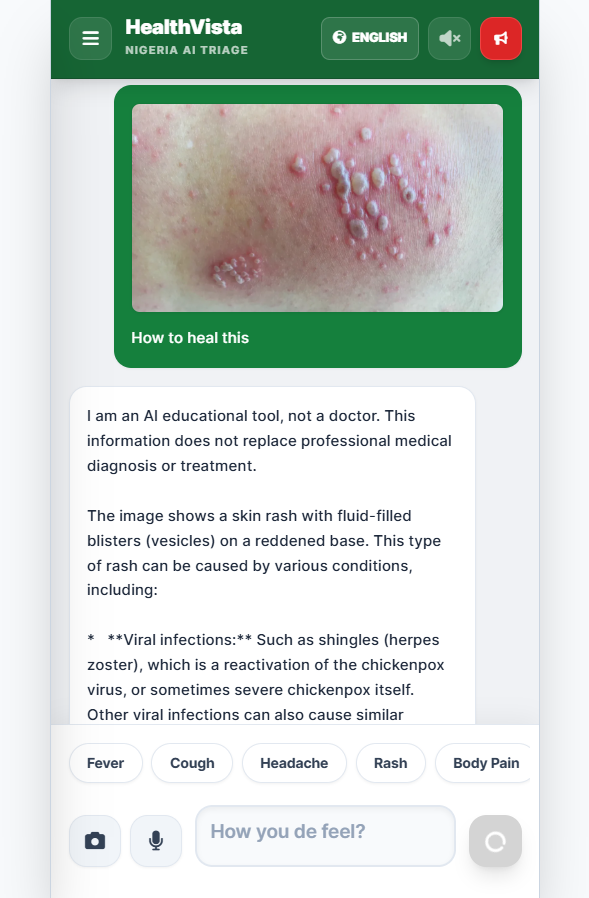
I prototyped in Google AI Studio using Gemini's API for core features. Started with a simple chat UI for inputs: text/voice via microphone, photos/videos via uploads. Gemini analyzes multimodally—e.g., vision for rash images, audio for cough videos—to generate non-diagnostic advice like "Fever and chills may indicate malaria; hydrate and seek help." Integrated Google Maps for nearby clinic suggestions (e.g., querying based on user location). Added prevention tips, voice outputs, and low-bandwidth modes. No code-heavy; mostly no-code configs with API calls for reasoning and natural language generation. Tested with simulated Nigerian scenarios.
Challenges we ran into
Balancing informativeness without crossing into medical advice was tough—iterated disclaimers to ensure ethics. Multimodal integration lagged on low-bandwidth simulations, requiring optimizations like text-first responses. Multilingual auto-detection for Pidgin/Yoruba needed fine-tuning for accuracy. Location permissions and API limits posed hurdles, but mock data helped. Time constraints (building in days) meant prioritizing core features over polish, yet it highlighted Gemini's rapid prototyping power. Overall, these pushed my problem-solving skills!
Accomplishments that we're proud of
AI for health care
What we learned
This project deepened my understanding of multimodal AI: Gemini's capabilities in processing text, voice, images, and videos for reasoned insights. I learned ethical AI design—emphasizing disclaimers to avoid misleading users—and integrating APIs like Google Maps for location-based suggestions. Technically, I grasped low-latency optimization for low-bandwidth areas, multilingual support (English, Pidgin, Yoruba), and privacy best practices (no data storage). It also taught me the importance of user-centric design for real-world impact in underserved communities.
What's next for HealthVista
HealthVista: AI symptom analyzer for remote Nigeria. Input text/voice/images/videos; get non-diagnostic insights, prevention tips, home remedies & nearby clinics via Google Maps. Empowers health access ethically.
Built With
- advanced
- ai
- and
- api
- development)ai-models/apis:-gemini-api-(for-multimodal-processing-of-text
- for
- hospitals/clinics)
- images
- language
- location-based
- mapping
- maps
- natural
- nearby
- no-code/low-code
- of
- platforms:
- prototyping
- react
- reasoning
- services:
- studio
- suggestions
- typescript
- voice

Log in or sign up for Devpost to join the conversation.