-
-
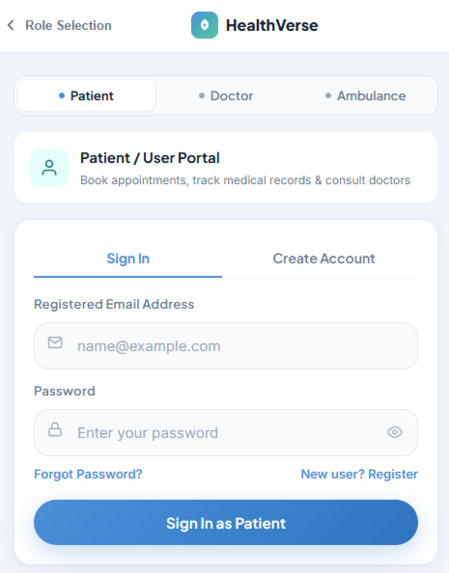
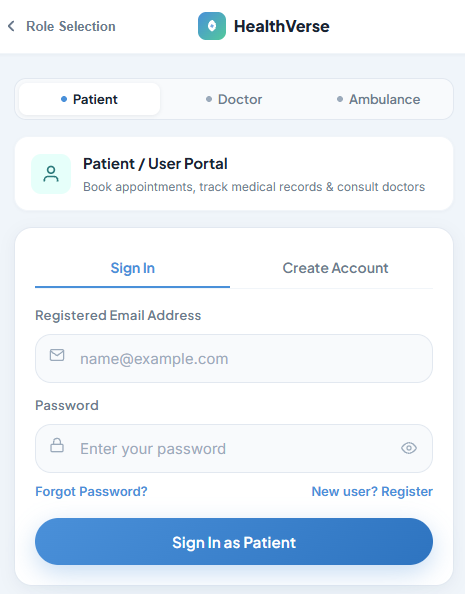
Login Page
-
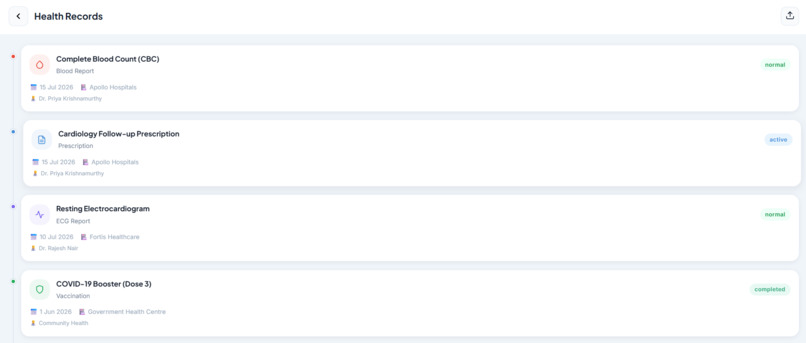
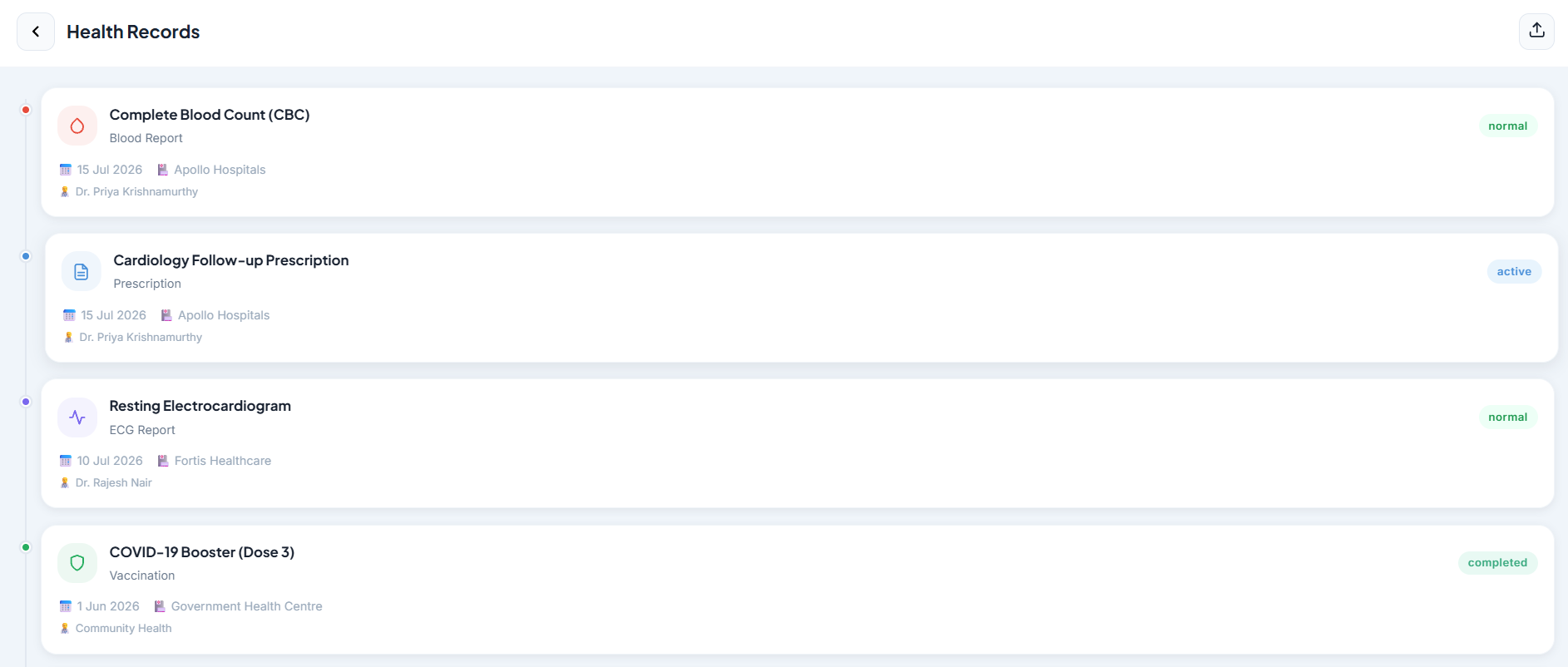
Health records
-
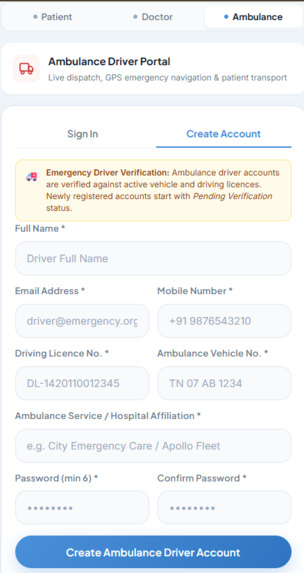
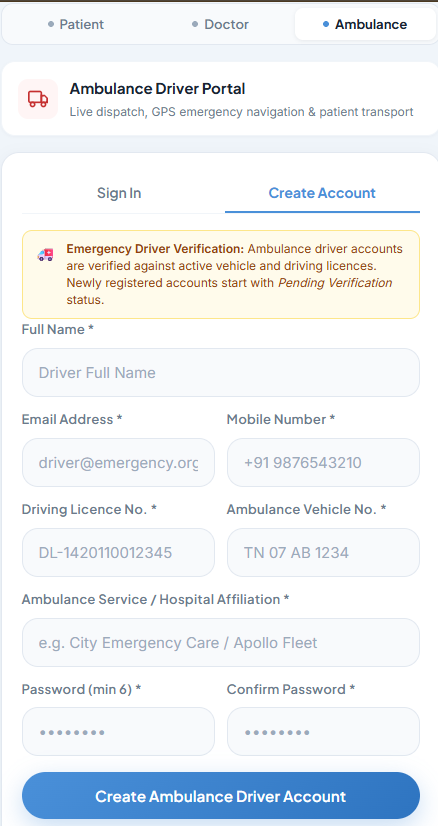
Ambulance Login page
-
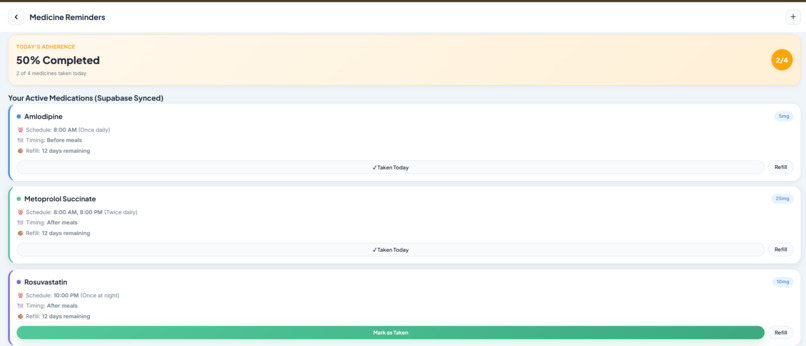
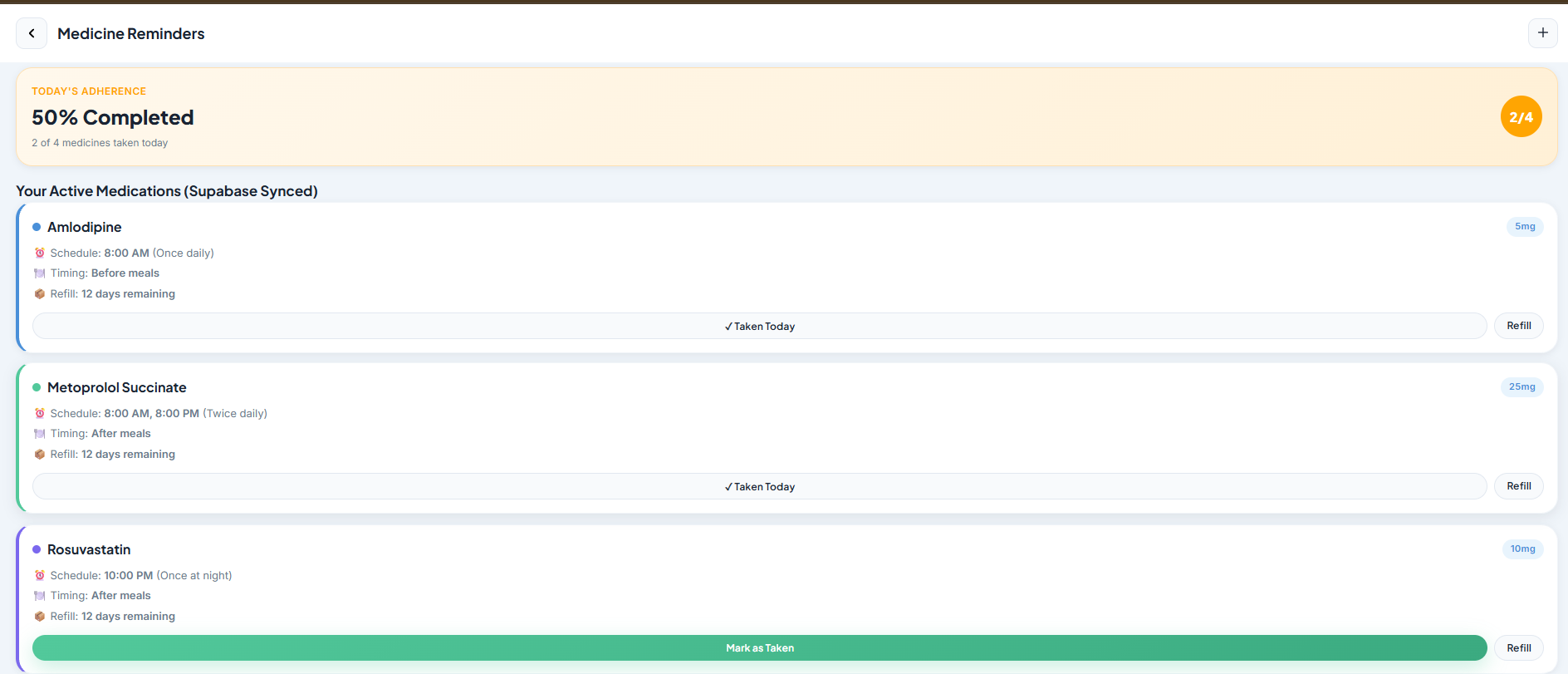
Medicine
-
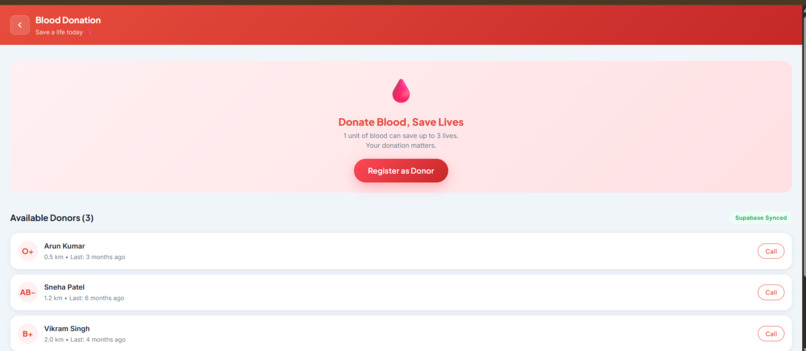
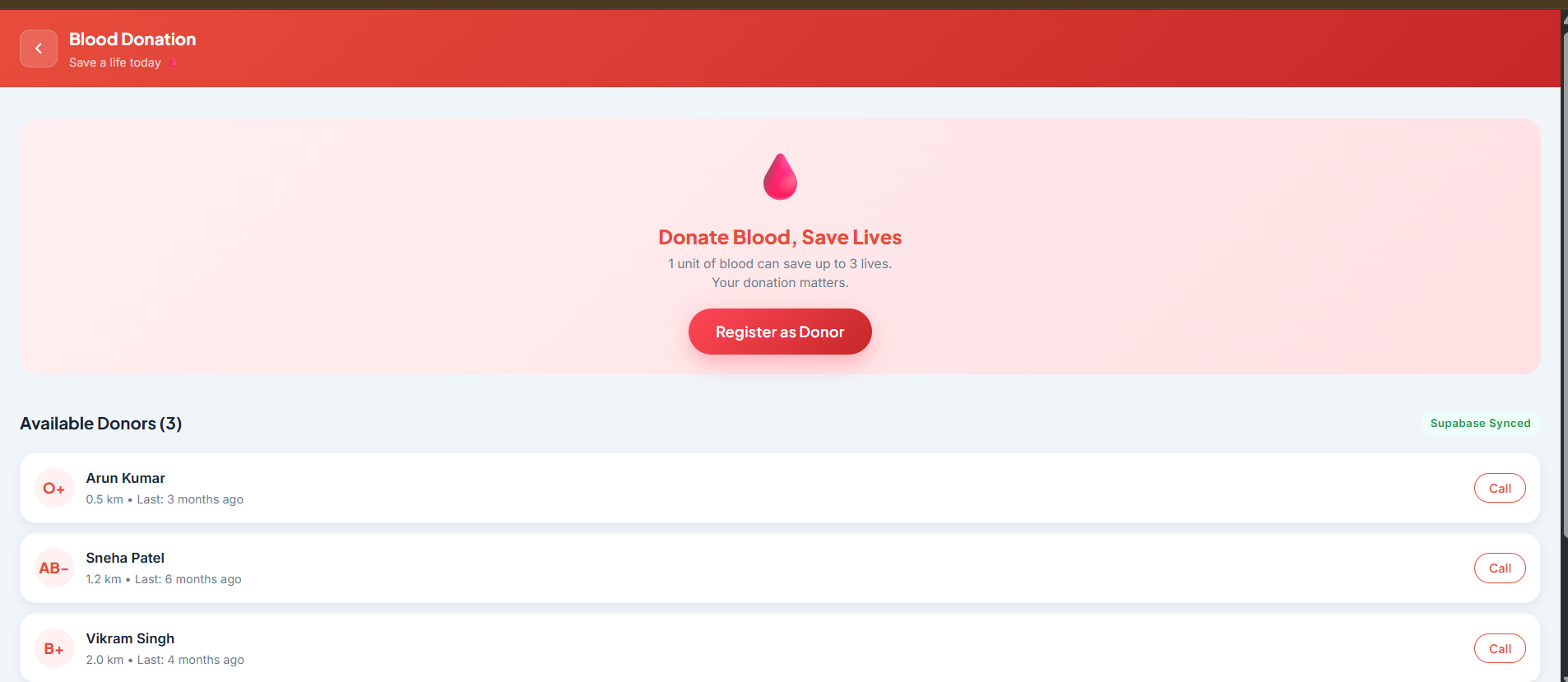
Blood Donation
-

Emergency Mood
-
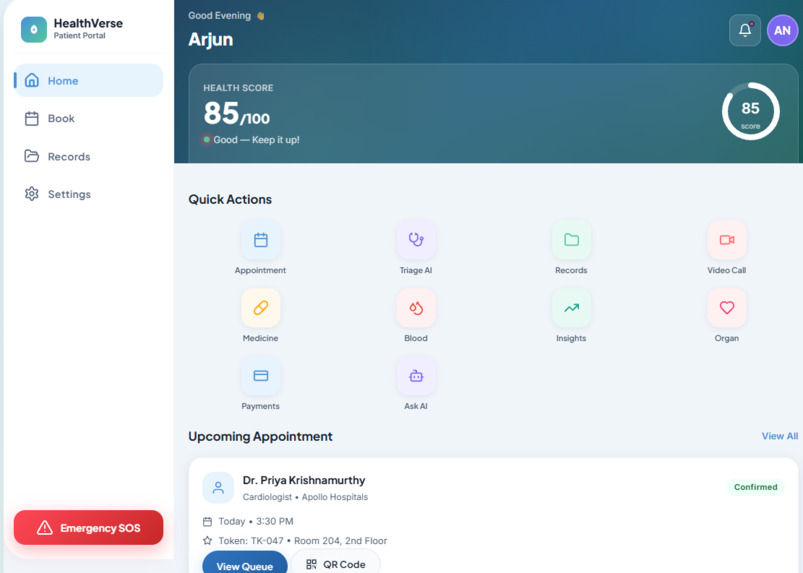
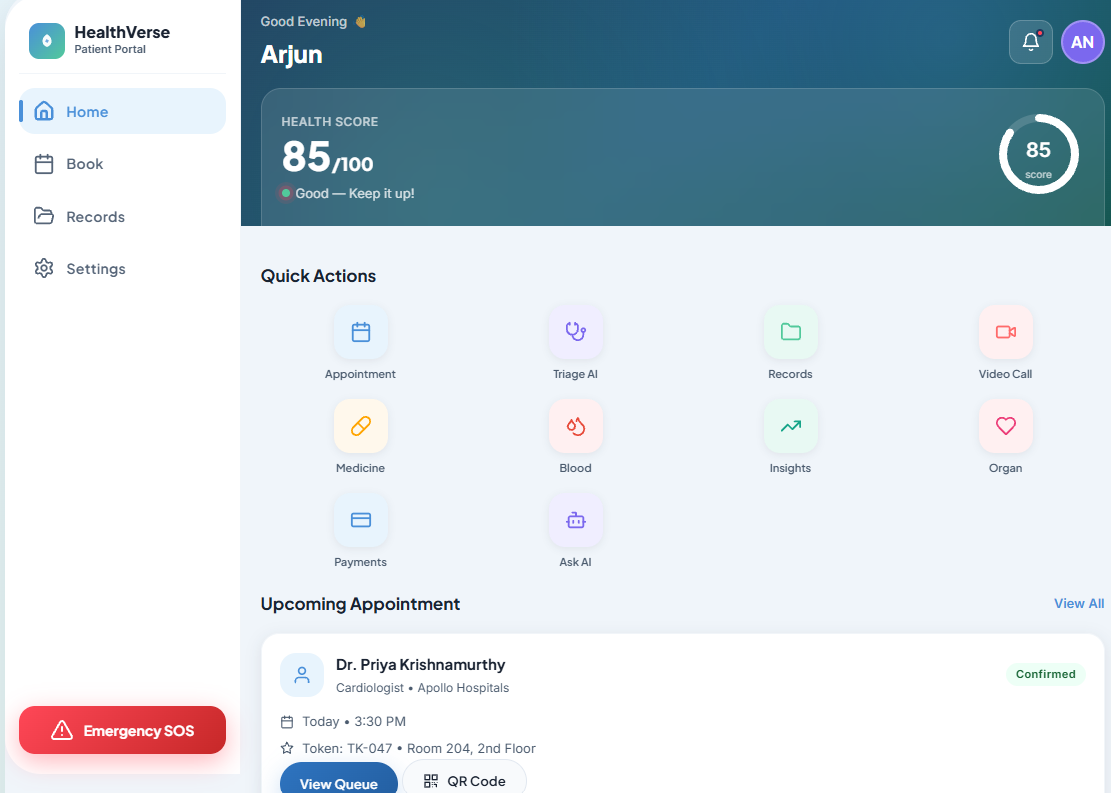
Dashboard

Inspiration
Healthcare is fragmented. Booking a doctor, keeping reports, ordering medicines and calling an ambulance usually mean different apps, or no app at all, and in an emergency the confusion costs minutes. Doctors and ambulance crews also work in separate systems, with no shared view of what the patient needs. We wanted one app where patients, doctors and ambulance drivers each get an experience built for their role, and where AI and payments remove friction instead of adding it.
What it does
HealthVerse is a mobile-first web app with three roles.
Patients can:
- Take a guided triage chat of six questions that rates urgency as Green, Yellow, Orange or Red
- Book appointments and follow a live queue
- Book telemedicine sessions
- Upload and view health records
- Order medicines
- Register as a blood or organ donor
- View a health insights dashboard with charts
- Receive notifications and switch between light and dark themes
- Raise an emergency SOS that creates a request for ambulance drivers
Doctors get a dashboard with a patient queue view and a prescription tool with a basic drug-allergy conflict warning.
Ambulance drivers get a dashboard to view incoming emergency requests and update their status.
Added for this hackathon:
- PayPal: After booking an appointment, a patient can pay the consultation fee through PayPal Sandbox checkout and see receipts on a payments page.
- AI: After triage, a large language model explains the result in plain language, with self-care tips and a suggested specialty. The rule-based urgency level stays the source of truth, and the AI never lowers it.
How we built it
- Frontend: Vanilla JavaScript (ES modules) with Vite. A hash-based router with 22 routes and role-based access checks. One shared CSS design system with light and dark themes. Leaflet for maps and Chart.js for charts.
- Data: A Supabase PostgreSQL schema with 19 tables and 5 storage buckets. If the backend is unreachable, the app falls back to demo data so it stays usable.
- Payments: Vercel serverless functions create and capture PayPal orders (Orders v2, Sandbox), so the PayPal secret never reaches the browser. The PayPal JS SDK renders the checkout buttons.
- AI: A serverless function sends the triage answers and the rule-based result to an LLM. It returns structured JSON that the app renders as an explanation card. If the call fails, the original result is shown unchanged.
- Hackathon update: HealthVerse already existed as a frontend app with the three role flows. For this hackathon we added PayPal checkout, the serverless API layer, the AI triage explanation and the receipts page.
- Deployment: Vercel.
Challenges we ran into
- Building three role-based experiences in one framework-free codebase, with routing, access checks and shared state.
- Keeping the app usable when a backend call fails, which led us to build graceful fallbacks.
- Splitting frontend and backend work across teammates while keeping the UI and the database schema in sync.
- Using AI safely in a health setting. We made the AI explanation-only, kept the deterministic triage as the source of truth, and told the model not to diagnose or give dosages and to point to emergency services for red-level cases.
- Integrating PayPal securely, with order creation and capture on the server and clear handling for cancelled or failed payments. We also had to charge in USD in the sandbox while showing rupee prices, so we show a labelled demo conversion rate.
- Designing emergency screens to be fast and clear, with few steps.
Accomplishments that we're proud of
- A deployed, end-to-end prototype serving three roles across 22 routes, backed by a 19-table schema.
- A working PayPal Sandbox payment flow with receipts, from booking to confirmation.
- An AI layer that explains triage results without changing the safety-critical outcome.
- A mobile-first interface with light and dark themes that keeps working even when the backend is unavailable.
What we learned
- For health use cases, keep safety-critical decisions deterministic and use an LLM to explain them.
- The PayPal create-and-capture order flow, and why secrets belong in serverless functions rather than the browser.
- Graceful degradation matters: a demo that fails silently is worse than one that falls back clearly.
- Clear contracts between frontend and backend make teamwork much faster.
- In healthcare UX, speed and clarity matter more than features.
What's next for Healthverse
- Production-grade authentication and database row-level security before any real patient data is handled
- Live GPS ambulance tracking and nearest-ambulance dispatch
- Real video consultations
- A hospital admin portal for bed availability and rosters
- PayPal checkout for medicine orders, and PayPal live mode
- Tamil and Hindi language support
- Push notifications and appointment reminders
Built With
- chart.js
- css3
- html5
- javascript
- leaflet.js
- llm
- lucide
- node.js
- paypal
- paypal-javascript-sdk
- paypal-orders-api
- postgresql
- rest-api
- supabase
- vercel
- vercel-serverless-functions
- vite
