
Inspiration
People rarely recognise health problems early on, but they frequently begin with minor lifestyle choices like poor sleep, excessive screen time, and inactivity. I wanted to create a tool that takes commonplace behaviours and provides an understandable, AI-powered health risk estimate. It should be quick, easy, and meaningful. The objective was to raise awareness of wellness without requiring wearable technology or medical equipment.
How we built it
Using a structured lifestyle-wellness dataset that included sleep duration, water consumption, steps, BMI, calories, heart rate, and other information, I trained a Random Forest Classifier. During dataset exploration, I created derived features like daily screen-time impact and mood score to improve prediction quality.
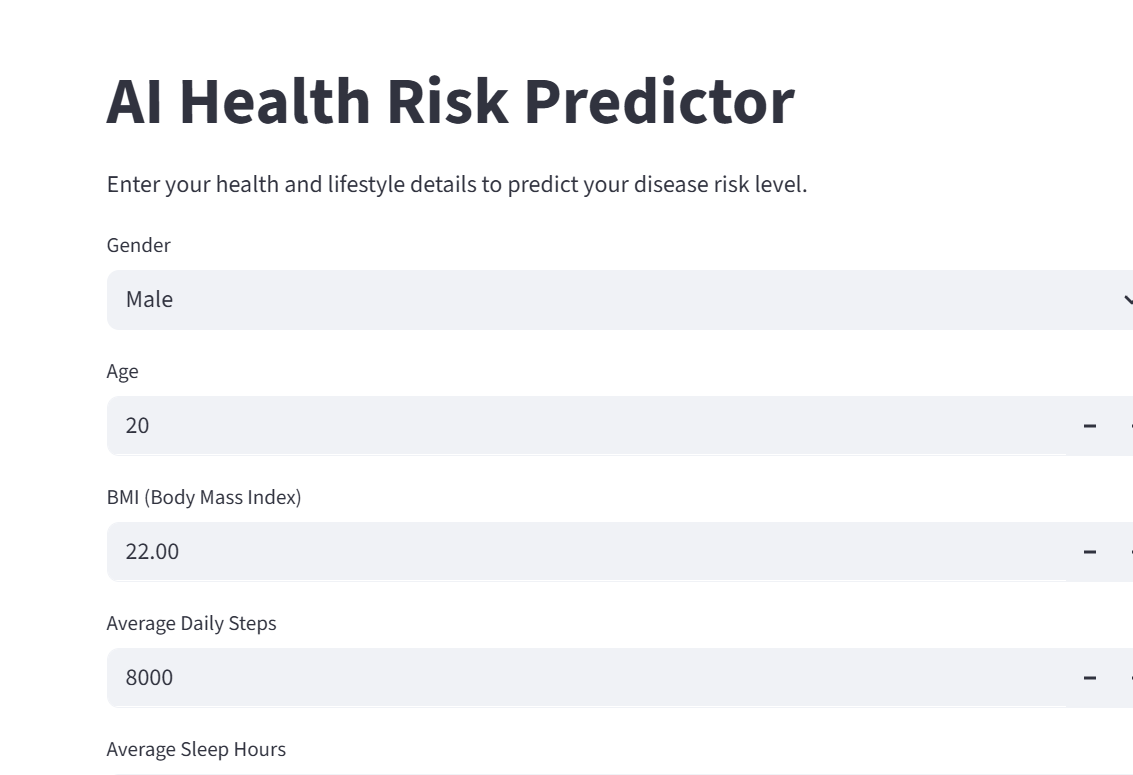
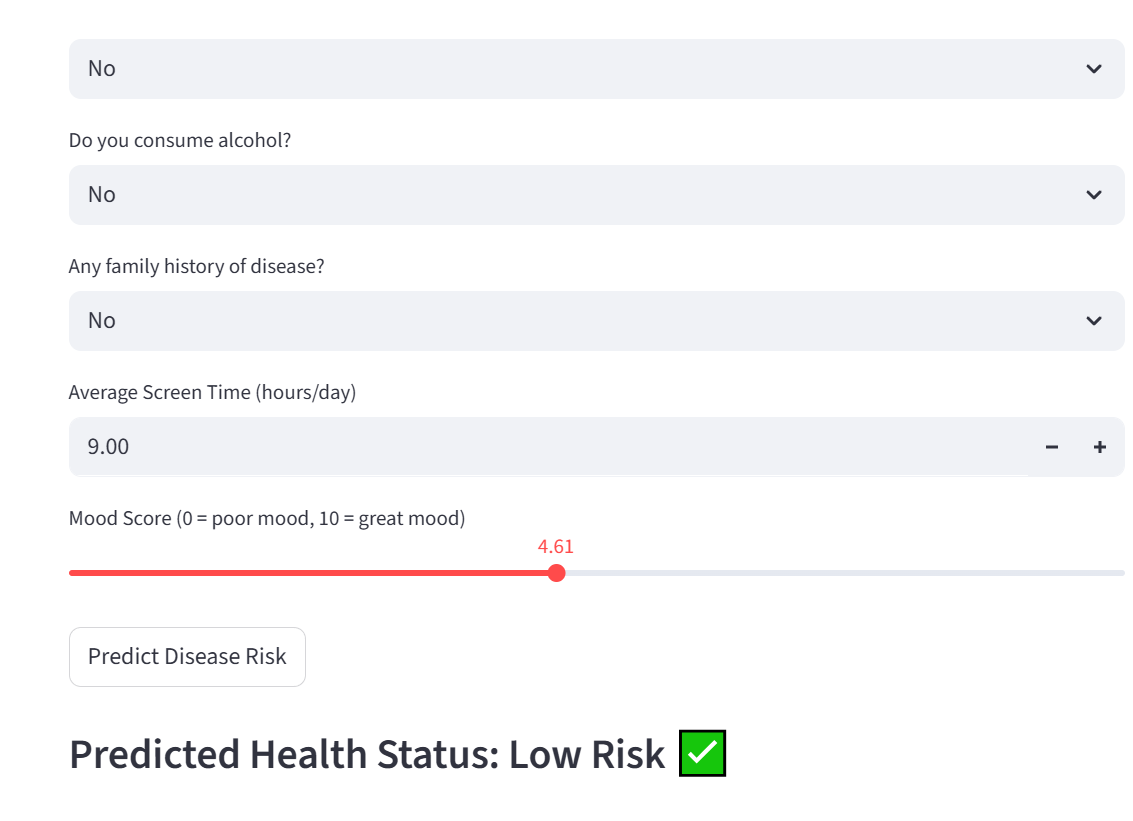
With user input, the Streamlit app executes the entire prediction pipeline (no retraining required) after loading the trained model from a.pkl file. Clean sliders and numeric fields make up the simple, fast, and beginner-friendly user interface.
Challenges we ran into
Managing a small dataset while maintaining model performance
Creating derived features that benefit the model rather than detract from it
Keeping predictions interpretable while avoiding overfitting
Making the user interface simpler to make it more approachable and intuitive
completing a polished demo video in the allotted three minutes
What we learned
How to preprocess real-world lifestyle data
Building and tuning tree-based ML models
Creating derived features that meaningfully improve classifier performance
Deploying interactive web apps with Streamlit
Making a clean, simple UI that works for non-technical users
What HealthPredictor does
Takes lifestyle inputs (sleep, steps, calories, water, etc.)
Includes derived features like screen time and mood score
Runs them through a trained ML model
Returns a simple Low / Medium / High health-risk score instantly
It’s built to be fast, helpful, and beginner-friendly.
Built With
- numpy
- pandas
- pickle
- python
- scikit-learn
- streamlit

Log in or sign up for Devpost to join the conversation.