Inspiration
Healthcare access is often limited not by the availability of treatment, but by the complexity of the system itself. Patients are denied medication, struggle to understand their insurance coverage, don't know their legal rights, and often have no idea how to file an appeal or complaint.
I wanted to build an AI assistant that helps people navigate healthcare bureaucracy so they can focus on getting the care they need instead of struggling with paperwork.
What it does
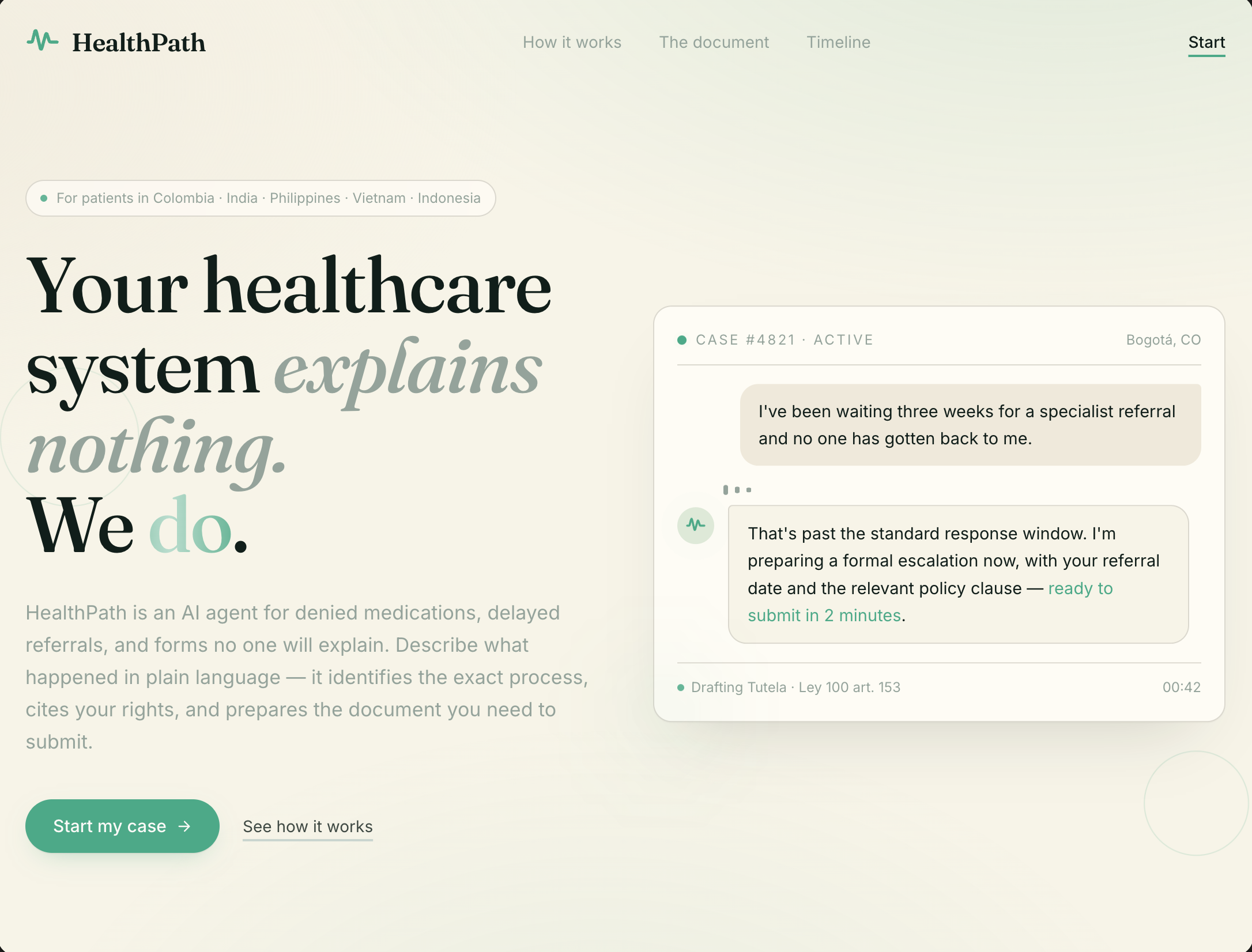
HealthPath is an AI-powered healthcare navigator that helps patients overcome healthcare bureaucracy.
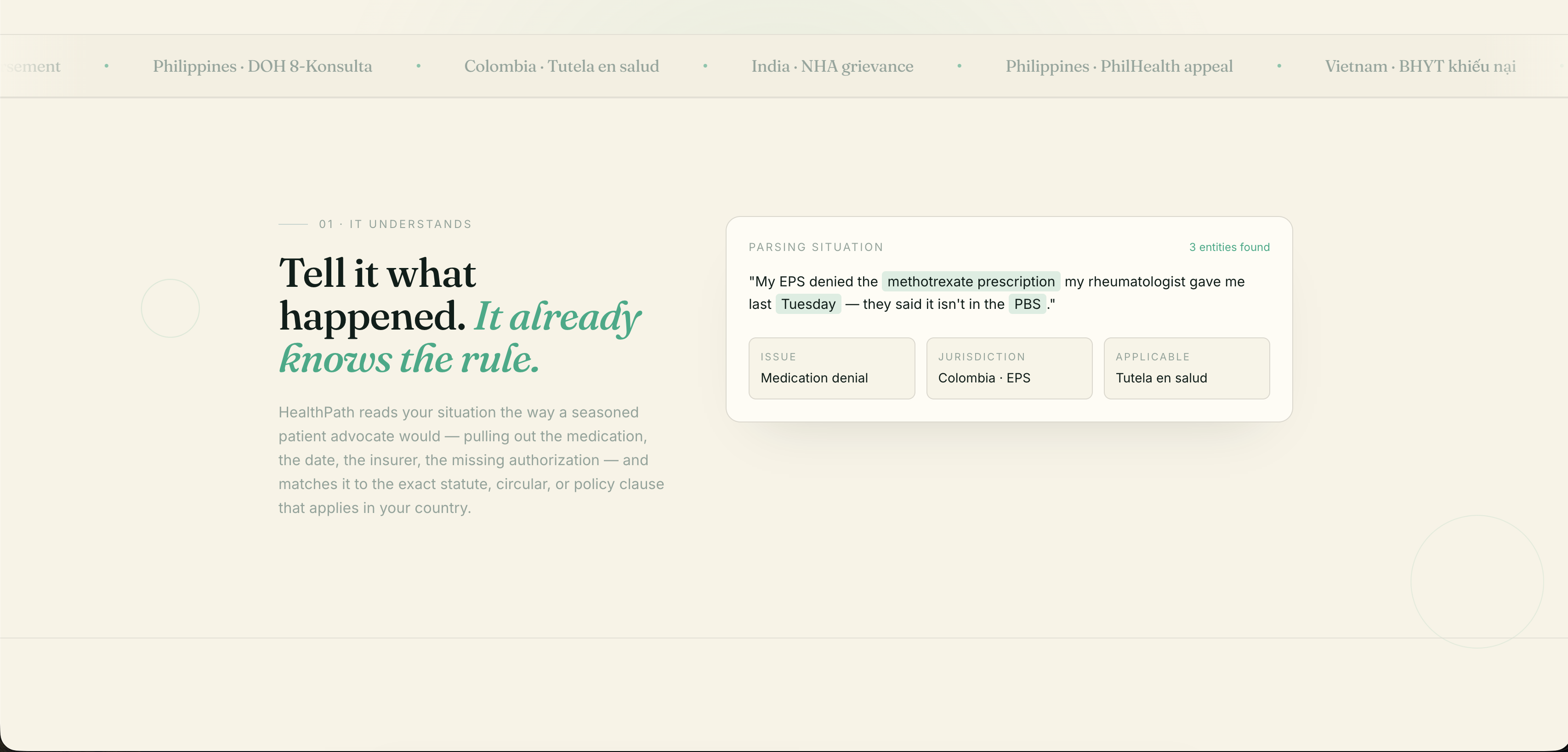
Users describe their situation in plain language, and HealthPath:
- Finds where medication or healthcare resources are available.
- Explains insurance or healthcare scheme coverage.
- Identifies the patient's rights.
- Generates ready-to-submit documents such as complaints, appeals, and requests.
HealthPath never provides medical advice, diagnoses, or treatment recommendations. If it detects a possible medical emergency, it immediately stops the conversation and directs users to emergency services or qualified healthcare professionals.
How I built it
HealthPath combines several AI technologies into a single workflow:
- Claude API for multilingual conversations, reasoning, and document generation.
- n8n for workflow automation and orchestration.
- React + TypeScript for the frontend.
- ElevenLabs for voice input and output.
- Supabase for authentication and data storage.
- Public healthcare datasets and synthetic data for development.
Every request first passes through an emergency classifier. If emergency symptoms are detected, the workflow stops immediately and emergency guidance is shown. Otherwise, HealthPath determines the appropriate administrative process and generates the required documents.
Challenges I ran into
The hardest challenge wasn't building the AI—it was defining where it should stop.
Designing a reliable safety layer that detects emergency situations before any response is generated required careful prompt engineering and workflow design. Whenever there is uncertainty, the system always chooses to stop and direct users to qualified healthcare professionals.
Another challenge was simplifying complex healthcare processes into an interface that anyone could use without prior knowledge of insurance or government healthcare systems.
Accomplishments that I'm proud of
- Built a working AI healthcare navigator from concept to deployment.
- Created a safety-first workflow that prioritizes human intervention during emergencies.
- Turned complicated healthcare bureaucracy into a simple conversational experience.
- Delivered a production-ready web application with multilingual support.
What I learned
This project reinforced that good AI is about solving real problems responsibly.
I learned that thoughtful constraints are just as important as powerful models, and that user experience, accessibility, and trust are essential when building AI for healthcare.
What's next for HealthPath
- Integrate with more healthcare and insurance systems.
- Expand multilingual support.
- Improve document generation for additional countries.
- Add SMS and low-bandwidth access for underserved communities.
- Build a case management dashboard for healthcare workers.
Built With
- claude-api
- elevenlabs
- github
- html5
- lovable-ai
- n8n
- react
- supabase-(postgresql)
- tailwind-css
- typescript
- vercel
- vite

Log in or sign up for Devpost to join the conversation.