Inspiration
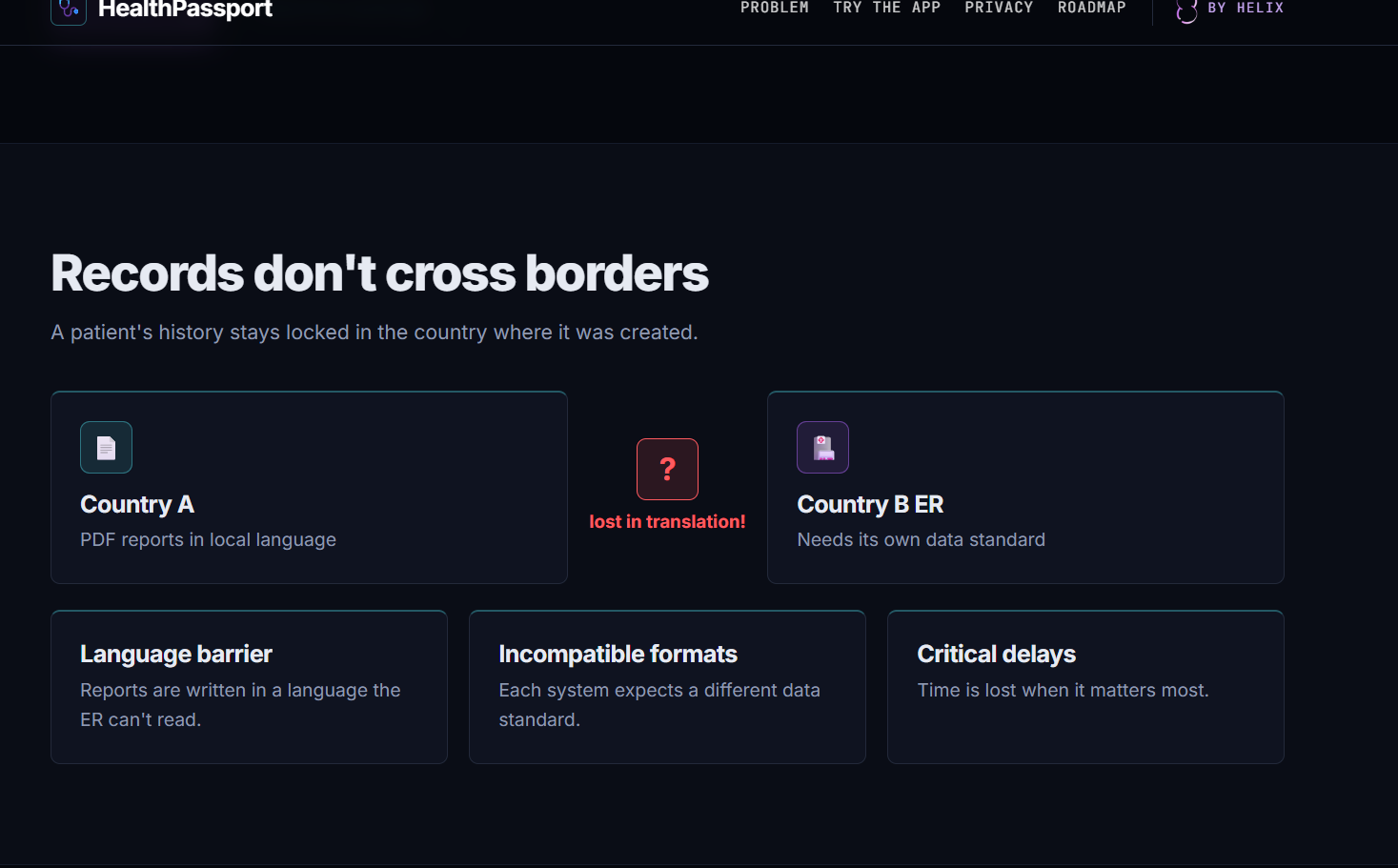
A patient's medical history stays locked in the country where it was created. Imagine a traveler collapsing abroad: her reports are PDFs in another language, in a format the ER's systems can't read, and every minute of delay matters. We built HealthPassport around one person, Meera, who lands in a new country with her records already in her pocket. We wanted care to follow the patient across borders, not the paperwork.
What it does
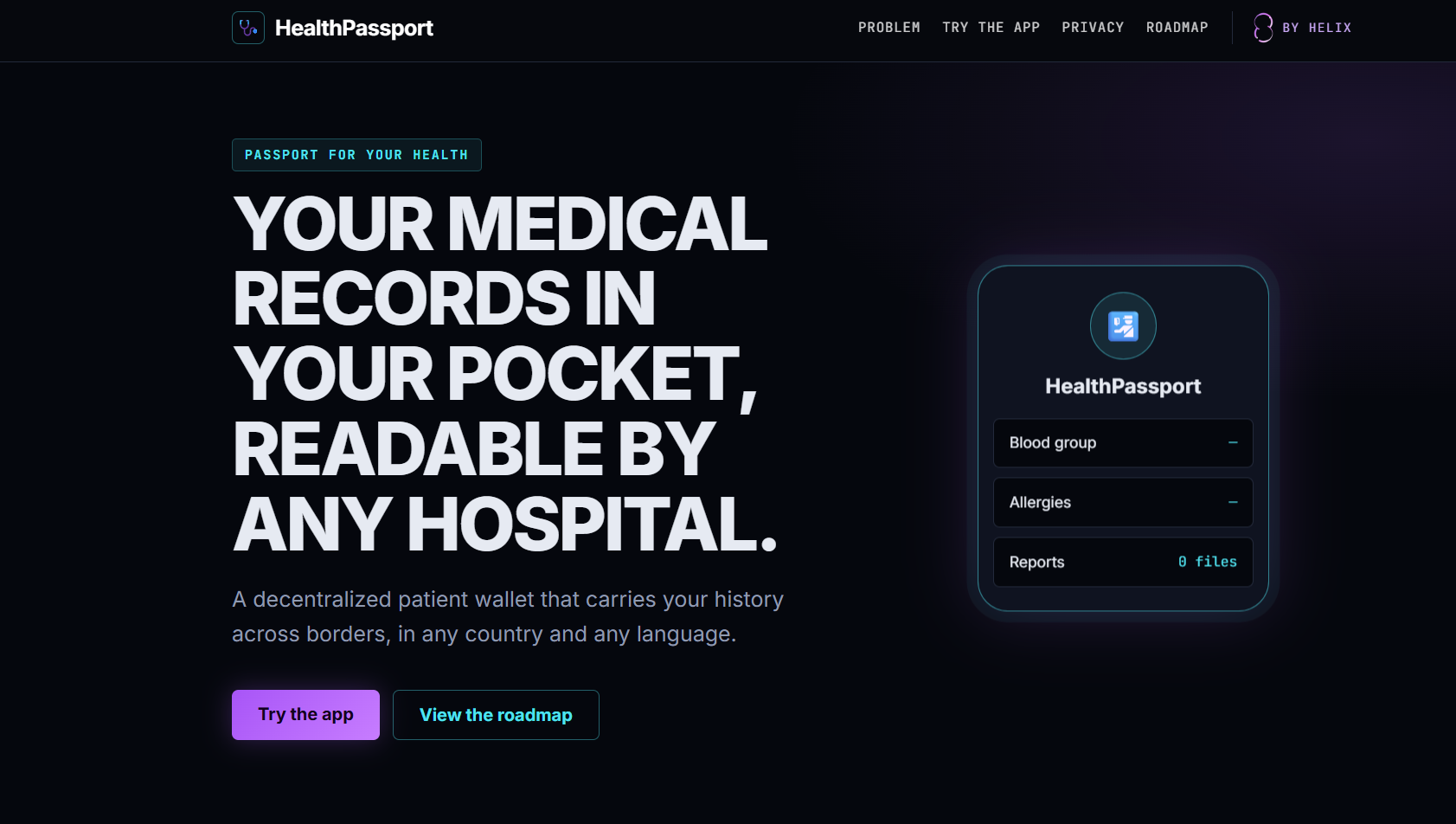
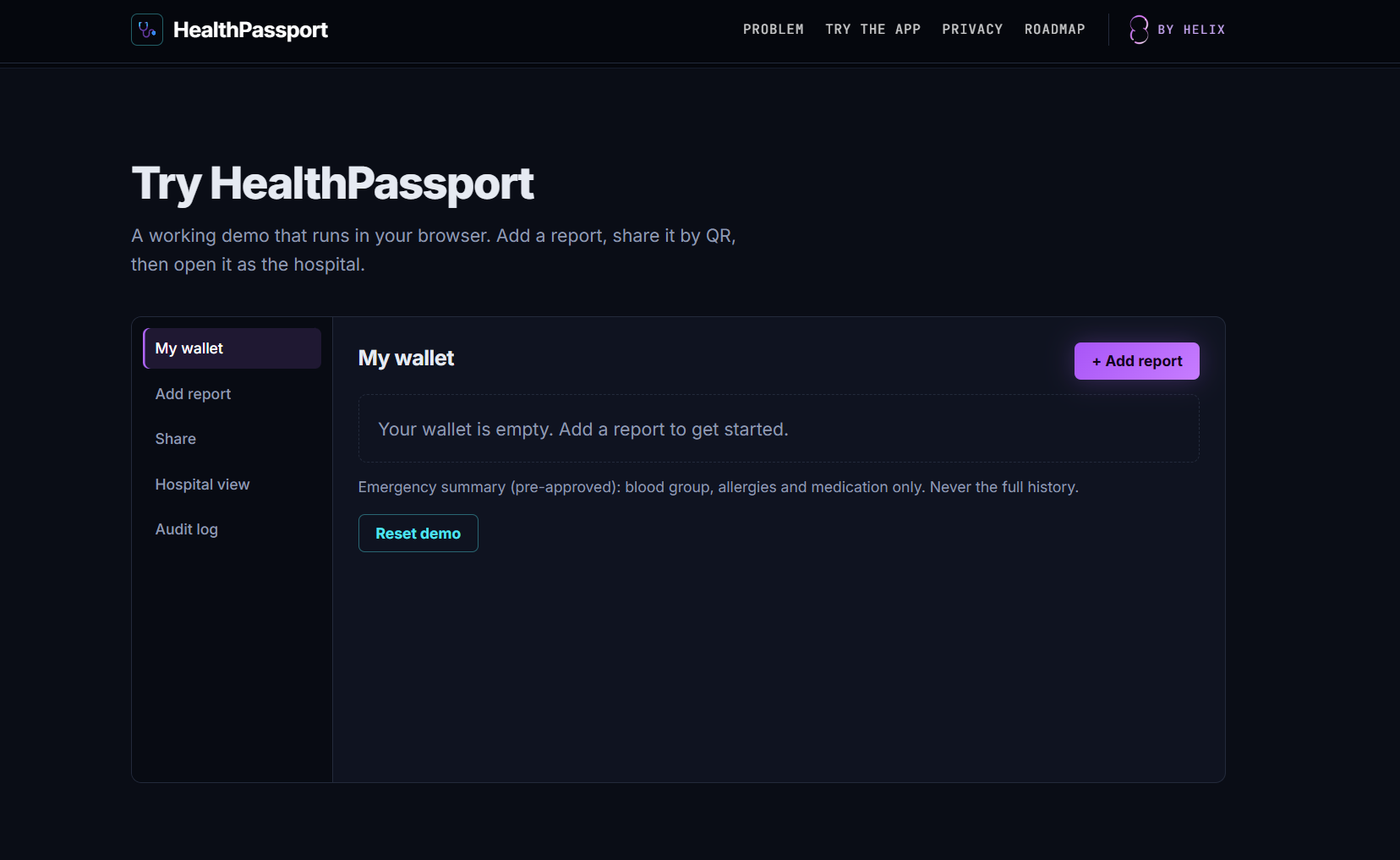
HealthPassport is a decentralized patient wallet. Records stay encrypted on your own device, and any hospital in any country can read them. Encrypted wallet: you hold the keys, and records never go to a central database. Schema translator: it reads a medical PDF, finds the medical fields and maps them to FHIR with SNOMED CT codes, so the ER gets the format it needs. Emergency QR: one scan gives a doctor the vital summary, and hospitals only need a browser. Consent and audit: every share is consent-based, time-limited and logged, so you always know who saw what. Emergency mode: if the patient is unconscious, a pre-approved summary opens with blood group, allergies and medication only. Never the full history. Our website includes a working demo of this flow. You can add a report, encrypt it, review the translated fields, share it by QR, open it as the hospital, and check the audit log.
How we built it
The site is a single self-contained page in plain HTML, CSS and JavaScript, with no build step. The demo runs entirely in the browser:
Encryption: files are encrypted with AES-256-GCM using the Web Crypto API, with a non-extractable key that stays on the device. Data standards: the translator output follows FHIR, with SNOMED CT and LOINC codes, and can be viewed as FHIR JSON. Sharing: QR codes are generated with qrcodejs, with live expiry countdowns and revocation. Storage: demo state lives in the browser's local storage, so nothing leaves your device.
The proposed production stack is Flutter or React Native for one mobile code base, on-device OCR plus an LLM to extract medical fields, and W3C decentralized IDs with verifiable credentials for identity. The Helix branding and the dark console design were built around our logo.
Challenges we ran into
Translation safety: a wrong translation could harm a patient. Our answer is that the patient confirms every field, and the original document always sits beside the translated one. Different privacy laws: GDPR, HIPAA and India's DPDP all differ. We went consent-first, with data staying with the patient and nothing central stored. Hospital adoption: hospitals will not install new software. We made it work from a QR code and a browser viewer, and it can export FHIR to existing systems. Turning slides into software: we had to make the idea a working product, not a presentation. That meant building the real flow of encrypt, translate, review, share, view and log.
Accomplishments that we're proud of
A complete patient-to-hospital flow that works end to end in the browser. Real encryption on the user's device, not a mock-up. Consent that expires on its own and can be revoked, with every access recorded in an audit log. An emergency mode that exposes only the vital summary. A clear story that anyone can follow, from Meera landing abroad to being treated safely.
What we learned
Trust is a design problem as much as a technical one. Showing the patient every translated field next to the original is what makes automatic translation acceptable. Interoperability only works if you meet hospitals where they are. A QR code and a browser beat asking anyone to install something. Privacy by design is simpler than privacy bolted on later. If data never leaves the patient's device, there is nothing central to breach. A working demo explains an idea better than slides do.
What's next for healthpassport
MVP (0 to 3 months): wallet and PDF upload, translation to FHIR, and a QR viewer for doctors, starting with one country pair and three document types. Pilot (3 to 9 months): partner with one or two clinics, add a second country pair, and build a doctor feedback loop. Scale (9 to 18 months): more languages, insurer and embassy tie-ins, and direct hospital integration. The biggest gap today is that the demo uses sample data instead of reading your own files. Real on-device OCR and LLM extraction is the first thing we would build.
Built With
- ccs
- claude
- gemini
- github
- html5
- javascript
- versel


Log in or sign up for Devpost to join the conversation.