-
-
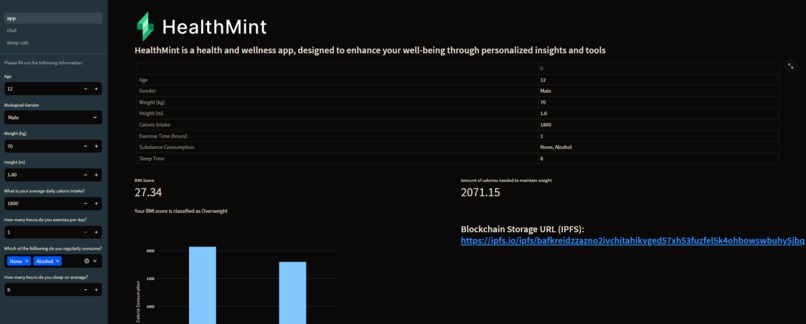
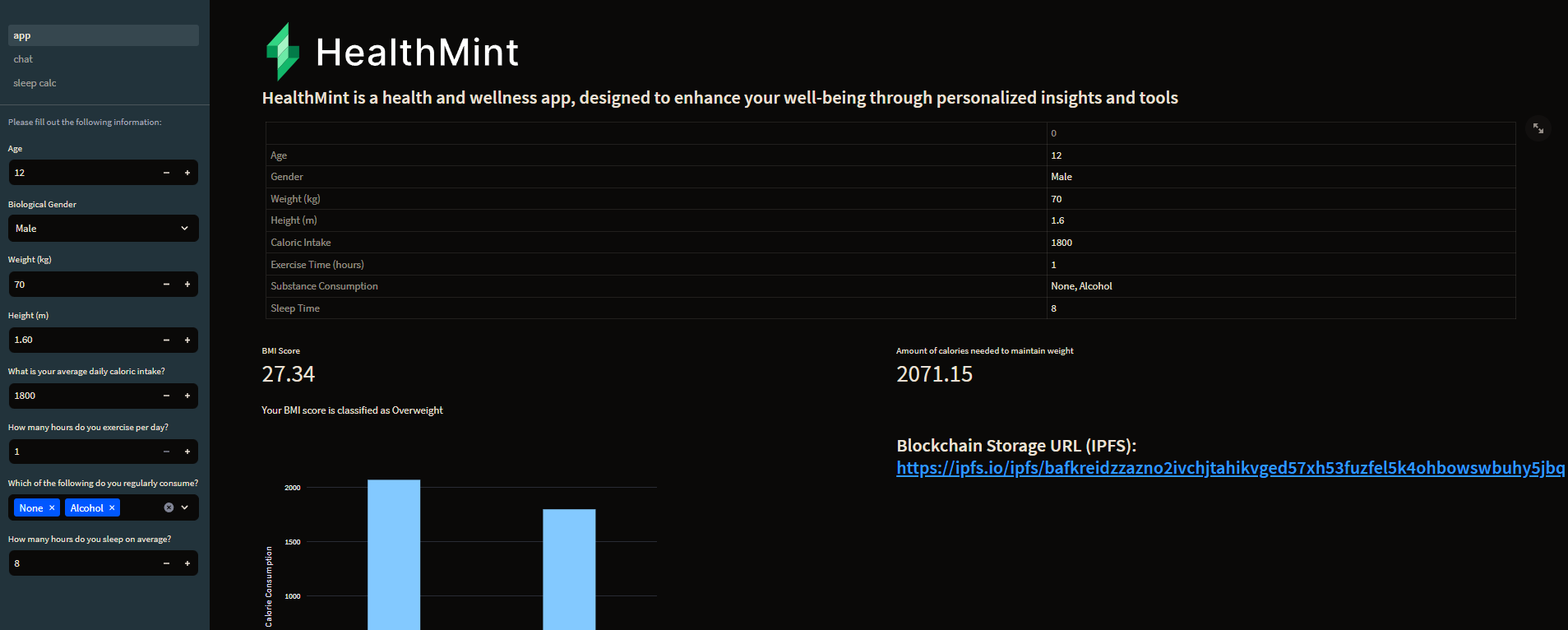
HealthMint - Home
-
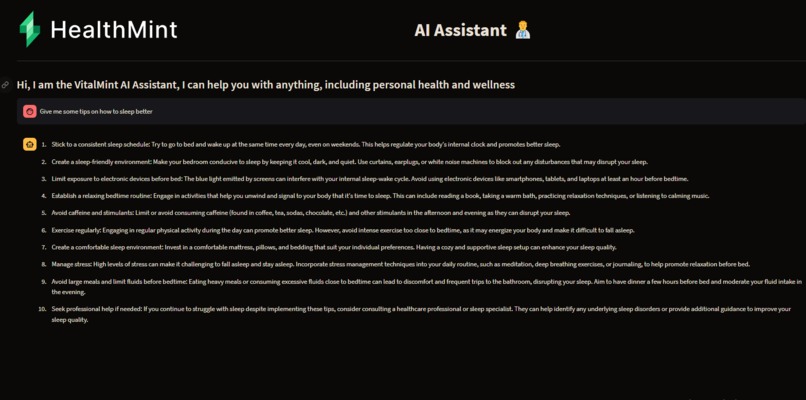
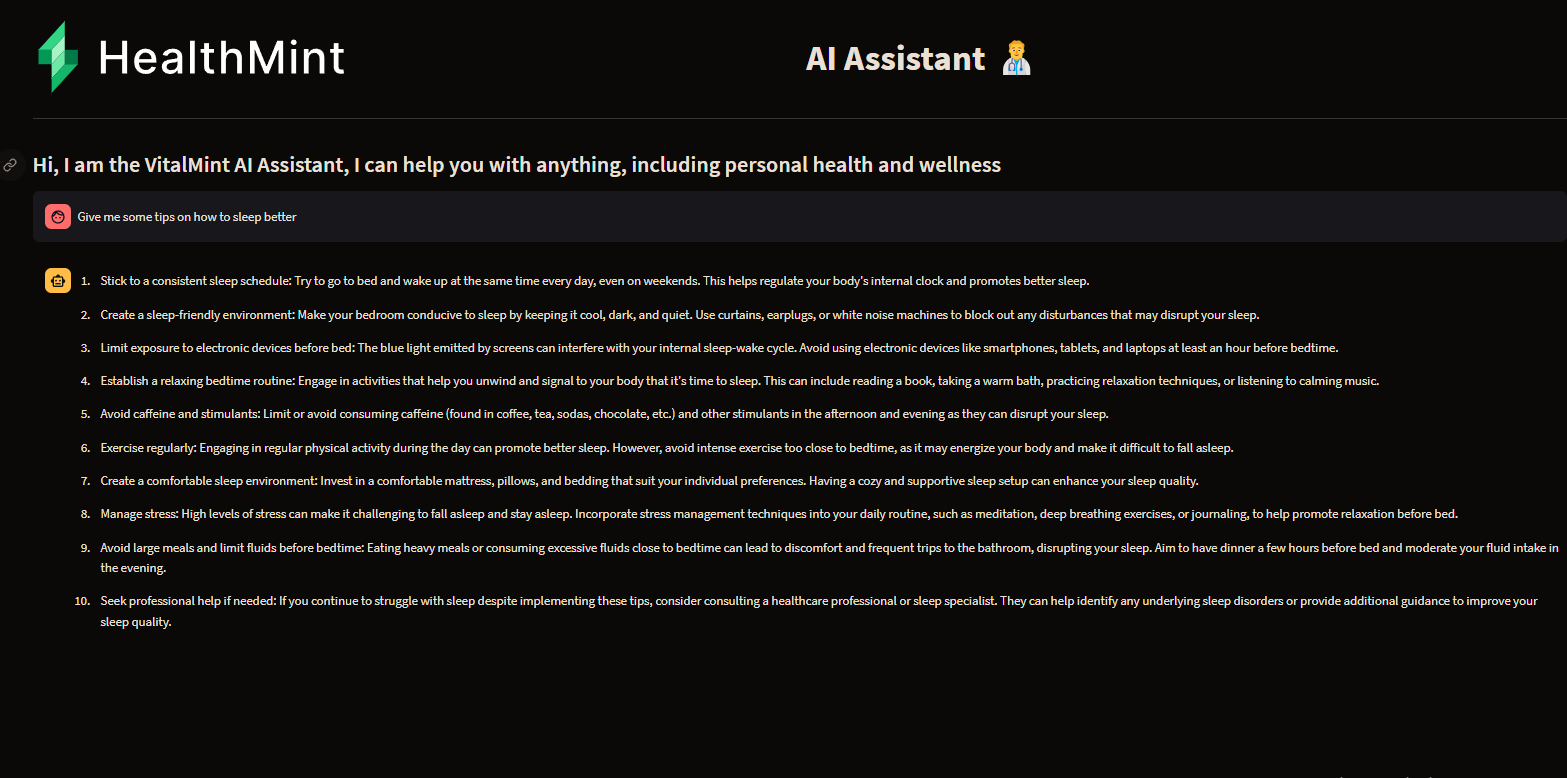
HealthMint - AI Assistant
Inspiration
With this year's focus on health, I noticed a lack of simple health and wellness web applications. Consequently, I aimed to create a simple platform that provides people with personal metrics and recommendations. Through this, I hope to contribute to a healthier community.
What it does
HealthMint gathers user information to provide personalized health insights, such as daily calorie intake recommendations. Moreover, features like the AI chat assistant answer any health-related questions, while the sleep cycle recommender suggests optimal wake-up times. We recognize the importance of personal data, HealthMint allows users to upload their information to the blockchain instead of storing it in our database, with the option to download it as a CSV.
How we built it
I built HealthMint using Streamlit, Python, Pandas, Open AI's GPT-3.5-turbo model, and the Verbwire API.
Challenges we ran into
Initially, I created HealthMint using React, Shadcn and Node.js, however, 5 hours into developing the app, I realized that I would never finish in time. Subsequently, I completely pivoted towards Python and Streamlit, allowing me to quickly create an MVP and demonstrate it for the purposes of this Hackathon. Furthermore, while HealthMint is fundamentally a health-tracking tool, the absence of health/vital tracking technology like an Apple Watch API made it challenging to generate in-depth insights for the user.
Accomplishments that we're proud of
I'm very proud of the lessons I learned along the way. For example, HealthMint is the first project where I've used Open AI's API.
What we learned
In general, I learned to plan an app before starting the creation process. Had I done this, I could have avoided spending half the hackathon working in a completely different technology stack.
What's next for HealthMint - The Wellness App
The next step for HealthMint is to incorporate LangChain into the AI assistant and train the bot on global health statistics, guides, etc...


