-
-
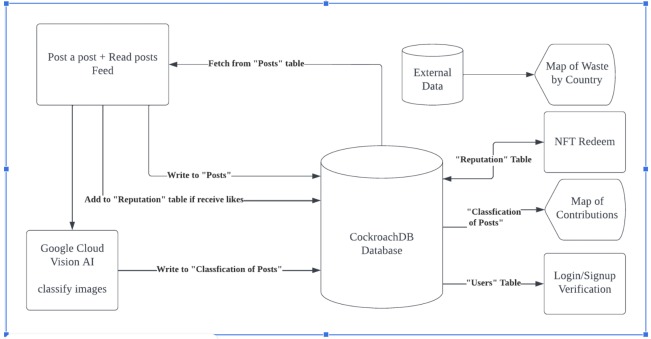
diagram

💡 Inspiration💡
We believe that trash can be transformational and that together, as a community, we can make an impact towards climate change. Big corporations like Coca-Cola and PepsiCo are one of the biggest contributors to waste all over the world and we want to encourage their involvement in the climate change crisis by promoting transparency and trust between the customer and the company. With this mission in mind, we sought to create a social media app where everyone can contribute to the fight for our planet in a positive and tangible way.
⚙️ What it does ⚙️
Our app is both a social media and a data-visualization platform. Users either create posts or view posts, much like any other social media app. However, instead of selfies or cute cat pictures, posts are all about trash that users find. They find trash, take a photo and upload it to make a difference. The data that we gather helps us make a case for companies to take more responsibility towards their waste and help shift their direction to a more sustainable approach.
Each post is proof that a specific product is simply thrown away and that this product’s packaging is not biodegradable and not sustainable for the environment. After you post a picture, the image is processed under the hood and identified as a specific product for a company using AI/ML.
To help better visualize each and every country’s waste distribution and to help you see the bigger picture, we created two maps that enable users to better understand our mission. The first map shows the waste in the countries we had data from and to make the user aware of their country’s contribution to the overall mission. The second map shows the data we collected and the location of where each product is found. The quantity of values in this map changes as users post about what they found in the webapp. Users can gain reputation points and redeem NFTs using those points. We receive those points from Environmental non-profit organizations that want to help the cause and make companies accountable
🏗️ How we built it 🏗️
For the UI of the social media app, we used React. For the backend, we used CockroachDB, Google Cloud’s Optical Character Recognition AI model, and Folium/Leaflet.
🟣 CockroachDB 🟣
There are two components to our app (social media and user data), and both have a DB table dedicated to them. We have a table for user accounts, user posts that are related to user account IDs, and data on classification of posts (that is, the number of posts of a certain item or product found in a certain country).
🔴 Artificial Intelligence 🔴
We used Google Cloud Vision’s AI model to identify words found in images from user posts. These words are used for data-gathering purposes: We use these words to find similar categories (using string comparisons) in order to help classify images. This data is then used to keep track of how much waste is littered for a certain product in a certain region.
⚫ Data Visualization ⚫
There are two data visualizations, both of which are in the form of choropleth maps built using Folium/Leaflet. Our map of waste per capita per country serves the purpose of convincing people that waste is not ethically managed around the world and that something needs to be done.
Our second map shows the number of posts per classification for trash that’s picked up. There are endless possibilities of how this data could be used. It’s most useful possibility is to bring companies to take accountability for the found waste of their products. It’s not easy to deny these statistics, especially since each post is attributed with location and visual proof in the form of an image.
🚩 Challenges we ran into
We were shocked to find that data about waste and non-biodegradable trash of countries were scarce and difficult to find. We wanted a comprehensive dataset of how much each country contributes to unethical waste management, but could only find data for some 50 countries. However, this shows that data about trash is in relatively low demand; it is often ignored, which is all the more reason why an app like ours is needed to make our world a better place.
🥇 Accomplishments that we're proud of
Successfully hosted the web app and added the important features. Successfully hosted the maps on the GitHub pages. Successfully managed to extract text out of images using Google Cloud Vision API.
📚 What we learned
We got to know that we need to pay more attention to the trash that is often ignored and that can be achieved only by collective effort by everyone. We gained a lot of technical knowledge and worked in a team.
⏳ What's next for Trash-ure Map?
We can work on the front-end part of the application to make it more attractive and user-friendly. Some work could also be done on the AI part to extract more accurate texts from the images. Keeping track of someone’s trash disposal and reuse.
Built With
- cockroach-db
- flask
- folium
- google-cloud-vision
- leaflet.js
- python
- react
- tensorflow


Log in or sign up for Devpost to join the conversation.