HealthLog
Your wearables know you're getting sick three days before you do. Your doctor only sees you when you're already in the clinic. We built the bridge.
Inspiration
A patient walks into a 15-minute consultation with 30 days of wearable data on their wrist and zero ability to communicate it. The doctor asks, "How have you been feeling?" The patient says, "Fine, I think."
This is the gap. Wearables detect resting heart rate elevations, sleep architecture shifts, and HRV drops days before a patient feels symptomatic. But that signal never reaches the clinician. It sits locked inside five different apps, in five different formats, with no clinical context.
HealthLog exists to close that loop.
What it does
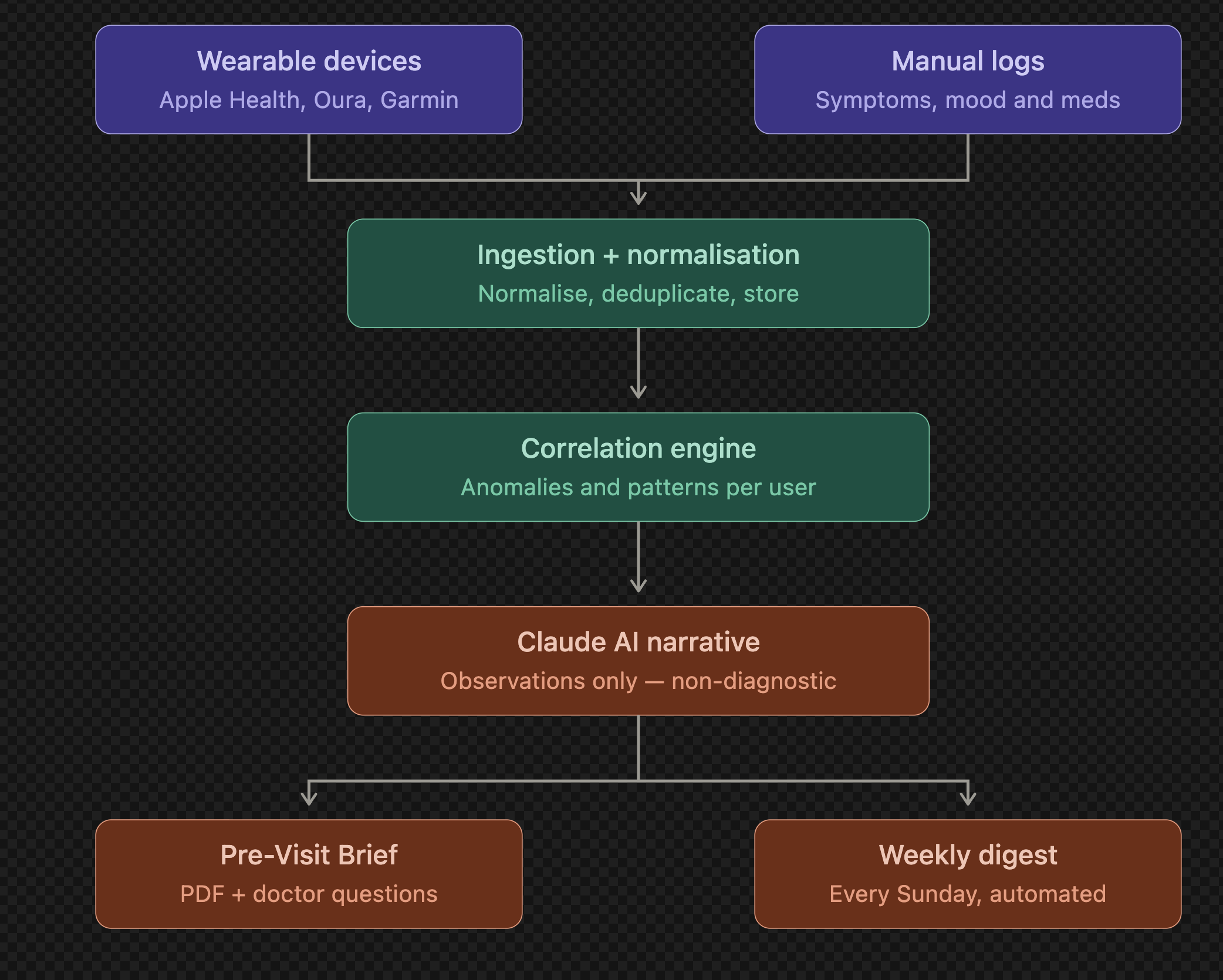
HealthLog is a health intelligence platform that aggregates wearable and self-reported data, computes personalized baselines, detects anomalies, and generates a Pre-Visit Brief - a structured, doctor-ready summary that translates weeks of physiological noise into clinical signal.
Data Aggregation
HealthLog pulls from Apple HealthKit, Oura, Luna (cycle tracking), Google Fit, Fitbit, and Garmin. Every metric - heart rate, HRV, sleep duration, blood pressure, SpO2, steps, cycle phase - gets normalized into a unified time-series model.
No more "Oura says this, Apple says that."
Personalized Baselines
Instead of comparing against population norms (which miss individual variance), HealthLog computes a rolling 30-day baseline per patient. An HR of 76 bpm is unremarkable for one person but an 8 bpm spike for another. We catch the spike.
Anomaly Detection
Rule-based and statistical thresholds flag what matters:
| Anomaly | Threshold | Severity |
|---|---|---|
| Systolic BP | ≥ 140 mmHg (IHG-III 2024) | HIGH |
| Resting HR elevation | ≥ baseline + 8 bpm, 2 consecutive days | MEDIUM |
| HRV depression | < baseline − 1.5 SD, 3 consecutive days | MEDIUM |
| Sleep deficit | < baseline − 1.5 hrs, 2 of 3 days | LOW |
Neither the patient nor the doctor wastes time on noise.
Correlation Engine
Using Pearson correlation over ≥ 10 data points with an r > 0.55 threshold, HealthLog surfaces non-obvious links - medication adherence tied to energy levels, sleep duration inversely tracking next-day heart rate, cycle phase modulating HRV. Only statistically significant patterns make it to the brief.
Cycle-Aware Analytics
By integrating Luna, HealthLog overlays menstrual cycle phase onto vitals. Luteal-phase HR elevation that would otherwise trigger a false anomaly gets contextualized. This is the first Indian health platform combining wearable telemetry with cycle tracking.
How we built it
The ingestion layer normalizes data from six wearable ecosystems into a single time-series schema - handling unit differences, timestamp misalignment, and confidence scoring per data point. The statistical engine runs rolling 30-day baseline computations and Pearson correlations to surface meaningful patterns. The narrative layer uses Anthropic's Claude API under strict non-diagnostic constraints - observations and citations only, never a diagnosis, never a prescription. Every generated string passes through a hard constraint filter before it reaches the patient.
Challenges we ran into
Data normalization across ecosystems. "Sleep" means different things to Oura, Apple, and Fitbit. HRV reporting varies between RMSSD and SDNN. We had to reconcile these into a single model without losing clinical fidelity.
Non-diagnostic positioning. In India, under NMC regulations, AI-generated health content walks a legal razor's edge. We engineered the AI layer so it structurally cannot output diagnostic language - it observes, cites, and suggests questions, but never concludes. This wasn't just prompt tuning; it's a design philosophy baked into every output path.
Balancing sensitivity and specificity. Too many anomaly flags and the brief becomes noise. Too few and it misses the signal. Tuning thresholds against real wearable data - where a "normal" day still has variance - required iterative calibration against clinical guidelines (IHG-III 2024, ICMR standards).
Accomplishments that we're proud of
Unified health schema across five ecosystems. Apple HealthKit, Google Fit, Fitbit, Garmin, and Oura - all speaking the same language. Deduplicated, confidence-scored, and time-aligned.
A Pre-Visit Brief that actually works. A patient can walk into a consultation, hand their doctor a one-page summary with anomalies, medication adherence, correlations, and suggested questions - all backed by 30+ days of their own biology. That changes the conversation from "How have you been?" to "Let's talk about this BP trend."
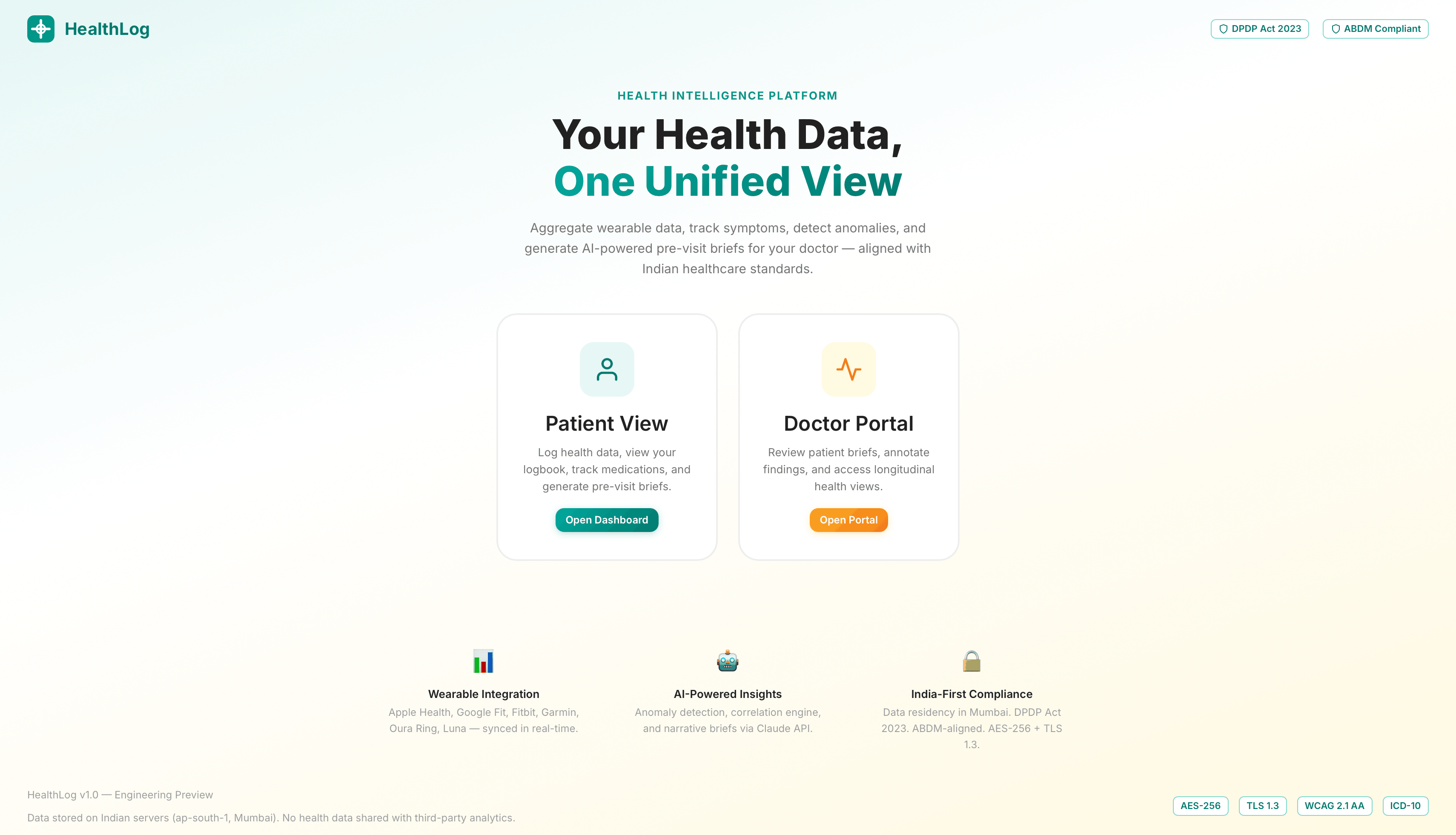
India-first compliance. DPDP Act 2023 data residency, ABDM-aligned data standards, NMC-compliant non-diagnostic positioning, ICD-10 coded symptoms. Not an afterthought - built in from day one.
Cycle-aware intelligence. Acknowledging that hormonal fluctuations modulate vitals by ±10% across the menstrual cycle. Ignoring this produces false positives. Accounting for it produces better medicine.
What we learned
AI in healthcare doesn't need to diagnose. It needs to organize evidence and make it legible. The highest-value intervention isn't a prediction - it's a well-structured summary that lets a 15-minute consultation focus on what actually matters.
The Pre-Visit Brief reduces the cognitive load on both sides: the patient doesn't need to remember, and the doctor doesn't need to dig.
We also learned that compliance isn't a constraint - it's a design driver. Building for DPDP and NMC from the start forced better architectural decisions than bolting privacy on later would have.
What's next for HealthLog
| Initiative | Description | Why deferred |
|---|---|---|
| Lab Report OCR | Structured extraction from pathology PDFs into the Pre-Visit Brief | Accuracy on diverse Indian lab formats demands more validation |
| Doctor Portal | Dedicated clinician interface for reviewing briefs longitudinally | MVP prioritized the patient-to-doctor bridge via shareable PDFs |
| FHIR R4 / EHR Integration | Direct export to hospital EMR systems | Integration layer needs partner validation |
| Cycle Phase Inference | Automated phase detection from vitals alone (without Luna) | Moved to P1 to avoid false-positive rates that erode clinical trust |
| Real-time Alerting | SMS/push for high-severity anomalies (BP spikes, sustained HRV drops) | Patients shouldn't wait until their next appointment to act |

Log in or sign up for Devpost to join the conversation.