-
-
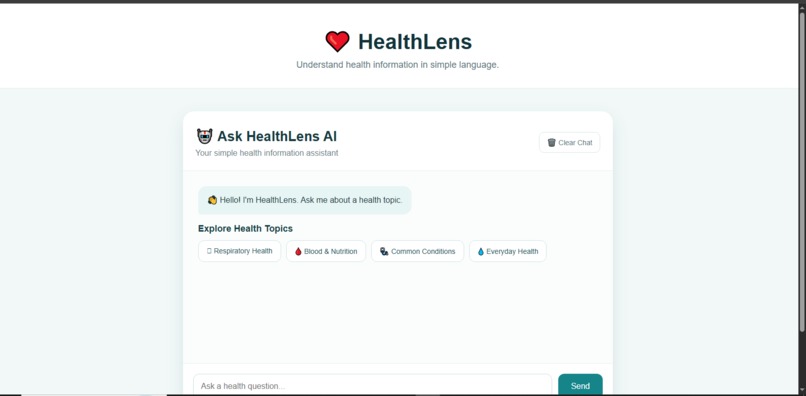
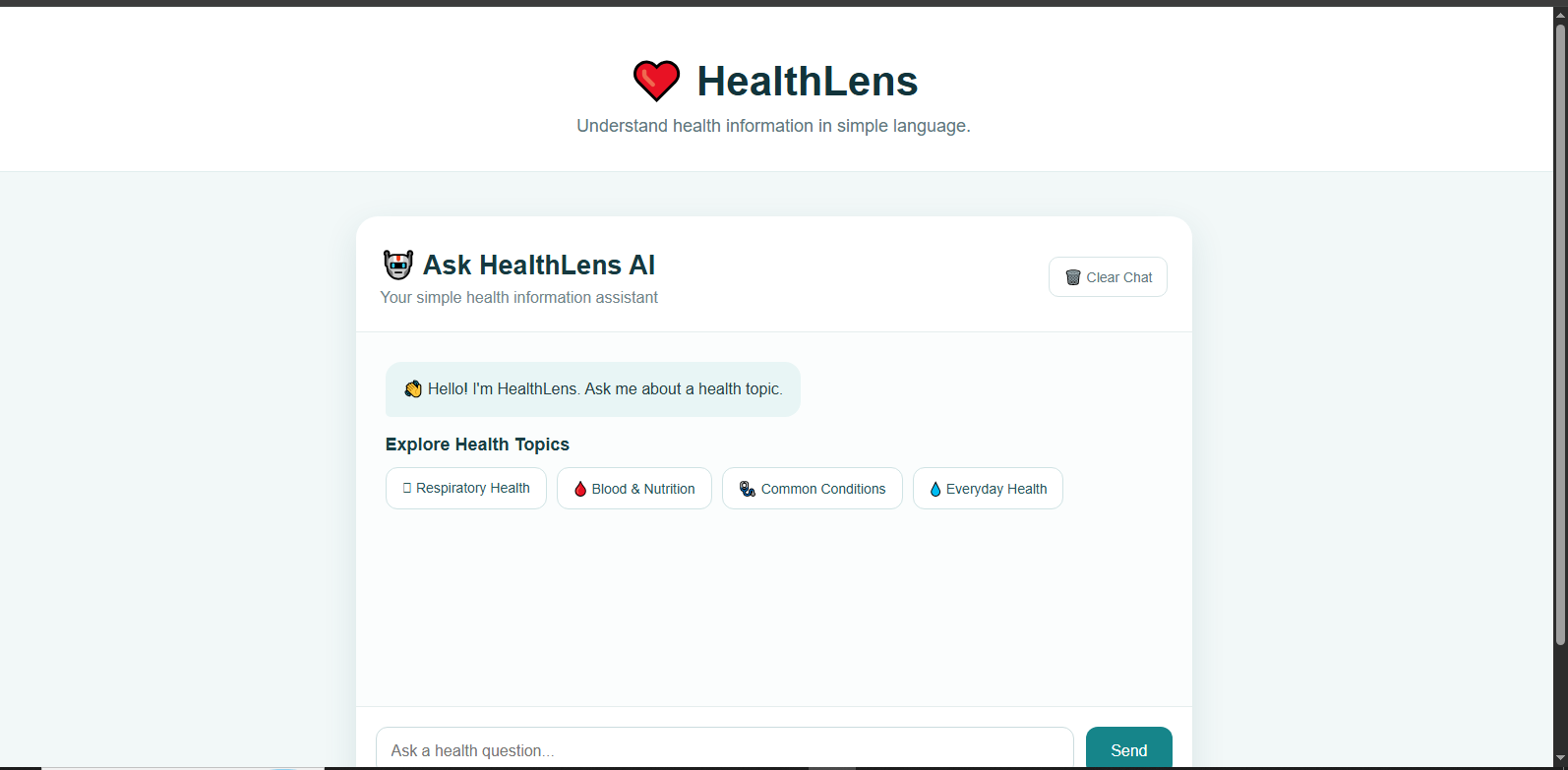
Main HealthLens interface
-
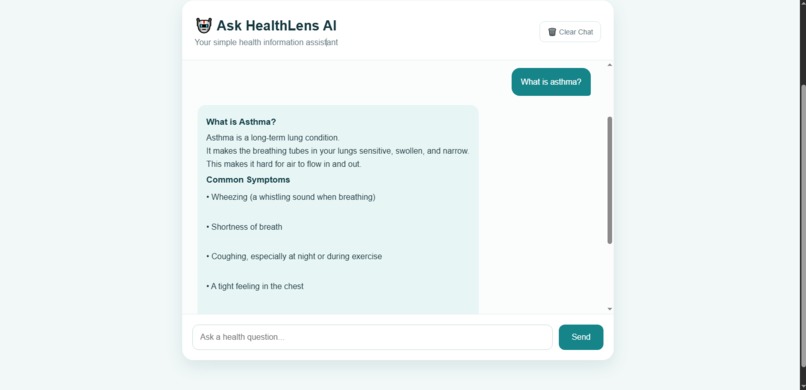
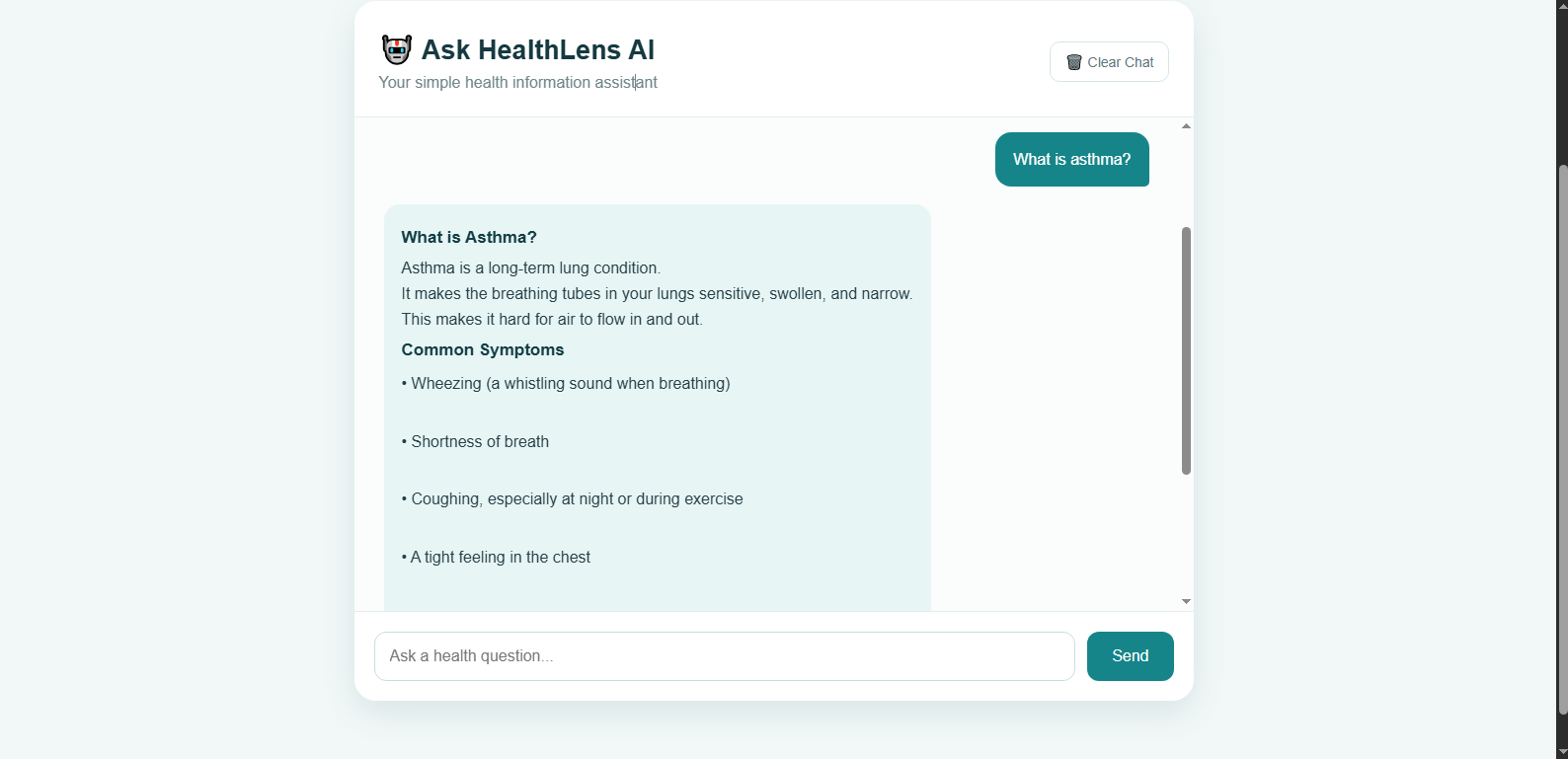
HealthLens answering a question
Inspiration
I wanted to make health information easier for people to understand. Many health topics are explained using difficult medical words or very long explanations. This can make it hard for an ordinary person to quickly understand what something means.
That is why I created HealthLens — a simple AI health-information assistant that explains health topics in easy language.
What it does
HealthLens is an AI-powered health-information assistant. A user can type a health question and get a short explanation in simple English.
It can:
- Answer questions about health topics.
- Explain difficult medical terms in easier language.
- Understand follow-up questions using the conversation history.
- Show answers in a clean and easy-to-read format.
- Save previous conversations so they can be viewed later on the History page.
HealthLens is made for health education and information. It does not diagnose diseases or replace a doctor.
How I built it
I built HealthLens using HTML, CSS, JavaScript, Python, Flask, Gemini API, and SQLite.
The website is the frontend where users can ask health questions. JavaScript sends the question to my Flask backend. Flask then sends the question and conversation history to the Gemini API and returns the AI response to the website.
I also added a SQLite database to save conversations and created a History page where previous questions and answers can be viewed.
For deployment, I connected my GitHub repository to SnapDeploy and used Gunicorn to run the Flask application online.
Challenges I ran into
This was my first time building and deploying a complete AI-powered web project, so I faced many challenges along the way.
At first, HealthLens worked on my computer, but getting it to work as a live website was a new experience for me. I had to learn how the frontend, Flask backend, API, database, GitHub, and deployment all connect together.
I also faced connection issues during deployment. For example, the website was using 127.0.0.1, which only works on my own computer. I learned why this did not work online and changed the frontend to communicate with the deployed backend correctly.
There were several moments when things did not work as expected, but I kept testing, debugging, and learning instead of giving up. This experience made me more confident in solving problems on my own.
Accomplishments that I'm proud of
I am proud that I was able to build HealthLens as a solo project and take it from an idea to a working live website.
This was my first time building and deploying an AI-powered web application, so getting the complete system working was a big achievement for me.
I am especially proud of connecting the frontend, Flask backend, Gemini API, and database into one working application. I also successfully deployed it online and created a History page for saved conversations.
Most importantly, I am proud that I kept working through the problems I faced instead of giving up. This project gave me more confidence in my ability to learn new technologies and build things on my own.
What I learned
I learned how different parts of a web application work together. Before this project, I had never built and deployed a complete AI-powered website like this.
I learned how to connect JavaScript with a Flask backend, send and receive data through API routes, connect an AI model using the Gemini API, and save conversations using SQLite.
I also learned how important deployment and debugging are. Something can work perfectly on a local computer but still need changes before it works online.
Most importantly, I learned that getting stuck is part of building something new. I became more comfortable with testing, finding errors, learning from them, and trying again instead of giving up.
What's next for HealthLens
I want to keep improving HealthLens after the hackathon.
Some features I would like to add in the future are:
- Support for more languages so more people can use HealthLens.
- Better conversation management and history.
- More health education topics.
- Improved answers using carefully selected and trusted health information sources.
- A better mobile-friendly experience.
My goal is to keep HealthLens simple, useful, and easy to understand while making it clear that it provides health information and does not replace professional medical advice.


Log in or sign up for Devpost to join the conversation.