-
-
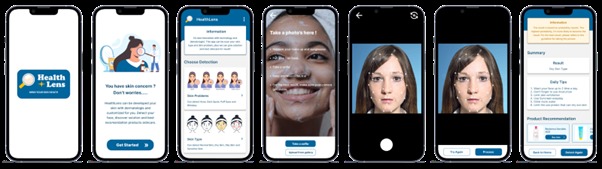
appllication
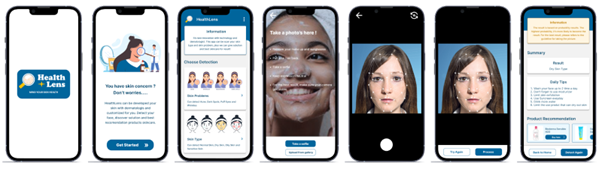
Inspiration
Nowadays, people are becoming aware about their facial health. Especially about their facial problems, specifically, like their skin doesn't look healthy, have acne, and problem skin-related. There are many kinds of skincare products with many variants like products, ingredients, and usefulness. The problems are people find it hard to identify which one skincare product is right for them because there are so many problems related to facial skin. The people aware of the skin do not look healthy, so we are create this app to help the people to identify they face quickly. there are chances that people don't use the skincare product wisely and suitable for them and only just make their facial problem more severe for themselves. Chances are high because sometimes people use skincare without consulting the professional, before. Mainly because of the high cost for them and there is a lack of professional facial doctors who could resolve the problem in their regions or residence. Briefly to conclude, we need some automation tools that could meet human professional-like intelligence for resolving the problems without being needed to consult a professional facial-skin doctor.
What it does
Basicly the Health Lens can be use for the man, easly to search what in information in he body, like if you scanning your body and the health lens can be automatic give you information, like your skin, your body very fat or very thin, and the health lens give you tips to suggestions for improving and making healthy patterns. and if you scanning your face the health lens can be make specified about your face skin, like so oil, so very drying, or skin dieses, no that is, the health lens can scan about your information you lack sleep, which is obtained from eye analysis. i think if this will grow maybe health lens will avalible to analysis mental health, and make suggetsion more detail.
How we built it
Machine Learning: Data generated from several search engines websites, free-popular website images (Unsplash, Freepik, GettyImages, Youtube etc.). Building models for the classifier with Machine Learning using TensorFlow API in Google Colabs. Preprocessing data using library Numpy using vectorized dataset, training the model with transfer learning features from InceptionV3. Deploying models in the cloud using python scripts at the Google Cloud Engine.
Cloud: Manage GCP by setting member roles, managing billing accounts, enabling API, creating storage buckets to store machine learning models and input. We create APIs with Flask Application. After that, we created a virtual machine as a web server. Next, we deploy a flask application in the virtual machine and Gunicorn to handle multiple HTTP requests.
Android: Making UI /UX for designing the apps and interpreting in Android Studio. Deploy the model from ML (Machine Learning) to the apps which use kotlin programming. Inside the application, users can detect your skin type and skin process. The result will be shown to the user. The result page such as : result skin, daily tips and recommendation product.
Challenges we ran into
The models that we actually have created; skin type model detection and skin disease detection, have an average accuracy about 75% and 80% respectively, when we tried to save the model we have challenges that the model weight have really large size respectively to 300 MB The machine learning model is large. So, it hard to upload it to github. The CC cannot access GPU, because of GCP features limitation.
Accomplishments that we're proud of
80% Validation Accuracy - Skin Type Model 75% Validation Accuracy - Skin Disease Model
What we learned
It could probably be the dataset has a miss label that makes the training less accurate, and also the model used for transfer learning (Inception v3) is too big. Dataset needs to be more collected for model making purposes. Team could use another dataset that was already provided on the internet. The dataset needed to be more representative and heterogeneous so that the model makes predictions more accurately. The model representative could use another popular model like the RESNET model, if already needed for another development model. The model that has been used for making a model (Inception V3) was too large so that it affects the output model for size. The model needs to be more simple and doesn’t get too complicated in order to the model output size doesn’t get too big for size. Additional suggestion is the team could use another batch with a higher batch in order to make the accuracy value more accurate.
What's next for Healthlens
August Publish Beta Version Apps on Google Play Store Making Social Media Feedback Gathering Feature and Market Research
September Collaboration with Another Stakeholder Development and Deployment Phase
October Next Version Apps Release Marketing Campaign

Log in or sign up for Devpost to join the conversation.