HealthIA — An AI-Native Virtual Primary Care Center
Inspiration
Healthcare professionals spend an enormous amount of time completing documentation, coordinating appointments, verifying patient information, preparing prescriptions, reviewing insurance requirements, and correcting administrative errors.
In many health systems, especially in low-resource environments, these fragmented processes reduce the time available for what matters most: listening to patients, making sound clinical decisions, and delivering continuous care.
As a physician, university professor, and developer, I have experienced this problem from several perspectives. I wanted to explore a different model:
What would a healthcare center look like if artificial intelligence managed almost every administrative process, while qualified health professionals remained responsible for clinical care?
That question inspired HealthIA, an AI-native virtual primary care platform designed to support patients before, during, and after a medical consultation.
HealthIA is not intended to replace physicians. Its purpose is to remove administrative friction, improve the quality and consistency of clinical information, and allow healthcare professionals to dedicate more attention to their patients.
What HealthIA Does
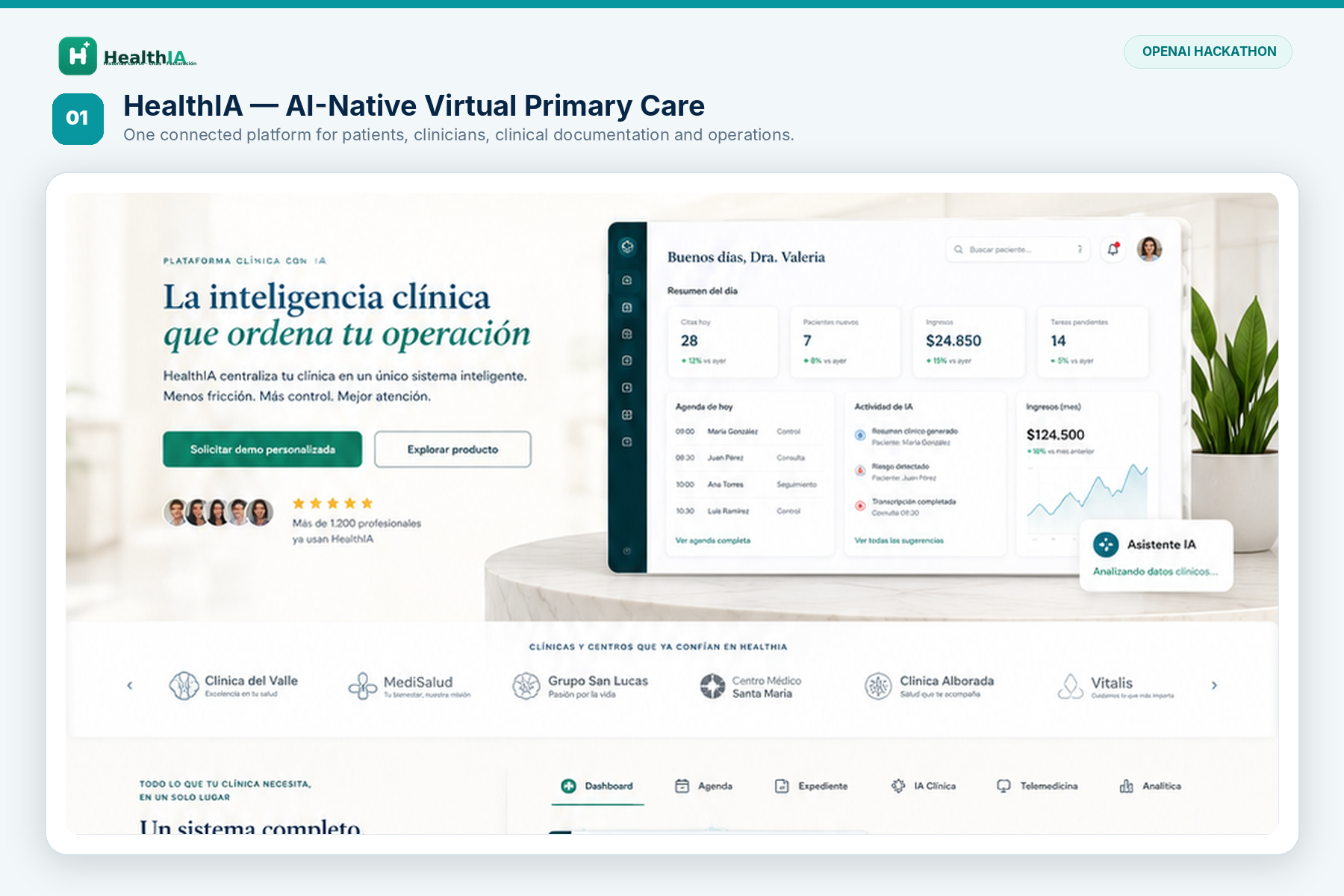
HealthIA combines a patient portal, AI-assisted clinical intake, virtual consultation workflows, medical documentation, administrative automation, and post-consultation auditing in one connected platform.
Instead of forcing patients and professionals to move between multiple disconnected systems, HealthIA creates a continuous workflow.
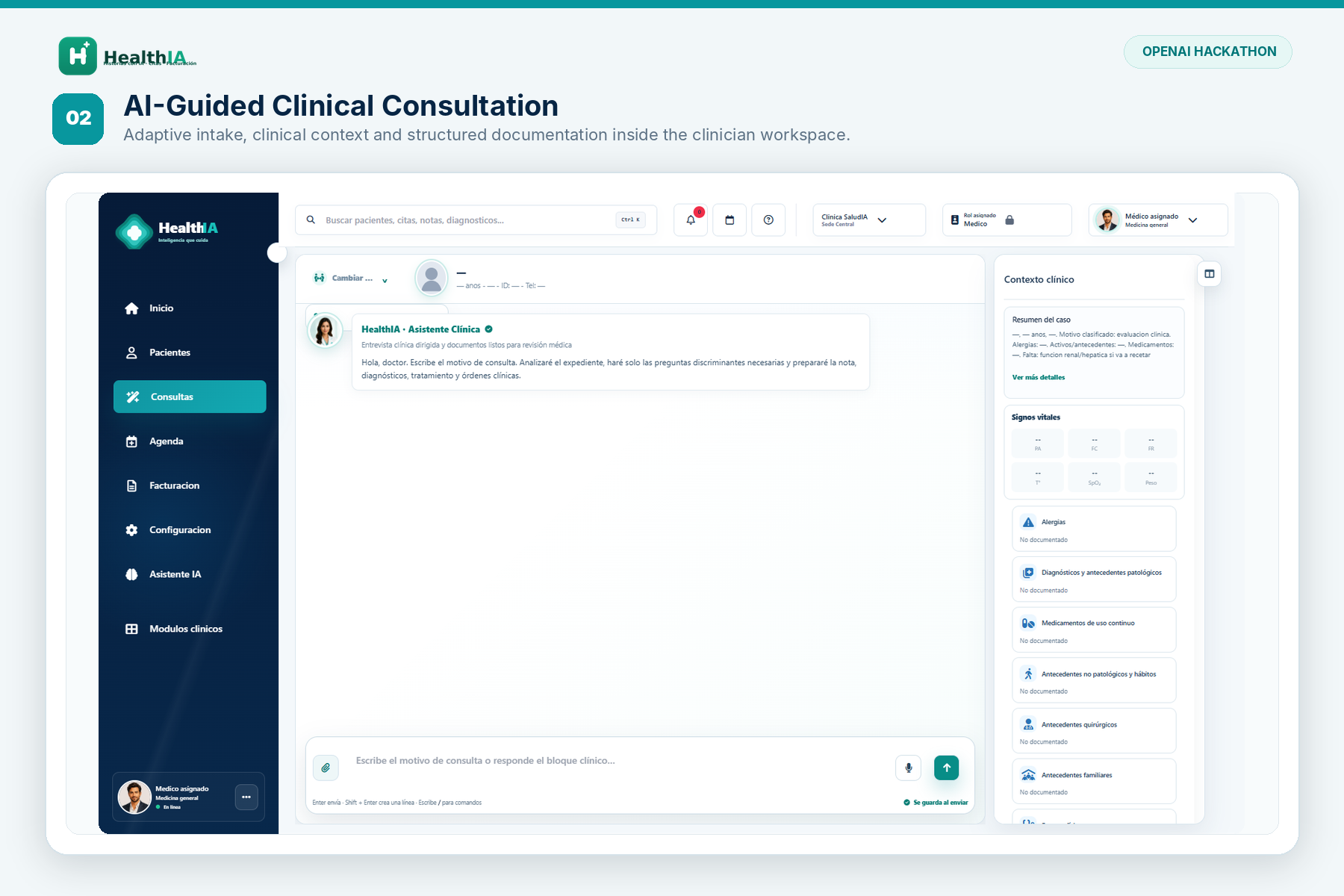
1. AI-Guided Patient Intake
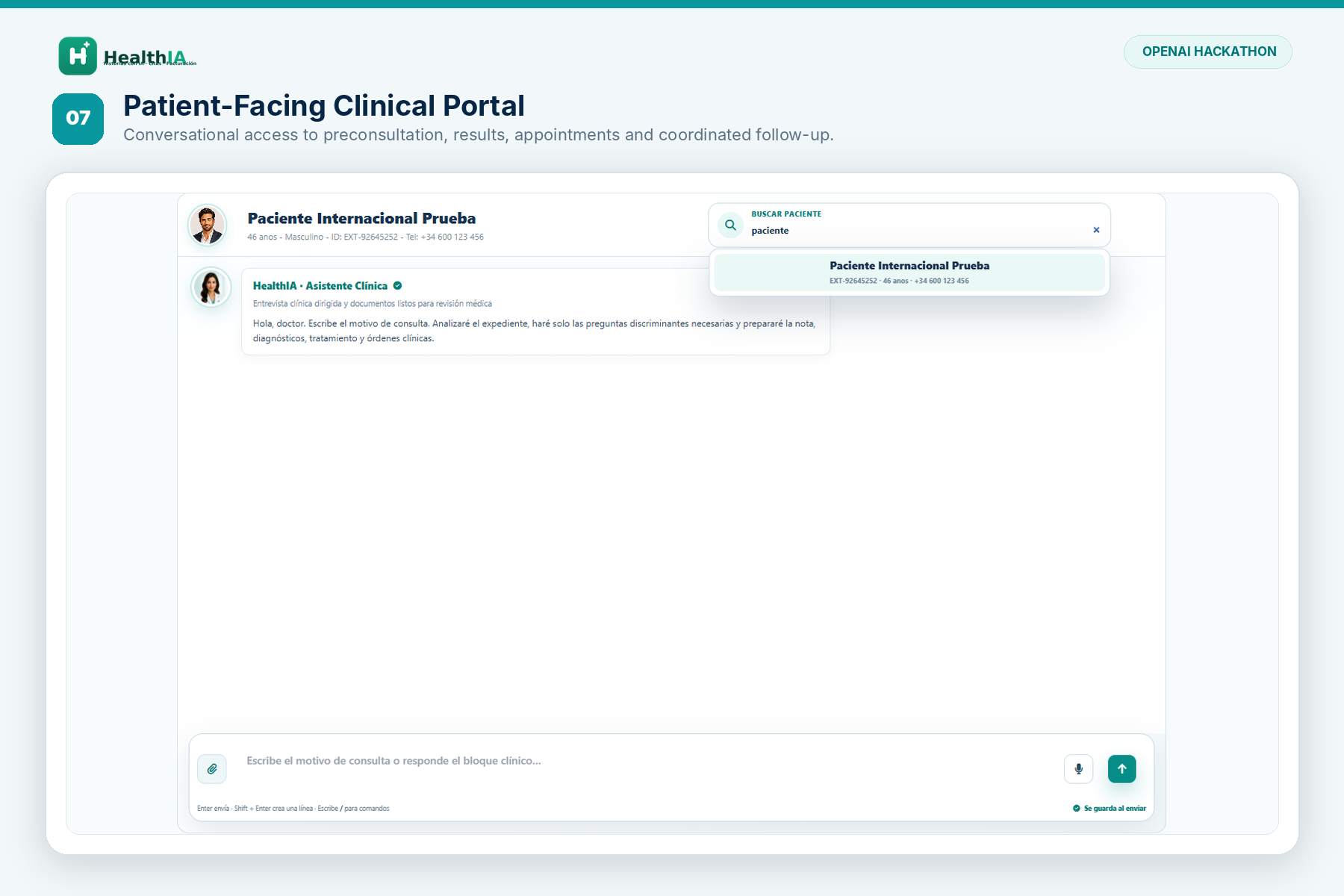
Patients describe their symptoms through a conversational interface.
The AI dynamically generates clinically relevant follow-up questions based on:
- The reason for consultation
- Symptom duration and severity
- Associated symptoms
- Medical and surgical history
- Allergies
- Current medications
- Relevant risk factors
- Potential warning signs
The system can adapt the interview instead of presenting every patient with the same static questionnaire.
When the patient enters information that may indicate an emergency, HealthIA prioritizes safety and recommends immediate evaluation rather than continuing a routine virtual consultation.
2. Structured Clinical Summary
HealthIA converts the conversation into structured clinical information that a healthcare professional can review.
The generated workspace may include:
- Chief complaint
- History of present illness
- Relevant medical history
- Allergies and current medications
- Review of systems
- Preliminary risk assessment
- Possible diagnoses
- Differential diagnoses
- Suggested laboratory tests
- Suggested imaging studies
- Potential referrals
- Follow-up considerations
- Patient education
The clinician remains in control and can edit, reject, or approve every generated element.
3. AI-Assisted Clinical Documentation
After reviewing the patient, the professional can use HealthIA to produce a coherent clinical note based on the information gathered during the encounter.
The platform is designed to help reduce common documentation problems such as:
- Missing relevant symptoms
- Contradictions between different sections of the record
- Incomplete medication instructions
- Unsupported diagnostic codes
- Inconsistent follow-up recommendations
- Missing clinical justification for tests or procedures
The objective is not simply to generate more text. The objective is to generate better-organized, clinically useful, and auditable documentation.
4. Intelligent Front Desk
HealthIA includes an AI-supported front-desk workflow capable of helping with:
- Patient registration
- Appointment scheduling
- Arrival confirmation
- Waiting-room management
- Document verification
- Insurance or program eligibility review
- Missing-document notifications
- Patient portal activation
- Pre-consultation instructions
- Follow-up coordination
This allows administrative processes to operate continuously without requiring every action to be performed manually.
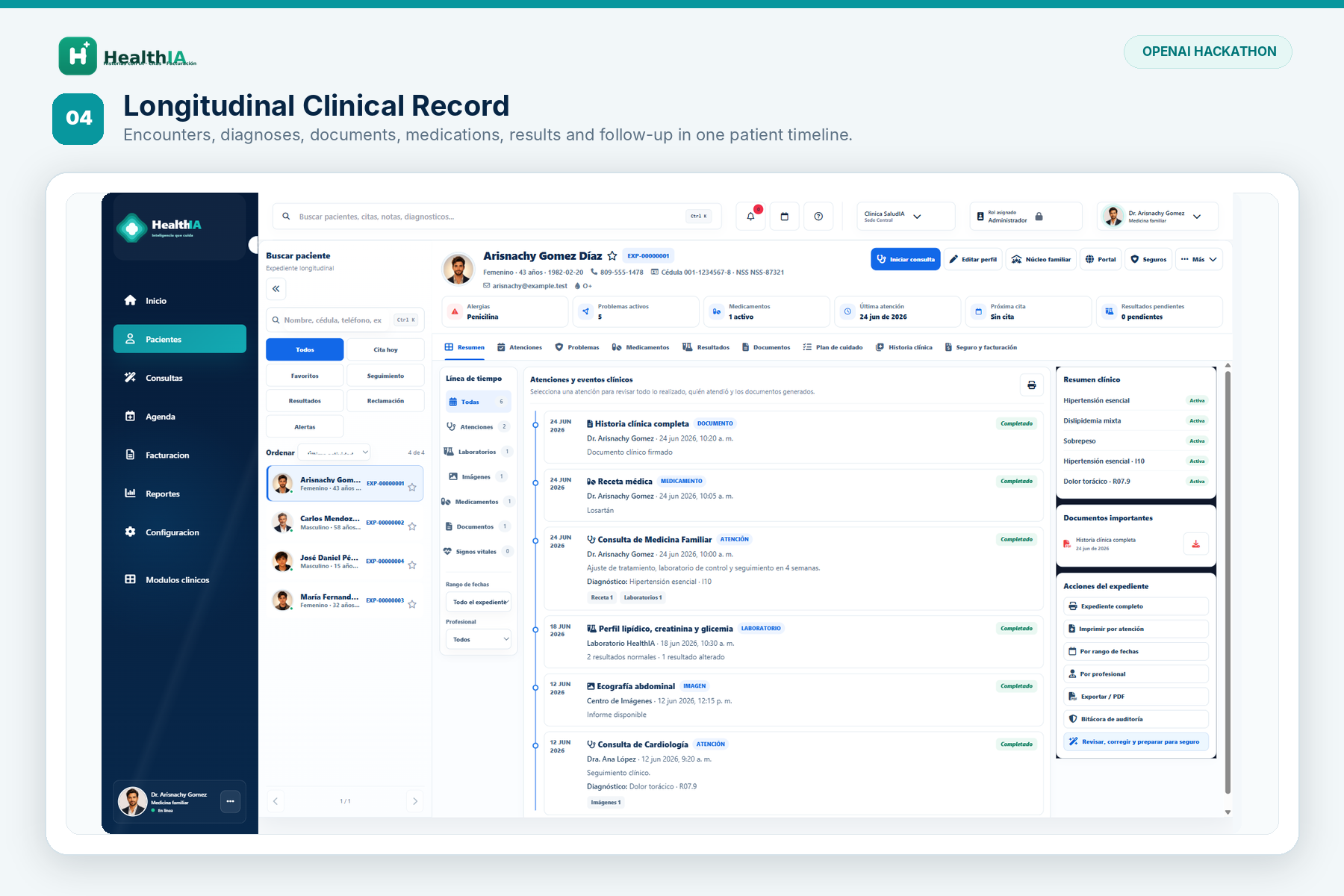
5. Unified Patient Record
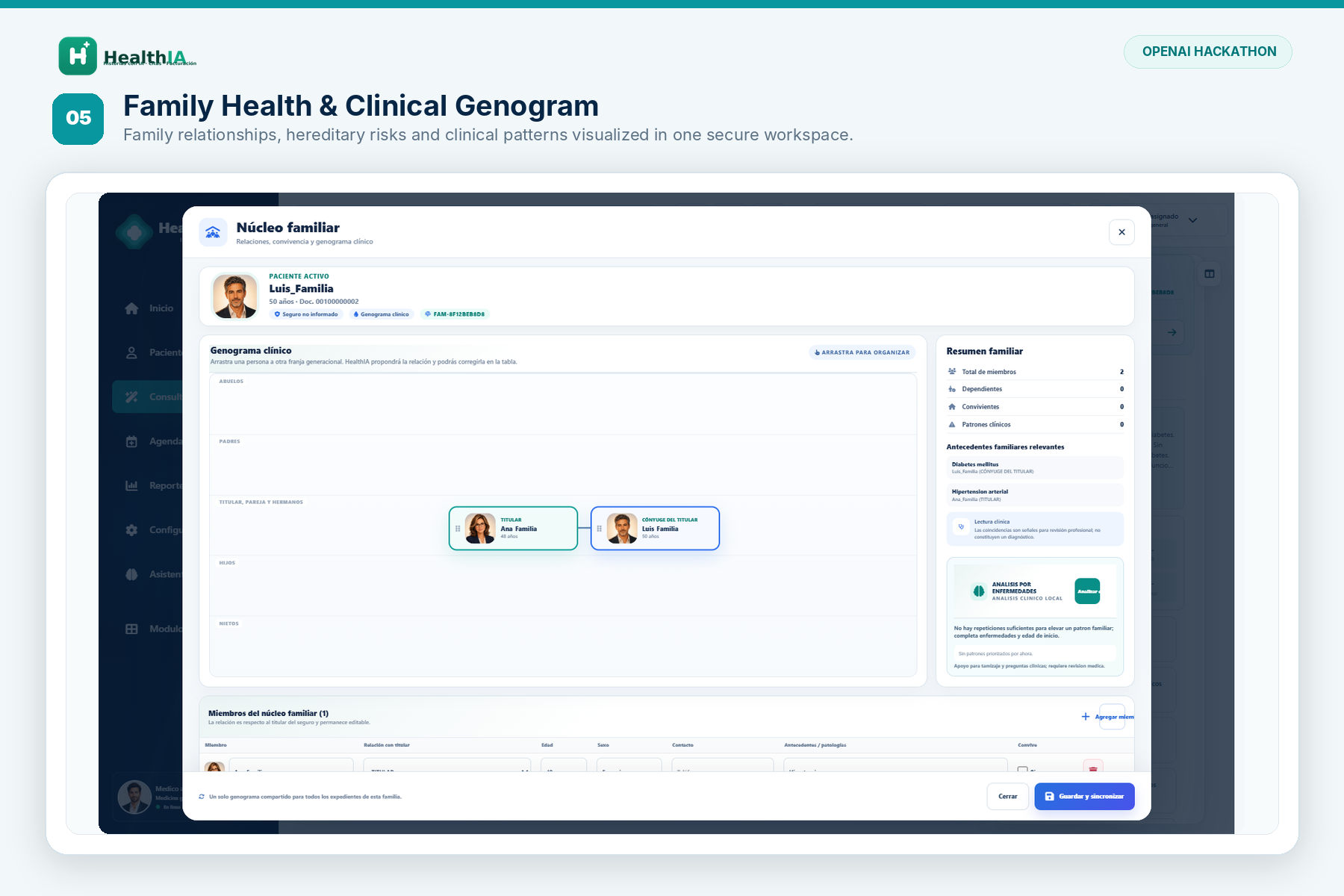
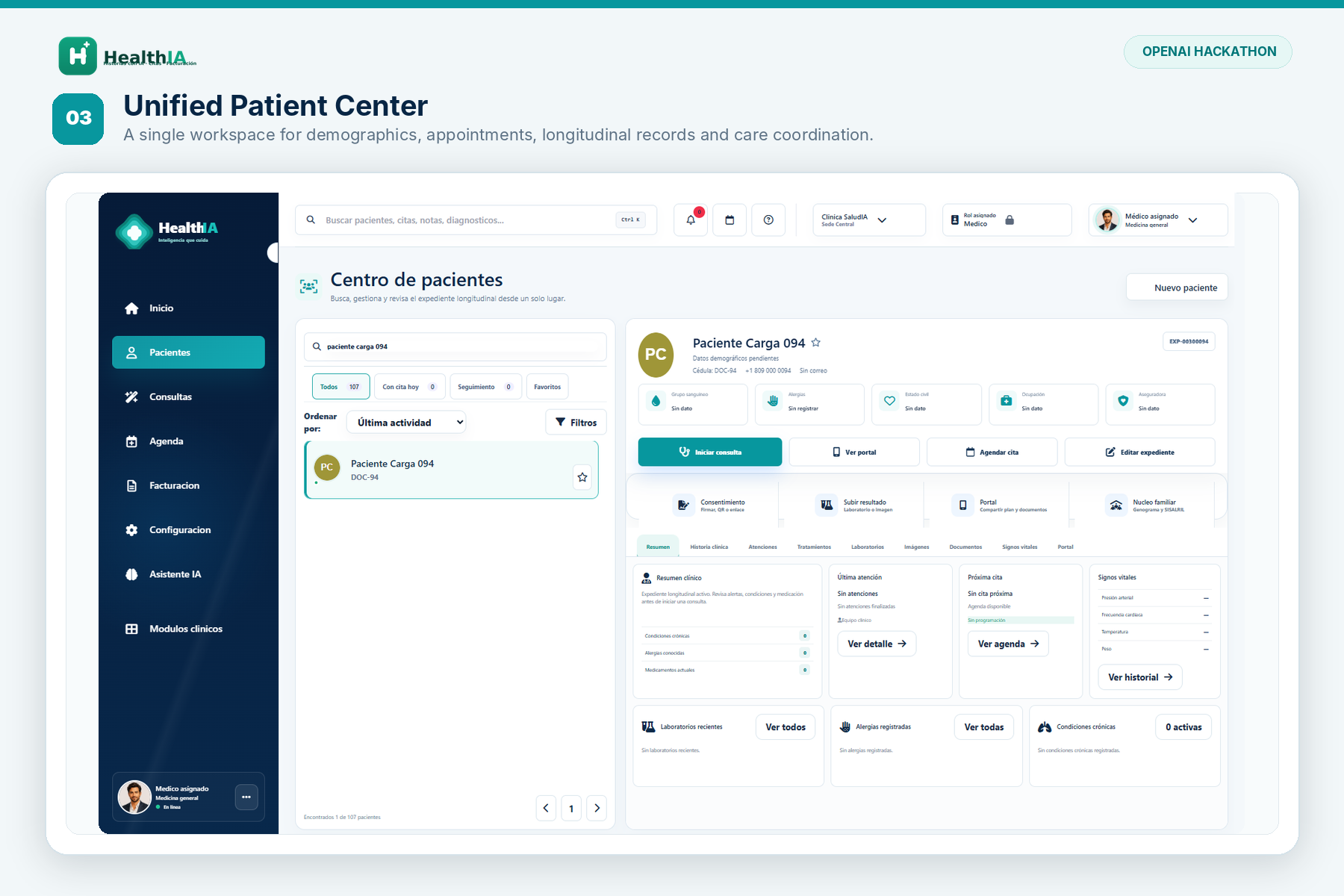
Each patient has a longitudinal digital record containing:
- Demographic information
- Previous encounters
- Diagnoses
- Prescriptions
- Laboratory orders
- Imaging requests
- Procedures
- Referrals
- Follow-up plans
- Consent records
- Uploaded documents
HealthIA is designed to organize this information around the patient rather than around isolated visits.
6. AI-Powered Clinical Audit
One of the most important components of HealthIA is its post-consultation audit workflow.
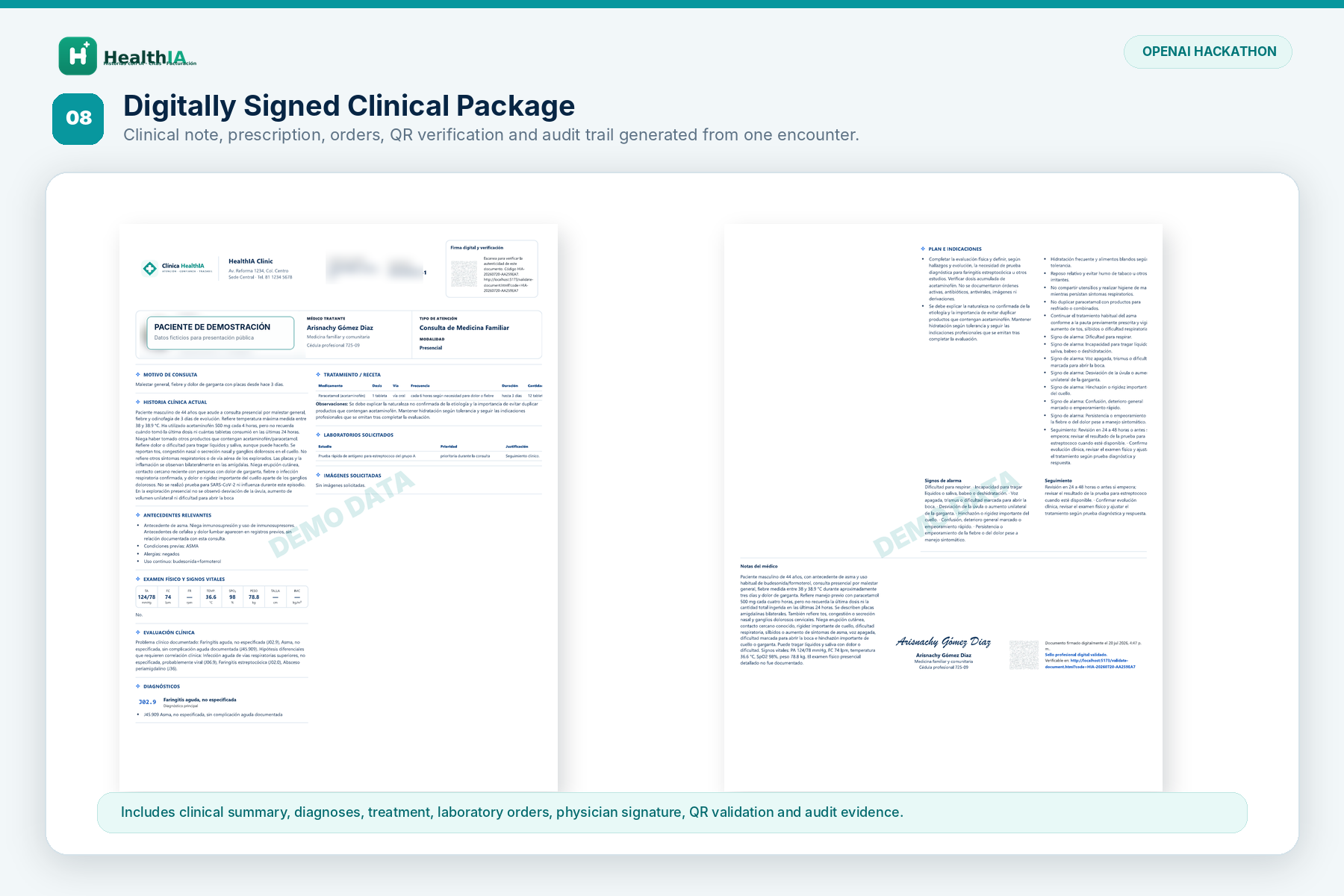
Before a clinical package is considered complete, the AI can evaluate whether the documentation is internally consistent.
For example, the system can identify situations where:
- A diagnosis is listed but not supported by the clinical note
- A medication is missing its dose, route, frequency, or duration
- A laboratory test lacks clinical justification
- A chronic condition mentioned by the patient was omitted from the medical history
- The follow-up plan does not match the level of risk
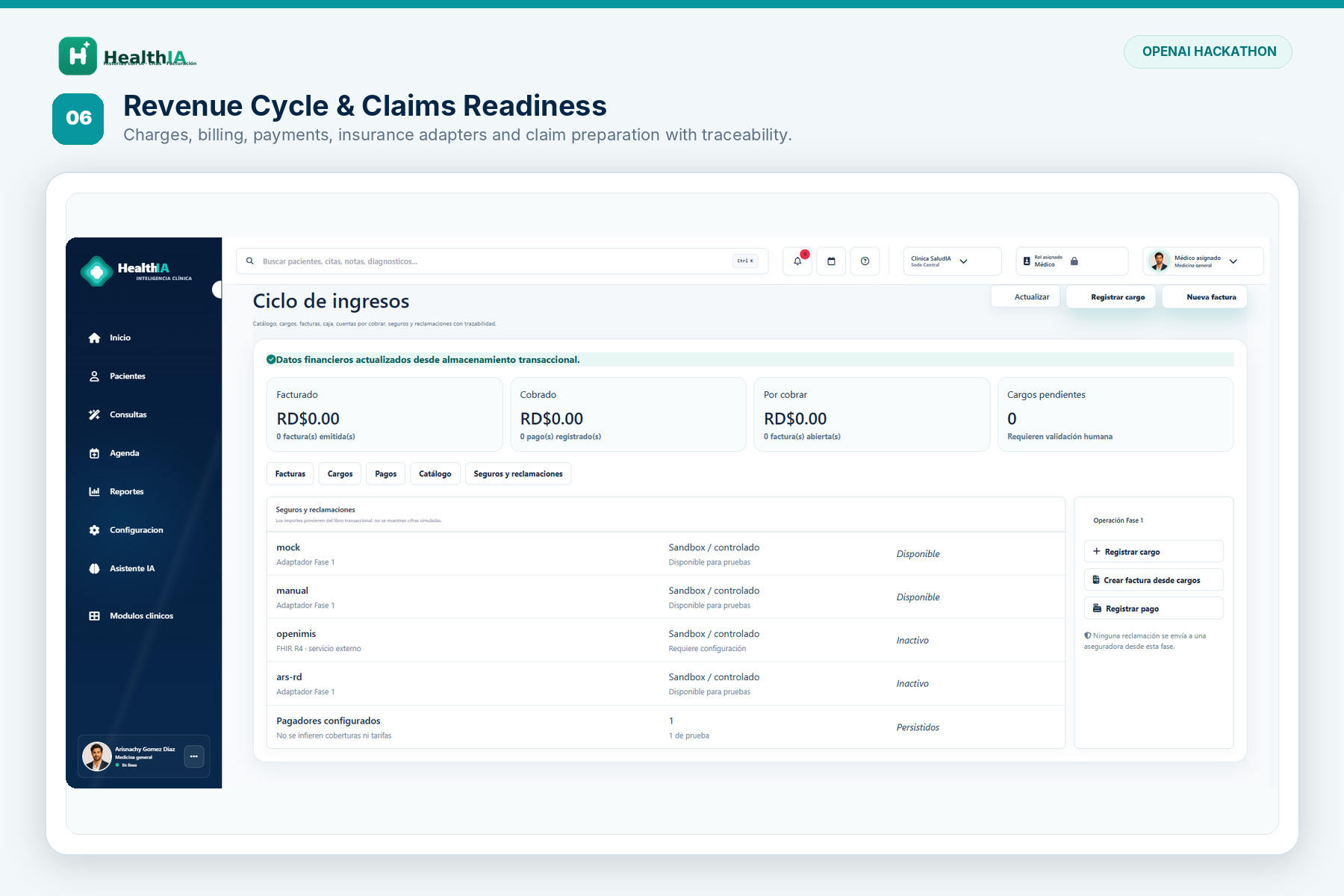
- The invoice contains services that are not reflected in the encounter
- Required documents or signatures are missing
The professional receives these observations before the record is finalized.
7. Support for International and Veteran Care Workflows
HealthIA also explores workflows for patients receiving virtual care across borders, including United States veterans living abroad.
The platform can help organize:
- Consultation documentation
- Diagnoses and ICD-10 codes
- CPT and HCPCS information
- Prescriptions
- Laboratory and imaging orders
- Digital signatures
- Consent records
- Itemized invoices
- Supporting documents
- Reimbursement packages
The goal is to reduce preventable omissions that could delay the review or reimbursement of legitimate healthcare services.
How We Built It
HealthIA was developed as a modular web application with separate experiences for patients, clinicians, front-desk personnel, administrators, and medical auditors.
The prototype uses:
- OpenAI models for conversational intake, clinical information extraction, structured generation, and document auditing
- OpenAI Responses API for model interactions
- Structured JSON outputs to convert natural-language conversations into usable clinical objects
- JavaScript and HTML for the application interface
- Vite for local development and frontend delivery
- Node.js APIs for secure communication between the application and AI services
- Role-based workflows for patients, clinicians, front desk, pharmacy, billing, and administration
- FHIR-oriented resources to support future health-data interoperability
- ICD-10, CPT, and HCPCS structures for diagnoses, procedures, services, equipment, and billing workflows
- Digital signatures, QR verification, and audit records for document integrity
A major architectural decision was to avoid using separate, disconnected AI calls for every part of the medical encounter.
Instead, HealthIA can request a consolidated structured response containing the clinical summary, diagnoses, medications, tests, referrals, education, follow-up plan, and audit information.
This reduces latency, limits contradictory outputs, and gives the interface a single source of truth.
Conceptually, the system optimizes a balance between response time, completeness, safety, and documentation consistency:
$$ Q = \alpha C + \beta S + \gamma K - \delta T $$
Where:
- (C) represents clinical completeness
- (S) represents patient safety
- (K) represents internal consistency
- (T) represents response time
- (\alpha, \beta, \gamma,\delta) represent the relative importance of each factor
For HealthIA, safety and consistency receive the highest priority.
Challenges We Faced
Maintaining Clinical Coherence
Generating an isolated diagnosis or a paragraph is relatively easy. Generating an entire clinical encounter in which symptoms, history, diagnoses, prescriptions, tests, follow-up, and billing remain consistent is much harder.
We addressed this by defining structured schemas and introducing a separate auditing stage that reviews the relationship between all parts of the encounter.
Balancing Speed and Completeness
Long clinical prompts can produce detailed answers, but they may also increase latency.
To improve performance, we reduced unnecessary sequential calls, reused previously collected patient context, and designed the system to generate multiple structured clinical components in one response.
Designing a Natural Patient Interview
A traditional medical form often feels rigid and overwhelming. However, an entirely open chat can miss essential information.
HealthIA combines both approaches. The AI conducts a natural conversation while internally tracking which clinical domains have already been covered and which questions remain necessary.
Preventing Unsafe Automation
Healthcare automation must have clear boundaries.
HealthIA was therefore designed around human oversight:
- The AI may suggest, organize, flag, or draft
- The clinician reviews and approves clinical decisions
- Emergency warning signs interrupt routine workflows
- High-risk recommendations remain visible
- Every important change can be recorded in an audit trail
Creating a Complex Interface Without Overwhelming Users
HealthIA includes many functions, but presenting all of them simultaneously would create a confusing experience.
We developed role-specific interfaces and collapsible clinical panels so that each user sees the information relevant to their current task.
Working With Real-World Documentation Requirements
Medical records are not only clinical documents. They may also be reviewed by insurers, government programs, auditors, pharmacies, laboratories, and patients.
Designing a workflow that keeps the clinical note, diagnosis codes, medical orders, consent records, and invoices aligned was one of the most demanding parts of the project.
What We Learned
Building HealthIA reinforced several important lessons.
First, the greatest value of healthcare AI may not come from replacing clinical judgment. It may come from connecting fragmented processes and reducing the invisible administrative work surrounding each medical decision.
Second, structured outputs are essential. Natural-language responses are useful for conversation, but healthcare applications require predictable objects, validation rules, and traceability.
Third, good clinical AI needs memory within the encounter. Information provided during intake must remain available when generating the history, diagnoses, treatment plan, and final documentation.
Fourth, human oversight cannot be added at the end. It must be part of the architecture from the beginning.
Finally, user experience is a clinical issue. A poorly designed interface can hide important warnings, slow down professionals, or cause relevant information to be missed.
Accomplishments We Are Proud Of
During the hackathon, we were able to create a functional prototype that demonstrates how an AI-native healthcare center could operate.
We are especially proud of:
- Creating an adaptive AI-guided patient interview
- Transforming conversations into structured clinical information
- Connecting patient intake with the professional workspace
- Generating editable clinical documentation
- Designing an AI-assisted audit workflow
- Supporting multiple healthcare and administrative roles
- Creating a unified patient record
- Exploring international and veteran reimbursement workflows
- Keeping the healthcare professional in control of final decisions
Most importantly, HealthIA demonstrates that AI can be more than a chatbot added to an existing healthcare application. It can become the coordination layer connecting patients, professionals, documentation, administration, and quality control.
What Is Next for HealthIA
The next stage of development will focus on:
- Production-ready authentication and access control
- Encrypted cloud data storage
- Full FHIR interoperability
- Integration with laboratories and pharmacies
- Video consultation
- Electronic prescriptions
- Automated appointment reminders
- Multilingual patient interactions
- Voice-based clinical intake
- Insurance eligibility verification
- Advanced medical coding assistance
- Secure electronic claim submission
- Continuous quality and safety evaluation
- Validation with real clinicians and representative clinical cases
We also plan to evaluate HealthIA using measurable indicators such as:
- Time saved per consultation
- Documentation completeness
- Number of inconsistencies detected
- Frequency of missing required fields
- Clinician acceptance of AI-generated suggestions
- Patient completion rate
- User satisfaction
- Reduction in preventable claim rejections
Our Vision
HealthIA represents a future in which a healthcare center can operate continuously, intelligently, and efficiently.
Patients receive guidance and support throughout their care journey. Healthcare professionals spend less time navigating fragmented systems. Administrators gain better visibility into operations. Clinical documentation becomes more coherent, complete, and auditable.
The vision is simple:
Let artificial intelligence manage the complexity surrounding healthcare, so healthcare professionals can focus on caring for people.
HealthIA is our first step toward that future.


Log in or sign up for Devpost to join the conversation.