-
-
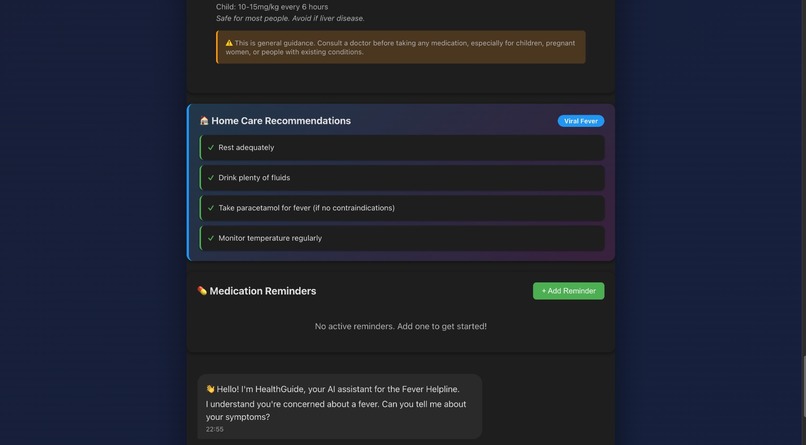
Home Care Recommendations
-
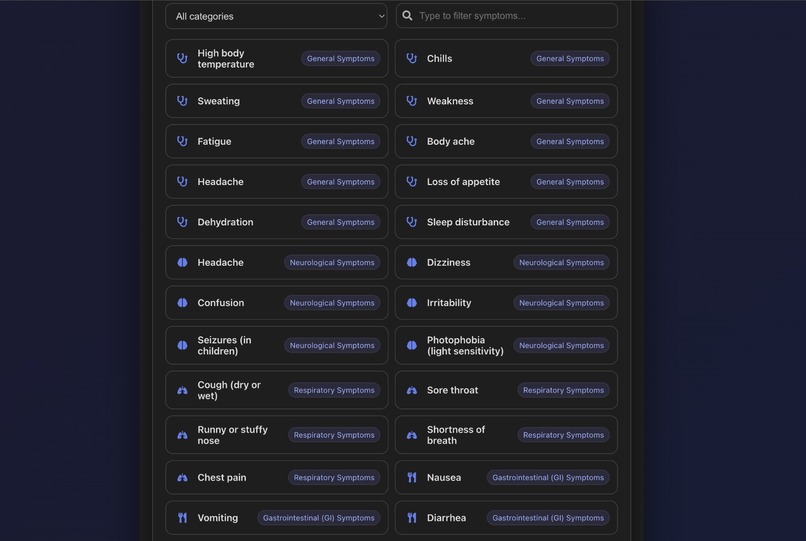
Common Symptoms
-
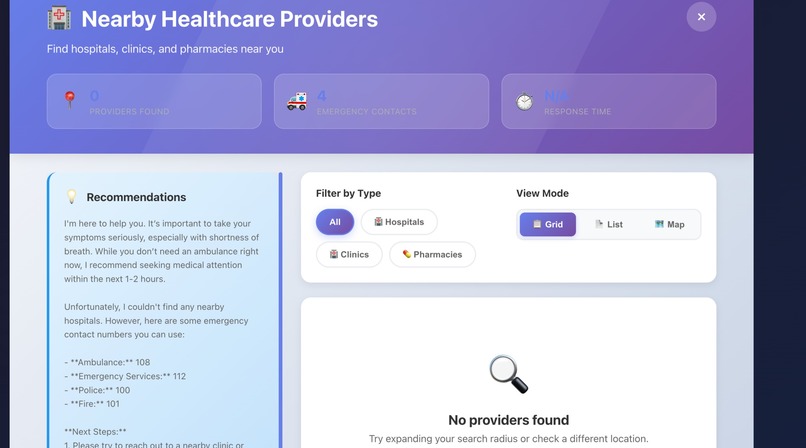
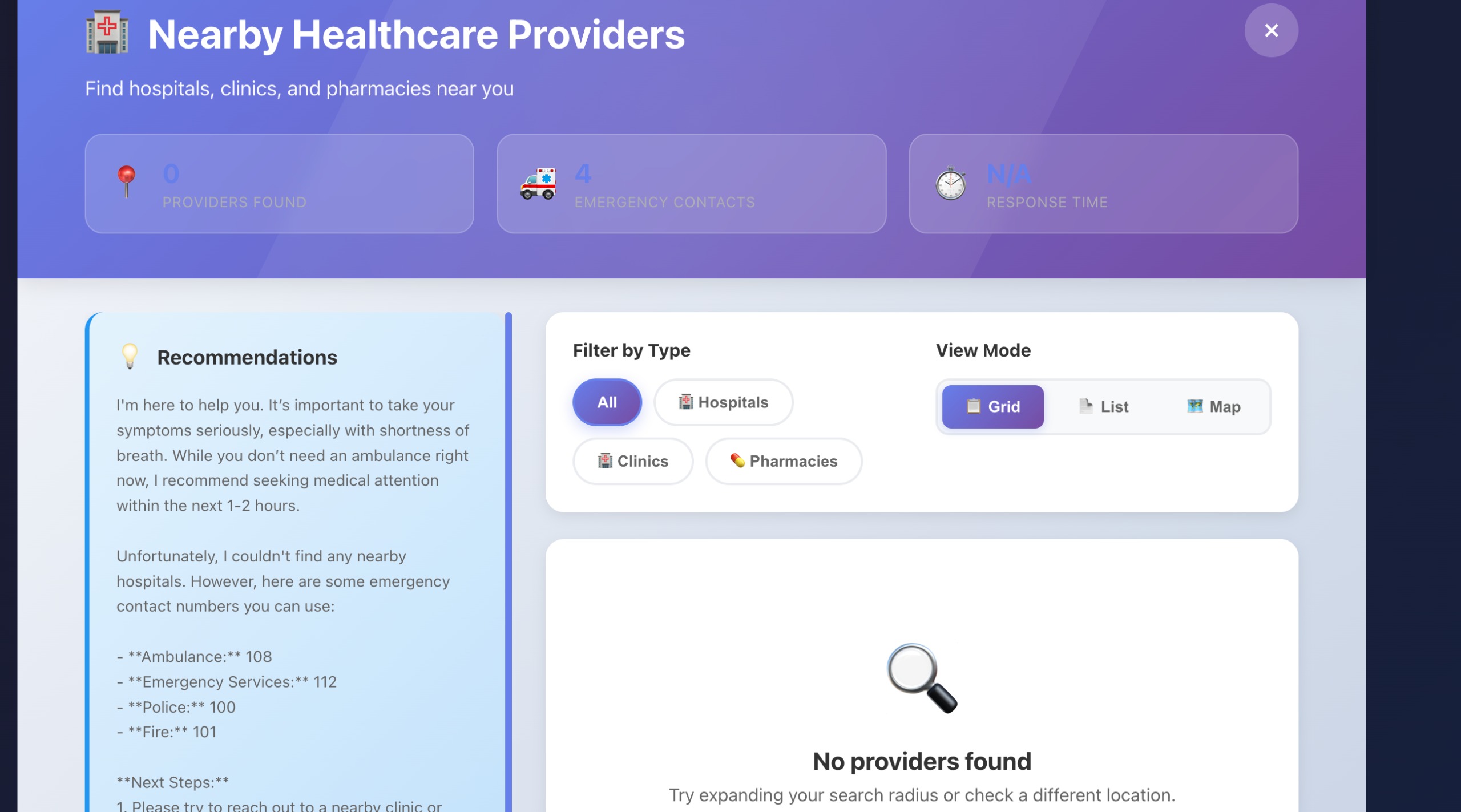
Healthcare providers
-
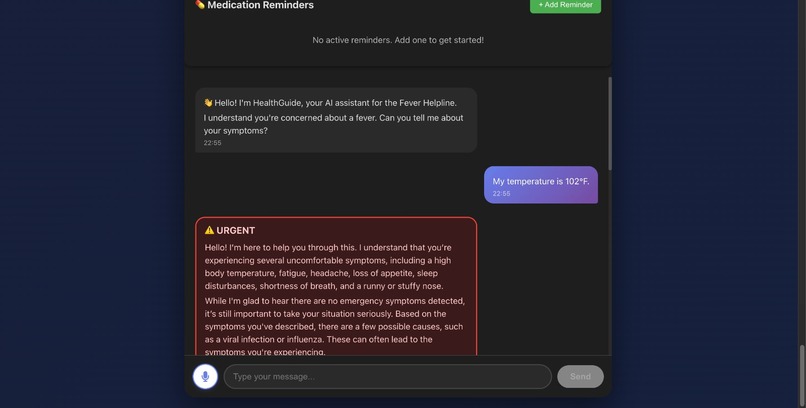
LLM Response
-
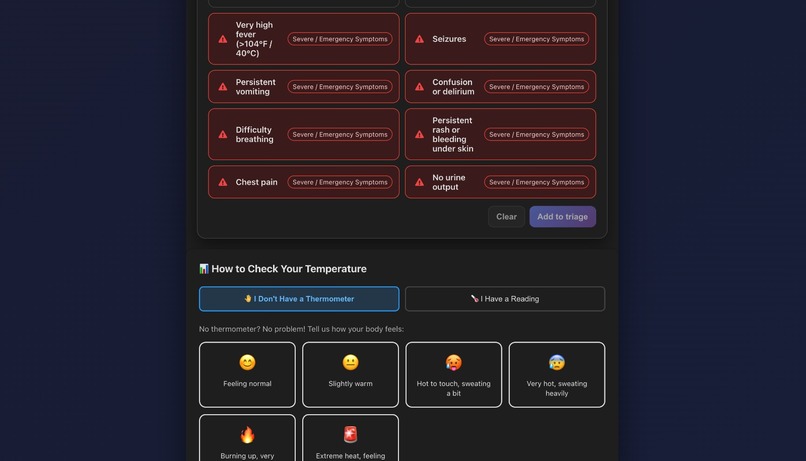
Emergency Symptoms
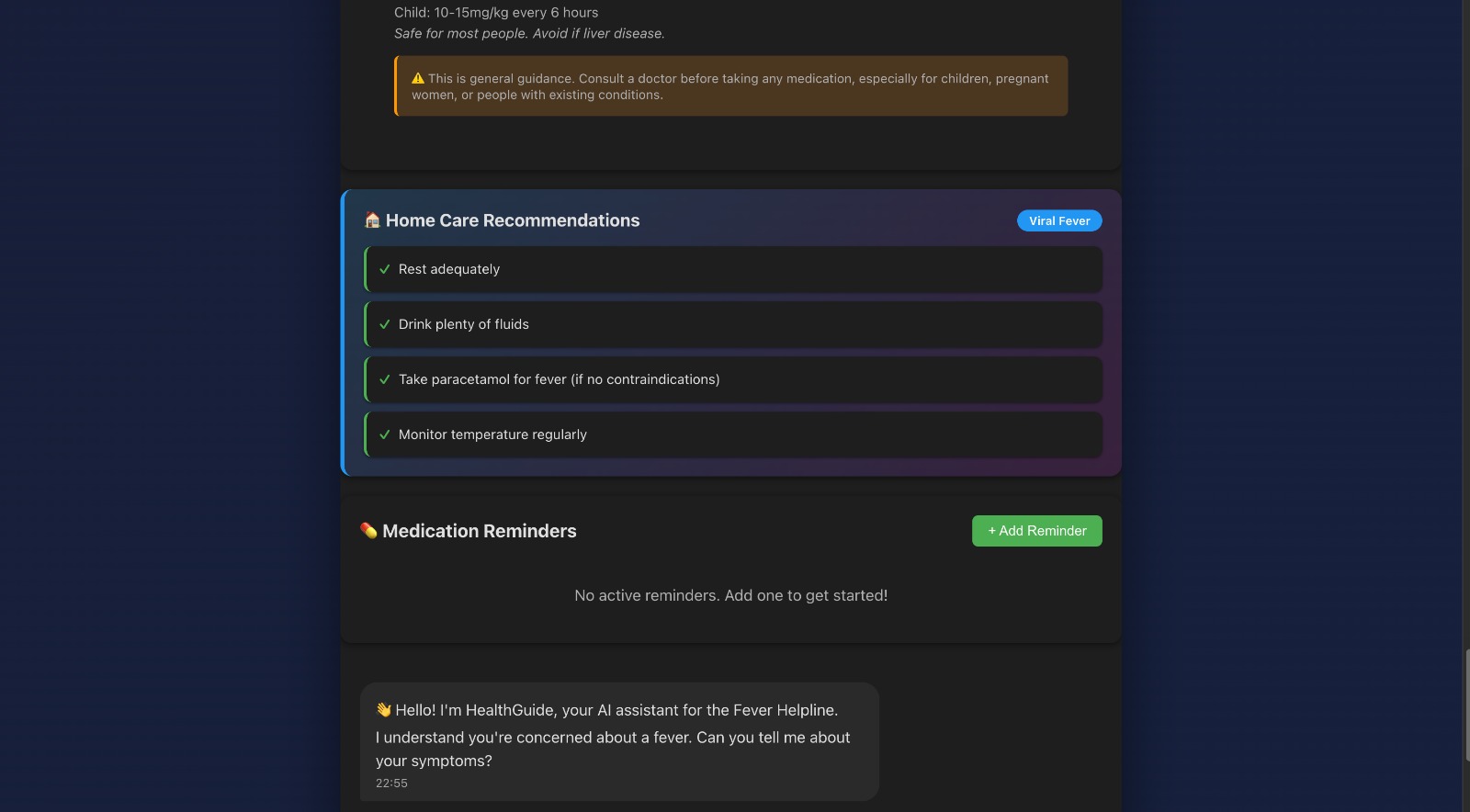
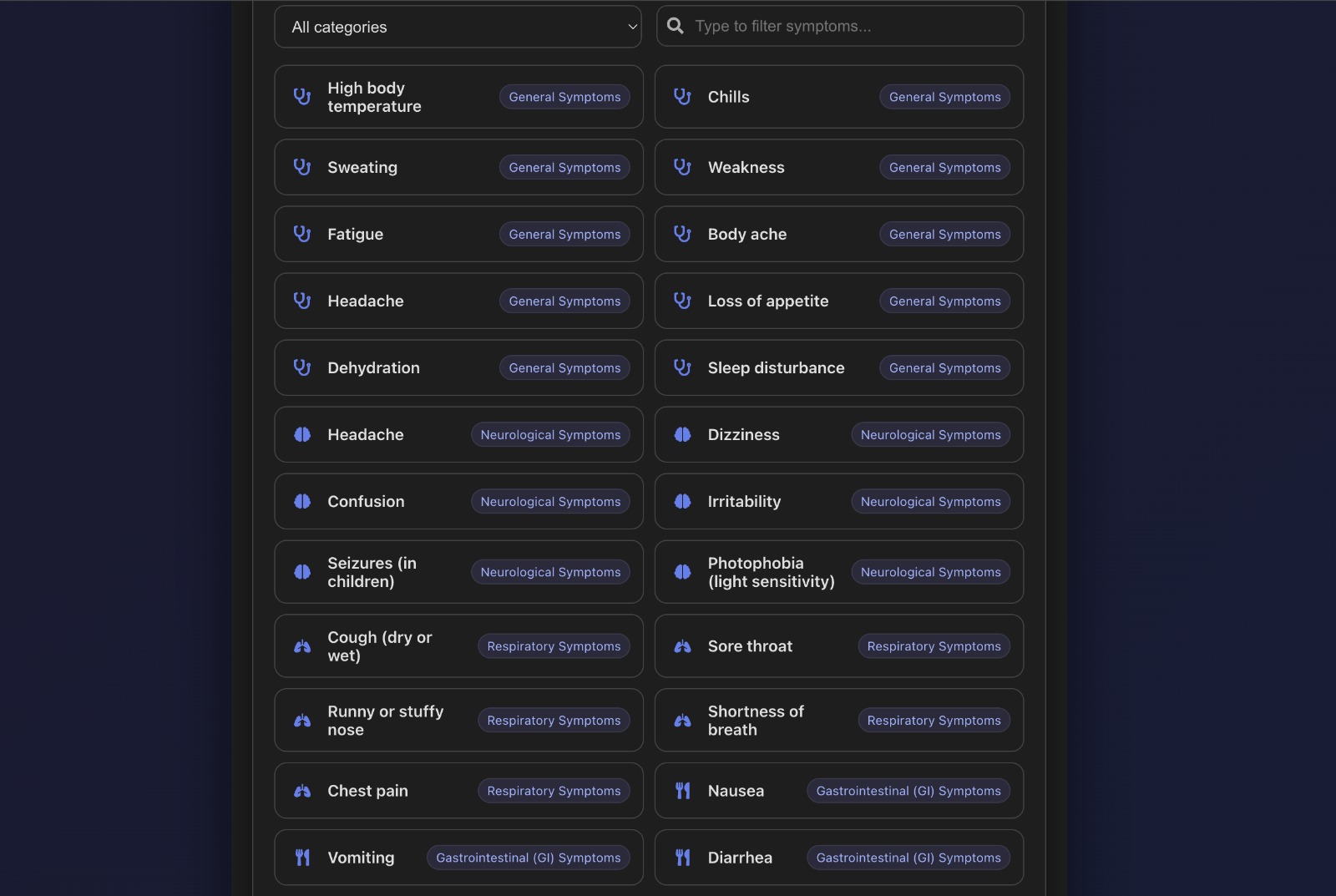
Inspiration
The inspiration for HealthGuide came from a common problem we’ve all faced — when fever strikes, we often turn to Google or unreliable online sources for help. This leads to confusion, anxiety, and sometimes dangerous self-medication. We wanted to create a platform that could provide: Accurate health guidance, not random internet advice. Empathetic, AI-driven conversations, not clinical coldness. Accessible healthcare support, available in multiple languages. Our motivation was simple — make healthcare guidance instant, trustworthy, and inclusive.
What it does
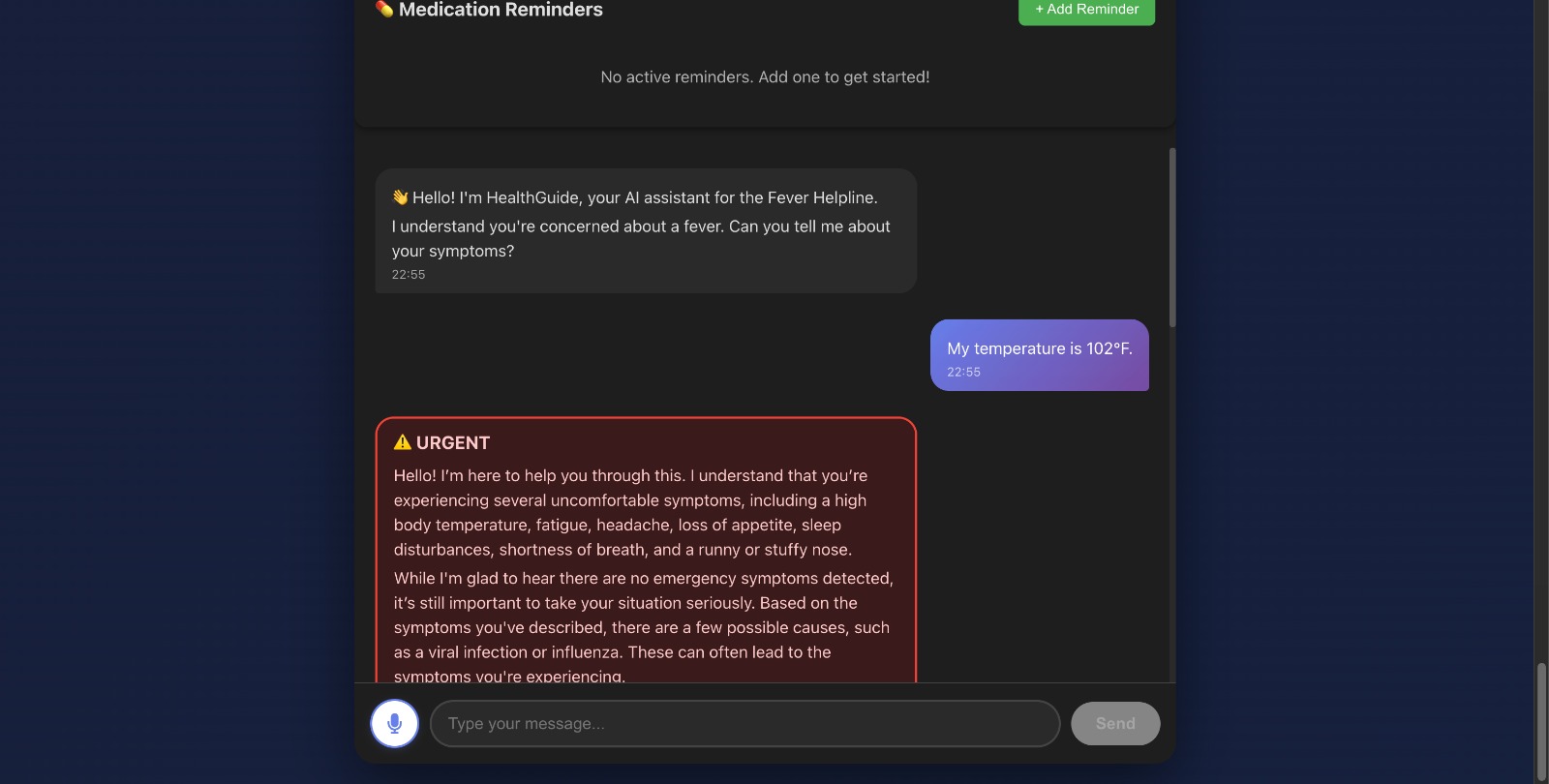
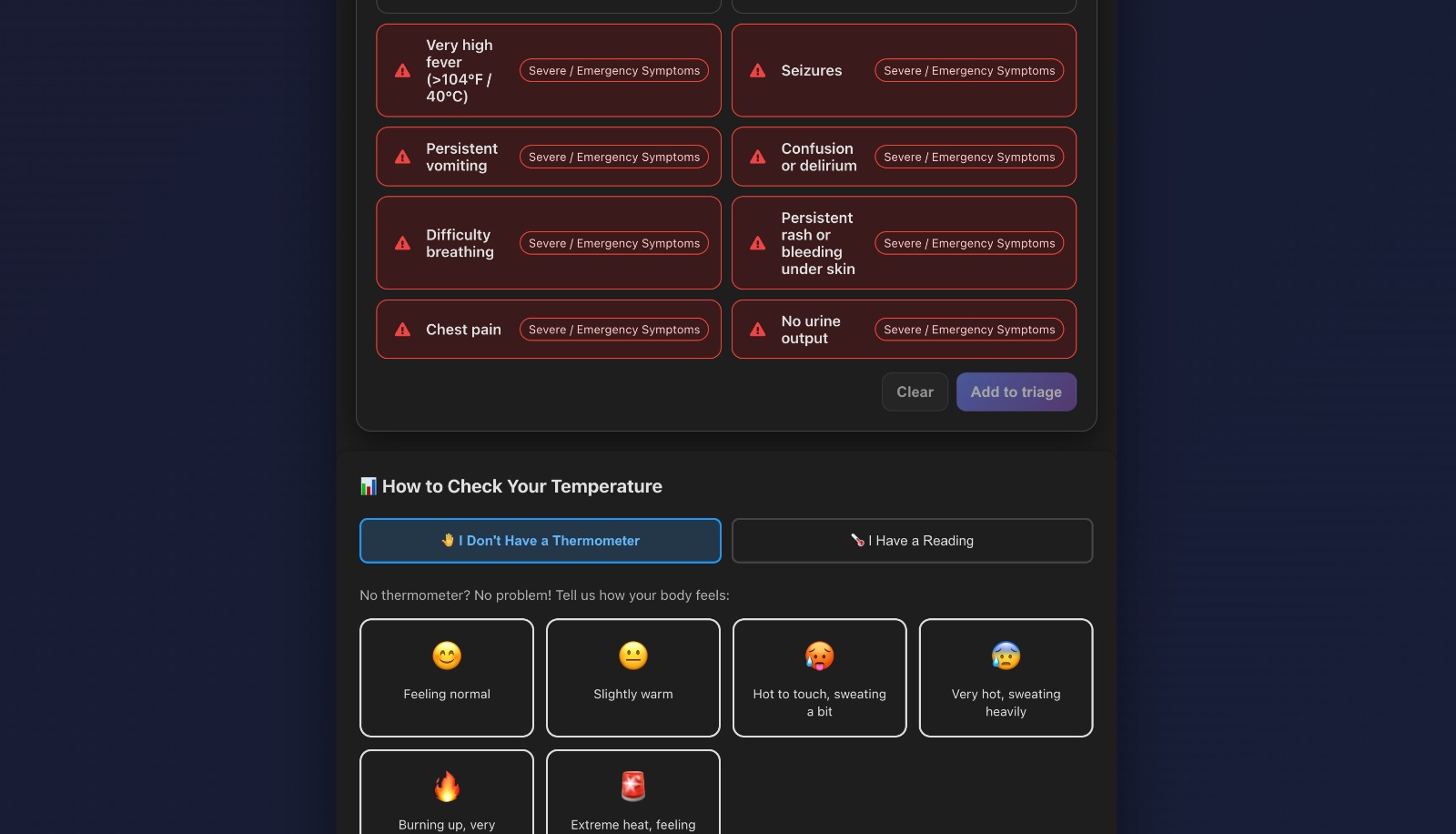
HealthGuide is an AI-powered fever helpline that: Analyzes user symptoms using LLM-based triage (OpenAI/Gemini). Detects red flag emergencies and provides urgent care instructions. Suggests probable fever-related causes (like Dengue, Viral Fever, etc.). Connects users to nearby hospitals, clinics, and pharmacies. Supports English, Hindi, and Spanish, with a clean, responsive UI.
How we built it
We divided our system into four main layers — each handled collaboratively across our team: Frontend (React + Vite): Designed an intuitive chatbot UI with message flows, language selector, and real-time updates. Backend (FastAPI): Built REST APIs for triage, session management, and provider location lookup. AI Engine (OpenAI/Gemini): Integrated LLM models for context-aware fever assessment and red flag detection. Data & Research Layer: Curated fever-related datasets and defined symptom–disease mappings to support AI reasoning. THE MATHEMATICS WE HAVE BUILT IT ON: % 1)Triage Scoring Function [ T_{score} = f(X_{symptoms}, C_{context}, L_{language}) ] % X_symptoms = input vector of symptoms % C_context = conversation context (previous messages) % L_language = selected user language % f(.) = AI model (LLM) triage function
% 2)Emergency Detection Probability [ P_{emergency} = \sigma(WX + b) ] % σ = Sigmoid activation function % W = Weight matrix for red-flag features % X = Encoded symptom vector % b = Bias term
% 3) Final Decision Rule for Triage Level [ Triage_{level} = \begin{cases} \text{EMERGENCY}, & \text{if } P_{emergency} \geq \tau_1 \ \text{URGENT}, & \text{if } \tau_2 \leq P_{emergency} < \tau_1 \ \text{SELF_CARE}, & \text{otherwise} \end{cases} ] % τ₁ and τ₂ = threshold values defining decision boundaries
% 4) Disease Probability Distribution (Softmax) [ P(D_i | X) = \frac{e^{z_i}}{\sum_{j=1}^{n} e^{z_j}} ] % Computes the probability of disease Dᵢ given symptoms X % zᵢ = model logits (disease scores)
% 5) Provider Recommendation Distance (Haversine Formula) [ d = 6371 \times \arccos \left( \cos(\phi_1)\cos(\phi_2)\cos(\lambda_2 - \lambda_1)
- \sin(\phi_1)\sin(\phi_2) \right) ] % d = distance in km % φ₁, φ₂ = latitudes % λ₁, λ₂ = longitudes % 6371 = Earth's radius (in km)
% 6)Overall AI Response Function [ Response = \text{LLM}\left( Prompt_{system} + Context_{user} + Symptoms_{encoded} \right) ] % LLM = Large Language Model generating the response % Combines system prompt, user context, and encoded symptom data
Challenges we ran into
Balancing AI flexibility with medical safety: Ensuring LLM outputs were helpful yet non-diagnostic. Prompt engineering complexity: Making the LLM interpret symptoms correctly across different languages. Data reliability: Curating medically valid datasets without direct clinical supervision. Time constraints: Integrating frontend, backend, and AI layers efficiently within deadlines. Multilingual consistency: Keeping translations medically accurate and contextually empathetic.
Accomplishments that we're proud of
Successfully built a real-time AI triage assistant from scratch. Integrated OpenAI and Gemini models with FastAPI seamlessly. Designed a responsive multilingual chat interface with emergency detection logic. Achieved a working prototype capable of identifying 7+ fever-related conditions. Created a solution that’s both technically robust and socially impactful.
What we learned
Deepened our understanding of LLM prompt design and context management. Learned how to build secure and scalable APIs with FastAPI. Improved our skills in team collaboration, system design, and healthcare research. Understood how AI, UX, and data engineering come together to form real-world solutions. Realized that empathy in healthcare technology is just as important as accuracy.
What's next for HealthGuide
Voice & WhatsApp Integration: Allow users to talk or text naturally with HealthGuide. Telemedicine Expansion: Connect users directly with verified doctors. Medication Reminder System: Automate follow-ups and reminders. Image-based Symptom Detection: Use AI to analyze rashes or visible symptoms. Public Health Analytics Dashboard: Aggregate anonymized data for outbreak detection. Globalization: Expand support to 10+ languages and region-specific disease data.
Built With
- aiagent
- and-google-places-api-for-a-scalable
- docker
- fastapi
- figma
- google-gemini
- healthcare
- multilingual
- openai-gpt
- postgresql
- react
- render
- vercel


Log in or sign up for Devpost to join the conversation.