HealthGuide AI
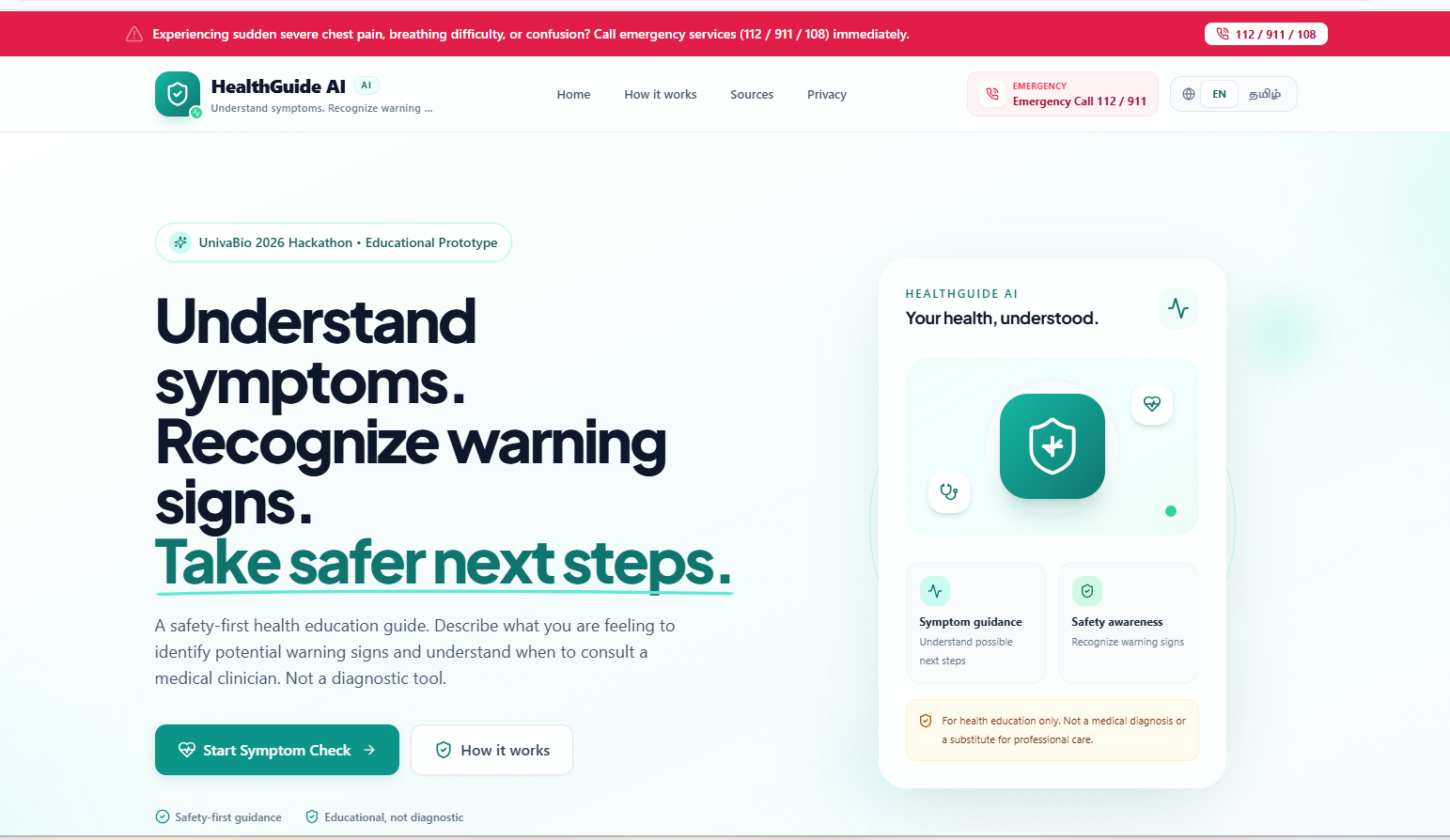
Understand symptoms. Recognize warning signs. Take safer next steps.
Inspiration
When people feel unwell, they often search the internet for answers but struggle to distinguish reliable health information from misleading advice. Language barriers can make this even harder. We wanted to build a health guidance tool that prioritizes safety, explains uncertainty, and helps people understand when professional medical care may be needed.
What it does
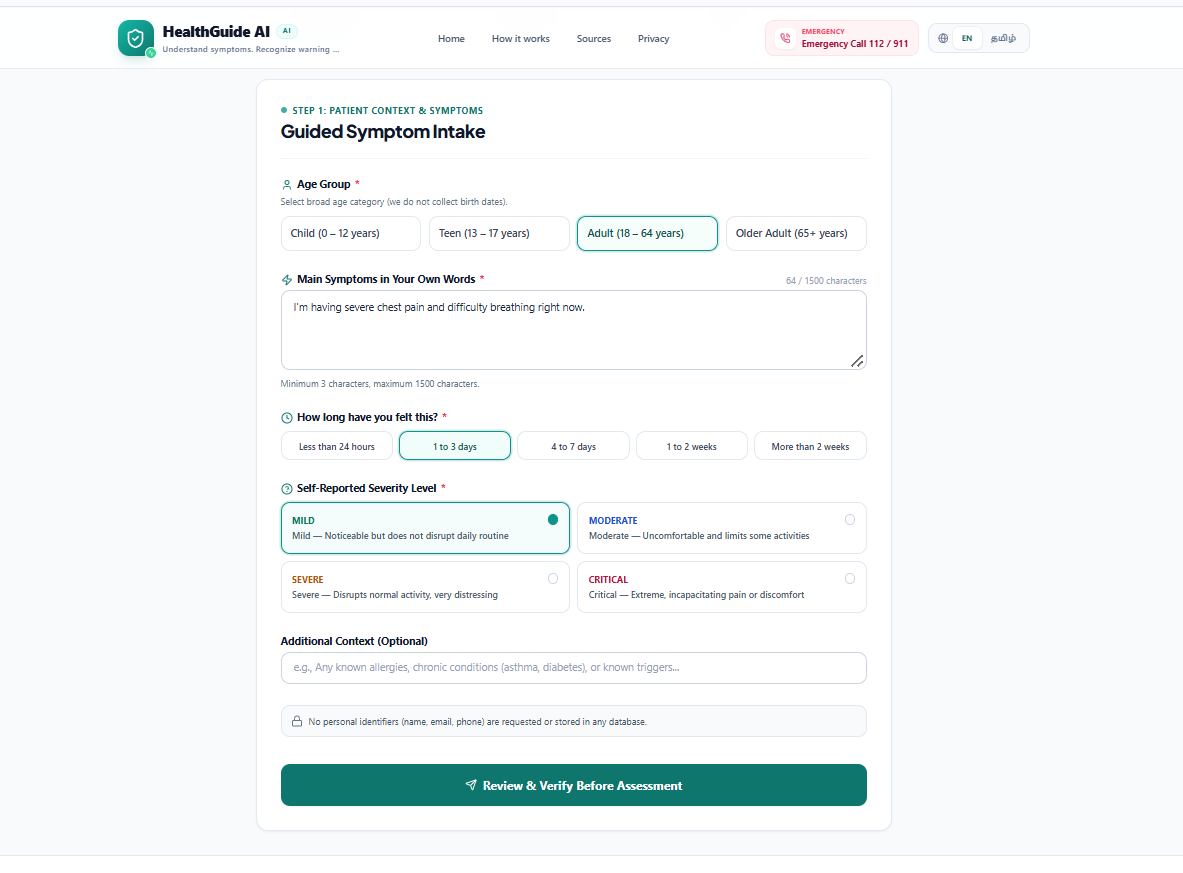
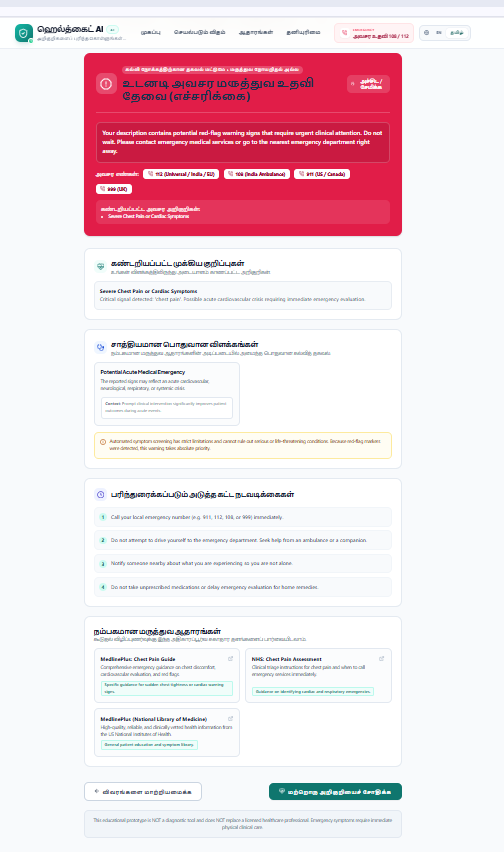
HealthGuide AI is a bilingual, safety-first health information prototype built for the UnivaBio 2026 hackathon. It allows users to describe their symptoms, checks for selected potential emergency warning signs, and provides general educational guidance about appropriate next steps.
The application supports English and Tamil, making its interface and safety messages more accessible to users who prefer either language.
Key features
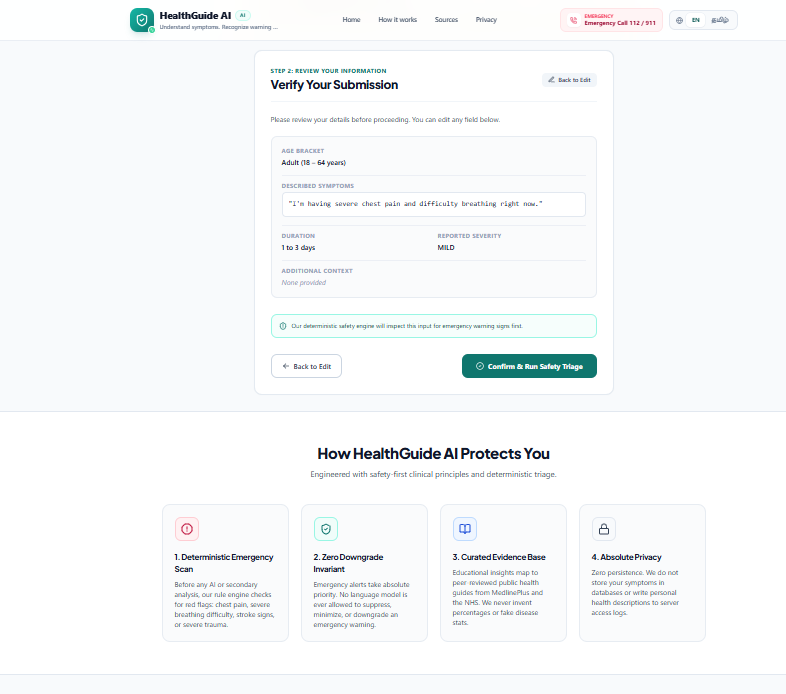
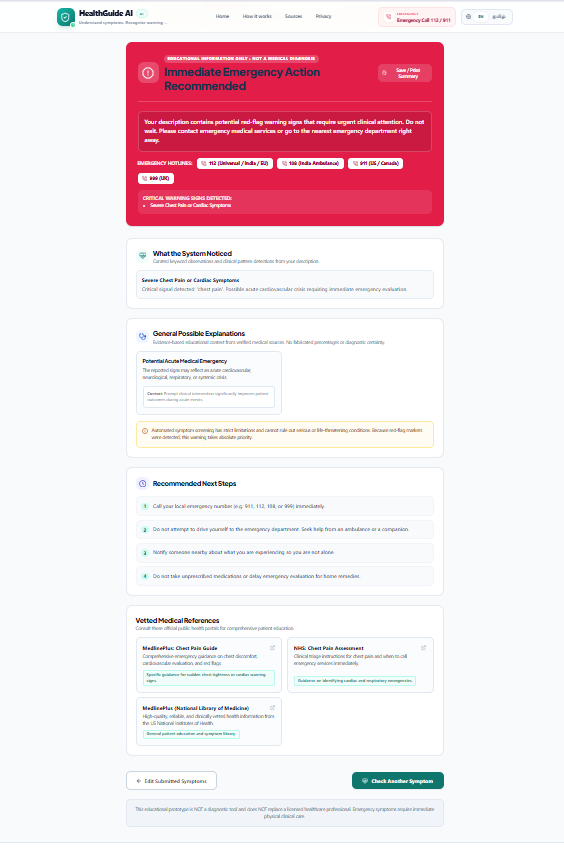
- Safety-first emergency screening: A deterministic rule engine checks for selected warning signs before optional AI processing.
- Emergency priority: Detected emergency warning signs cannot be downgraded by the user's selected severity or optional AI output.
- Explainable guidance: The application presents general information and acknowledges uncertainty instead of inventing diagnoses or disease probabilities.
- Bilingual accessibility: English and Tamil support for a more inclusive user experience.
- Trusted references: Links to MedlinePlus and NHS health information resources.
- Privacy-conscious design: No login or database is required for the core prototype, and the application is designed to avoid logging raw symptom descriptions.
- Automated testing: The backend currently passes 21 automated tests covering input validation, emergency rules, safety priority, privacy logging, fallback behavior, and Tamil guidance.
How we built it
The frontend uses React, Vite, TypeScript, Tailwind CSS, and Lucide icons. The backend uses Python, FastAPI, and Pydantic for API handling and input validation.
A deterministic safety engine evaluates selected emergency warning signs before routine educational processing. If an emergency pattern is detected, the application prioritizes urgent-care guidance rather than continuing with ordinary self-care recommendations. Optional AI integration can support general explanations, while the core application remains usable without a paid AI API key.
Challenges and learning
One of our main challenges was designing an AI-assisted health experience that does not create false reassurance. We addressed this by separating emergency screening from optional AI processing, validating user input, providing an ambiguous-result pathway, and testing safety-priority behavior.
Building this project reinforced the importance of transparent limitations, privacy-conscious engineering, accessible language, and testing safety-critical software beyond its visual interface.
Health impact
HealthGuide AI aims to help people understand health information more clearly, recognize selected warning signs, and identify when professional medical attention may be appropriate. Its bilingual approach is intended to reduce language barriers in accessing general health education.
Limitations and responsible use
HealthGuide AI is an educational hackathon prototype, not a clinically validated diagnostic or triage system. Its rule set is limited and may miss emergencies or unusual presentations. It cannot confirm that someone is safe, replace professional assessment, or provide a definitive diagnosis. Users should never delay emergency care while using the application.
Future improvements
Future work could include evaluation with qualified healthcare professionals, broader language testing, improved accessibility, more comprehensive reviewed medical content, and formal validation of the safety rules before any real-world clinical use.
Built for UnivaBio 2026 — Artificial Intelligence for Human Health.
Built With
- artificial-intelligence
- fastapi
- healthcare
- natural-language-processing
- pytest
- python
- react
- rest-api
- tailwind-css
- typescript
- vite


Log in or sign up for Devpost to join the conversation.