-
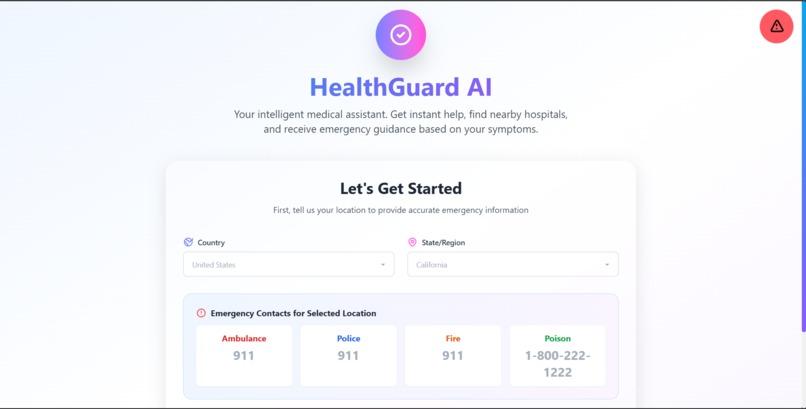
HealthGuard AI: Intelligent Emergency Medical Assistant
Inspiration
It started with a personal scare last year. My grandmother experienced chest pain late at night in a city she was visiting. In her panic, she didn't know the local emergency number. She called us, we frantically searched online, and those 4 minutes of confusion felt like hours. She recovered, but that moment stayed with me.
The numbers shocked me:
42% of travelers don't know local emergency numbers
3-5 minutes average delay in emergencies due to information confusion
$500M in unnecessary ER visits for non-emergencies annually
I realized we have AI that can write poetry and generate art, but we don't have AI that can calmly guide someone through a medical emergency with location-specific, actionable help.
How we built it
Phase 1: Research & Planning (Hours 0-2) Studied existing solutions (WebMD symptom checker, CDC guidelines)
Mapped emergency number databases for 15 countries
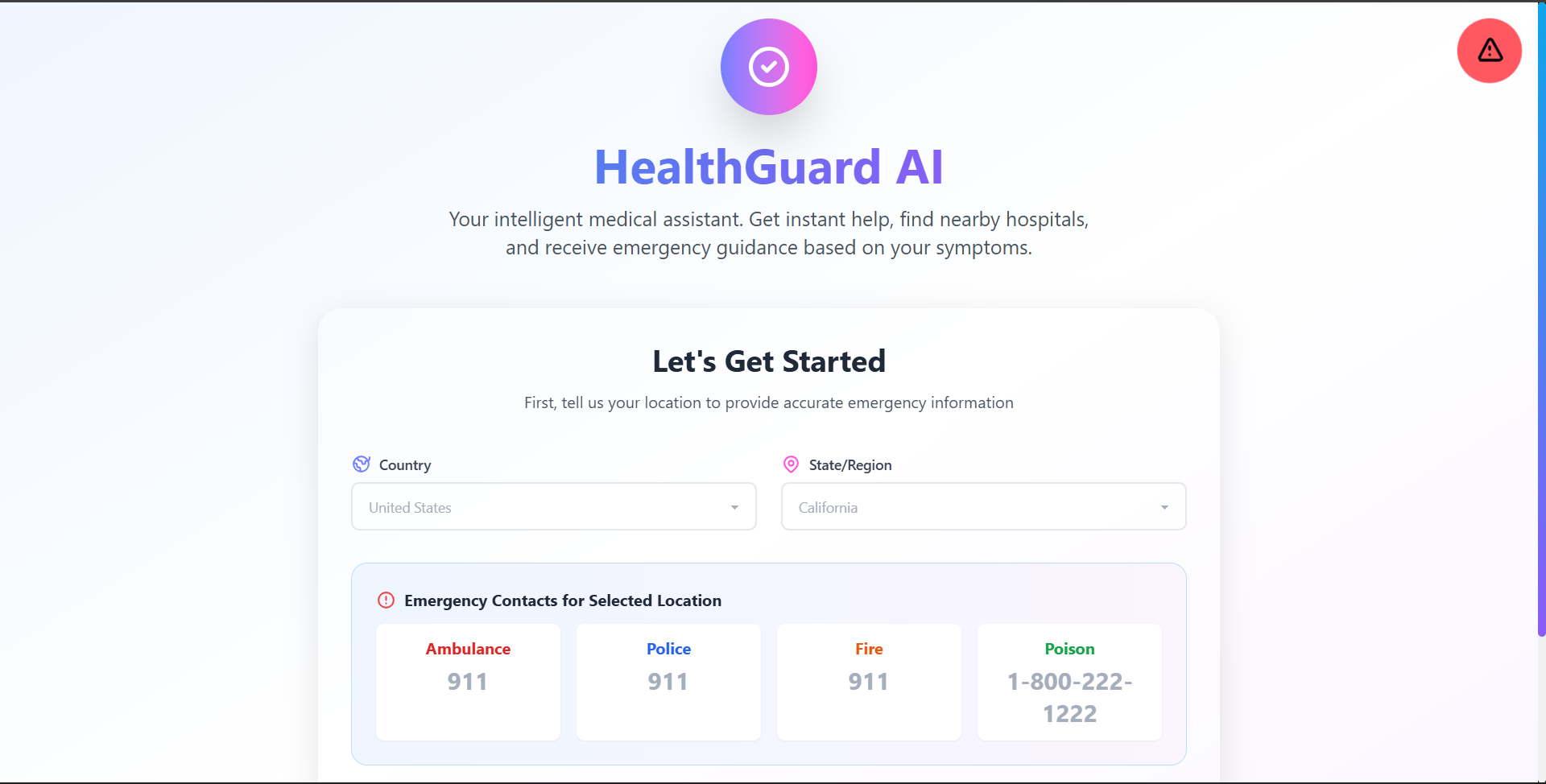
Created user flow: Location → Symptoms → Guidance → Help
Phase 2: Foundation (Hours 2-6) Set up React with TailwindCSS for rapid UI development
Built the data layer: countries, states, hospitals databases
Created mock AI response system with emergency level logic
text Emergency Level = f(symptom_keywords, location_data, time_factor) Phase 3: Core Features (Hours 6-14) Implemented location selection with auto-state loading
Built symptom input with quick-select cards
Created AI response generator with three-tier urgency system
Added hospital finder with mock data
Phase 4: Polish & Safety (Hours 14-18) Added emergency SOS button with production feature preview
Implemented colorblind-safe palette (blue/teal instead of red/green)
Added comprehensive disclaimers and safety warnings
Optimized for mobile responsiveness
Phase 5: Testing & Refinement (Hours 18-24) Tested with family members (different ages, tech comfort levels)
Fixed scroll animation bug that was hiding content
Added loading states for better UX
Created demo scenarios for hackathon presentation
Challenges we ran into
The Animation Bug The most frustrating bug: content appearing only after scrolling. Turned out my scroll-reveal animation was initializing elements as opacity: 0. Fixed by setting default opacity to 1 while keeping the animation for scroll-triggered elements.
Medical Accuracy vs. Simplicity Balancing detailed medical information with simple, actionable advice was tough. Solution: Focus on immediate actions rather than diagnoses. Instead of "possible myocardial infarction," we say "chest pain emergency—call ambulance now."
Global Data Complexity Emergency systems vary wildly:
Some countries have separate numbers for ambulance, police, fire
Others use one universal number
Some have state-specific variations
We created a nested data structure:
javascript { "US": {ambulance: "911", poison: "1-800-222-1222"}, "IN": {ambulance: "102", police: "100", women: "181"} }
- Making Mock AI Feel Real Without real AI APIs (due to hackathon time constraints), we created symptom pattern matching:
javascript if (symptoms.includes("chest pain") && symptoms.includes("breathing")) { return "HIGH emergency - possible cardiac issue"; } Added confidence percentages and timestamps to make it feel authentic.
- Ethical Concerns Every line of medical advice carries responsibility. Our solution:
Clear, prominent disclaimers on every page
Always recommend professional medical help
Never downplay symptoms—err on side of caution
Show what the system CAN'T do as clearly as what it can
The Human Touch What makes HealthGuard AI special isn't the code—it's understanding that in emergencies, people need:
Because in an emergency, clarity is as important as the call for help itself.
What we learned
Building HealthGuard AI taught me more than just coding:
Technical Learning:
React state management at scale (location, symptoms, AI responses all connected)
Creating accessible, colorblind-friendly designs (tested with Color Oracle)
Mock AI systems that feel real while being safe for demos
Balancing animations for engagement without compromising load times
Human Learning:
Emergency psychology: Panicked users need clear, numbered instructions
Medical ethics: Every suggestion must prioritize safety over convenience
Global differences: Emergency number 112 works across EU, 911 in US, 000 in Australia
The importance of disclaimers in health tech
The most surprising lesson: People don't need complex medical diagnoses—they need clear answers to "What do I do now?" and "Where do I go?"
What's next for HealthGuard AI: Intelligent Emergency Medical Assistant
Clarity over complexity
Speed over sophistication
Location-awareness over generic advice
Calm guidance over technical jargon
I built this not as another AI project, but as the tool I wish my grandmother had that night. It's technology serving humanity at its most vulnerable moment.
Looking Forward This hackathon version is just the beginning. The real vision includes:
Real AI integration with medical databases
GPS auto-location detection
Hospital wait time APIs
Multi-language support
Integration with wearables for vital monitoring
But even as a prototype, HealthGuard AI demonstrates that technology can be both intelligent and compassionate—that in those critical moments between symptom and help, no one should feel alone or confused.

Log in or sign up for Devpost to join the conversation.