-
-
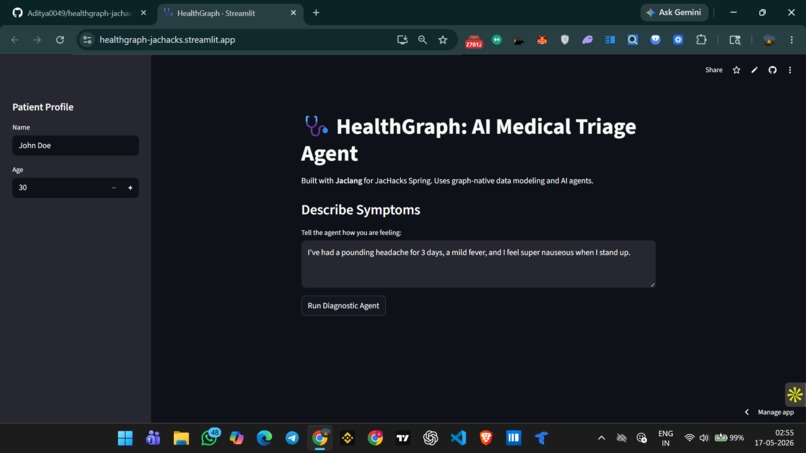
start
-
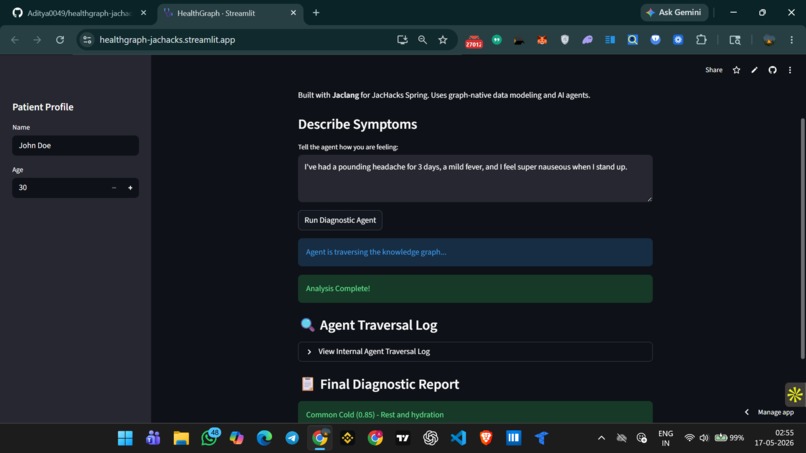
processing data
-
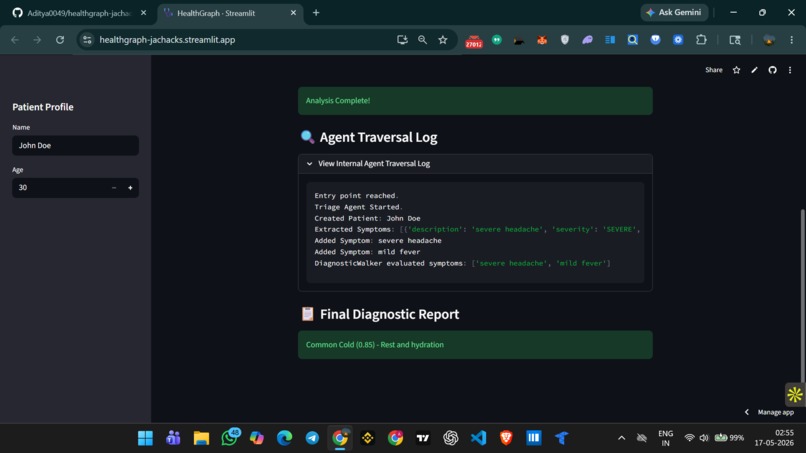
Result
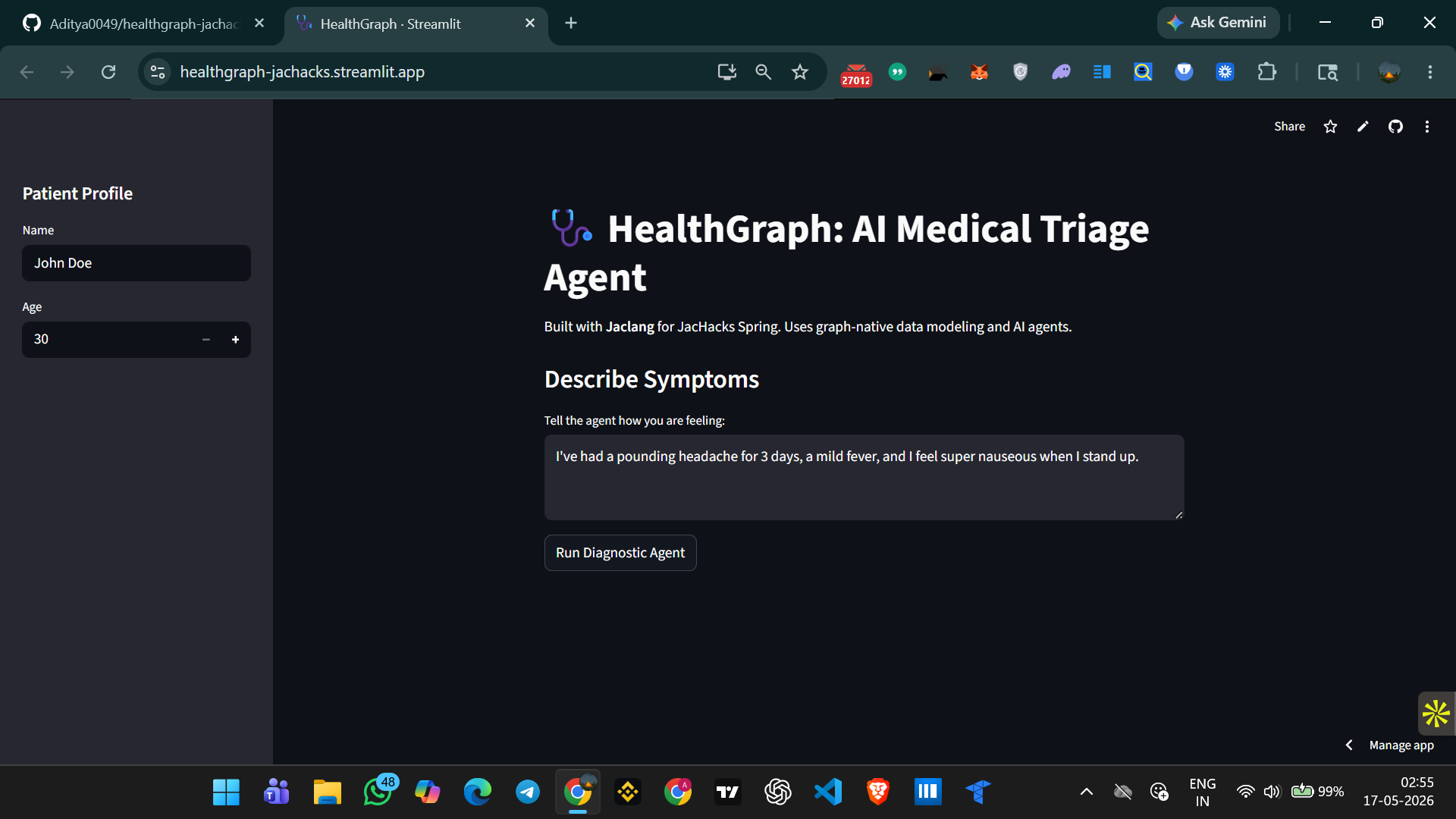
💡 Inspiration
Healthcare triage today is incredibly rigid. Patients are forced into drop-down menus or simple keyword searches that completely miss the nuances of human pain and experience. We wanted to build a system that listens to a patient’s natural, messy description of their symptoms and intelligently maps it out just like a real doctor would. We were inspired by the potential of agentic programming to move beyond simple chatbots and create a living, reasoning architecture for medical diagnostics.
⚙️ What it does
HealthGraph is an autonomous medical triage agent. Instead of a standard UI wrapped around a basic API call, it uses a traversable knowledge graph.
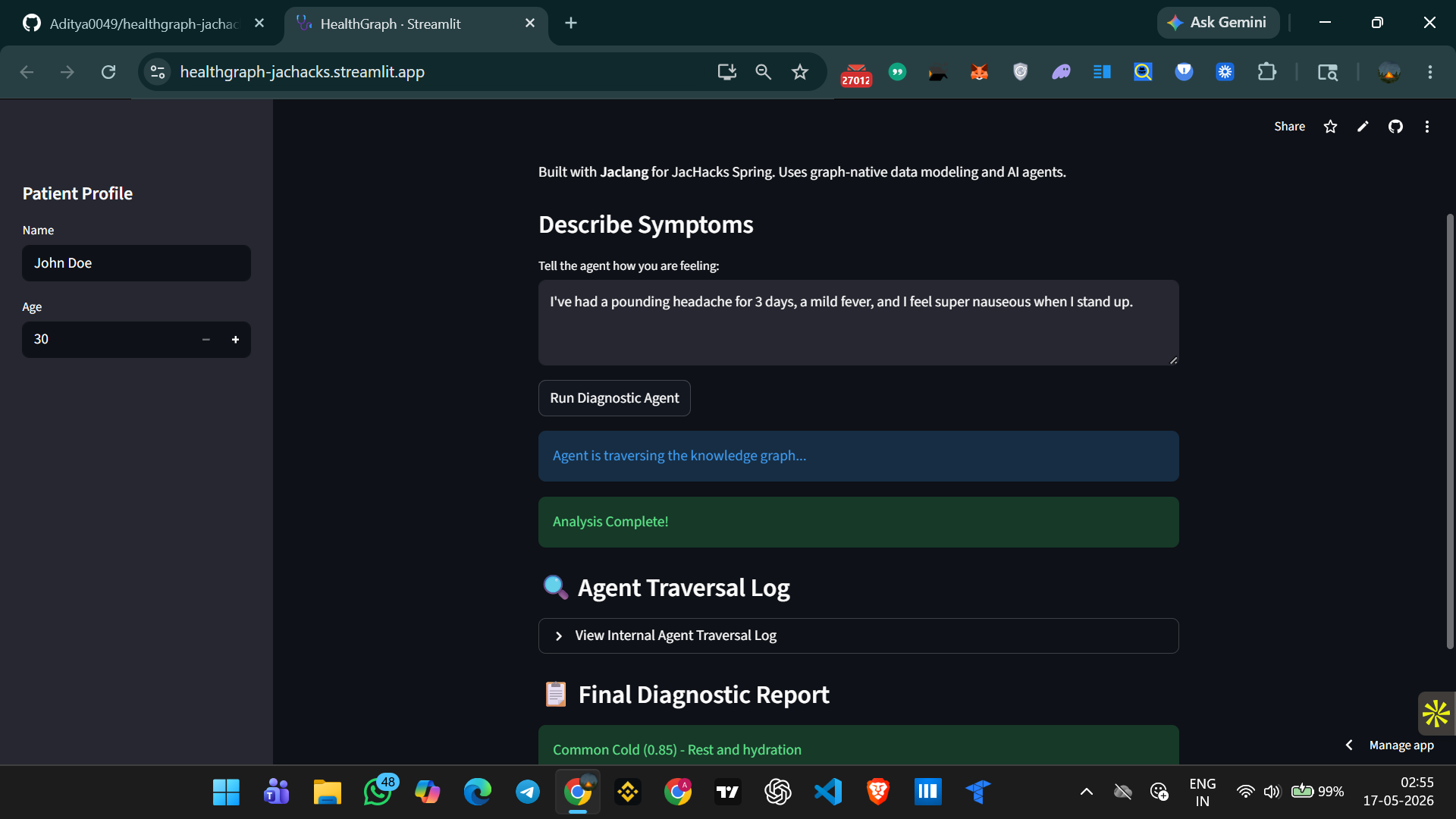
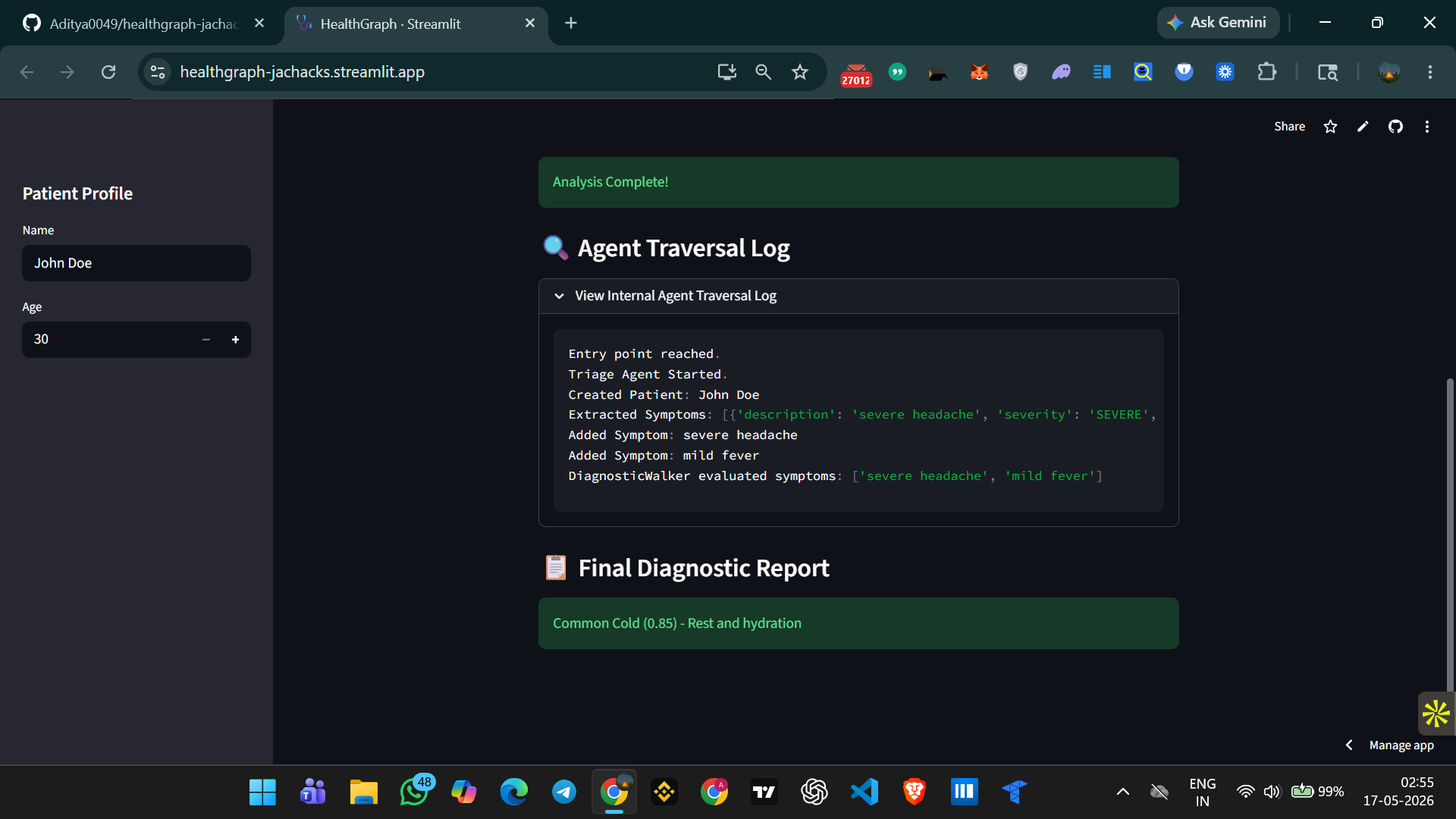
A patient inputs how they are feeling in plain English. The system deploys a TriageAgent walker that parses the text, extracts structured symptoms, and dynamically creates Symptom nodes connected to the Patient node. Then, a DiagnosticWalker traverses this newly formed subgraph, holistically evaluates the symptoms, and generates a highly accurate medical Diagnosis node with confidence scores and recommendations.
🛠️ How we built it
We built HealthGraph using a single-file full-stack architecture powered by Jaclangthe world's first agentic programming language.
- Object-Spatial Programming (OSP): We explicitly modeled the patient journey using graph-native
Nodeobjects (Patient,Symptom,Diagnosis). - Walkers: We deployed autonomous
Walkeragents to navigate the graph and execute logic. - Meaning-Typed Programming: We deeply integrated the
by llm()construct. Instead of writing brittle prompt chains, we let the Jac compiler natively handle the reasoning to extract symptoms and formulate diagnoses. - Frontend: We built a sleek, responsive interface using Streamlit (Python) that seamlessly interfaces with the underlying Jac runtime.
⚠️ Challenges we ran into
Shifting from traditional Object-Oriented Programming (OOP) to Object-Spatial Programming (OSP) was a massive paradigm shift. Learning how to properly instantiate nodes and use spawn to trigger walkers required us to completely rethink how state is managed. Additionally, handling the by llm() constructs natively inside the walkers took some trial and error to ensure the agents were reliably parsing the natural language inputs into strictly typed enum values for severity.
🏆 Accomplishments that we're proud of
We are incredibly proud to have built a true agentic application rather than just an LLM wrapper. By successfully implementing a dynamic graph where walkers autonomously traverse and modify state based on AI reasoning, we proved that AI can be treated as a first-class citizen in software architecture.
🧠 What we learned
We learned the immense power of Jaclang and the Jaseci ecosystem. The ability to abstract away microservices, database management, and prompt engineering directly into the language syntax (jaclang) allowed us to build a highly complex, reasoning AI application in a fraction of the time it would take using traditional tech stacks.
🚀 What's next for HealthGraph
We want to scale the graph! The next step is integrating a massive, pre-existing medical knowledge graph (like SNOMED CT) into the Jaseci ecosystem. We also plan to build out patient history persistence so our DiagnosticWalker can traverse past illnesses and medications to provide highly personalized, longitudinal healthcare triage.
Built With
- jaclang
- jaseci
- knowledge-graph
- llm
- python
- streamlit

Log in or sign up for Devpost to join the conversation.