What it does
GPA. Net worth. Rankings. Nutritional counts. We spend our lives maximizing numbers frivolously sacrificing time and energy to the ends , while we put aside the most important number: longevity.
Many of the diseases that are casual to the majority of deaths are heavily influenced by lifestyle choices we all make years, even decades before the onset of initial symptoms. While most of us would like to live longer, do the things we love for longer, and be around the people we love longer, the urgency to change aspects of our lifestyle is not obvious, nor are they measurable today.
Live life to the fullest, based on the choices you can make today. HealthForward offers a personalized recommendations on steps you can take to reduce your risk for future chronic health issues. Based on simple input data, HealthForward can match your profile to a diverse population model with hundreds of thousands of samples and, using the power of neural networks, predict your risk for common diseases at a later point in life. In addition, we provide suggestions for preventative lifestyle choices that minimize the risk of illness and improve prognosis.
How we built it
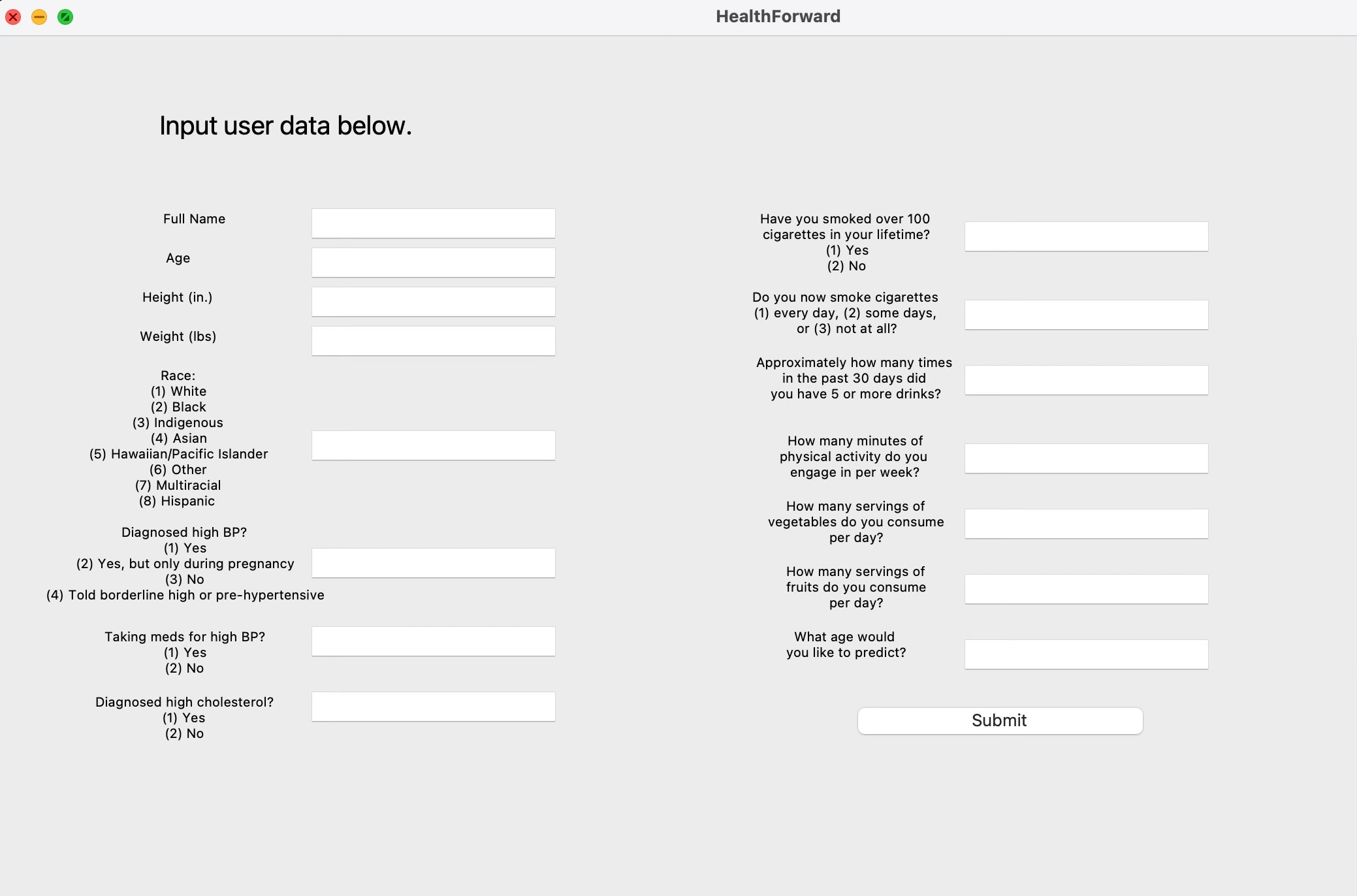
We compiled large sets of data that contained data for various diseases. We proceeded with a vigorous data cleaning, which was then used to train a series of neural networks, which are used to predict the likelihood of a person developing a disease at a later point in their life. As our product is a proof of concept, we formed a simple frontend form that allows users to input a set of attributors and receive a set of risk probabilities of contracting chronic conditions, followed by listed advice that help decrease these probabilities.
Challenges we ran into
This was a novel idea and an ambitious goal to complete. We wracked our heads to figure out how to create an airtight solution to the problem successfully. As with any machine learning problem, finding data, finding ways to integrate InterSystems, and cleaning the data took a significant amount of time. Finding data was made even more challenging by the fact that we spent the first several hours of the competition without wifi, and were therefore unable to search for datasets. We also initially created a React-based frontend to enhance the user experience, but when trying methods to integrate our TensorFlow models and frontend together, we found that these TensorFlow programs were incompatible with all our Macbook M1 processors, which set us with a capital constraint that we had to compromise for to still have a successful proof of concept.
Accomplishments that we're proud of
We successfully trained all the models with high accuracy, and have demonstrated a successful proof of concept for this idea.
What's next for HealthForward
We want to elaborate on our ideas by further training our models to more precisely quantify the effects recommended lifestyle changes could have on the risk of condition development. We also want to increase the number of conditions that we consider, as well as increasing the number of samples we use for model training to push past our current edge case limitations: given our proof of concept, this is something we believe is very achievable with the InterSystems's platforms incredible access to cross system patient data.
Built With
- html5
- intersystems
- javascript
- python
- react
- scikit-learn
- tensorflow

Log in or sign up for Devpost to join the conversation.