-
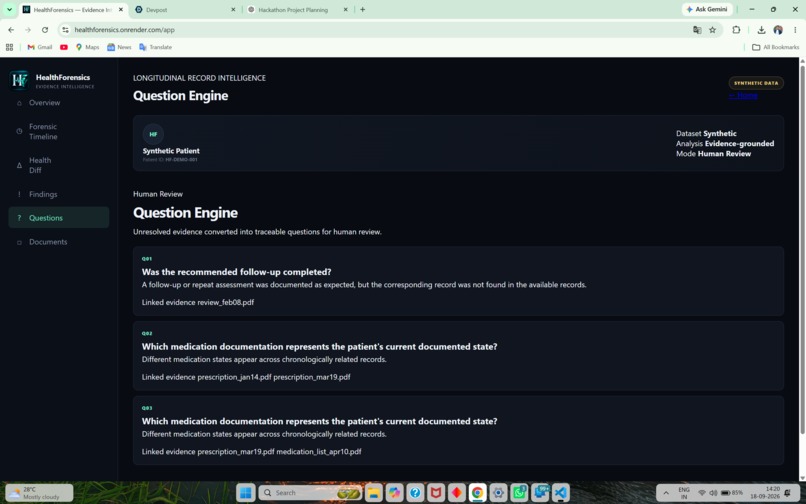
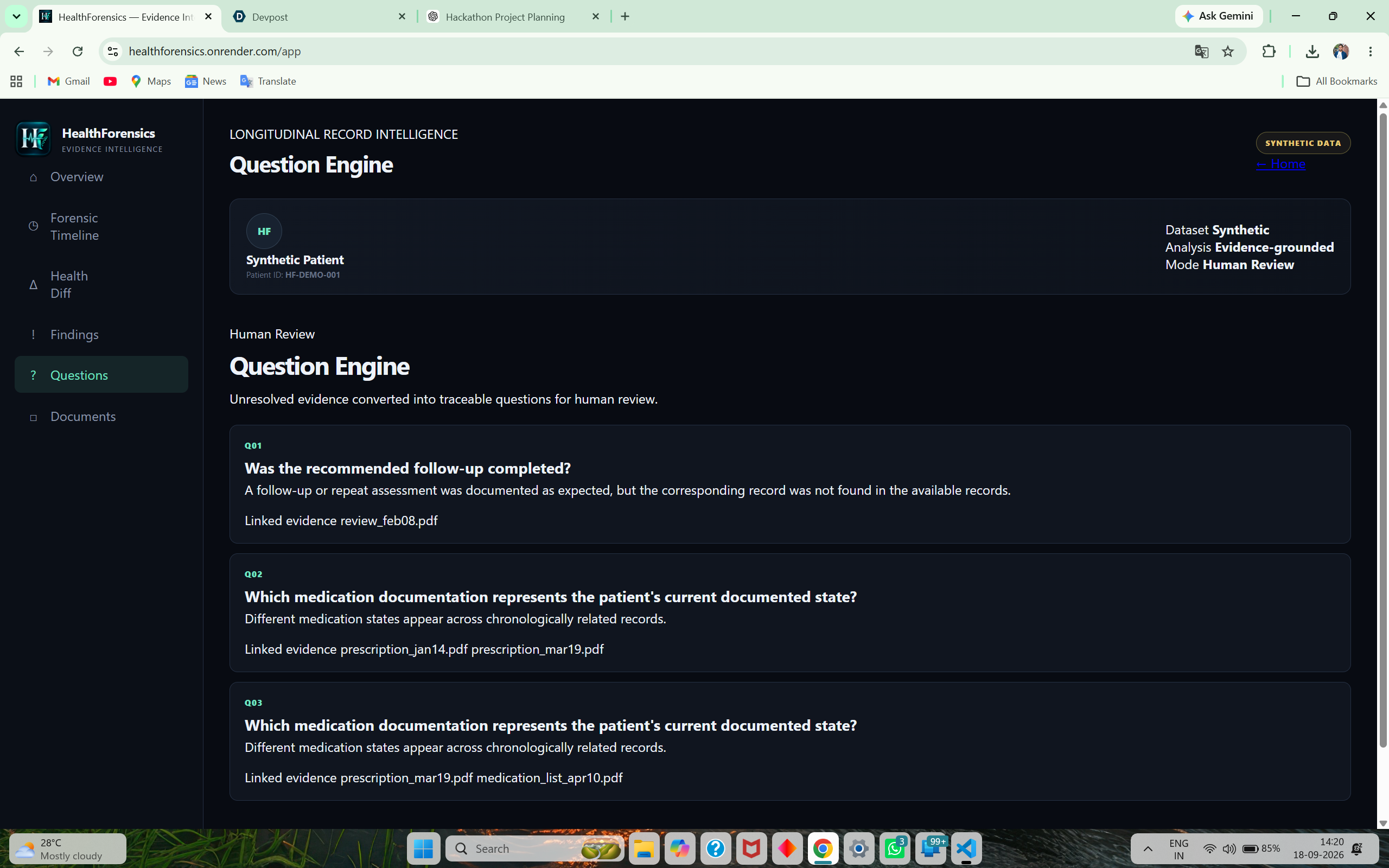
Questions
-
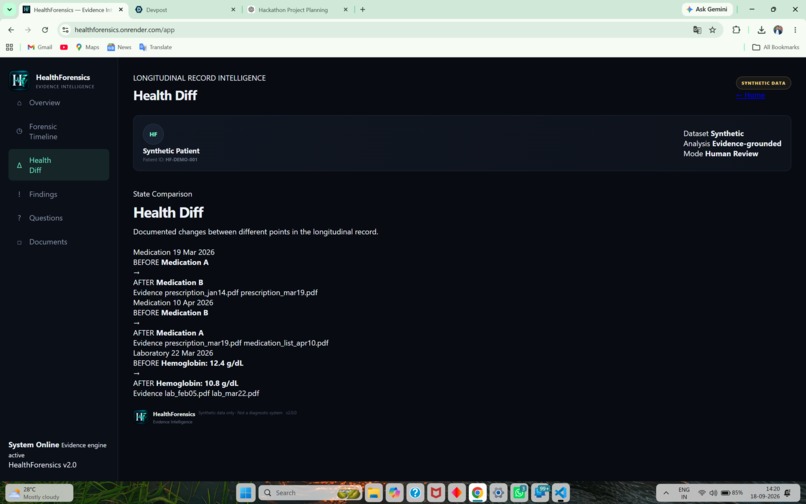
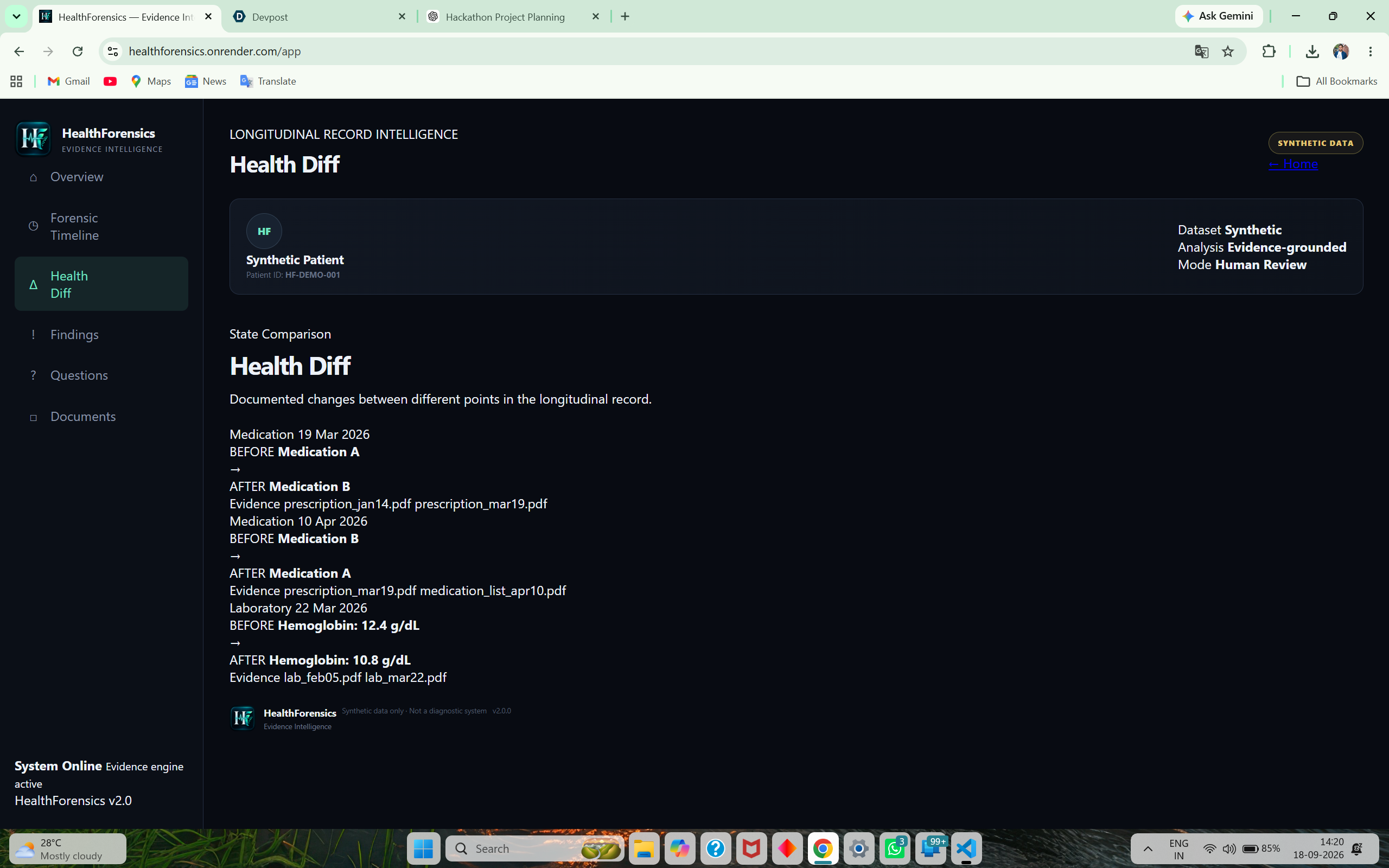
Health Diff
-
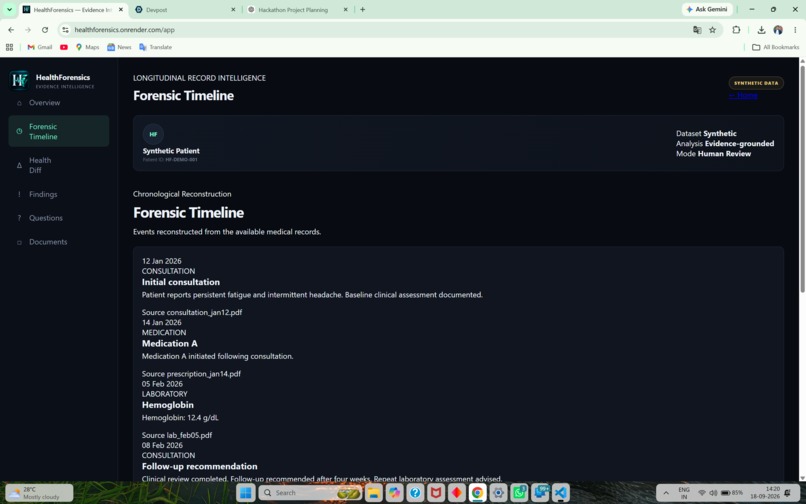
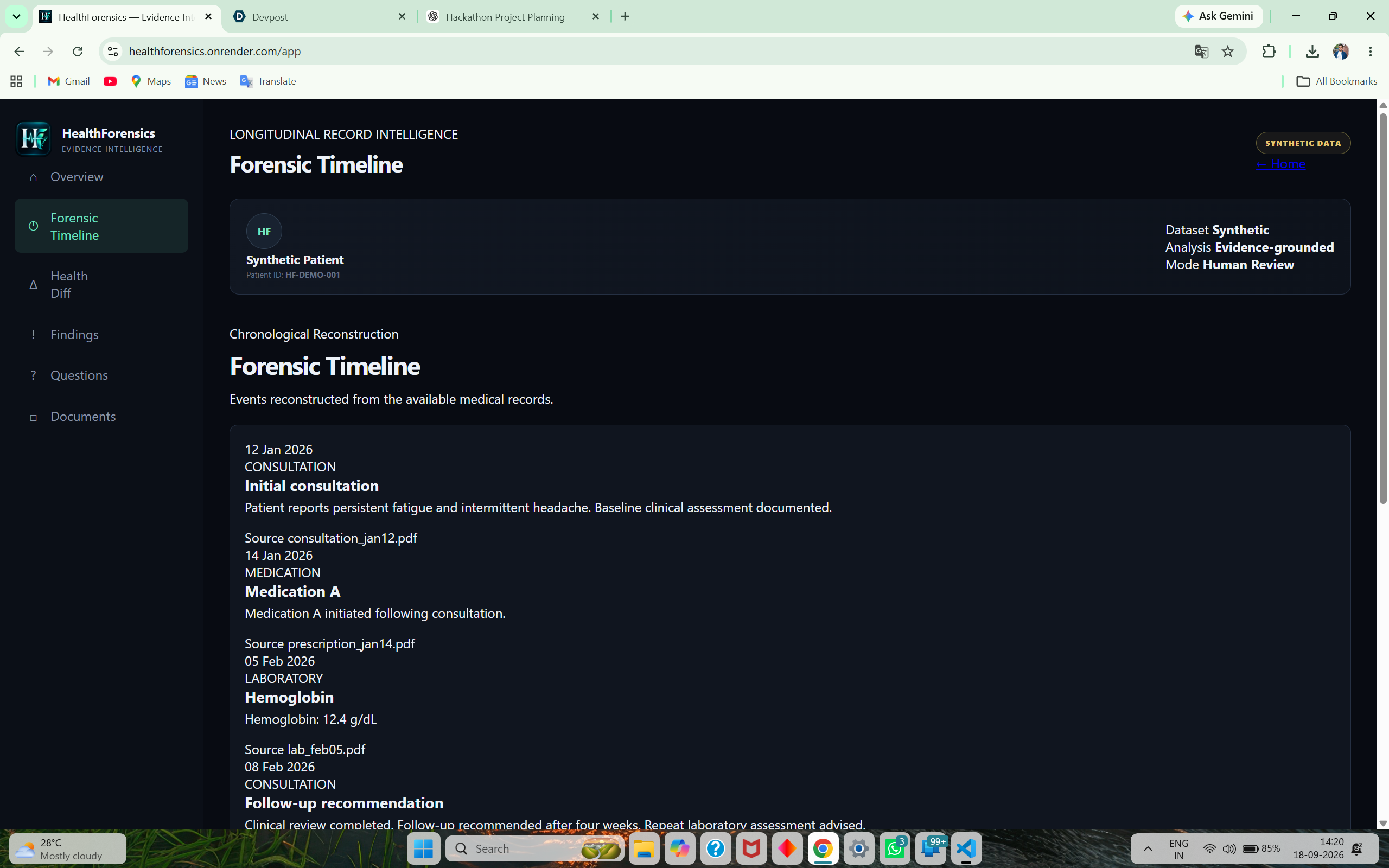
Forensic Timeline
-
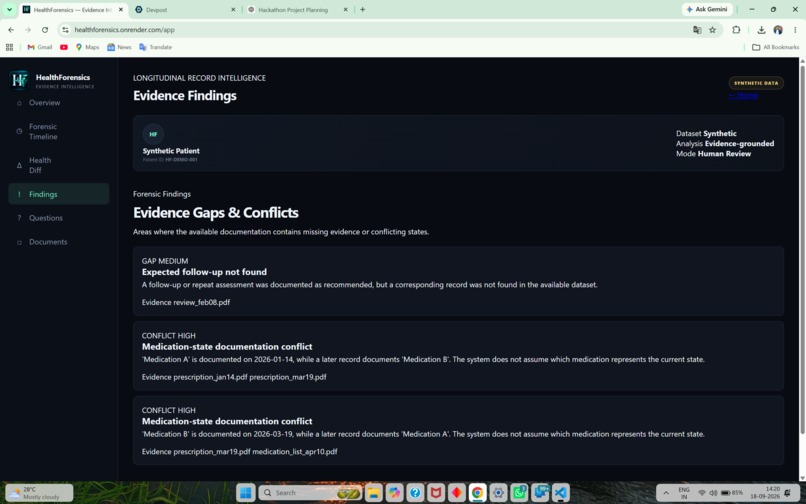
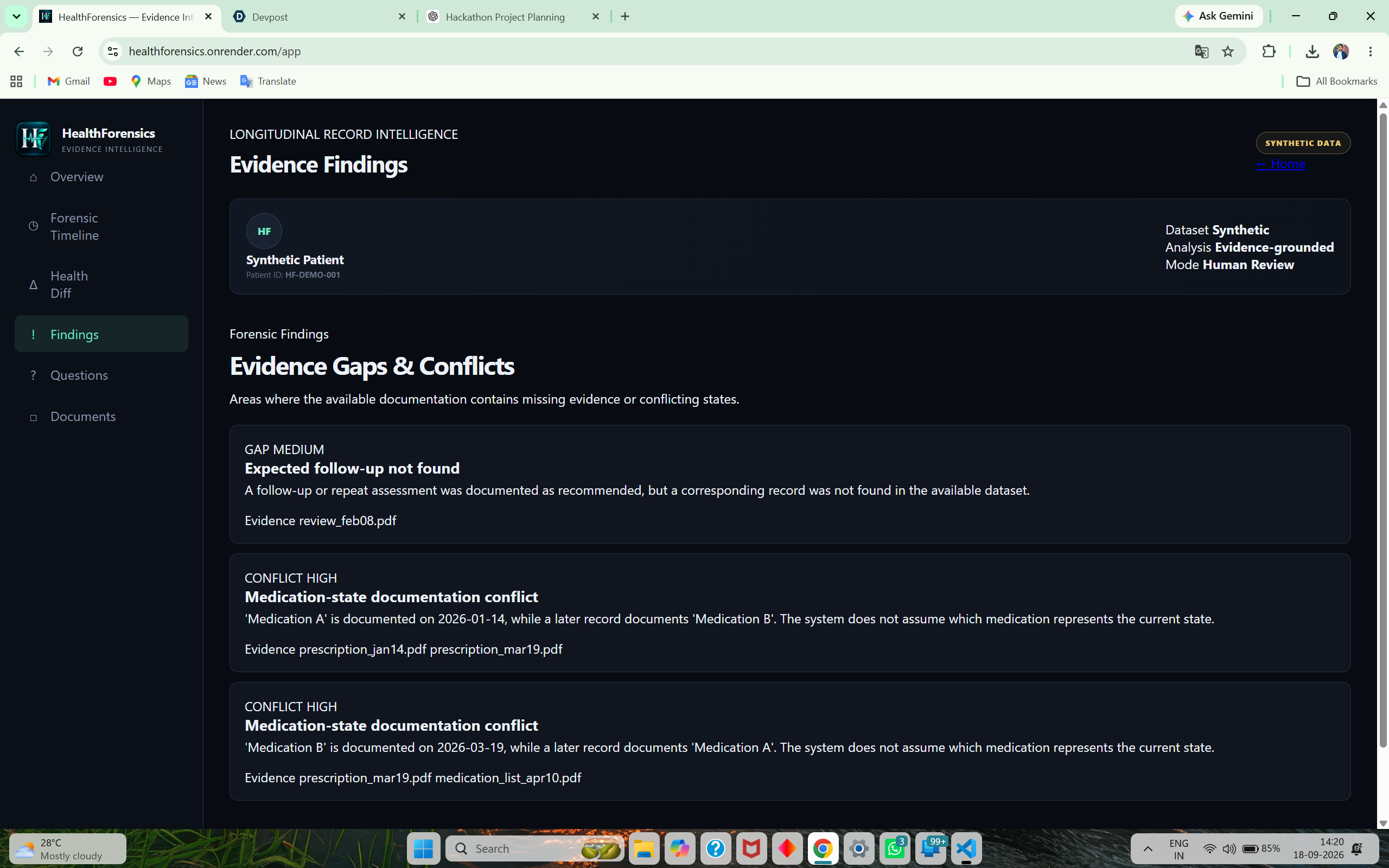
Findings
-
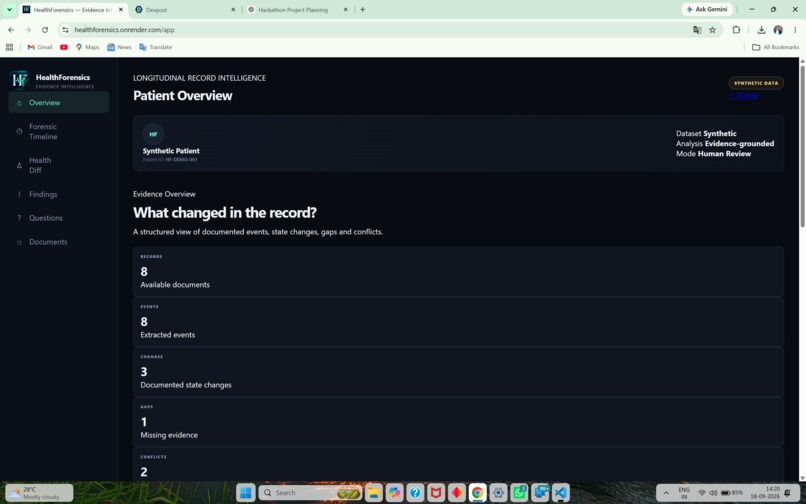
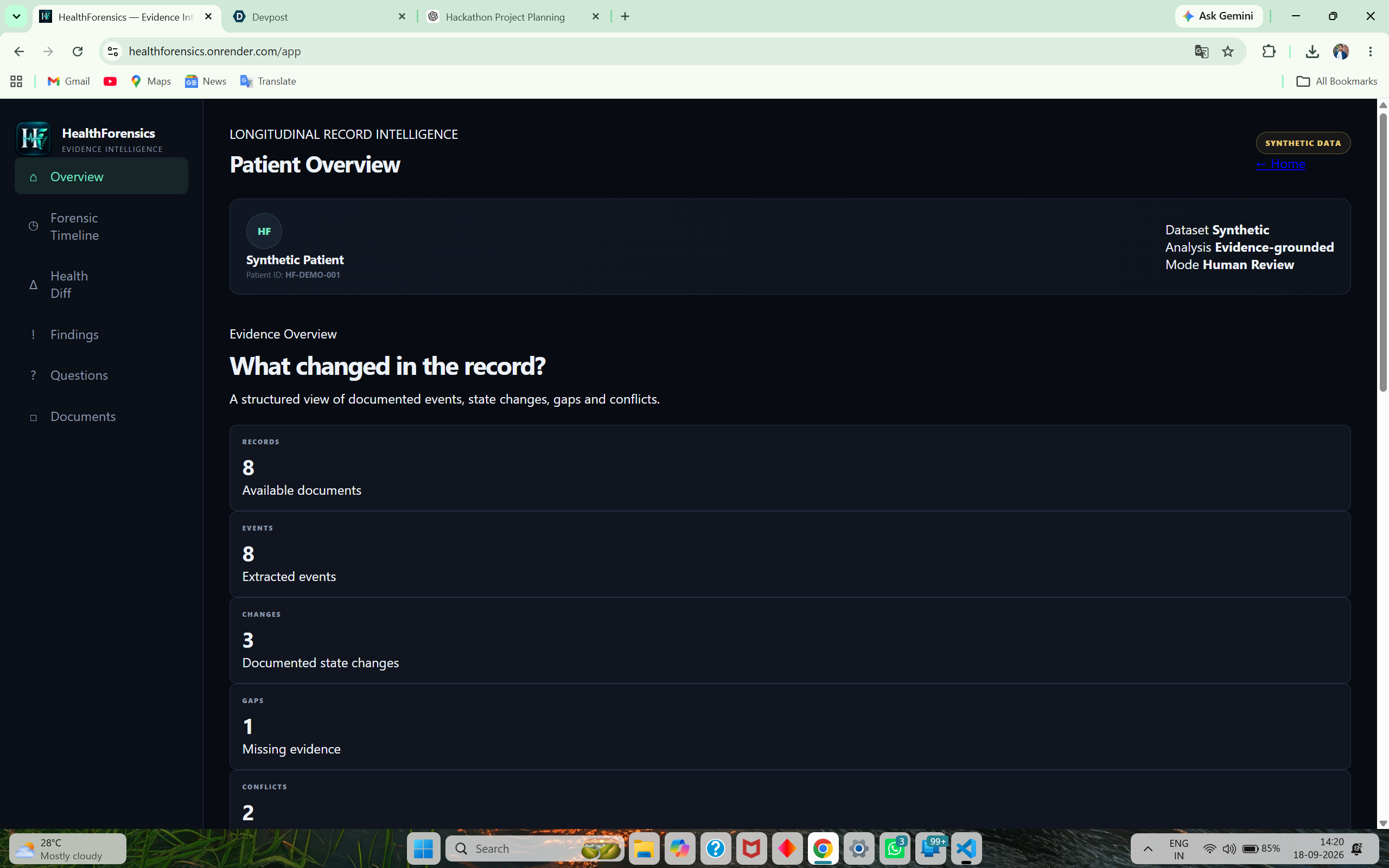
Dashboard Overview
-
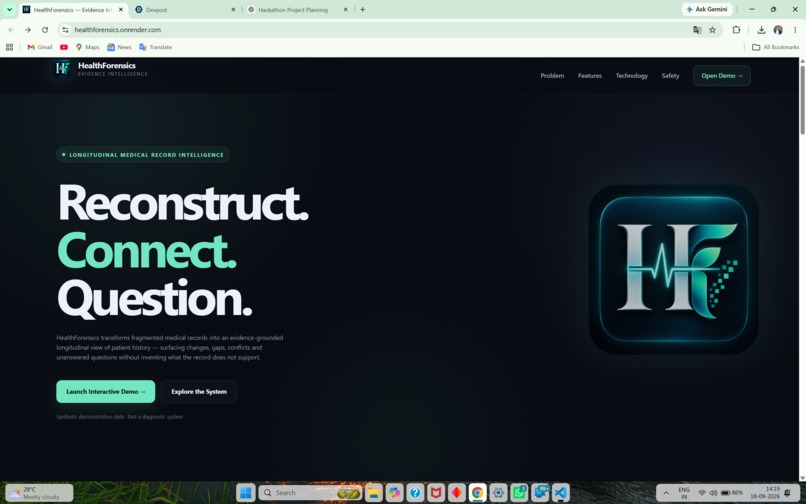
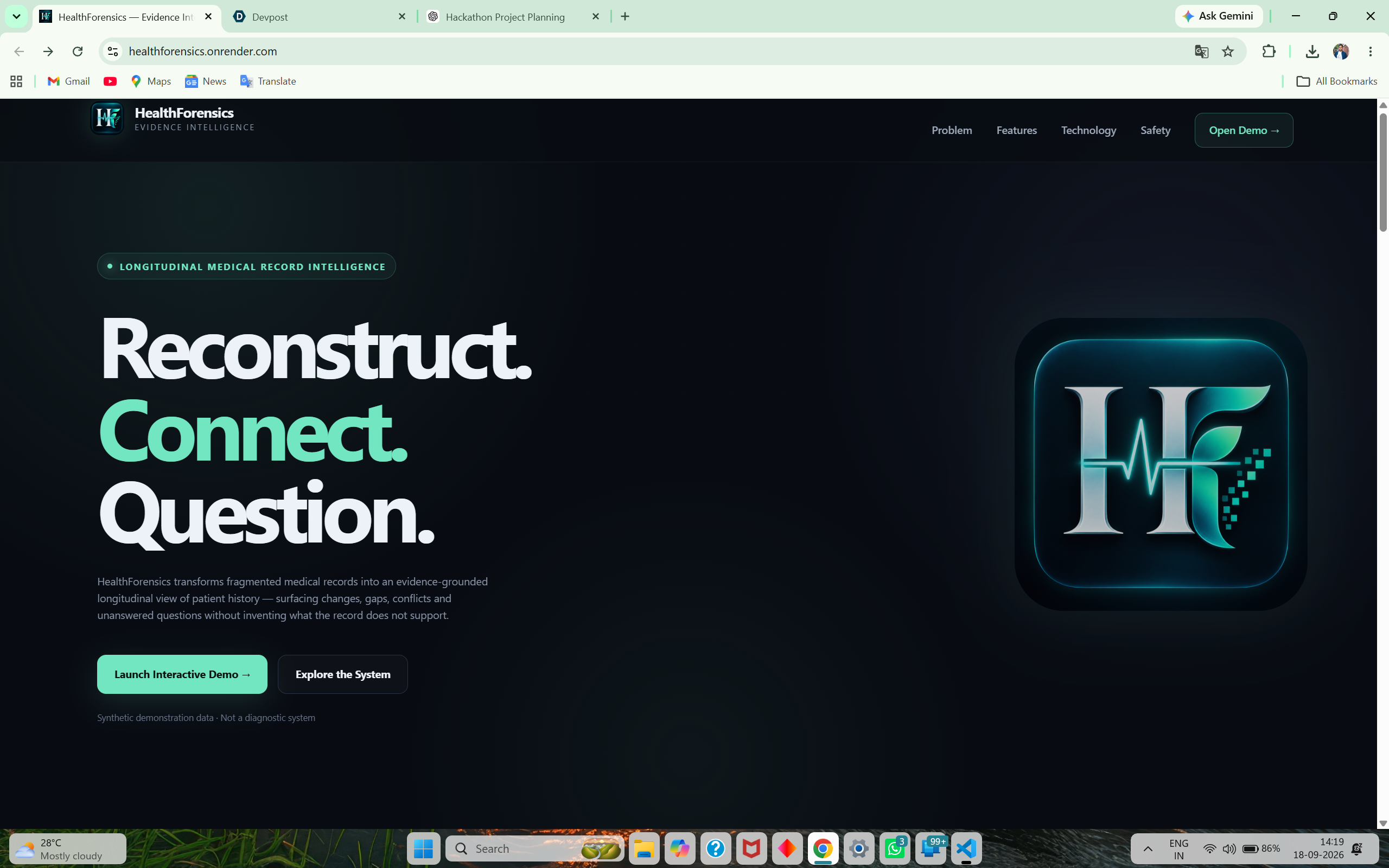
Landing Page
HealthForensics
Reconstruct. Connect. Question.
Healthcare records are often fragmented across consultation notes, prescriptions, laboratory reports and medication lists. Reviewing these documents chronologically can make it difficult to see what changed, what information is missing, and where documentation does not agree.
HealthForensics is an evidence-grounded longitudinal medical record intelligence system designed to help reconstruct this fragmented history.
What we built
HealthForensics processes medical records in PDF/TXT format and converts documented information into a chronological evidence map.
The system:
- Extracts text and structured medical events from records.
- Reconstructs a longitudinal patient timeline.
- Compares documented patient states using Health Diff.
- Detects documented medication and laboratory changes.
- Identifies potential documentation gaps such as a recommended follow-up that is not found in the available records.
- Surfaces documentation conflicts without assuming which record is correct.
- Generates unresolved, evidence-linked questions for human review.
- Connects findings back to their source documents through an Evidence Chain.
How it works
Medical Records → Text Extraction → Event Extraction → Timeline Reconstruction → Health Diff → Gap & Conflict Detection → Question Engine → Evidence Chain → Human Review
The system follows an evidence-first principle:
Documented ≠ Inferred ≠ Not Found
If information is not present in the available records, HealthForensics does not invent an explanation. It explicitly identifies the information as not found in the available dataset. When records disagree, the system surfaces the conflict rather than deciding which record is correct.
What we learned
Building the prototype highlighted the importance of chronological context when working with medical records. A single document may provide only part of a patient's history, while changes become meaningful when multiple records are connected across time.
We also learned that healthcare intelligence systems need to make their evidence and limitations visible instead of presenting automated conclusions without context.
Challenges
Key challenges included:
- Extracting structured events from semi-structured medical documents.
- Handling incomplete or inconsistent documentation.
- Comparing medical states across different dates.
- Detecting gaps without incorrectly assuming that an event never occurred.
- Maintaining traceability between findings and their original documents.
- Designing the system so that it supports human review rather than autonomous clinical decision-making.
Technology
HealthForensics is implemented as a software-only web application using Python, FastAPI, PyMuPDF, Pydantic, HTML, CSS and JavaScript. The prototype is deployed as a public web application and uses synthetic demonstration data.
Responsible design
HealthForensics is not a diagnostic or treatment system. It does not prescribe medication or generate unsupported clinical explanations. Its purpose is to organize documented evidence, identify areas requiring review, and make unresolved questions traceable.
Prototype
Live Working Prototype:
https://healthforensics.onrender.com/
Source Code:
https://github.com/yoursagnik123/healthforensics
Team: NEXORA Labs
Hackathon: Hack2Heal 2.0 – Global Healthcare Innovation Hackathon
Built With
- analysis
- api
- clinical
- css
- data
- ehr
- fastapi
- healthcare
- healthtech
- html
- javascript
- longitudinal
- medical
- natural-language-processing
- pydantic
- pymupdf
- python
- records
- rest

Log in or sign up for Devpost to join the conversation.