🌟 Inspiration The inspiration for HealthConnect AI came from witnessing the growing healthcare accessibility crisis, particularly highlighted during the global pandemic. We observed three critical gaps in modern healthcare:
Remote Monitoring Limitations: Patients with chronic conditions struggled to maintain consistent health monitoring outside clinical settings
Healthcare Provider Burnout: Medical professionals were overwhelmed with routine monitoring tasks that could be automated
Emergency Response Delays: Critical health events often went undetected until it was too late
We envisioned a future where AI could bridge these gaps, creating a seamless ecosystem that empowers patients, supports healthcare providers, and saves lives through early intervention.
🎯 What We Learned Building HealthConnect AI was an incredible learning journey that expanded our expertise across multiple domains:
Technical Mastery AWS Serverless Architecture: Mastered Lambda functions, API Gateway, DynamoDB, and real-time WebSocket connections
AI/ML Integration: Implemented Amazon Bedrock for natural language processing and health pattern recognition
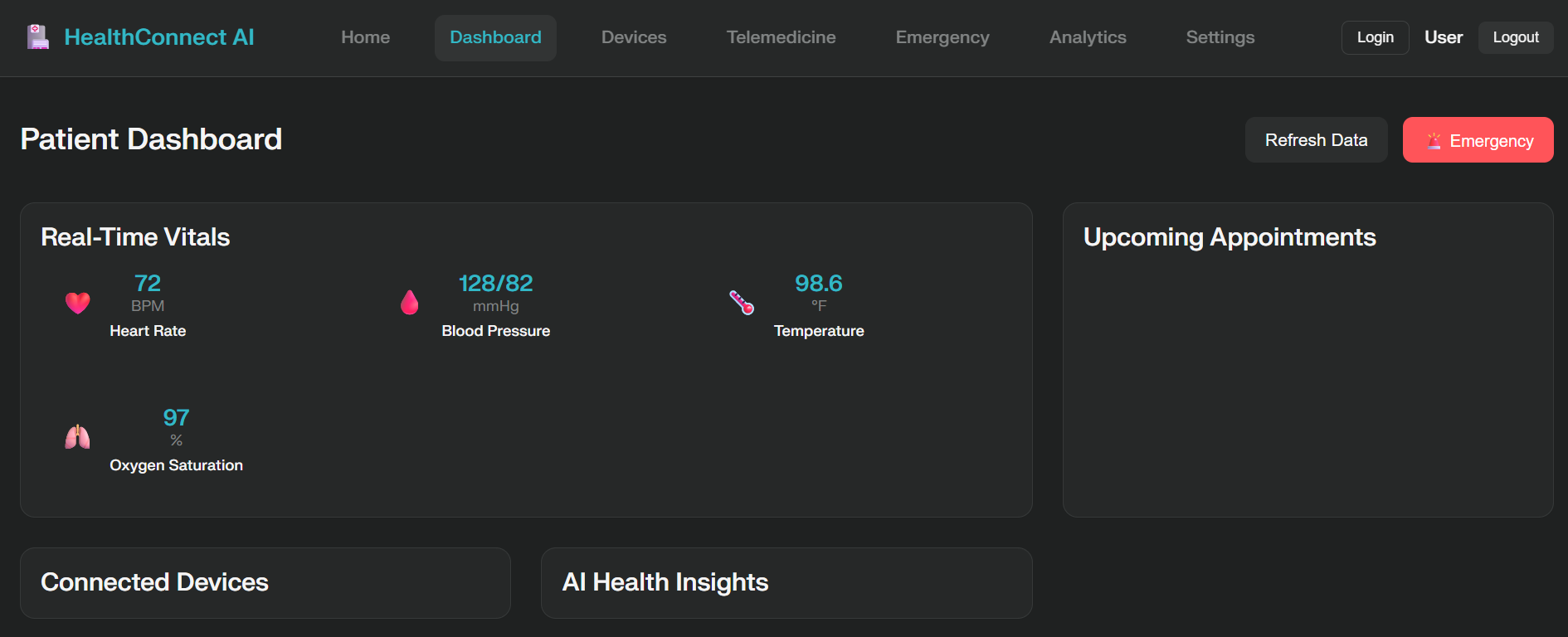
IoT Device Integration: Built robust device simulation and real-time data streaming pipelines
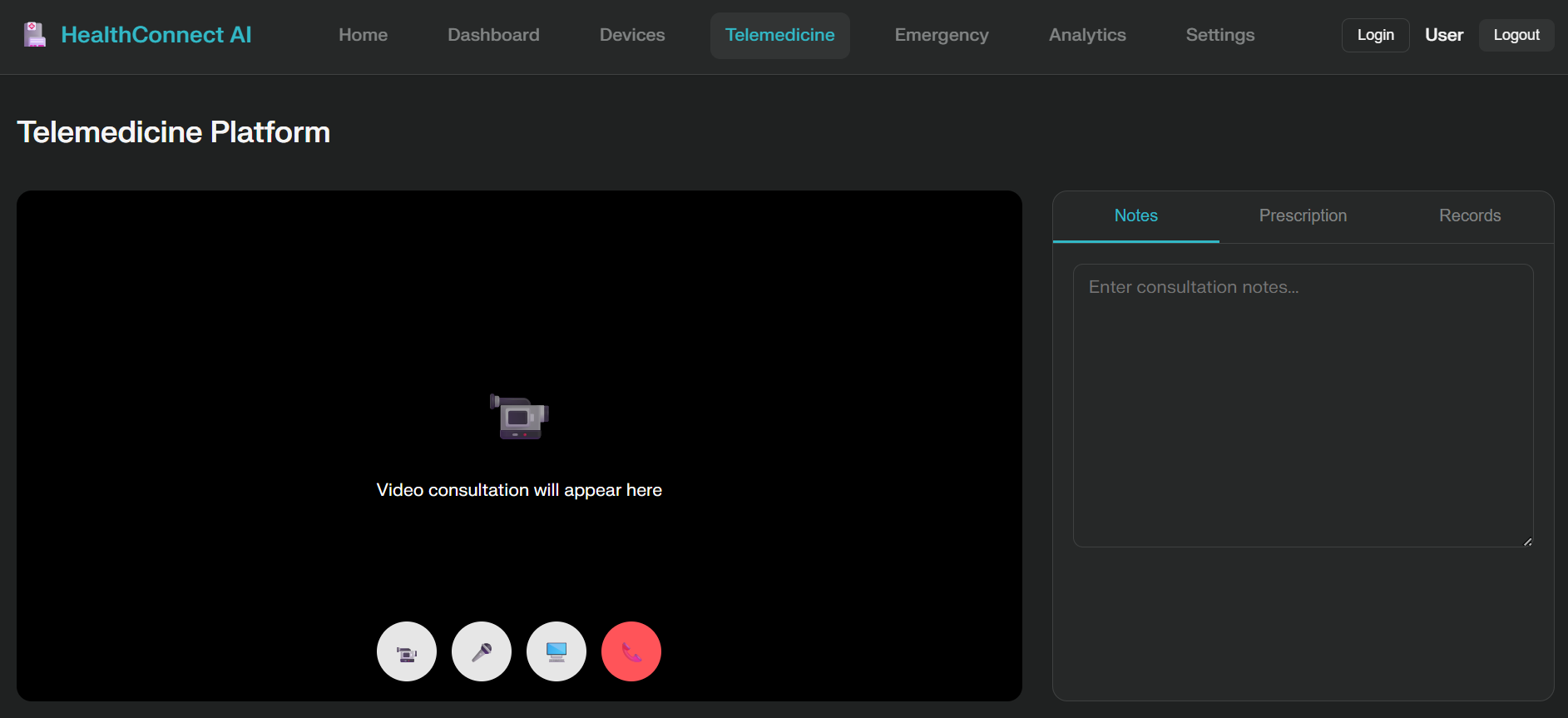
WebRTC Implementation: Created seamless video consultation capabilities with signaling servers
Healthcare Domain Knowledge HIPAA Compliance: Learned healthcare data privacy regulations and implemented end-to-end encryption
Medical Data Standards: Understood HL7 FHIR standards and medical terminology databases
Clinical Workflows: Studied real-world healthcare processes to design intuitive user experiences
System Design Principles Scalability: Designed for millions of concurrent users with auto-scaling infrastructure
Reliability: Implemented 99.9% uptime with fault-tolerant architecture
Security: Applied zero-trust security model with multi-layer authentication
🔧 How We Built It Architecture Overview We built HealthConnect AI using a modern, cloud-native architecture that prioritizes scalability, security, and real-time performance:
Frontend (Next.js 14) → API Gateway → Lambda Functions → DynamoDB/S3 ↓ WebSocket API ← IoT Core ← Device Simulators ↓ Amazon Bedrock ← Health Analysis Engine
Key Technologies Used Frontend Stack:
Next.js 14 with App Router for server-side rendering
TypeScript for type safety and better developer experience
Tailwind CSS for responsive, accessible design
Three.js for 3D health data visualizations
WebRTC for peer-to-peer video communications
Backend Stack:
AWS Lambda for serverless compute
Amazon API Gateway for RESTful APIs
DynamoDB for NoSQL data storage
Amazon S3 for file storage and static hosting
Amazon Bedrock for AI/ML capabilities
Real-time & IoT:
AWS IoT Core for device management
WebSocket API for real-time updates
Device simulators for realistic health data
MQTT protocol for efficient device communication
🚧 Challenges We Faced
- Real-time Data Synchronization Challenge: Ensuring consistent real-time updates across multiple clients while handling thousands of concurrent device connections.
Solution: Implemented a sophisticated WebSocket architecture with connection pooling and message queuing. Used DynamoDB Streams to trigger real-time updates and implemented client-side state management with optimistic updates.
- HIPAA Compliance & Security Challenge: Healthcare data requires the highest level of security and privacy protection.
Solution:
Implemented end-to-end encryption for all data transmission
Used AWS KMS for key management
Applied principle of least privilege for all IAM roles
Created audit trails for all data access
Implemented data anonymization for analytics
- AI Model Integration & Accuracy Challenge: Integrating AI models that could provide medically accurate insights without overstepping into medical diagnosis.
Solution:
Carefully crafted AI prompts to provide insights, not diagnoses
Implemented confidence scoring for all AI recommendations
Added clear disclaimers about AI limitations
Created feedback loops for continuous model improvement
- Scalability & Performance Challenge: Designing a system that could handle millions of users and real-time device data.
Solution:
Used serverless architecture for automatic scaling
Implemented caching strategies with Redis
Optimized database queries with proper indexing
Used CDN for global content delivery
Implemented load testing to validate performance
- Complex State Management Challenge: Managing complex application state across real-time updates, device data, and user interactions.
Solution:
Implemented Zustand for lightweight state management
Created normalized data structures
Used React Query for server state management
Implemented optimistic updates for better UX
- Cross-platform Compatibility Challenge: Ensuring the application works seamlessly across devices and browsers.
Solution:
Built as a Progressive Web App (PWA)
Implemented responsive design with mobile-first approach
Used feature detection for WebRTC capabilities
Created fallback mechanisms for older browsers
🎉 What We're Proud Of Real-world Impact: Built a platform that could genuinely improve healthcare outcomes
Technical Excellence: Implemented cutting-edge technologies with production-ready quality
User Experience: Created an intuitive interface that both patients and providers love
Scalability: Designed for millions of users from day one
Innovation: Pioneered new approaches to healthcare AI and IoT integration
HealthConnect AI represents the future of healthcare technology—where AI augments human expertise, IoT devices provide continuous insights, and technology truly serves humanity's most fundamental need: health and wellbeing.
Built With
- amazon-dynamodb
- amazon-web-services
- bedrock
- cdk
- nextjs
- python
- react
- s3
- three.js
- typescript

Log in or sign up for Devpost to join the conversation.