Inspiration
Doctors lose too much time turning a patient story into documentation that supports an insurance review, especially for labs and biomarkers that may need clearer clinical context before a payer reviews them. HealthClock was built for the Klarity Health challenge: an AI layer that improves provider workflow, documentation quality, follow-up, and audit readiness without replacing clinician judgment.
## What it does
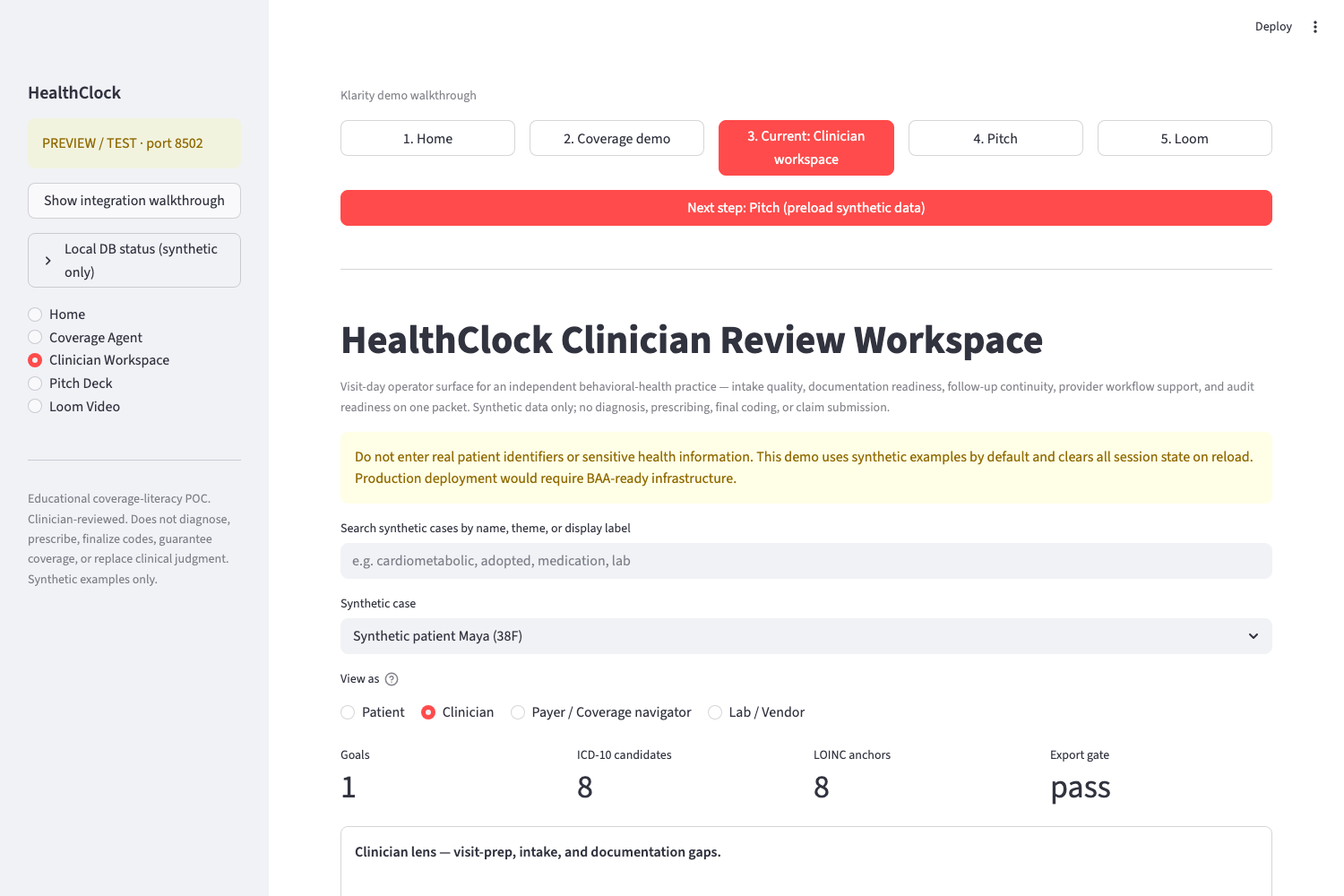
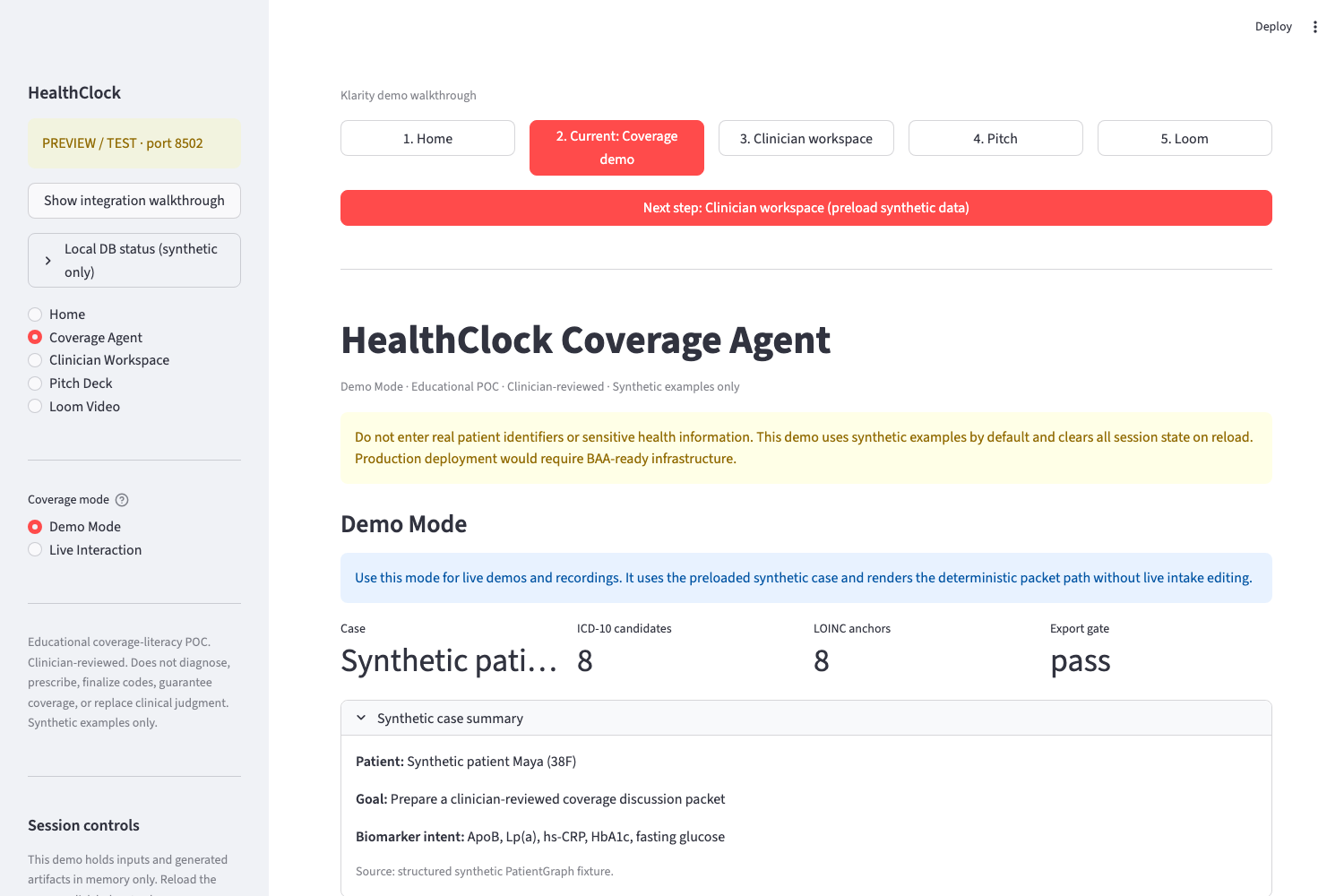
HealthClock turns a synthetic patient history into a clinician-reviewed documentation packet. The app organizes structured intake, personal history, biological vs adoptive family history, medications and supplements, lab and biomarker interests, goals, notes, candidate ICD-10 family discussion, possible LOINC anchors, documentation gaps, payer questions, role-specific views, and provenance receipts.
It includes patient, clinician, payer, and lab perspectives so the same case can be reviewed by different workflow audiences.
HealthClock does not diagnose, prescribe, order labs, finalize codes, submit claims, or guarantee payer approval.
## How we built it
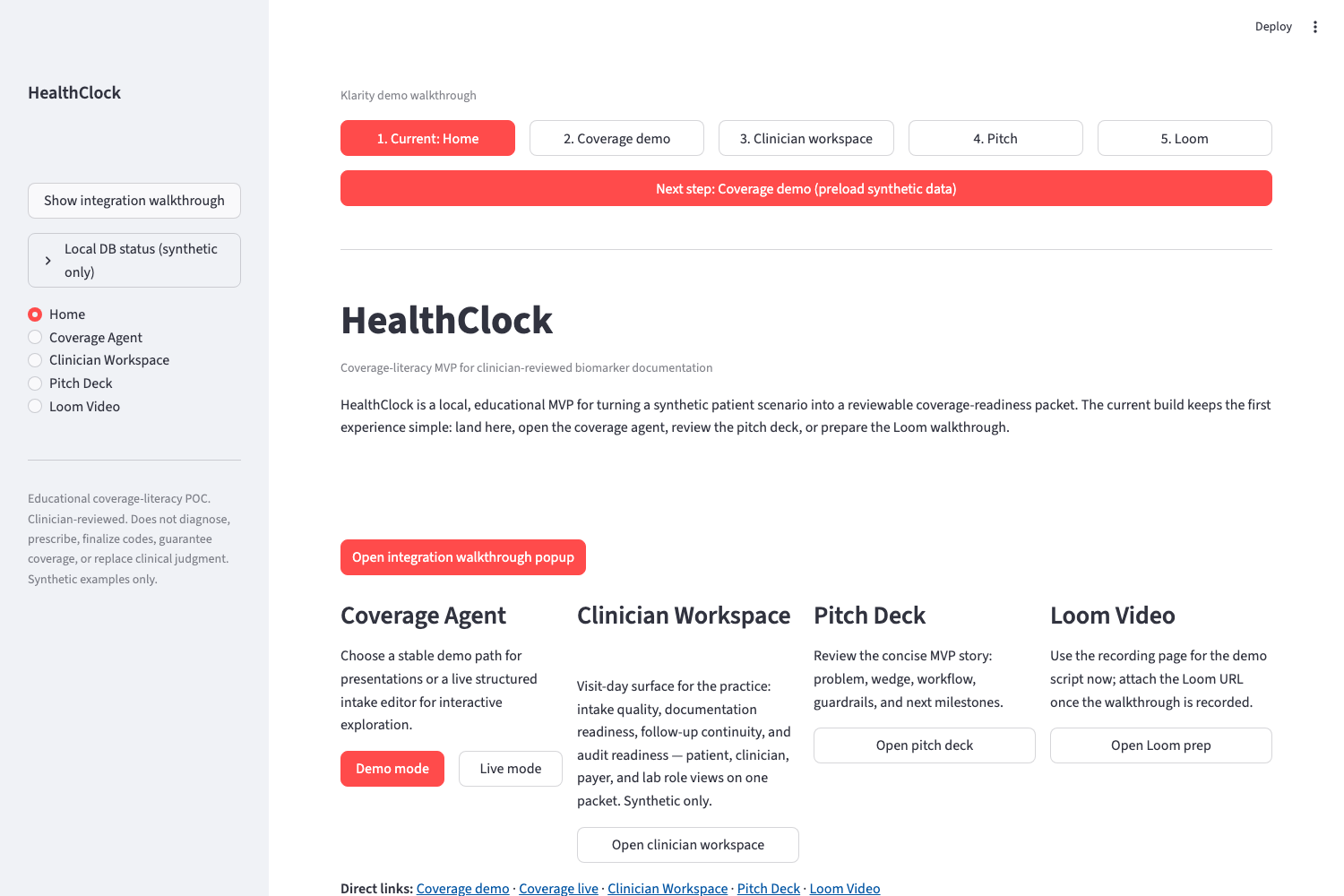
We built HealthClock as a local Streamlit app in Python with Pydantic schemas, deterministic agent stages, synthetic patient fixtures, a patient knowledge graph, and provenance receipts.
The pipeline moves from structured intake to clinical framing, lab anchors, coverage-readiness rationale, packet generation, and privacy review. We also added a clinician workspace with role- specific views for patient, clinician, payer, and lab workflows.
## Challenges we ran into
The hardest part was keeping the product useful while staying inside a safe hackathon scope. We used synthetic data only, avoided real PHI, avoided unsupported sponsor claims, and kept the default demo deterministic so it could be judged reliably.
We also had to balance sponsor-track ambition with honest implementation boundaries. Some integrations were explored but kept gated unless they were actually working.
## Accomplishments that we're proud of
We built a working end-to-end demo with structured intake, patient knowledge graph data, clinician- facing documentation packets, coverage-readiness rationale, lab anchors, role-specific views, and provenance receipts.
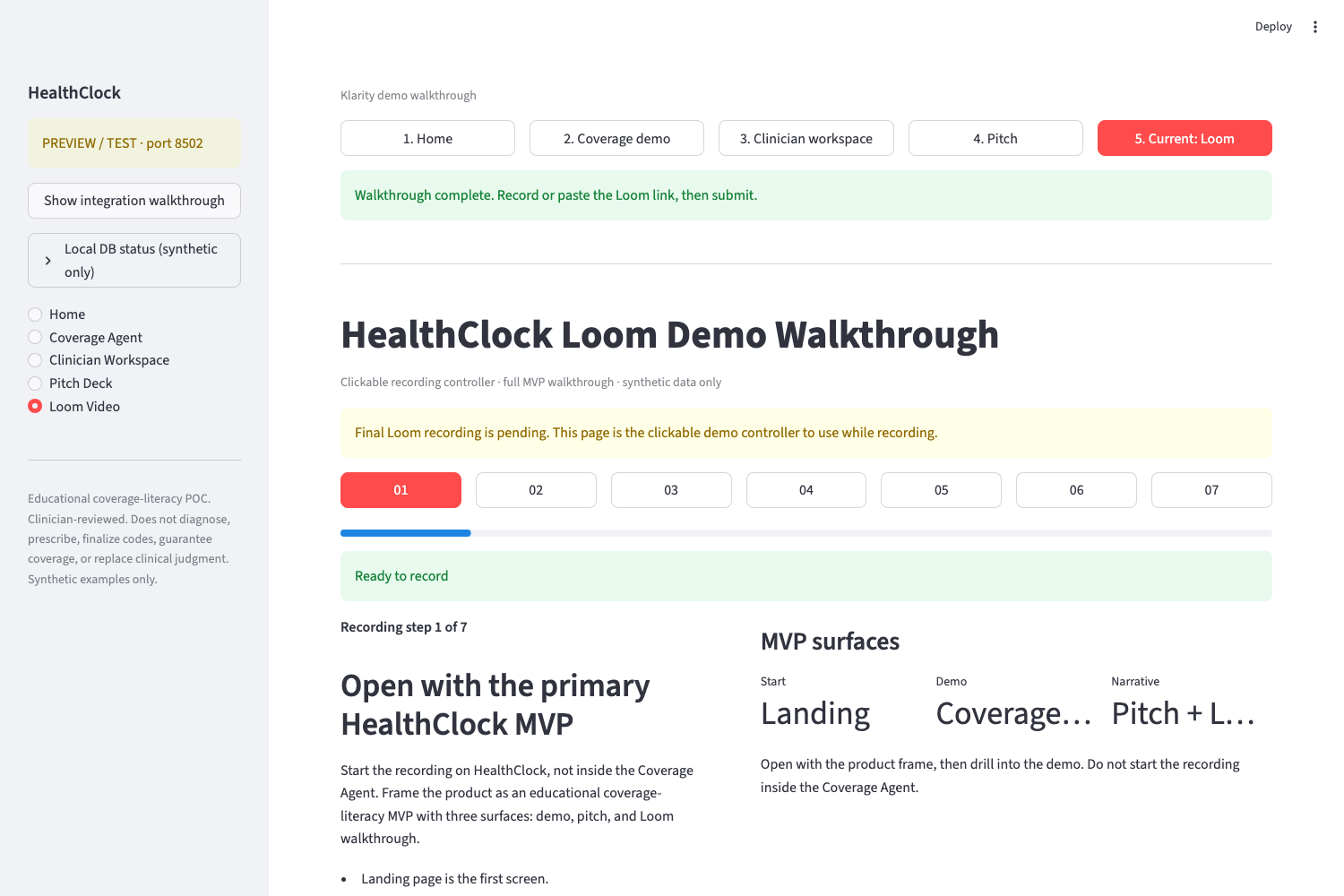
We also created multiple synthetic patient examples and a guided demo flow that can be shown reliably in a 2-3 minute walkthrough.
## What we learned
The useful AI layer for providers is not a generic chatbot. It is structured workflow support: help the clinician collect the right context, identify documentation gaps, prepare payer-facing questions, and preserve an audit trail.
## What's next for HealthClock
Next steps are provider feedback, safer terminology ingestion, stronger dataset provenance, optional local LLM polish behind deterministic validators, and a reviewed public deployment path.

Log in or sign up for Devpost to join the conversation.