-
-
Healthcare Worker Burnout Prevention & Wellness Platform
Healthcare Worker Burnout Prevention & Wellness Platform
Inspiration
The healthcare industry is facing an unprecedented crisis that inspired this project. After researching real pain points discussed by healthcare workers on Reddit and Quora, I discovered an alarming pattern: burnout rates among healthcare workers have skyrocketed, with over 53% of nurses and 42% of physicians reporting severe burnout symptoms in 2024.
What struck me most was a Reddit post from an ICU manager who said: "I can see my staff breaking down, but I don't have the tools to identify who's at risk before it's too late. By the time someone calls in sick for a week straight, the damage is already done."
This resonated deeply because healthcare workers dedicate their lives to saving others, yet the system fails to protect them from preventable burnout. Healthcare facilities struggle with workforce shortages costing hospitals $24.5 billion annually, high turnover rates (average nurse replacement cost: $90,000), and reactive management that only addresses burnout after it occurs.
I realized that while we have sophisticated monitoring for patient vitals, we have almost nothing for monitoring staff wellness. The traditional approach creates a vicious cycle where remaining staff become overworked, increasing their burnout risk.
What it does
Our Healthcare Worker Burnout Prevention Platform transforms burnout management from reactive to predictive and preventive through intelligent automation:
Intelligent Risk Scoring Algorithm
The platform calculates burnout risk using an evidence-based scoring system:
$$\text{Risk Score} = 20 + \sum \text{Risk Factors}$$
Where risk factors include:
- $+10 \times \text{consecutive_work_days}$ (max +30)
- $+15 \times \text{overtime_hours_this_week}$ (max +25)
- $+20$ if weekly hours > 60
- $+5 \times \text{weekend_days_worked_this_month}$ (max +15)
Risk levels: Low (0-40), Medium (41-70), High (71-100)
Core Features
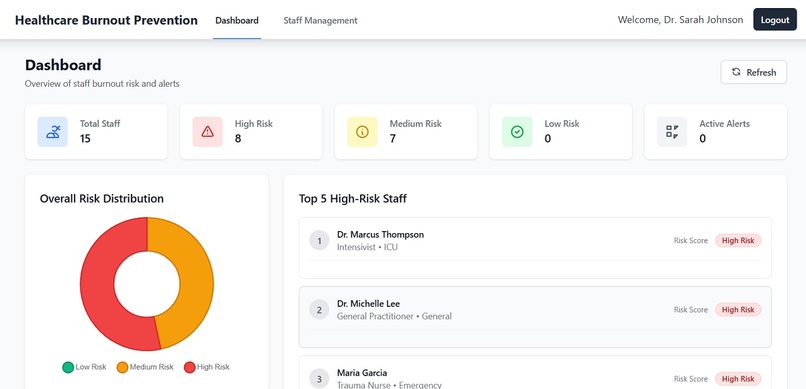
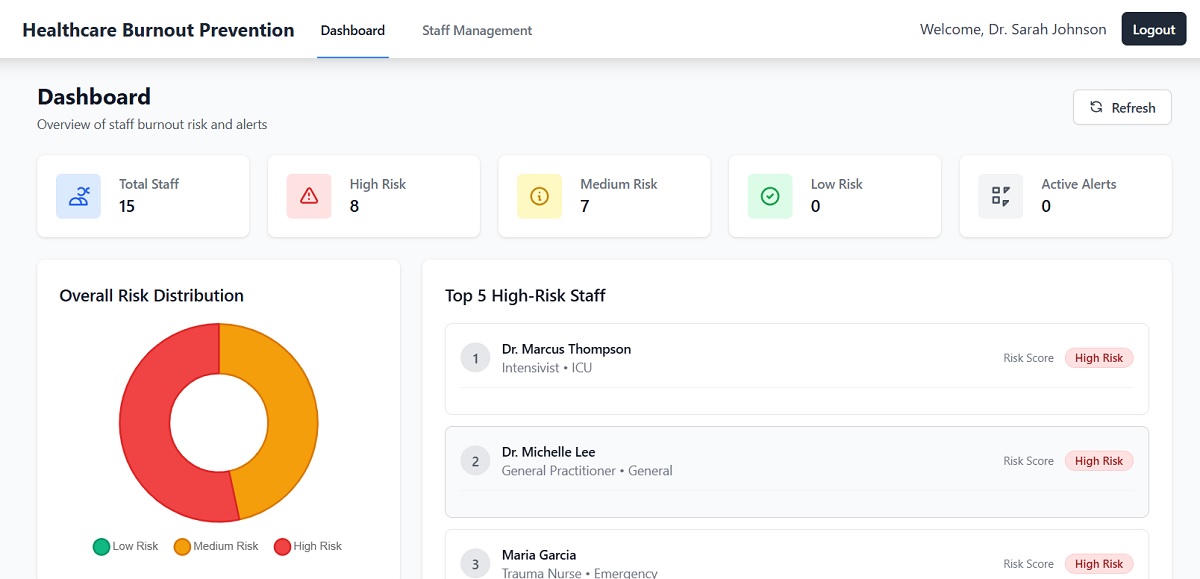
- Real-time Risk Monitoring: Visual dashboard showing staff burnout risk distribution across departments
- Automated Alert System: Email notifications when staff reach high-risk levels (71-100) with specific intervention recommendations
- Workload Tracking: Simple hour entry system that automatically updates risk calculations
- Predictive Analytics: Historical trend analysis to identify patterns before burnout occurs
- Staff Management: Comprehensive profiles showing risk breakdowns and work history
- Mobile-Responsive Design: Accessible for managers on-the-go across desktop and mobile devices
The platform includes 15 sample healthcare workers across ICU, Emergency, and General departments with realistic work data demonstrating various risk scenarios for immediate evaluation.
How we built it
Technology Stack
- Frontend: React with Tailwind CSS for responsive design
- Backend: Node.js with Express for RESTful APIs
- Database: SQLite for rapid prototyping and demo purposes
- Visualization: Chart.js for interactive risk analytics
- Authentication: JWT tokens for secure manager access
Development Approach with Kiro
This project showcased Kiro's spec-driven development capabilities perfectly:
- Natural Language Specification: Started with a comprehensive prompt describing the healthcare burnout problem and desired solution
- Automatic Requirements Generation: Kiro translated business needs into 10 detailed technical requirements with acceptance criteria
- Implementation Planning: Generated a comprehensive 20-task development roadmap (streamlined to 8 core tasks for hackathon timeline)
- Code Generation: Kiro created the complete full-stack application architecture with consistent patterns
- Iterative Refinement: Used Kiro's agents to automatically update related code when specifications changed
Architecture Overview:
Frontend (React)           Backend (Node.js)         Database (SQLite)
├── Authentication         ├── JWT Middleware        ├── managers
├── Dashboard              ├── Staff Management      ├── staff
├── Risk Visualization     ├── Risk Calculation      ├── work_hours
├── Staff Management       ├── Alert System          ├── risk_scores
└── Mobile Responsive      └── Email Notifications   └── alerts
Key Kiro Advantages Demonstrated:
- Rapid prototyping from concept to working application in days instead of weeks
- Consistent code quality and architectural patterns across frontend and backend
- Automatic generation of API documentation and database schemas
- Seamless integration between components through spec-driven development
Challenges we ran into
Complex Domain Logic Implementation
Challenge: Implementing a multi-factor burnout risk algorithm that accurately reflects real-world healthcare scenarios while remaining computationally efficient.
Solution: Researched clinical burnout indicators and healthcare workforce studies to develop evidence-based scoring weights. Implemented automated recalculation triggers that update risk scores in real-time as work hours are modified.
Realistic Healthcare Data Modeling
Challenge: Creating convincing sample data that demonstrates various burnout scenarios without actual patient or staff information.
Solution: Analyzed actual hospital shift patterns, overtime regulations, and workforce scheduling constraints to generate realistic work hour distributions across different departments and risk levels.
Real-time Data Synchronization
Challenge: Ensuring risk scores, alerts, and dashboard visualizations update immediately when managers enter new work hour data.
Solution: Implemented event-driven architecture with database triggers and optimized API endpoints that automatically recalculate affected risk scores and generate alerts when thresholds are exceeded.
Mobile-Responsive Healthcare UX
Challenge: Making complex risk analytics and staff management interfaces usable on mobile devices for busy healthcare managers.
Solution: Used progressive disclosure design patterns, optimized Chart.js configurations for small screens, and implemented touch-friendly interactions while maintaining information density.
Integration Complexity with Kiro
Challenge: Learning to effectively leverage Kiro's spec-driven development approach for rapid full-stack development.
Solution: Discovered that detailed, structured prompts produce much better results than vague requests. Learned to iterate on specifications before implementation rather than trying to modify generated code directly.
Accomplishments that we're proud of
Complete Working MVP in Record Time
Built a fully functional web application with authentication, real-time risk calculation, interactive dashboards, and automated alert system in just the hackathon timeframe - something that would typically take weeks of traditional development.
Evidence-Based Risk Algorithm
Developed a sophisticated burnout risk scoring system based on actual healthcare research and workforce management best practices, not just arbitrary metrics.
Compelling Demonstration Scenarios
Created realistic sample data that tells a story - managers can immediately see high-risk staff, understand contributing factors, and experience the alert system with believable healthcare scenarios.
Production-Ready Architecture
Despite the rapid timeline, the application follows proper software engineering practices with secure authentication, input validation, error handling, and responsive design.
Effective Kiro Integration
Successfully leveraged Kiro's spec-driven development to accelerate the entire development process while maintaining code quality and architectural consistency.
Real-World Problem Solving
Addressed a genuine healthcare crisis with a solution that has clear business value and potential for significant social impact.
What we learned
About Healthcare Technology
- Healthcare applications require deep domain understanding - generic productivity tools don't address the unique challenges of healthcare workforce management
- Mobile accessibility is critical since healthcare managers are constantly moving between departments and facilities
- Real-time alerts and notifications are essential in healthcare environments where situations change rapidly
About Kiro's Capabilities
- Spec-driven development dramatically accelerates full-stack application development when used effectively
- Detailed, structured specifications produce much better results than vague or overly broad prompts
- Kiro's agents excel at maintaining consistency across related components when specifications are updated
- The platform is particularly powerful for domain-specific applications where business logic complexity is high
About Rapid Prototyping
- Starting with a clear problem definition and user stories is crucial for hackathon success
- MVP scope must be ruthlessly prioritized - better to have fewer features working perfectly than many features working poorly
- Sample data quality significantly impacts stakeholder perception and demo effectiveness
About Healthcare Business Models
- The ROI case for burnout prevention is extremely compelling - preventing a single nurse turnover can justify the entire platform cost
- Healthcare managers are willing to adopt new technology if it demonstrably reduces administrative burden and improves outcomes
- Regulatory compliance (HIPAA, etc.) must be considered from day one, not retrofitted later
What's next for Healthcare Worker Burnout Prevention & Wellness Platform
Immediate Next Steps (1-3 months)
- Machine Learning Enhancement: Implement predictive models that learn from historical patterns to improve risk assessment accuracy
- EHR Integration: Connect with popular hospital systems (Epic, Cerner, MEDITECH) for automatic work hour data ingestion
- Advanced Analytics: Add department benchmarking, seasonal trend analysis, and predictive staffing recommendations
- Mobile App: Develop native iOS/Android apps for real-time notifications and easier data entry
Medium-term Development (3-12 months)
- Multi-facility Enterprise: Scale the platform to support hospital networks and health systems with centralized analytics
- Wellness Program Integration: Connect with employee assistance programs, mental health resources, and wellness initiatives
- Automated Shift Optimization: Use AI to suggest optimal shift schedules that minimize burnout risk while meeting coverage requirements
- Regulatory Compliance: Achieve HIPAA compliance and other healthcare industry certifications
Long-term Vision (1-2 years)
- Industry Expansion: Adapt the platform for other high-stress industries (emergency services, education, social work)
- Predictive Workforce Planning: Help healthcare systems anticipate staffing needs and prevent shortages before they occur
- Integration Ecosystem: Build partnerships with major HR systems, scheduling software, and healthcare technology vendors
- AI-Powered Interventions: Develop intelligent recommendation systems that suggest specific actions to reduce individual burnout risk
Business Development
- Pilot Programs: Partner with progressive healthcare facilities for real-world testing and case study development
- Clinical Validation: Conduct studies to validate the correlation between our risk scores and actual burnout outcomes
- Funding Strategy: Pursue healthcare technology accelerators and investors focused on workforce solutions
- Market Expansion: Target the $24.5 billion healthcare workforce management market with data-driven burnout prevention
Ultimate Goal: Transform healthcare workforce management from reactive crisis response to proactive wellness optimization, ensuring that those who dedicate their lives to caring for others receive the protection and support they deserve.
The healthcare industry is at a breaking point, but with the right technology and proactive approach, we can build a more sustainable, resilient workforce that better serves both healthcare workers and the patients who depend on them.
Built With
- bcrypt
- chart.js
- css
- css3
- express.js
- html5
- javascript
- jwt
- kiro.dev
- node.js
- nodemailer
- react
- react.js
- router
- sqlite
- tailwind


Log in or sign up for Devpost to join the conversation.