👶 NatalTrace (Post-Natal Tracking & Triage)
Bridging the gap between Hungarian Mothers and Overwhelmed Postnatal Nurses
Problem Statement: A Systemic Crisis in Hungary
Based on data from Válasz Online investigate article (2023) and KSH healthcare statistics.
The Hungarian "Védőnő" system—a 100-year-old national treasure—is currently facing a structural collapse. Despite centralization under county hospitals, the core issues remain unaddressed:
📉 The Reality by the Numbers:
- The Ratio: Approximately 5,000 nurses are responsible for 90,000+ newborns annually.
- The Time Gap: In overwhelmed districts (suburbs and "healthcare deserts"), a nurse often has only 15 minutes per visit.
- Result: This is insufficient to detect early-stage physical deformities or parental mental health issues (e.g., postpartum depression).
- The Geographic Desert: In some rural areas, services are "permanently suspended," while in growing suburbs, a single nurse may manage an impossible caseload that exceeds safety standards. The centralization efforts of the government in June 2023 made this issue even more appearent.
📝 The "Digital Burden" Paradox:
Current "online" solutions have often increased the workload rather than reducing it. Nurses report:
- Duplicate data entry (Paper + Digital).
- Rigid hospital reporting structures that prioritize "compliance" over "care."
- No way to prioritize visits based on actual infant health risk. > "When everyone is a priority on paper, the most vulnerable children become invisible in practice."
🏡 The Collapse of Home Care
Our analysis reveals a critical vulnerability in the current Hungarian "Védőnő" system:
- The Home Visit Crisis: In 2000, every mother received ~5 home visits. By 2024, this has dropped to 2.2 (a 54% decrease).
- The "Clinic Shift": Since 2007, families have been forced to travel to clinics more often than they receive home visits. This places a massive burden on new mothers and reduces the nurse's ability to observe the child's home environment.
- The 2020 "Observation Gap": During the pandemic, visits reached a dangerous all-time low of 1.4 per mother.
The NatalTrace InterventionWe fill the 54% "Observation Gap." By providing AI-triaged data from the home directly to the nurse's phone, we restore the "virtual" safety net. This allows nurses to monitor high-risk metrics without the logistical barrier of a physical house call. |
👩💻 The Dual-View Solution
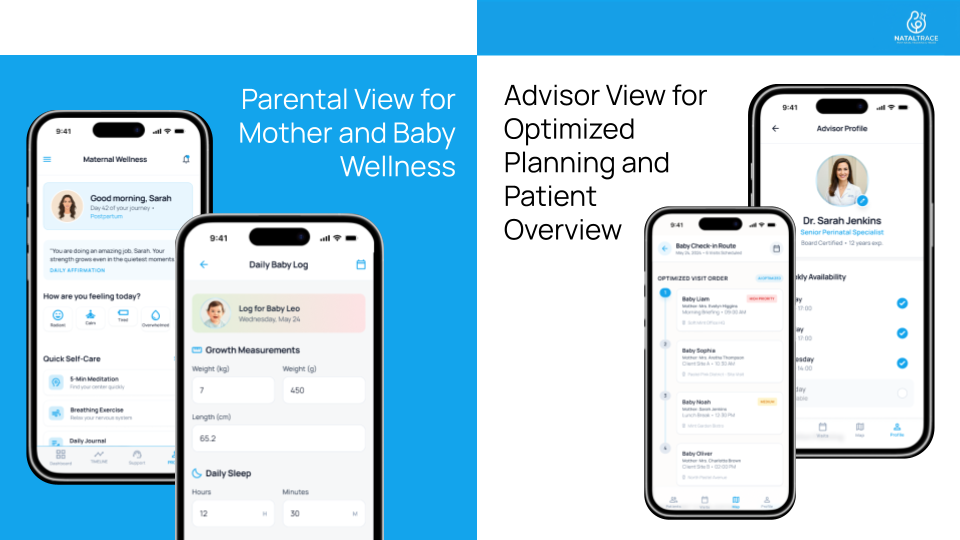
The Nurse View:
The Nurse Dashboard transforms the role from a data-entry clerk to a high-impact care provider by focusing on Smart Prioritization:
- AI Urgency Engine: Real-time scanning for clinical "red flags" based on the following metrics: date of last entry, severity of symptoms, development irregularities, emergency button history.
- Geospatial Optimization: Azure Maps integration to solve the "Suburban Overload" by planning the most efficient travel routes.
- Predictive Analytics: Early detection of developmental lags via long-term data visualization.
- Smart Prioritization: Leverages AI to calculate a real-time Urgency Score for each child and travelling distance (using Azure Maps), allowing nurses to plan their daily routes in a smarter, more efficient way.
The Mother View:
- Comprehensive Health Logging: "One-tap" tracking for essential vitals, including weight and length, alongside daily biological cycles (nutrition, hydration, sleep, and diaper changes/peeing-pooping patterns).
- AI-Powered Guidance (Breastfeeding & Cognition): Real-time breastfeeding support and personalized cognitive development recommendations. The AI suggests playful, age-appropriate games designed to assess and stimulate the child's mental growth.
- Milestone & Developmental Tracking: Automatic comparison of "Big Milestones"—such as crawling, sitting, and speech—against the ideal developmental timeline, allowing for the early detection of potential lags.
- Proactive Mental Health Screening: A daily "How are you feeling today?" check-in that utilizes sentiment analysis to detect early signs of postpartum depression or anxiety, ensuring maternal mental health is never overlooked in the postnatal fog.
- Verified Wisdom: In-app educational library sourced directly from WHO and local health guidelines.
- Reliably sourced data:
|
|
|
|
System Architecture
- Logic Layer: Python 3.11/FastAPI with asynchronous SQLAlchemy for low-latency triage processing.
- Intelligence Layer: Managed Azure OpenAI (GPT-4o) instance restricted to EU regions for pseudonymized health analysis.
- Frontend Layer: React 18+ with TypeScript, optimized for cross-platform rendering of complex clinical dashboards and geospatial nurse maps.
⚖️ Legal Framework
To ensure the highest standards of safety and legal compliance, NatalTrace operates under a "Human-in-the-Loop" (HITL) architecture.
1. Data Privacy & Sovereignty (GDPR & EU AI Act)
- Regional Data Residency: All personally identifiable information (PII) and health data are stored in Azure’s North/West Europe regions (Germany/Netherlands), ensuring 100% compliance with GDPR. As per the Microsoft EU Data Boundary (EUDB), 100% of data processing—including technical support logs and metadata—remains within the European Union, ensuring absolute GDPR compliance and protection against extra-territorial data access
- EU AI Act Compliance: NatalTrace operates as a Class IIa Clinical Decision Support System. We do not diagnose or prescribe; instead, we utilize Azure AI to triage and visualize domestic data, empowering the nurse to make faster, data-driven interventions. This 'Human-in-the-Loop' (HITL) architecture ensures full compliance with the EU AI Act's requirements for High-Risk healthcare tools. The app functions as an early-warning system, alerting parents to seek professional medical advice when data deviates from standard developmental baselines.
- National Health Cloud Sync: Designed to integrate directly with EESZT, ensuring bi-directional data flow between NatalTrace and the national health records. By leveraging government-grade authentication for identity verification, the platform securely manages sensitive information, including vaccination schedules and pediatric medical histories, through robust, automated data transfer protocols.
2. Medical Liability & Safety
- Decision Support vs. Diagnosis: NatalTrace is strictly a Clinical Decision Support System (CDSS). The app includes a permanent legal disclaimer: "AI insights are for prioritized triaging only and do not constitute a medical diagnosis."
- The "Emergency" Button: the application provides the mother with a direct one-tap button to local emergency services (112) and the contact information of the nearest ER or nurse.
📈 Expansion & Funding
Alignment with EU4Health Regulation (EU) 2021/522
NatalTrace is engineered to fulfill the strategic objectives of the EU4Health Programme, specifically addressing the "Digital" and "Healthcare Workforce" strands.
- Digital Transformation: Directly contributing to the reinforcement of health data and digital services through AI-driven triage.
- Resilience & Access: Solving the "fragility" of regional health systems by optimizing staff allocation and improving care accessibility in "healthcare deserts."
Download the Full EU Grant Timeline (PDF)
In-application advertisements
Brand Partnerships: Premium Infant Care (Dermatological products, diapers, and hygiene), Nutrition & Feeding (Specialized weaning tools, bottles, and supplements), Developmental Hardware (smart monitors, white noise machines, and ergonomic furniture).
Developed for GDE-MIT Hackathon - 2026
Built With
- ai
- azure
- figma
- ksh
- stitch
- who


Log in or sign up for Devpost to join the conversation.