-
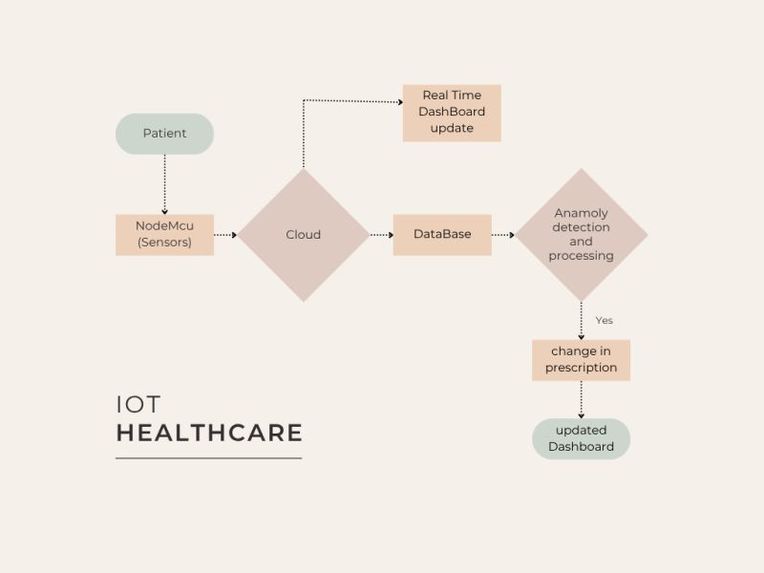
Workflow
Inspiration
Hospitals generate massive amounts of patient data every second, yet much of this information remains fragmented across devices and monitoring systems. Critical changes in a patient's condition can sometimes go unnoticed due to delayed communication or manual observation. We wanted to leverage the power of IoT and Digital Twin technology to create a system that provides healthcare professionals with a real-time virtual representation of patients, enabling faster decision-making and improved patient care.
What it does
Our project is an IoT-based Healthcare Digital Twin platform that creates a real-time virtual representation of each hospital bed and patient. The system:
- Collects patient vital data using IoT sensors connected through NodeMCU devices.
- Transmits sensor data to a centralized server.
- Stores and processes data in a database.
- Creates a digital twin that mirrors the patient's current state.
- Displays real-time information on a web dashboard.
- Generates alerts when any health parameter crosses predefined thresholds.
- Provides historical trends and analytics for healthcare professionals. The platform enables continuous monitoring and helps medical staff respond quickly to emergencies. --- # How we built it We built the system using a combination of IoT hardware and modern web technologies. --- ### Hardware
- NodeMCU (ESP8266)
- Health monitoring sensors
* Buzzer and LED indicators for emergency alerts
Software Stack
- MongoDB for data storage
- Express.js and Node.js for backend services
- React.js for the monitoring dashboard
- WebSockets for real-time communication
* Digital Twin engine for maintaining virtual patient representations
Workflow
- Sensors collect patient health data.
- NodeMCU sends the readings to the backend server.
- The backend stores data in MongoDB.
- The Digital Twin updates its virtual model in real time.
- The dashboard receives live updates through WebSockets.
- Alerts are triggered whenever abnormal readings are detected. # Challenges we ran into
- Maintaining reliable real-time communication between IoT devices and the server.
- Handling multiple patient beds while ensuring data is mapped to the correct digital twin.
- Designing a scalable architecture capable of supporting an entire hospital ward.
- Managing sensor noise and inconsistent readings.
- Creating a dashboard that remains responsive despite continuous data updates.
* Ensuring low latency between physical events and their digital representations.
Accomplishments that we're proud of
- Successfully developed a working Digital Twin prototype for healthcare monitoring.
- Achieved real-time synchronization between physical sensors and virtual patient models.
- Implemented live alerts and monitoring capabilities.
- Built a scalable MERN-based architecture for future expansion.
- Integrated IoT hardware and software into a single unified platform.
* Demonstrated how Digital Twin technology can be applied to healthcare environments.
What we learned
Throughout this project, we gained valuable experience in:
- IoT device communication and data transmission.
- Real-time systems using WebSockets.
- Digital Twin architecture and implementation.
- Healthcare monitoring workflows and requirements.
- Full-stack application development with the MERN stack.
- Managing large volumes of streaming sensor data.
- Designing systems that combine physical hardware with digital intelligence. Most importantly, we learned how Digital Twins can transform healthcare from reactive monitoring to proactive patient management. --- # What's next for Healthcare Management using IoT We see this project as the foundation for a much larger smart healthcare ecosystem. Future enhancements include:
- AI-powered prediction of medical emergencies before they occur.
- Integration with wearable devices and smart medical equipment.
- Advanced analytics for patient health trends.
- Automated nurse and doctor notification systems.
- Remote patient monitoring for home healthcare.
- 3D interactive Digital Twin visualizations of patients and hospital wards.
- Integration with Electronic Health Records (EHR) systems.
- Predictive maintenance for medical equipment using Digital Twins.
- Smart hospital management with Digital Twins for beds, wards, staff, and resources. Our long-term vision is to build a fully connected smart hospital where every patient, device, and healthcare asset has a real-time digital counterpart, enabling safer, faster, and more intelligent healthcare delivery.
Built With
- arduino
- css3
- ejs
- express.js
- html
- javascript
- mongodb
- node.js
- nodemcu
- sensors


Log in or sign up for Devpost to join the conversation.