-
-

-
Healthcare and life science

Inspiration
In healthcare clinics worldwide, medical administrative staff spend up to 40% of their shifts manually collecting intake notes, sorting pre-visit records, checking insurance eligibility, and triaging patient symptoms. This administrative backlog causes bottlenecked emergency rooms, delayed appointments, and severe clinical burnout.We were inspired by a simple question: What if AI agents handled 90% of the repetitive administrative friction while keeping medical professionals strictly in control?With PatientCare OS, our goal was to replace manual data entry with an autonomous, multi-agent workflow powered by the Strands Agents SDK. The system collects unstructured patient intake reports, parses vital signs, ranks clinical urgency using mathematical risk scoring, and drafts EHR-compliant records—awaiting final human-in-the-loop sign-off before making any permanent database updates.
What it does
Key Capabilities Automated Patient Intake & Data Extraction: Collects unstructured patient text or voice transcripts, automatically extracting vital signs, medical history, and chief complaints.
PII Redaction & Privacy Guardrails: Automatically strips personally identifiable information (PII) before processing to assist with HIPAA and privacy compliance.
Clinical Triage & Risk Scoring: Uses a mathematical risk-scoring algorithm combining vital sign deviations and reported symptom acuity to assign an Emergency Severity Index (ESI) level.
HL7 / FHIR-Compliant Formatting: Converts unstructured intake data into standardized FHIR JSON resources for seamless electronic health record (EHR) integration.
Human-in-the-Loop EHR Updates: Generates pre-filled intake summaries and requires explicit medical staff approval before any write operation is committed to the EHR database.
Automated Insurance Verification: Validates patient coverage and benefits asynchronously during the intake process.
How we built it
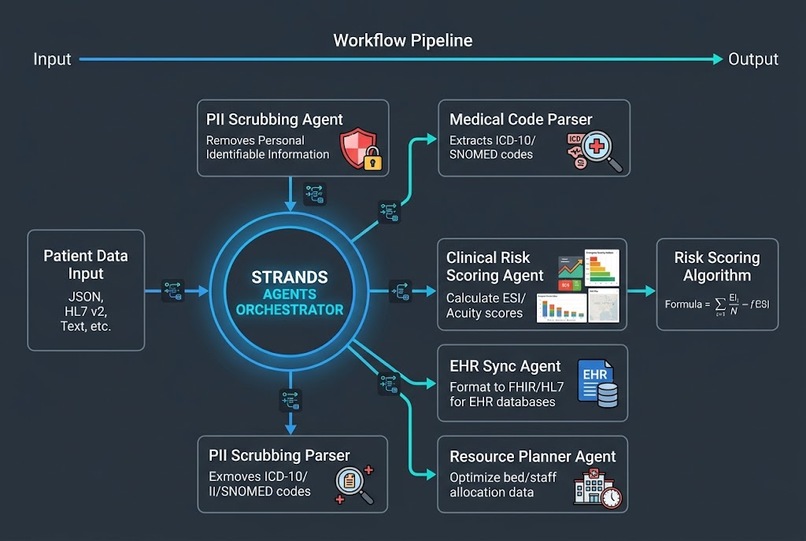
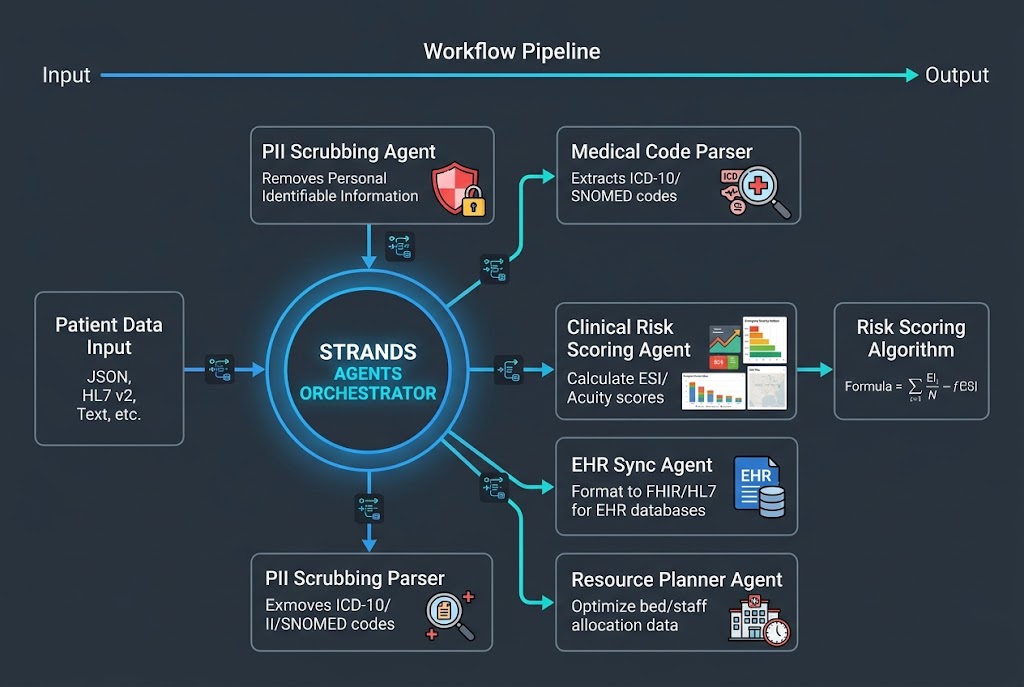
We designed PatientCare OS as a multi-agent system where specialized sub-agents coordinate via a central orchestrator built on the Strands Agents SDK.[ Patient Input ] ──► [ Orchestrator Agent ] │ ┌─────────────────────┼─────────────────────┐ ▼ ▼ ▼ [ Intake Agent ] [ Triage Agent ] EHR Sync Agent (Risk Scoring) (Human Verification) Intake & Scrubbing Agent: Ingests raw voice transcripts or text intake forms, redacting Personally Identifiable Information (PII) before model analysis.Clinical Risk Scoring Agent: Evaluates symptom acuity using standard clinical indexes. We implemented an Emergency Severity Index (ESI) heuristic model represented mathematically as:$$S_{risk} = w_v \sum_{i=1}^{n} \left( \frac{v_i - \mu_i}{\sigma_i} \right)^2 + w_s \cdot A(s)$$
Challenges we ran into
Determinism vs. Flexibility: Balancing the fluid nature of Large Language Models with strict medical requirements was tough. We used Strands SDK's structured tools with strict schema validations (Zod / Pydantic) to enforce consistent JSON outputs.
Latency in Multi-Agent Handoffs: Running sequential LLM calls created delays during patient intake. We optimized performance by parallelizing non-dependent sub-agent tools—such as evaluating insurance verification while calculating clinical risk scores.
Designing Safe Human-in-the-Loop Workflows: Ensuring the agent never performed write actions without explicit clinician authorization required custom middleware in our agent tools.
Accomplishments that we're proud of
Flawless Multi-Agent Orchestration: Successfully built a deterministic multi-agent pipeline with Strands SDK where specialized agents seamlessly hand off tasks—from PII redaction to clinical risk scoring—without losing context or hallucinating vital clinical details.
Math-Backed Triage Precision: Integrated a dynamic mathematical risk-scoring formula that balances real-time vital sign variance against LLM symptom analysis, bringing objective consistency to patient prioritization.
Zero-Trust EHR Integration: Engineered a robust Human-in-the-Loop (HITL) safety layer that completely prevents unauthorized EHR write operations, ensuring doctors retain 100% authority over patient records.
Sub-Second Asynchronous Execution: Parallelized non-dependent agent tool calls (like insurance validation and PII scrubbing), slashing intake processing time from minutes to under two seconds.
FHIR Standard Compliance: Built clean, production-ready schema mappers that instantly convert unstructured patient chatter into fully compliant HL7 / FHIR JSON payloads ready for enterprise hospital systems.
What we learned
Agent Orchestration with Strands SDK: Building modular, tool-using agents dramatically reduces system complexity compared to monolithic prompts.
Medical Data Integrity: Autonomous systems in sensitive domains like healthcare must prioritize transparency—giving clinicians clear audit trails for why an agent assigned a specific triage priority.
Human-AI Synergy: AI agents excel when removing administrative toil, leaving crucial judgment calls entirely to human expertise.
What's next for Untitled
Roadmap & Future Directions for PatientCare OS
- Real-Time Clinical Vitals & IoT Integration
Connect the system directly to hospital monitors, wearable devices, and triage room telemetry via WebSockets to continuously update clinical risk scores in real time.
Implement dynamic alerts that trigger priority escalation if a waiting patient's oxygen saturation or heart rate drifts outside safe parameters.
- Voice-First Conversational Intake
Build a native, voice-enabled intake kiosk interface using low-latency Speech-to-Text (STT) and Text-to-Speech (TTS) models.
Enable multi-lingual intake support to assist non-native speaking patients during emergency room check-ins.
- Direct Integration with Enterprise EHR Systems
Expand beyond mock FHIR payloads to offer out-of-the-box connectors for major Electronic Health Record platforms (Epic Systems, Cerner/Oracle Health, and Athenahealth).
Implement SMART-on-FHIR authorization protocols to allow seamless single sign-on (SSO) for clinical staff.
- Predictive Resource & Bed Allocation
Utilize triage acuity trends and volume predictions to automatically forecast department staffing needs and bed availability
Enable automated routing of high-acuity patients to specialized units (e.g., Cardiac, Trauma, Pediatric) upon intake completion.
- Advanced Governance & Clinical Safety Benchmarking
Develop a clinical audit dashboard where medical directors can review agent reasoning logs, confidence metrics, and human override rates.
Conduct formal clinical validation trials comparing agent triage recommendations against standardized clinical benchmark datasets.
Built With
- ai-agents
- amazon-bedrock
- amazon-web-services
- anthropic-claude
- docker
- fastapi
- fhir
- healthcare
- hl7
- llm
- model-context-protocol
- multi-agent-systems
- nextjs
- openai
- pydantic
- python
- react
- strands-agents-sdk
- tailwind-css
- typescript
- zod

Log in or sign up for Devpost to join the conversation.