About the Project
Inspiration
The inspiration behind the Healthcare Diagnostic Assistant project stemmed from the pressing need to leverage AI technology to improve healthcare outcomes. We were inspired by the potential of AI to assist healthcare professionals in diagnosing illnesses, interpreting medical images, and providing timely recommendations for patient care. Witnessing the challenges faced by healthcare providers in managing large volumes of medical data and making accurate diagnoses, we saw an opportunity to develop an AI-powered assistant that could augment their capabilities and streamline the diagnostic process.
What We Learned
Throughout the development process, we gained valuable insights into the intersection of AI technology and healthcare diagnostics. Some key learnings include:
- Medical Domain Knowledge: Understanding the complexities of medical terminology, diagnostic procedures, and healthcare protocols.
- Data Handling and Privacy: Managing sensitive medical data while adhering to strict privacy regulations such as HIPAA (Health Insurance Portability and Accountability Act).
- Model Selection and Optimization: Selecting appropriate AI models and optimizing them for healthcare-specific tasks such as medical image analysis and natural language processing (NLP).
- Integration with Healthcare Systems: Integrating the assistant seamlessly into existing healthcare workflows and electronic medical record (EMR) systems.
- Ethical Considerations: Addressing ethical considerations such as bias mitigation, transparency, and accountability in AI-driven healthcare applications.
How We Built It
The Healthcare Diagnostic Assistant was built using a combination of AI technologies and frameworks, including:
- Transformers Library: Leveraging the Hugging Face Transformers library for natural language processing (NLP) tasks and model inference.
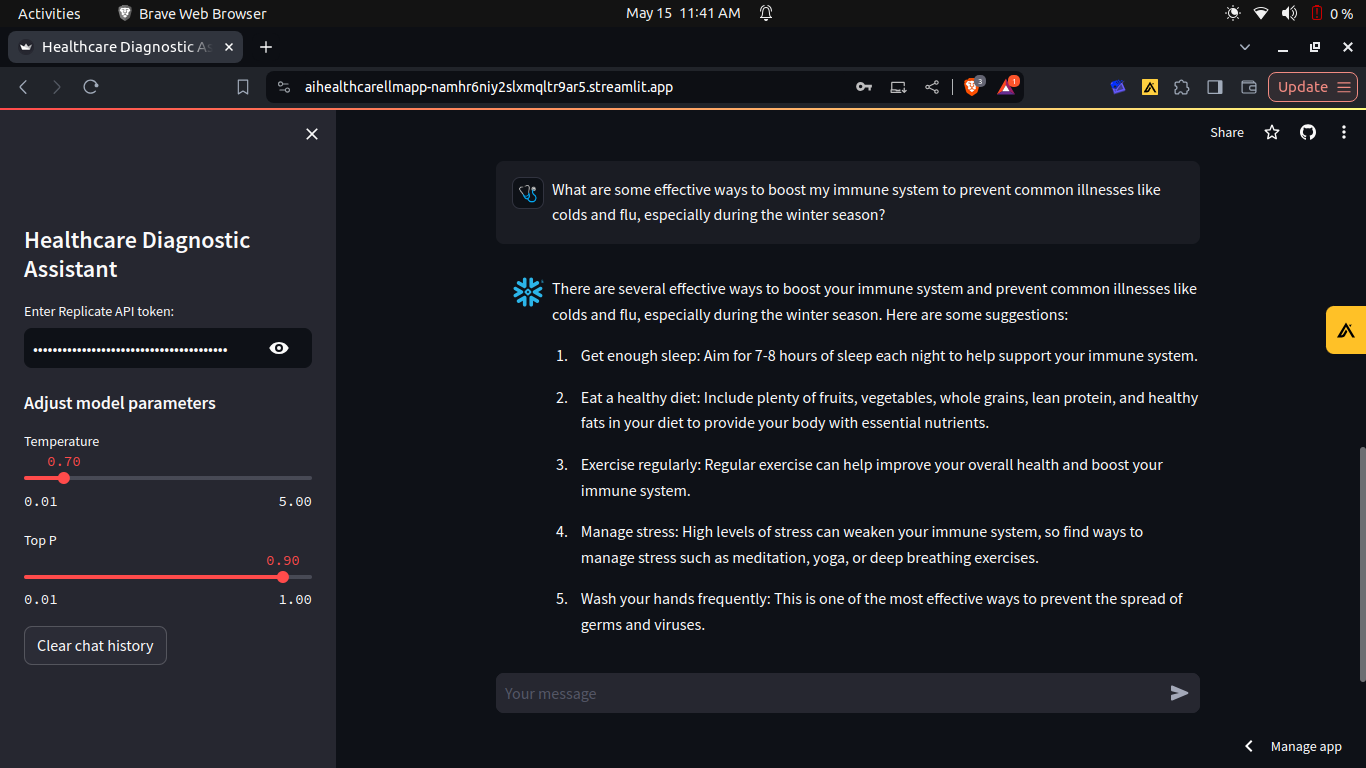
- Streamlit: Utilizing the Streamlit framework for building the user interface and enabling real-time interaction with the assistant.
- Replicate API: Integrating with the Replicate API for model inference, enabling scalable and efficient deployment of AI models.
- AutoTokenizer: Employing the AutoTokenizer module from the Transformers library for tokenization and preprocessing of input text data.
The development process involved iterative testing, feedback collection from healthcare professionals, and continuous refinement of the assistant's capabilities to ensure its effectiveness and usability in real-world healthcare settings.
Challenges We Faced
Several challenges were encountered during the development of the Healthcare Diagnostic Assistant, including:
- Data Quality and Availability: Accessing high-quality labeled medical datasets for training AI models while ensuring patient privacy and data security.
- Model Interpretability: Ensuring the transparency and interpretability of AI-generated diagnostic recommendations to facilitate clinical decision-making.
- Regulatory Compliance: Navigating regulatory requirements and compliance standards in the healthcare industry, particularly regarding data privacy and medical device regulations.
- User Acceptance: Building trust and acceptance among healthcare professionals for AI-driven diagnostic tools, addressing concerns about reliability, accuracy, and accountability.
Accomplishments We're Proud Of
- Successfully developing an AI-powered assistant capable of providing diagnostic recommendations and support to healthcare professionals.
- Designing a user-friendly interface that facilitates seamless interaction between healthcare providers and the AI assistant.
- Overcoming technical challenges and regulatory hurdles to deploy a scalable and secure solution in healthcare environments.
- Establishing partnerships and collaborations with healthcare institutions and professionals to validate the effectiveness and utility of the assistant in clinical settings.
What's Next for Healthcare Diagnostic Assistant
- Continuous Improvement: Iteratively enhancing the assistant's capabilities based on user feedback and advances in AI technology.
- Integration with Medical Devices: Integrating with medical imaging devices and diagnostic equipment to enable real-time analysis and interpretation of medical data.
- Clinical Validation Studies: Conducting rigorous clinical validation studies to evaluate the performance and impact of the assistant on healthcare outcomes.
- Expansion to New Healthcare Domains: Extending the assistant's capabilities to address a broader range of healthcare domains and specialties, such as radiology, pathology, and telemedicine.
- Global Deployment: Scaling the deployment of the assistant globally to reach healthcare providers in diverse geographic regions and healthcare settings.

Log in or sign up for Devpost to join the conversation.