Inspiration
Healthcare is one of the areas where timely access to information can make a significant difference. We were inspired by the difficulty people often face when trying to understand their symptoms, especially when immediate access to a healthcare professional is not available. This motivated us to build a Healthcare Diagnosis Assistant Agent that can provide preliminary guidance by analyzing symptoms and suggesting possible health conditions, while encouraging users to consult qualified medical professionals for proper diagnosis and treatment.
What We Learned
Through this project, we learned how to combine Artificial Intelligence, natural language processing, healthcare knowledge, and user-friendly interfaces to solve a real-world problem. We also learned that healthcare applications require more than simply generating predictions—they must communicate uncertainty clearly, handle sensitive information responsibly, and prioritize user safety.
We gained practical experience in:
Designing an AI-powered healthcare assistant Processing and understanding user-provided symptoms Developing a conversational interface Connecting AI models with application logic Structuring medical information for easier understanding Handling edge cases and potentially urgent symptoms Designing responsible AI behavior for a high-stakes domain
How We Built It
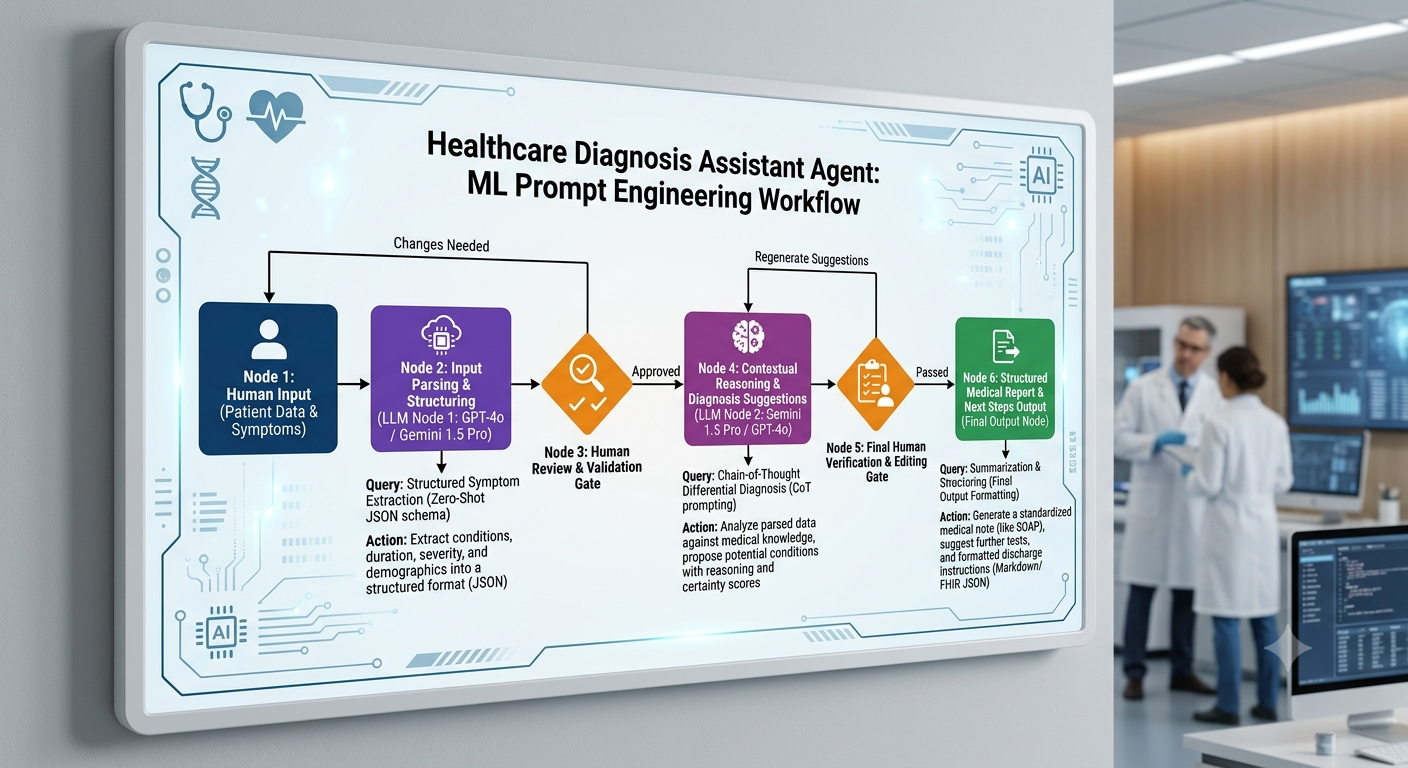
The Healthcare Diagnosis Assistant Agent works by taking information provided by the user, such as symptoms, their duration, severity, medical history, and other relevant details. The system processes this information and analyzes it against its medical knowledge and reasoning system.
A simplified workflow is:
User Symptoms→Information Processing→AI Analysis→Possible Conditions→Risk Assessment→Guidance
The agent is designed to ask relevant follow-up questions when additional information is needed. Instead of presenting its output as a definitive diagnosis, it provides possible conditions and general guidance, helping users understand what they may need to do next.
We focused on making the interface simple and conversational so that users can describe their symptoms naturally without needing medical terminology.
Challenges We Faced
One of our biggest challenges was dealing with the complexity and uncertainty of medical symptoms. Many different conditions can have similar symptoms, making it inappropriate to treat a single prediction as a definitive diagnosis.
Another challenge was designing the system to be safe and responsible. We needed to ensure that the assistant would not encourage users to self-diagnose or delay professional care when serious warning signs are present. We therefore focused on communicating uncertainty, identifying potentially urgent situations, and recommending professional medical evaluation when appropriate.
We also faced challenges in organizing healthcare information, handling different ways users describe the same symptom, and creating a system that is both technically useful and easy for non-technical users to understand.
What's Next
In the future, we would like to improve the agent with more reliable medical knowledge sources, better personalization, multilingual support, integration with health records and wearable devices, and stronger safety and evaluation mechanisms.
Our goal is not to replace doctors, but to build an accessible first layer of healthcare information and guidance that can help people better understand their symptoms and make more informed decisions about seeking medical care.
Built With
- ai
- analysis
- api
- artificial
- base
- conversational
- css
- fastapi
- healthcare
- html
- intelligence
- javascript
- knowledge
- language
- large
- learning
- machine
- medical
- models
- natural
- processing
- python
- react
- rest
- symptom

Log in or sign up for Devpost to join the conversation.