Inspiration
In many underserved regions, access to timely and accurate healthcare is a serious challenge. We were inspired by the idea of putting a smart, caring doctor in everyone’s pocket—especially in communities with limited access to medical professionals. We wanted to build a tool that empowers individuals to understand their symptoms, get personalized treatment guidance, and make better health decisions with the help of AI.
What it does
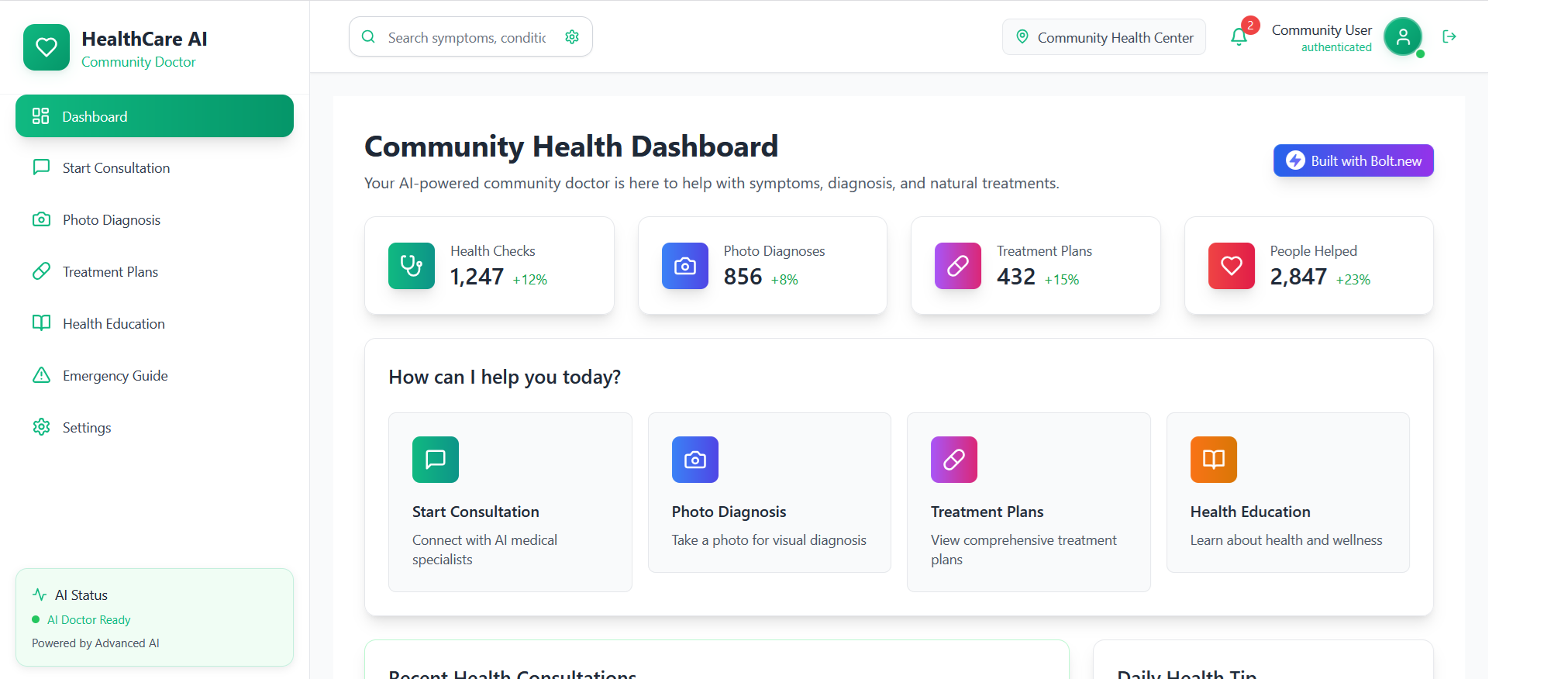
HealthCare AI – Community Doctor is a smart assistant that empowers users to: - Check symptoms and get likely diagnoses. - Analyze medical photos (e.g. skin rashes, X-rays, MRI, CT scans). - Receive full treatment plans including natural remedies, healing foods, medications, and how to take them.
- View health education and prevention tips.
- Access emergency guides for life-threatening conditions.
- Manage care settings with personalized AI and notification controls.
- Buy recommended medications and food items via Paystack or Stripe.
How we built it
We built the frontend using React and styled it with Tailwind CSS. We structured the app into modular pages such as: - Dashboard - Symptom Checker - Photo Diagnosis - Treatment Plans - Health Education - Emergency Guide - Settings The backend was developed in Node.js (Express) and connected to Supabase. We used AI services like OpenAI and Gemini for language and image understanding. All sensitive keys are stored securely in a .env file. The app is optimized for mobile and deployed Vercel with support for Supabase as the database.
Challenges we ran into
- Ensuring DICOM and medical image support across devices was complex.
- Balancing natural remedies with standard medications for diverse users required careful curation.
- Making AI outputs safe, interpretable, and personalized for non-technical users.
- Managing state and responsiveness across multiple screen sizes.
- Handling secure AI and payment integrations while preserving user privacy.
Accomplishments that we're proud of
- Built a fully functional, mobile-first digital health assistant.
- Enabled multi-modal diagnosis through symptoms and medical photo analysis.
- Delivered AI-powered treatment plans including voice reminders and prevention strategies.
- Integrated e-commerce for users to easily purchase prescribed items.
- Built a solution that could significantly impact underserved populations globally.
What we learned
- AI can meaningfully enhance healthcare access when applied responsibly.
- User experience in health tech must prioritize clarity, comfort, and accessibility.
- Building for real-world use requires anticipating edge cases, especially in low-resource environments.
- Securing APIs and health data from the start saves a lot of time and trust later.
What's next for HealthCare AI – Community Doctor
We're now focused on: - Adding more regional languages and dialects for inclusivity. - Partnering with clinics and pharmacies to expand real-world use. - Training our own health-specific AI models tailored to African medical datasets. - Adding offline mode for remote users with low internet access. - Integrating telemedicine so patients can speak with real doctors when needed.
Built With
- css
- express.js
- gemini
- javascript
- lucide
- node.js
- openai
- paystack
- react
- stripe
- supabase
- tailwind
- typescript
- vercel
- vite


Log in or sign up for Devpost to join the conversation.