-
-
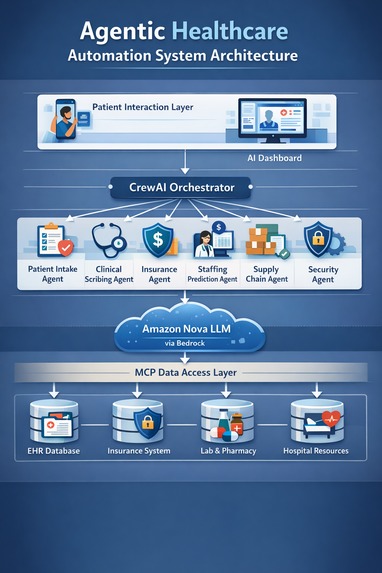
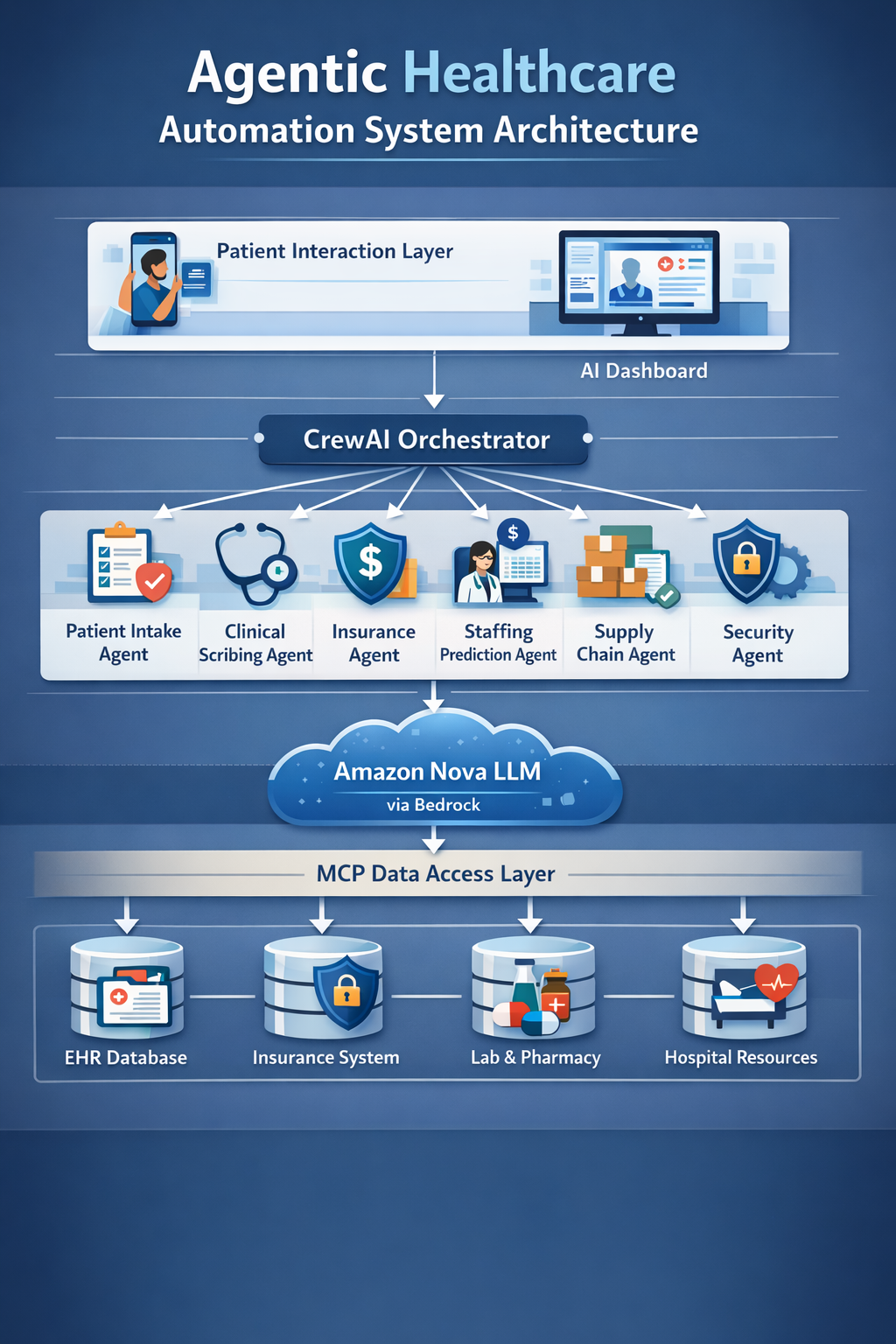
This is the overall system architecture.
Inspiration
Healthcare systems around the world face a major operational challenge: clinicians and hospital staff spend a significant portion of their time on administrative and operational tasks rather than direct patient care. Studies show that doctors can spend up to 50% of their time on electronic health record documentation, insurance approvals, and workflow management instead of interacting with patients.
At the same time, hospitals struggle with fragmented systems, manual processes, staffing shortages, and inefficient communication between departments such as laboratories, pharmacies, insurance providers, and patient services.
This project was inspired by the idea of using autonomous AI agents to automate hospital workflows. Instead of relying on a single AI assistant, the system introduces multiple specialized agents that collaborate together, each responsible for a specific task such as clinical documentation, insurance authorization, staffing prediction, and supply chain monitoring.
By combining Agentic AI, Amazon Nova foundation models, and CrewAI orchestration, the goal is to demonstrate how hospitals could operate with an intelligent AI layer that coordinates administrative and operational tasks automatically.
Ultimately, the vision is to reduce administrative burden, improve hospital efficiency, and allow healthcare professionals to focus on what matters most: patient care.
What it does
This project is an Agentic Healthcare Workflow Automation System that simulates how autonomous AI agents can streamline and coordinate hospital operations. The platform uses multiple specialized AI agents that collaborate together to automate key clinical and administrative workflows inside a hospital environment.
The system includes the following intelligent agents:
Patient Intake Agent
Collects patient information such as symptoms, age, and insurance details, and generates structured patient records.
Clinical Scribing Agent
Automatically converts doctor–patient conversations into structured clinical notes, reducing the documentation burden on clinicians.
Insurance Authorization Agent
Analyzes diagnoses and treatment plans to automatically verify insurance eligibility and generate prior authorization requests.
Staffing Prediction Agent
Uses hospital data to predict patient inflow and recommend optimal staffing levels to ensure proper nurse-to-patient ratios.
Supply Chain Agent
Monitors medical inventory and alerts hospital administrators when critical supplies or medications fall below required thresholds.
Cybersecurity Monitoring Agent
Continuously monitors system activity to detect anomalies and protect sensitive healthcare data.
All agents are coordinated by a CrewAI orchestrator, while Amazon Nova LLM provides the reasoning capabilities for decision making. Agents securely access healthcare data using Model Context Protocol (MCP) and simulated FHIR-based healthcare APIs.
Together, these agents simulate a complete hospital workflow—from patient intake and clinical documentation to insurance processing and operational management—demonstrating how agentic AI can significantly improve healthcare efficiency and reduce administrative overhead.
How we built it
We built the system as a multi-agent healthcare automation platform where different AI agents collaborate to simulate real hospital workflows.
The backend of the project was developed using Python, with CrewAI used as the multi-agent orchestration framework. Each agent in the system was designed with a specific role, such as patient intake, clinical documentation, insurance authorization, staffing prediction, and supply chain monitoring.
To power the reasoning and decision-making capabilities of these agents, we integrated Amazon Nova foundation models through Amazon Bedrock. These models enable agents to understand clinical conversations, generate structured medical notes, and make workflow decisions.
The system architecture includes a central orchestrator agent that coordinates multiple specialized agents and manages task delegation across the workflow. Each agent performs its task and passes structured outputs to the next agent in the pipeline.
To simulate healthcare interoperability, we implemented a lightweight Model Context Protocol (MCP) data layer, allowing agents to securely access external resources such as patient records, insurance data, hospital inventory, and staffing information. Healthcare data structures were modeled using simplified FHIR-style JSON formats.
We also created example datasets for patients, hospital staffing history, insurance rules, and medical inventory to simulate real hospital operations.
For demonstration purposes, we built a simple interface and workflow runner that shows how a patient visit flows through the system—from patient intake and clinical documentation to insurance authorization, staffing prediction, and inventory monitoring.
Overall, the project demonstrates how agentic AI systems can coordinate complex healthcare workflows using collaborative AI agents powered by modern foundation models.
Challenges we ran into
One of the biggest challenges was designing a multi-agent architecture that could realistically simulate how different departments in a hospital interact with each other. Healthcare workflows are complex and involve many independent systems such as electronic health records, insurance providers, laboratory systems, and pharmacy databases. Coordinating these interactions through autonomous agents required careful planning of agent roles and data flow.
Another challenge was simulating healthcare interoperability. Real hospitals rely heavily on standards such as FHIR APIs and secure data exchange protocols, but accessing real hospital systems is not possible in a prototype environment. To solve this, we created simplified datasets and simulated FHIR-style resources so agents could interact with structured healthcare data.
Integrating Amazon Nova models via Amazon Bedrock was also challenging, particularly in designing prompts that allowed agents to generate structured outputs like clinical notes, insurance requests, and workflow summaries.
Additionally, designing agents that could collaborate effectively through CrewAI orchestration required multiple iterations to ensure that tasks were properly delegated and outputs from one agent could be used as inputs for another.
Finally, since this project simulates an entire hospital workflow, we needed to balance realistic healthcare functionality with a lightweight prototype that could still demonstrate the power of agentic AI within a short development time.
Accomplishments that we're proud of
One of the accomplishments we are most proud of is successfully designing and implementing a multi-agent healthcare workflow system where multiple AI agents collaborate to simulate real hospital operations.
We were able to build a working prototype that demonstrates how agentic AI can automate several critical hospital processes, including patient intake, clinical documentation, insurance authorization, staffing prediction, and supply chain monitoring.
Another key achievement was integrating Amazon Nova foundation models via Amazon Bedrock to power the reasoning capabilities of the agents. This allowed the system to generate structured clinical notes, analyze workflow data, and make intelligent decisions across different stages of the hospital workflow.
We also successfully implemented CrewAI-based agent orchestration, enabling different specialized agents to communicate and coordinate tasks through a centralized orchestrator. This demonstrates how complex healthcare workflows can be managed by collaborative AI systems rather than isolated automation tools.
Additionally, we created a simulated healthcare data environment using MCP-based access and FHIR-style data structures, allowing agents to interact with patient records, insurance information, staffing data, and inventory resources in a realistic way.
Overall, we are proud that this project showcases how agentic AI systems can transform hospital operations by reducing administrative workload, improving operational efficiency, and allowing healthcare professionals to focus more on patient care.
What we learned
Through this project, we gained valuable insights into how agentic AI systems can coordinate complex real-world workflows such as those found in healthcare environments.
One of the key things we learned was how to design collaborative multi-agent architectures using CrewAI. Instead of relying on a single AI model, we created specialized agents with different roles that work together through a centralized orchestrator. This approach makes it easier to break down complex hospital processes into manageable tasks.
We also learned how to integrate Amazon Nova foundation models through Amazon Bedrock to power intelligent decision-making. Prompt design and structured outputs were especially important for tasks like generating clinical notes and workflow summaries.
Another important learning experience was understanding healthcare interoperability concepts, such as FHIR-based data structures and secure data access through Model Context Protocol (MCP). Even though this was a simulated environment, it helped us understand how real healthcare systems exchange data between hospitals, laboratories, insurance providers, and pharmacies.
Additionally, we learned how to design systems that balance realistic healthcare functionality with lightweight prototypes, which is essential when building projects within limited time during hackathons.
Overall, this project helped us deepen our understanding of agent-based AI systems, healthcare workflow automation, and the potential of foundation models to transform complex industries like healthcare.
What's next for HEALTHCARE AGENTIC SYSTEM
The current prototype demonstrates the potential of agentic AI in healthcare, and the next step is to evolve it into a real-world, scalable hospital AI platform.
One of the primary goals is to integrate with real hospital systems, including Electronic Health Records (EHR), laboratory systems, and insurance providers using secure FHIR APIs. This would allow the agents to operate on live data and support real clinical workflows.
We also plan to enhance the system by introducing more advanced agents such as:
- Autonomous Emergency Triage Agents for prioritizing critical patients
- Radiology AI Agents for analyzing medical images like X-rays and MRIs
- Medication Safety Agents to prevent drug interactions and prescription errors
- Real-time Patient Monitoring Agents for predicting health deterioration
Another key direction is improving multi-modal capabilities, enabling the system to process not only text but also voice, medical images, and sensor data using advanced foundation models.
We aim to deploy the system on scalable cloud infrastructure using AWS services, making it capable of handling real-time hospital workloads with high reliability and security.
In the long term, this project can evolve into a full-fledged “AI Operating System for Hospitals”, where autonomous agents manage end-to-end healthcare workflows, reduce administrative burden, improve efficiency, and ultimately enhance patient outcomes.
This vision brings us closer to a future where AI works alongside healthcare professionals to deliver faster, safer, and more accessible care.

Log in or sign up for Devpost to join the conversation.