-
-
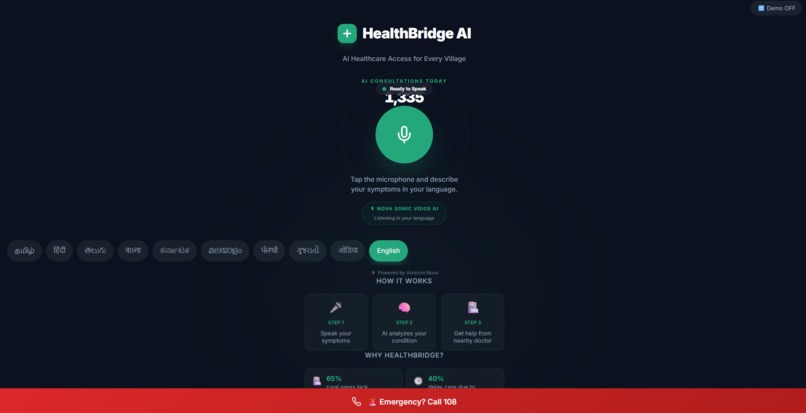
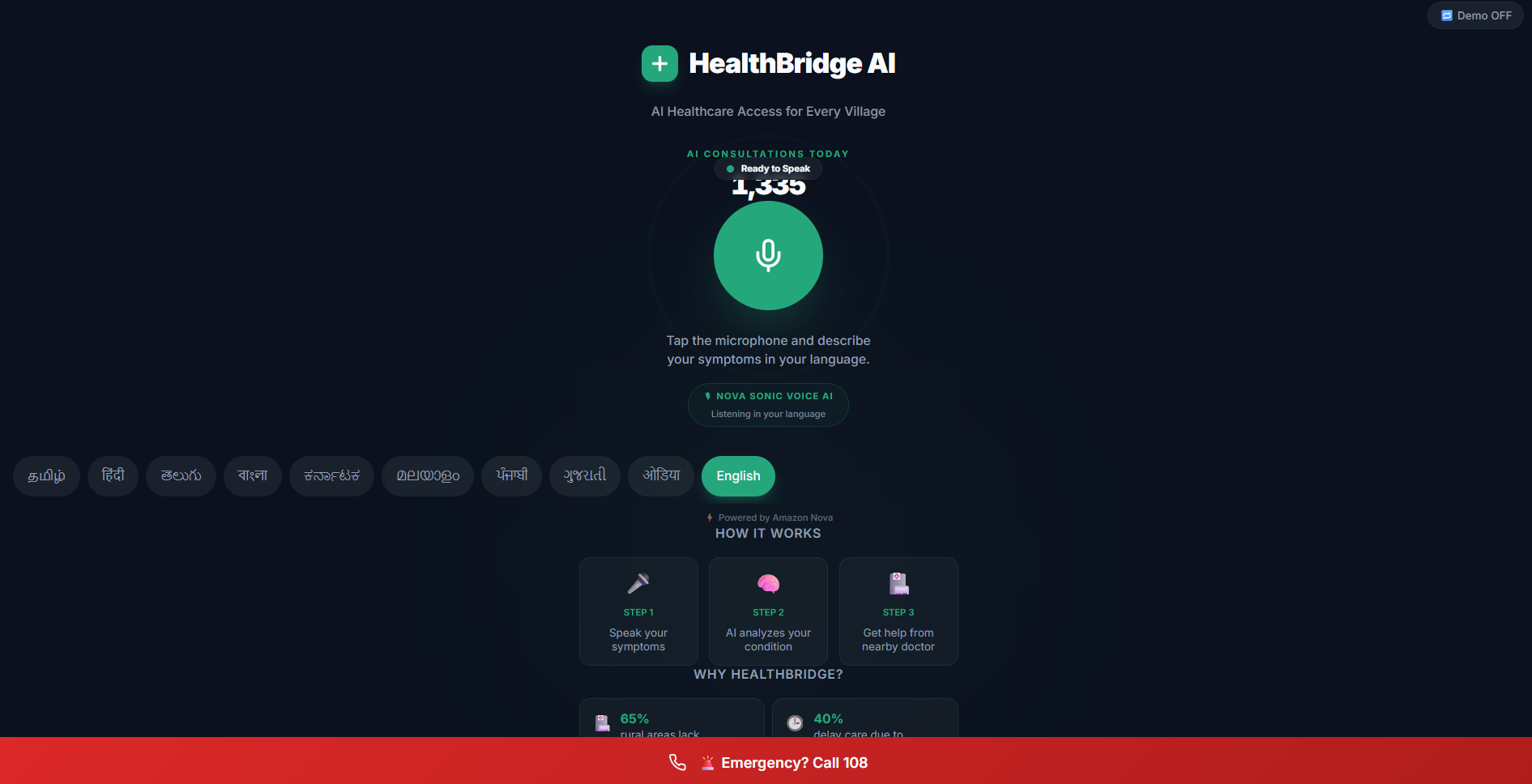
HealthBridge AI landing page where users start a consultation by speaking symptoms in their native language.
-
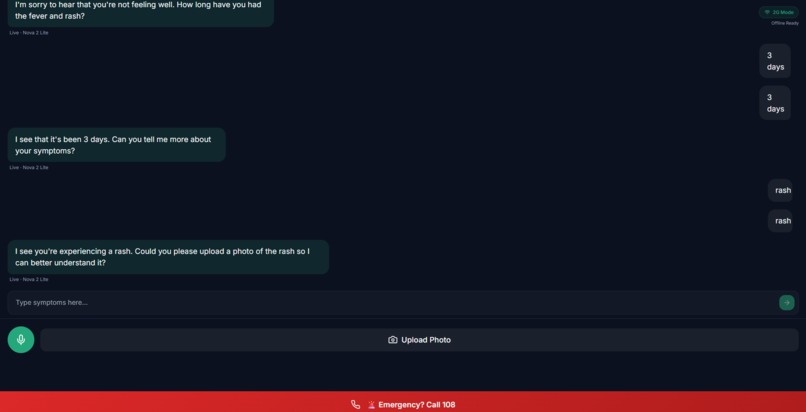
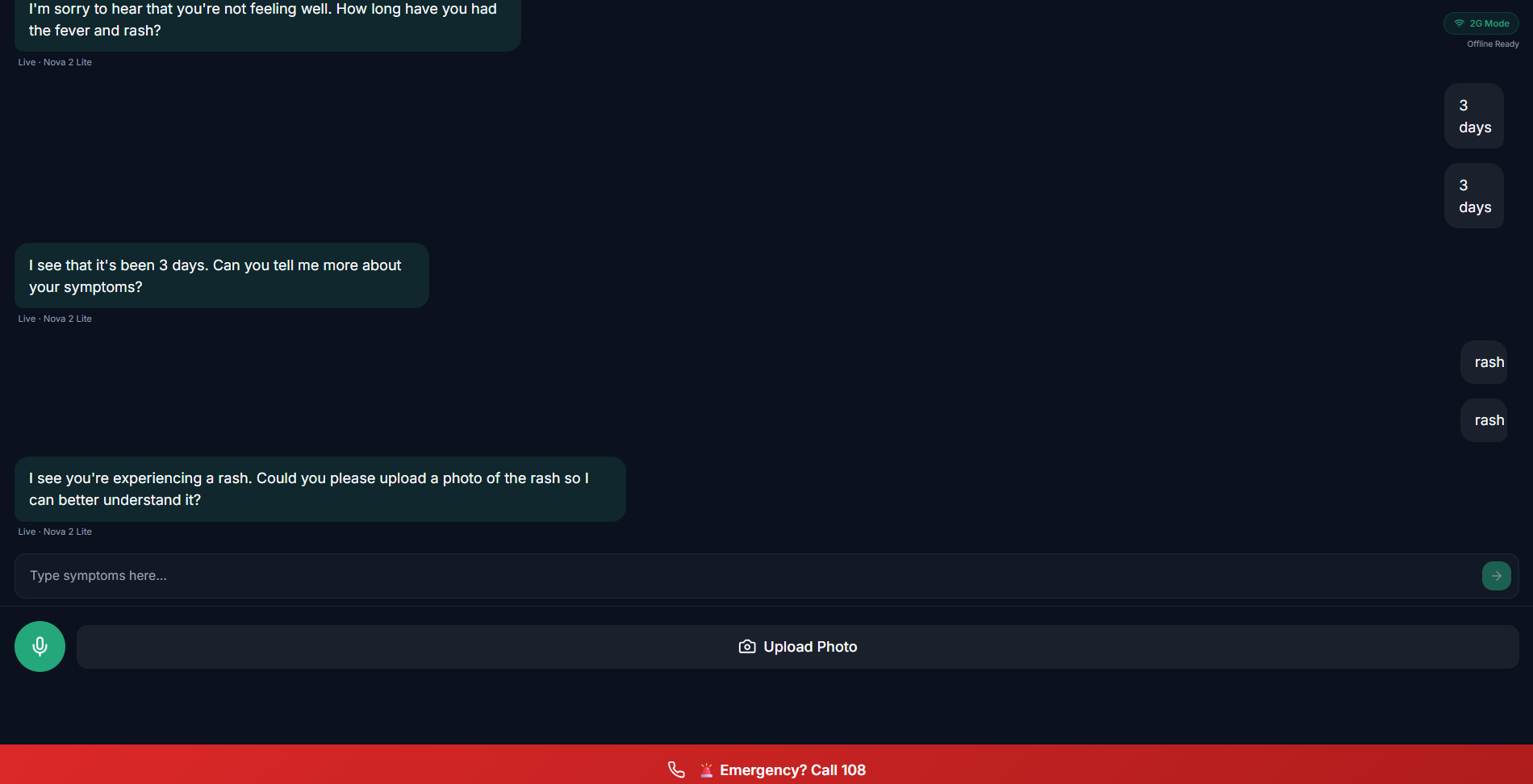
Real-time AI voice consultation powered by Nova Sonic, collecting symptoms directly from patient speech.
-
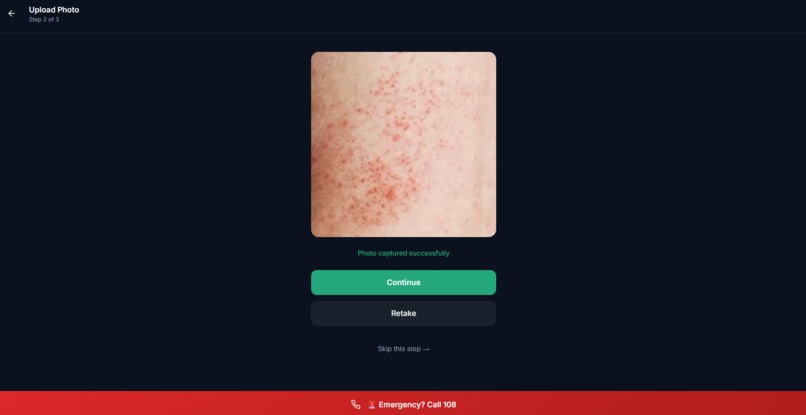
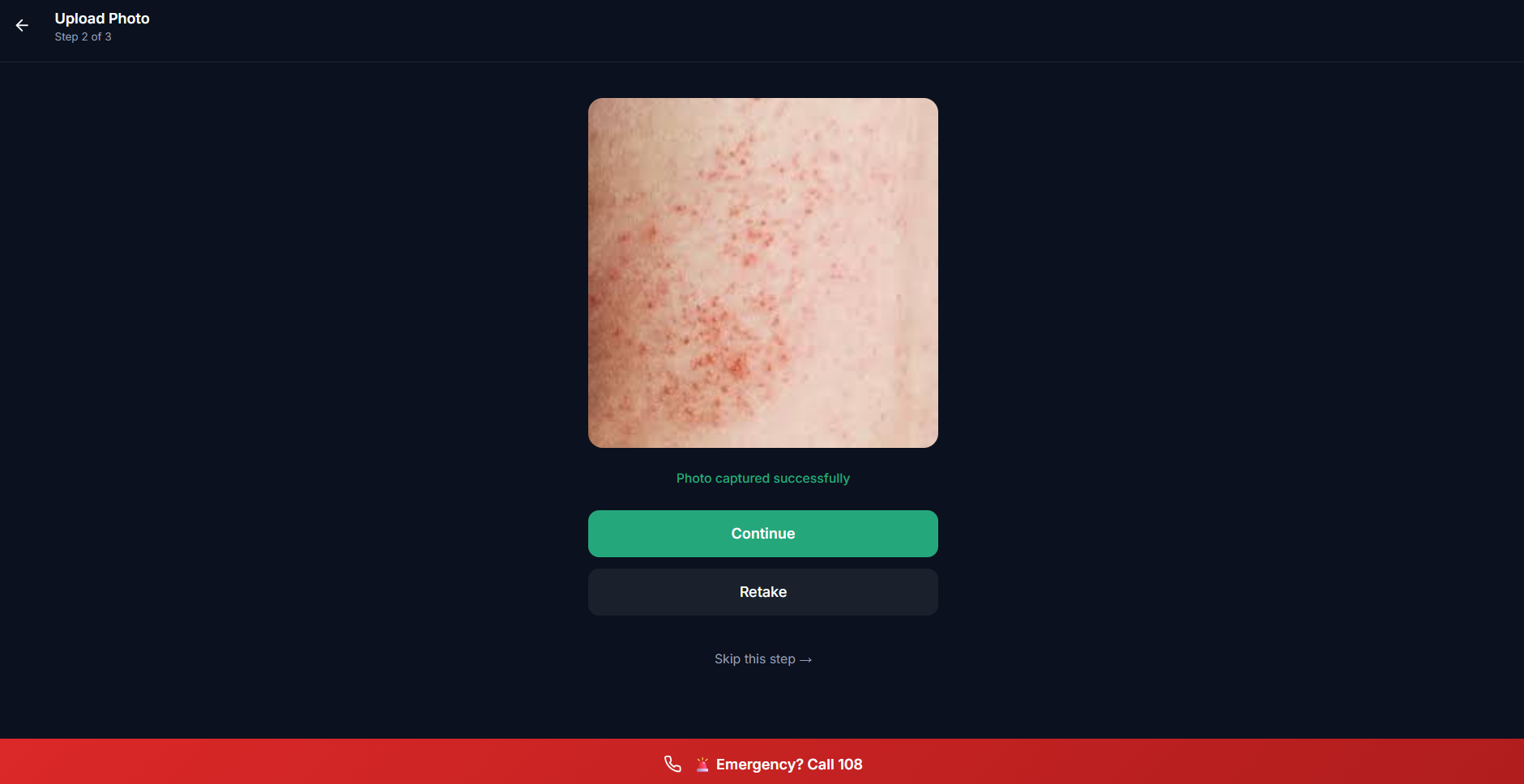
Patients can upload images of symptoms (such as rashes or wounds) for multimodal AI analysis using Nova Vision.
-
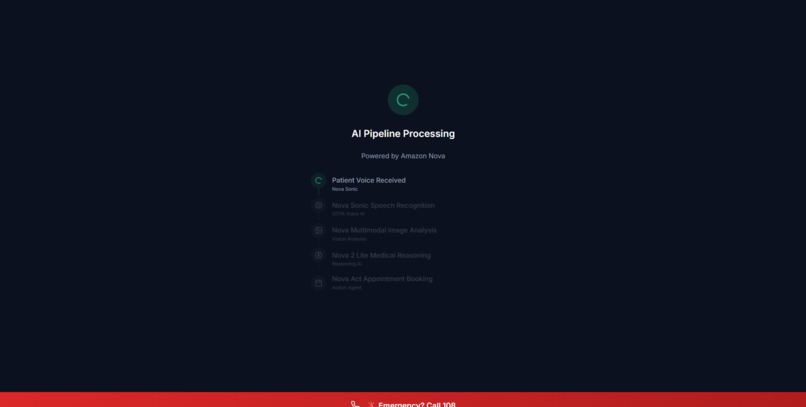
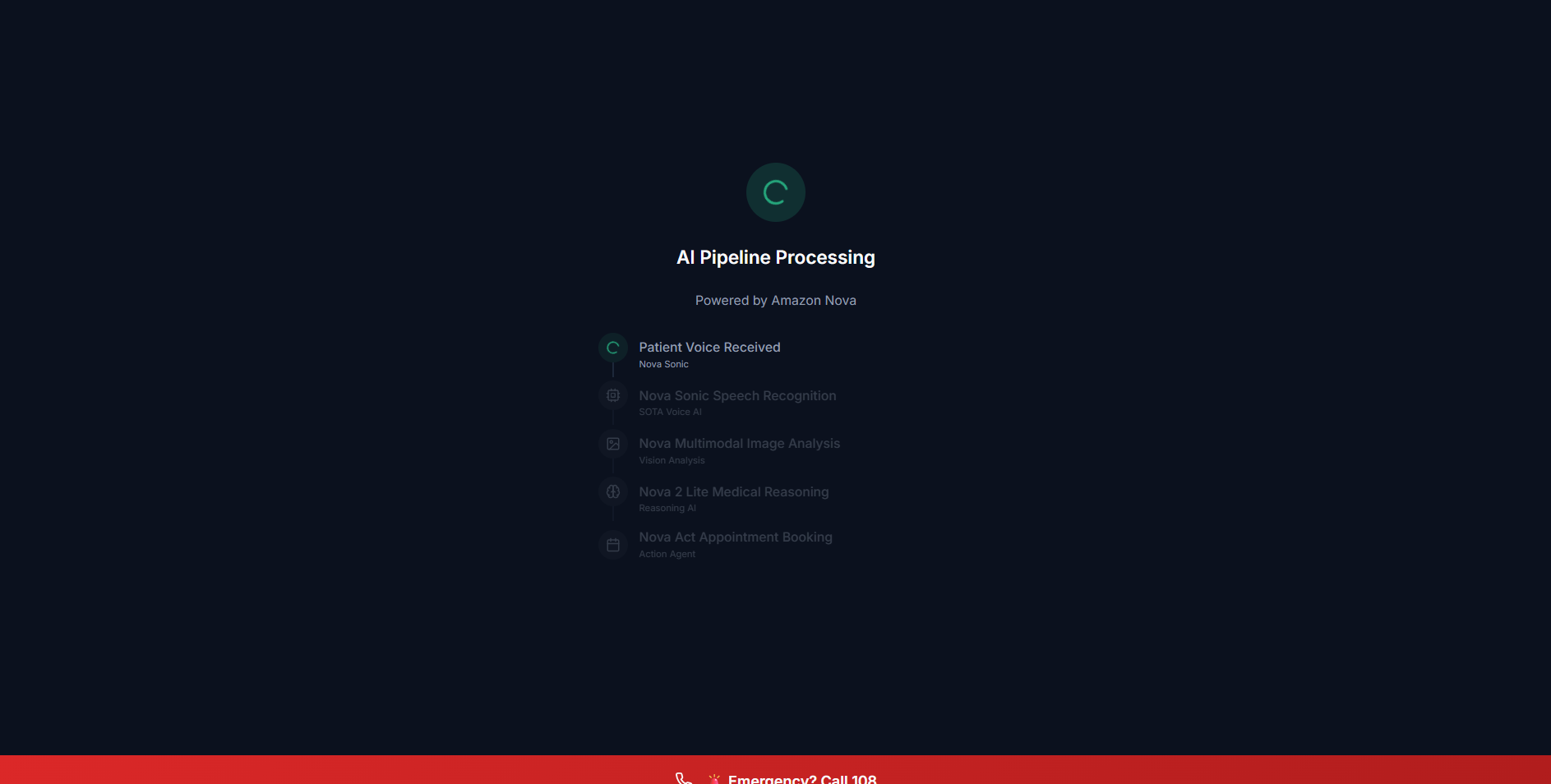
AI pipeline processing: voice recognition, image analysis, medical reasoning, and triage generation.
-
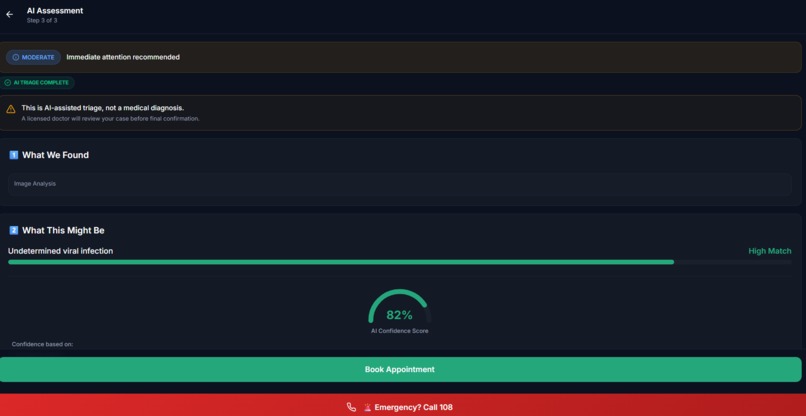
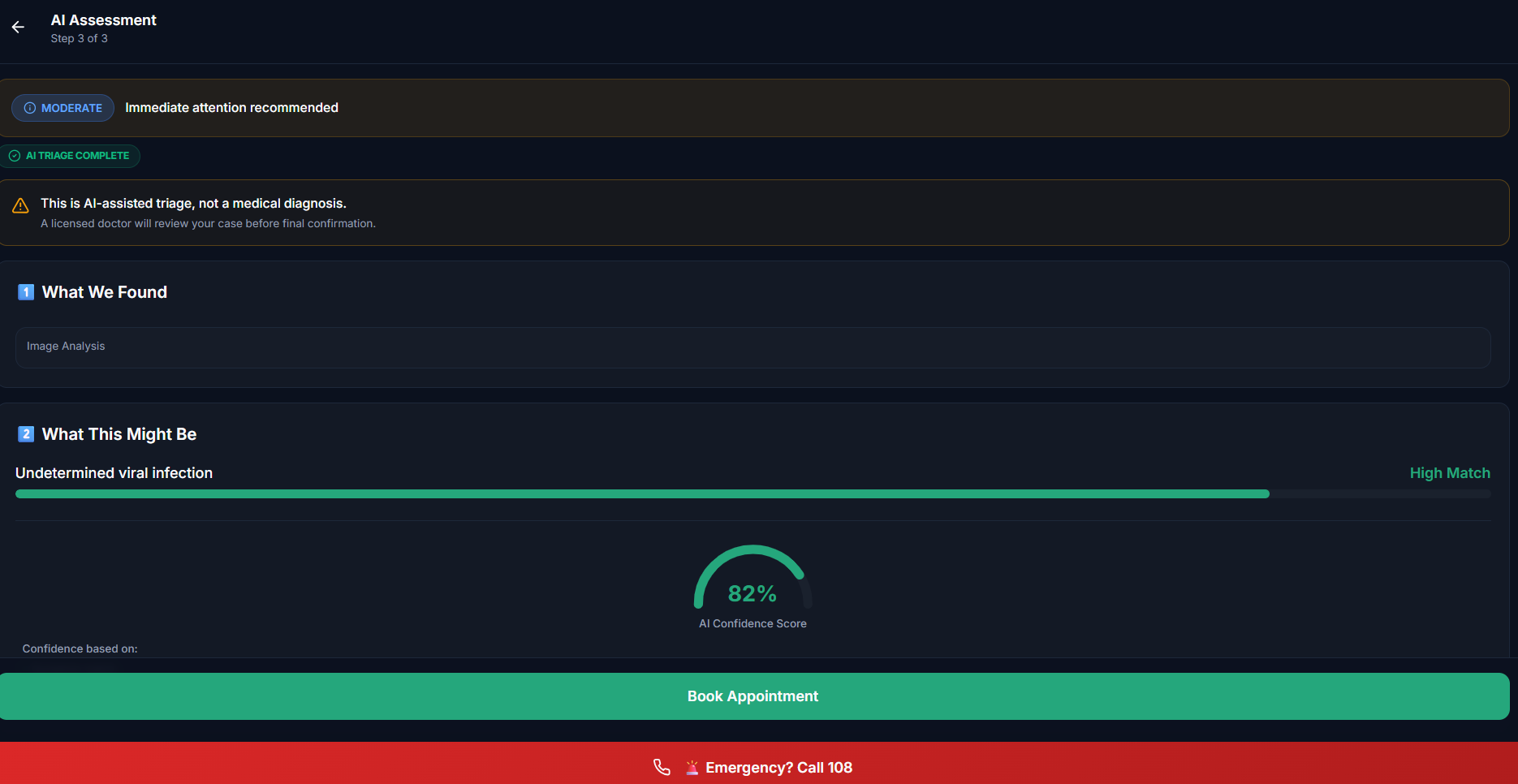
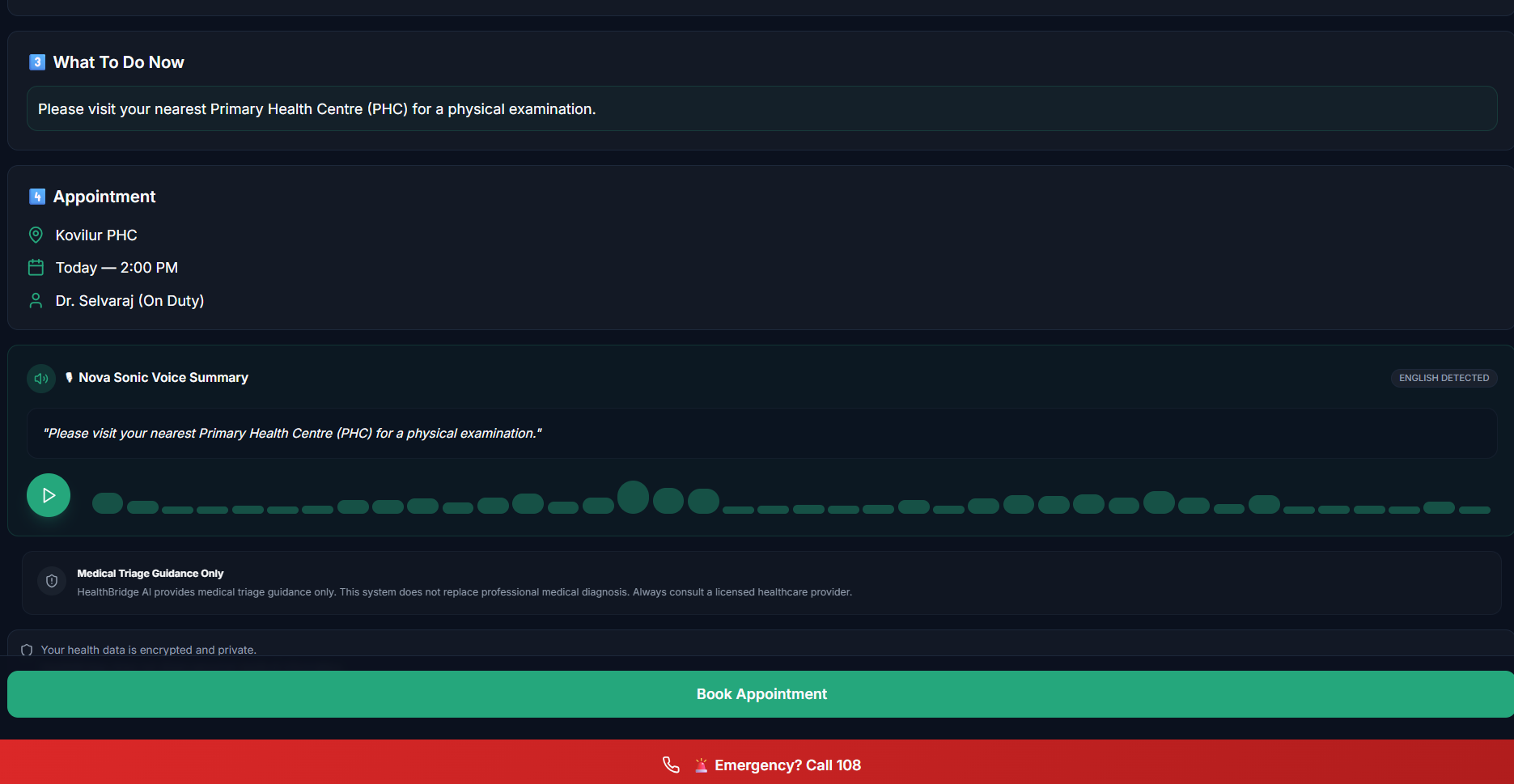
Final AI triage result showing confidence score, condition assessment, and recommended medical action.
-
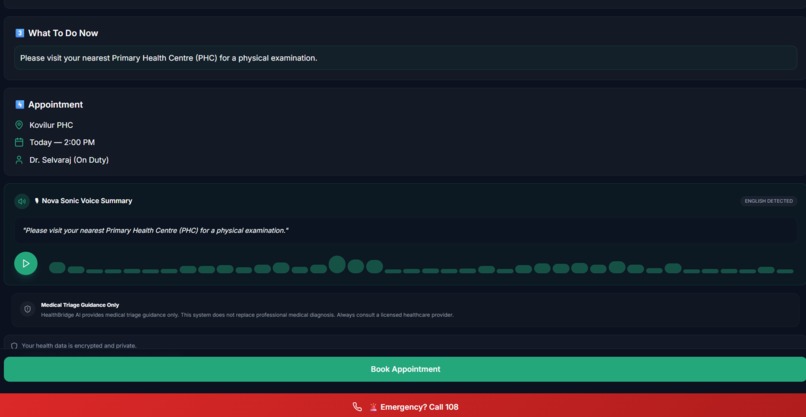
HealthBridge automatically routes patients to the nearest Primary Health Centre and recommends a consultation.
-
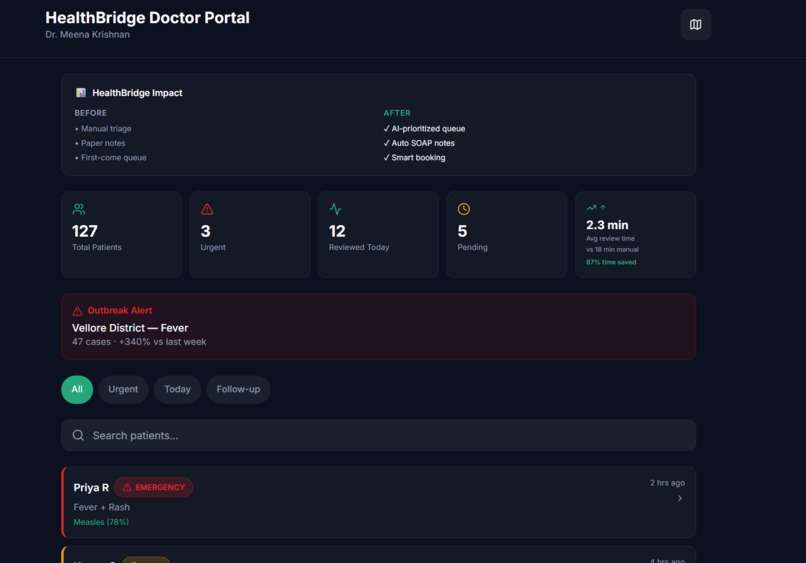
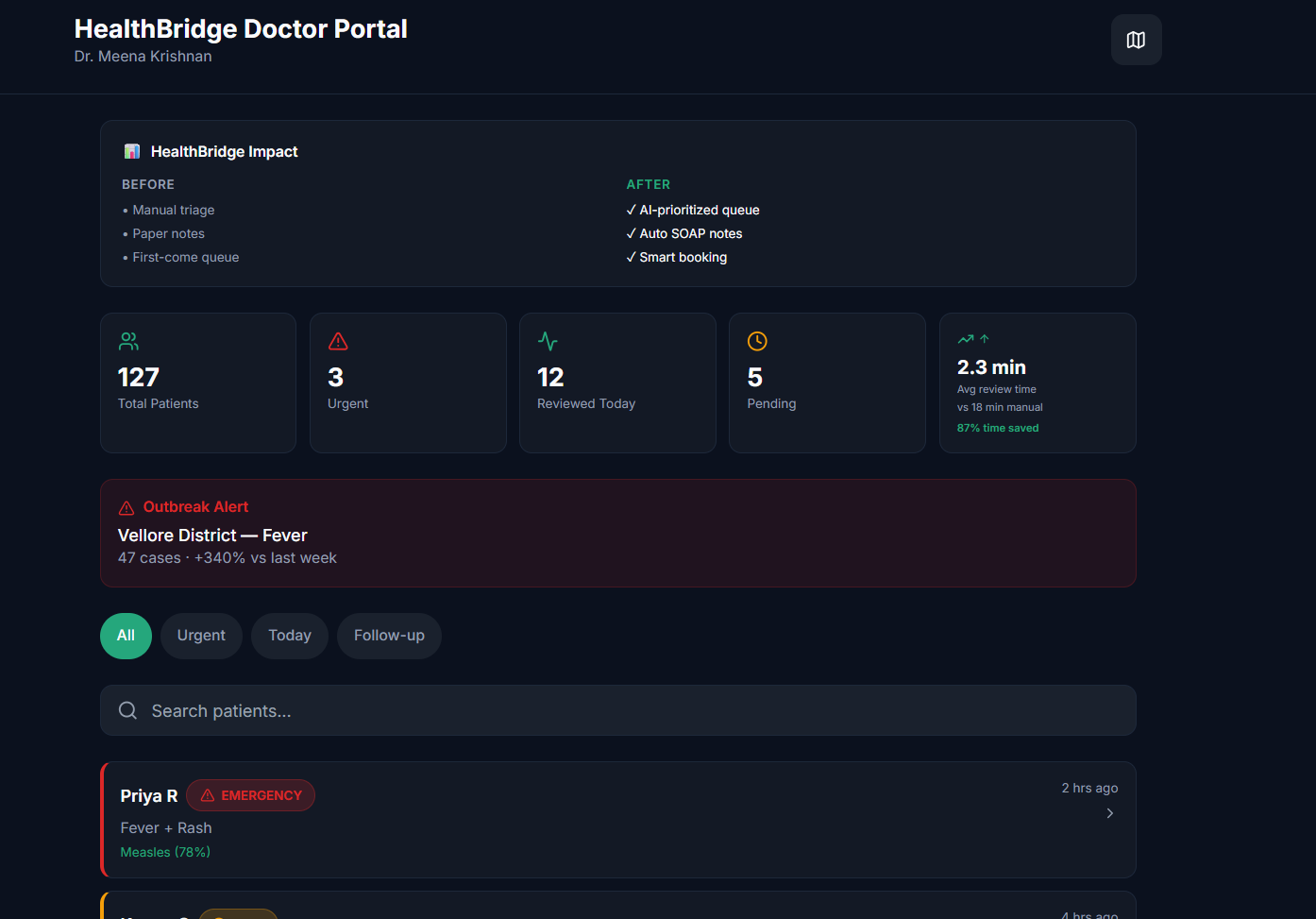
Doctor dashboard showing AI triage results, reasoning trace, and patient consultation status.
-
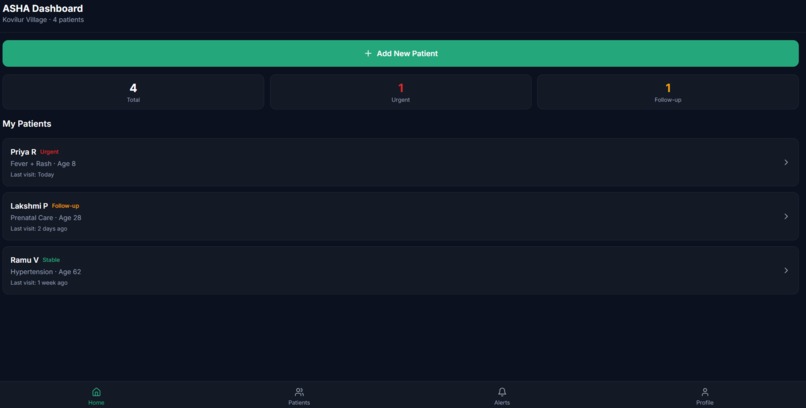
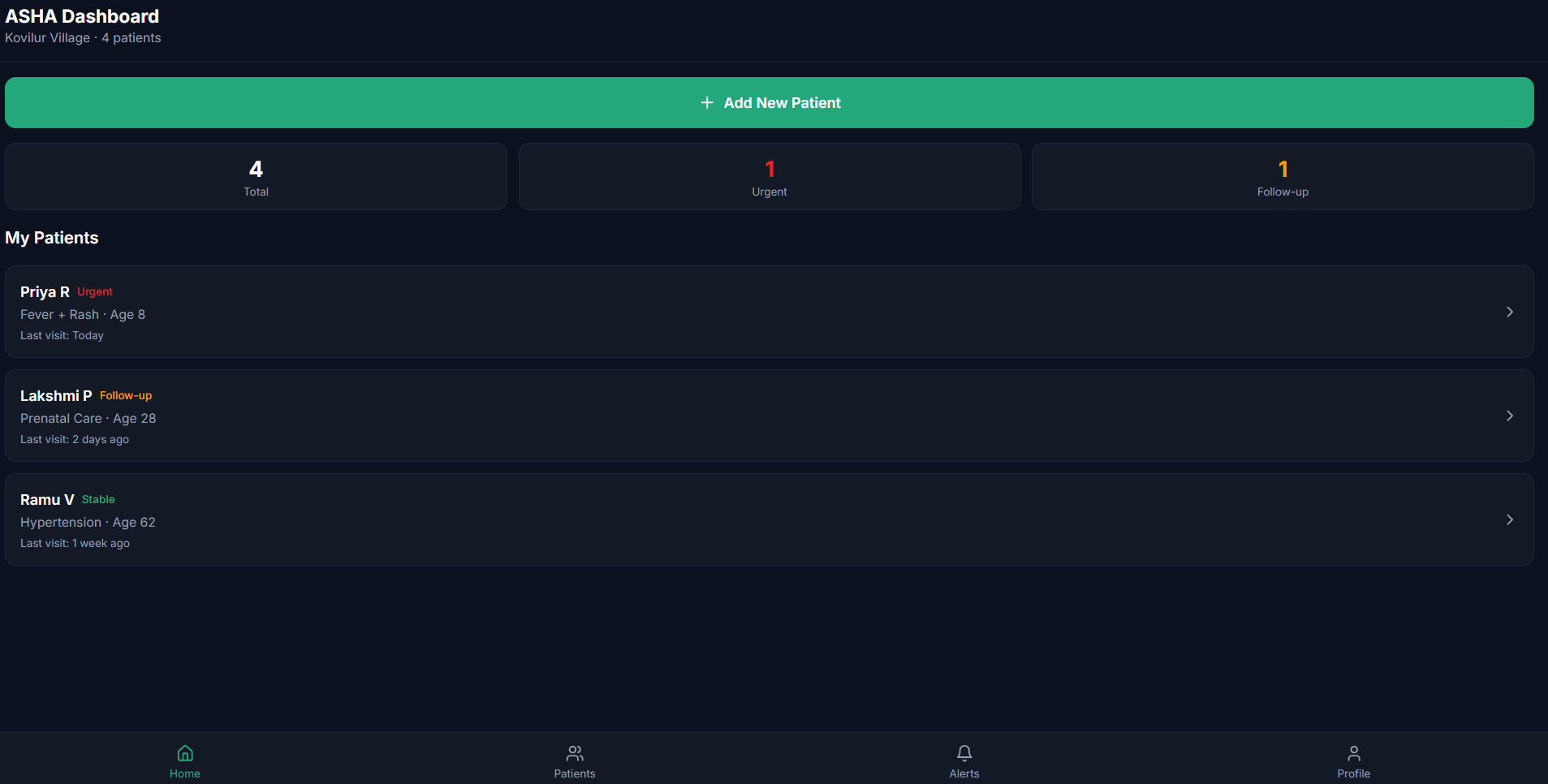
ASHA worker dashboard used by community health workers to track patients, monitor follow-ups, and manage village healthcare cases.
Inspiration
Millions of people living in rural areas lack immediate access to healthcare professionals.
Often the nearest clinic is hours away, and many patients delay seeking medical help because they are unsure whether their symptoms are serious.
During research, we found that early symptom triage can significantly reduce preventable health complications, but rural communities frequently lack the tools to access this guidance quickly.
We built HealthBridge AI to address this gap.
Our goal was to create a voice-first AI healthcare assistant that allows patients to simply describe their symptoms in their own language, receive an AI-powered triage assessment, and get directed to the nearest healthcare facility.
By combining voice AI, multimodal analysis, and medical reasoning, HealthBridge AI can help communities access faster health guidance while also assisting doctors and public health officials.
What it does
HealthBridge AI is a real-time AI healthcare triage system designed for rural communities.
Patients can:
- Describe symptoms using natural speech
- Upload images of visible symptoms (rash, wounds, swelling)
- Receive AI-powered triage guidance
- Get routed to the nearest Primary Health Centre (PHC)
The system then:
- Converts speech to text using AI voice processing.
- Analyzes symptoms and images using multimodal AI.
- Performs medical reasoning using WHO guideline knowledge retrieval.
- Calculates urgency and recommended next steps.
- Finds the nearest healthcare facility using geospatial search.
- Sends emergency alerts when critical symptoms are detected.
Doctors also benefit from:
- AI-generated case summaries
- Explainable reasoning traces
- outbreak detection insights
This creates a bridge between rural patients and healthcare systems.
How we built it
HealthBridge AI integrates several technologies to create a full AI healthcare pipeline.
Frontend
- Next.js
- TailwindCSS
- Framer Motion
- Web Speech API
Backend
- FastAPI
- WebSockets for real-time voice streaming
- Background task processing
AI Stack
We used Amazon Nova foundation models to power the system:
- Nova Sonic – real-time voice interaction
- Nova Multimodal – medical image analysis
- Nova 2 Lite – reasoning and triage
- Nova Act – workflow automation
Data Layer
- Supabase PostgreSQL
- pgvector for AI embeddings
- PostGIS for geospatial healthcare routing
Infrastructure
- Redis caching (Upstash)
- Twilio SMS alerts
- Railway deployment
- Vercel frontend hosting
The AI pipeline works as follows:
Patient Voice → Speech AI → Symptom Extraction
Optional Image → Vision AI Analysis
Symptoms + Image → Reasoning Model + WHO RAG
Urgency Score → PHC Location Search → Patient Guidance
Challenges we ran into
Building HealthBridge AI required solving several technical and design challenges.
1. Multimodal AI coordination
We had to combine voice, text, and image inputs into a single reasoning pipeline while ensuring the system remained responsive.
2. Real-time voice streaming
Implementing real-time speech processing required WebSocket communication between the frontend and backend.
3. Reliable medical reasoning
To improve accuracy, we implemented a RAG system using WHO medical guidelines so the AI could reference trusted medical sources.
4. Safety and responsible AI
Healthcare AI must be cautious.
We added:
- emergency keyword guardrails
- explainability traces
- doctor override functionality
- audit logging
5. Rural connectivity constraints
Many rural regions have slow internet.
We designed the system to be lightweight and optimized for low-bandwidth environments.
What we learned
This project taught us several important lessons:
- AI systems are most powerful when they combine multiple modalities (voice + vision + reasoning).
- Responsible AI is critical in healthcare applications.
- Explainability helps doctors trust AI recommendations.
- AI can play a major role in public health monitoring, not just individual diagnosis.
Most importantly, we learned that technology can significantly reduce healthcare access gaps when designed thoughtfully.
Impact
HealthBridge AI has the potential to:
- Reduce delays in medical consultation
- Improve early detection of health conditions
- Support frontline healthcare workers
- Provide healthcare guidance in underserved areas
- Detect public health trends through anonymized analytics
Even simple triage guidance can help patients seek medical help sooner and avoid complications.
What's next for HealthBridge AI
Future improvements could include:
- multilingual voice models for regional languages
- integration with telemedicine platforms
- electronic health record integration
- mobile-first offline support
- expanded outbreak monitoring dashboards
Our long-term vision is to create a global AI-powered health triage platform accessible to everyone, regardless of location.
Built With
- amazon
- fastapi
- framer
- motion
- next.js
- nova
- pgvector
- postgis
- postgresql
- python
- railway
- redis
- supabase
- tailwindcss
- twilio
- vercel
- websockets


Log in or sign up for Devpost to join the conversation.