🏥 Inspiration
Healthcare is becoming increasingly data-driven, but patients and healthcare providers often see health information as separate measurements rather than as a connected picture of a person's health.
A heart rate reading, blood pressure measurement, sleep pattern, activity level, glucose value, and medication adherence can each provide useful information. However, understanding how these factors change together over time can be difficult.
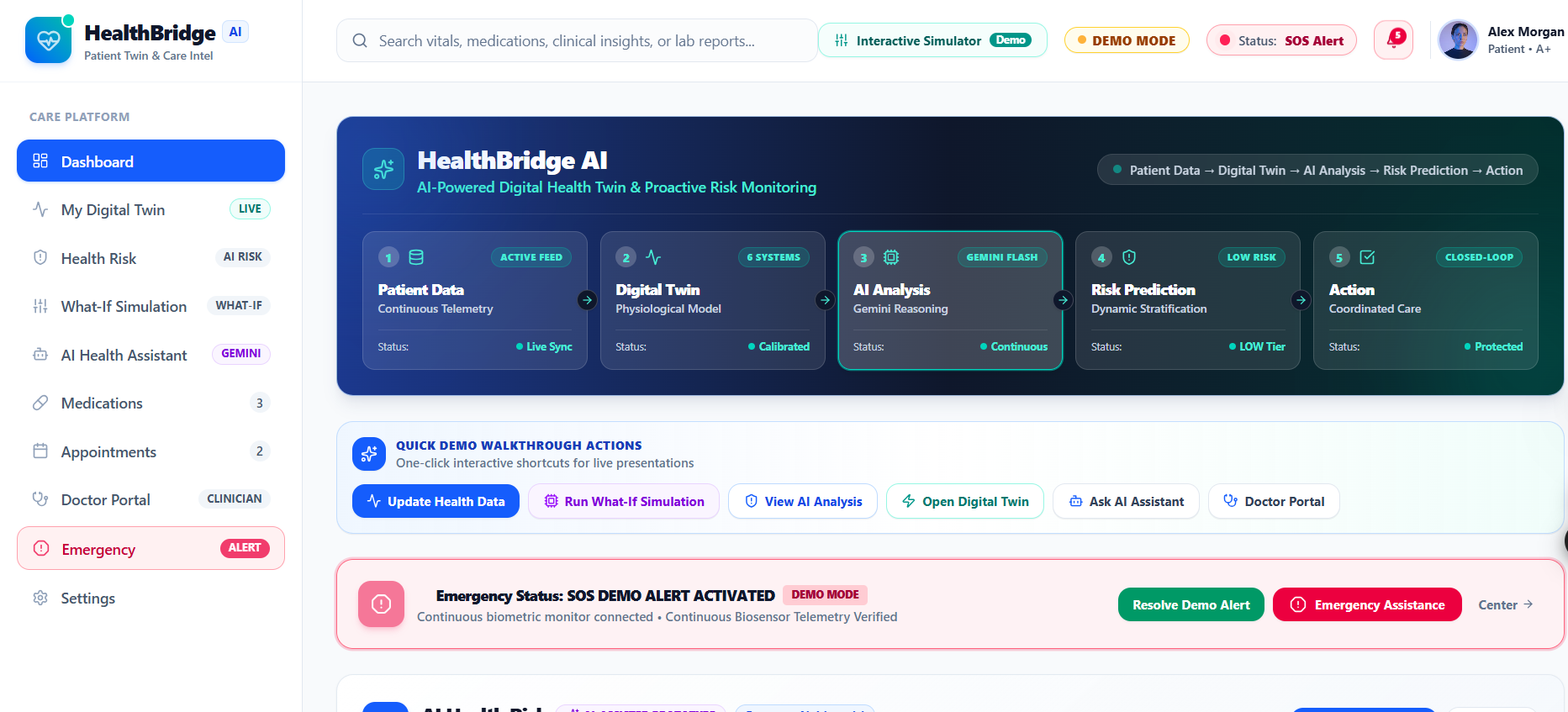
This inspired us to build HealthBridge AI — an intelligent healthcare coordination platform that creates a Digital Health Twin of a patient and continuously analyzes their health data to provide understandable, proactive insights.
Our goal was not to build another health dashboard, but to create a system that connects:
Patient Data → Digital Health Twin → AI Analysis → Risk Assessment → Action
💡 What is HealthBridge AI?
HealthBridge AI is an AI-powered healthcare platform centered around a patient's Digital Health Twin.
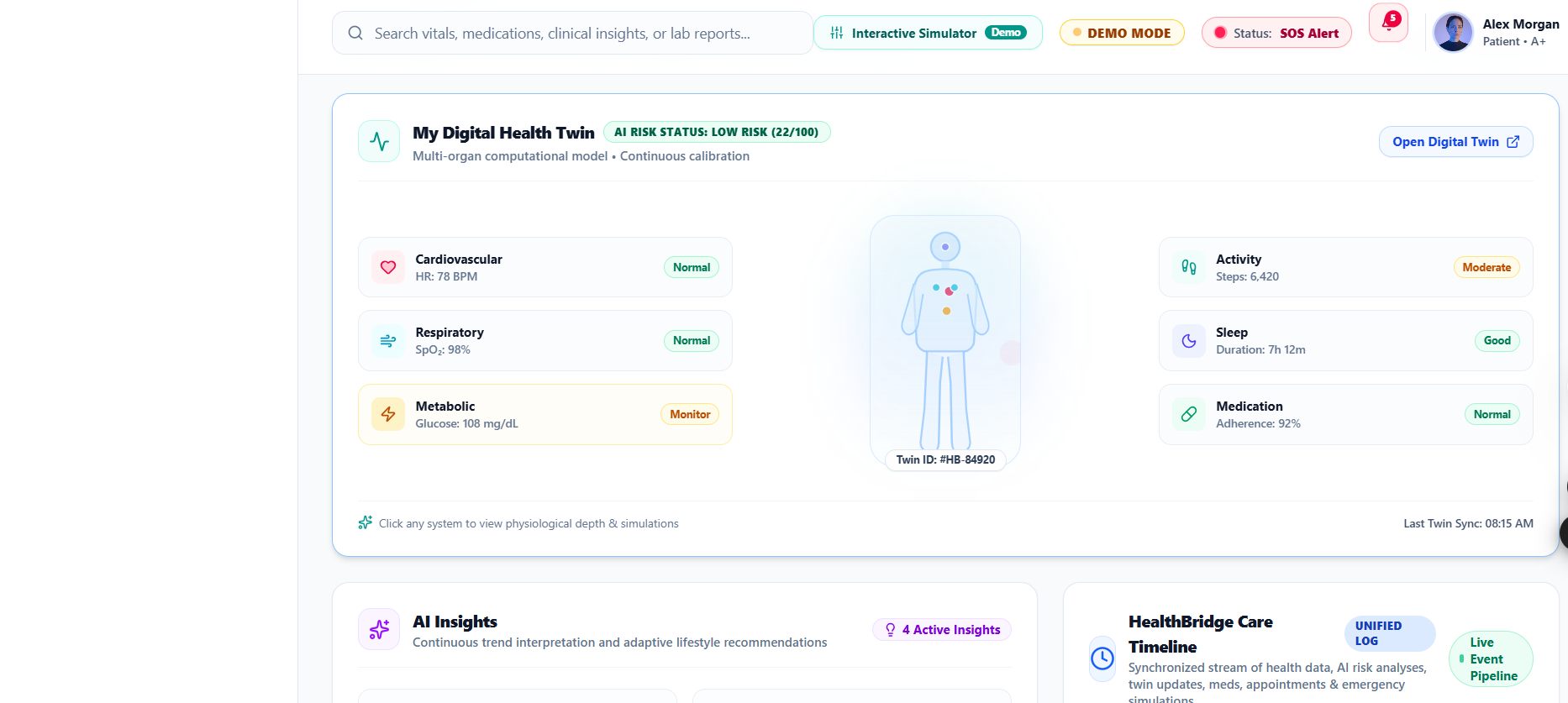
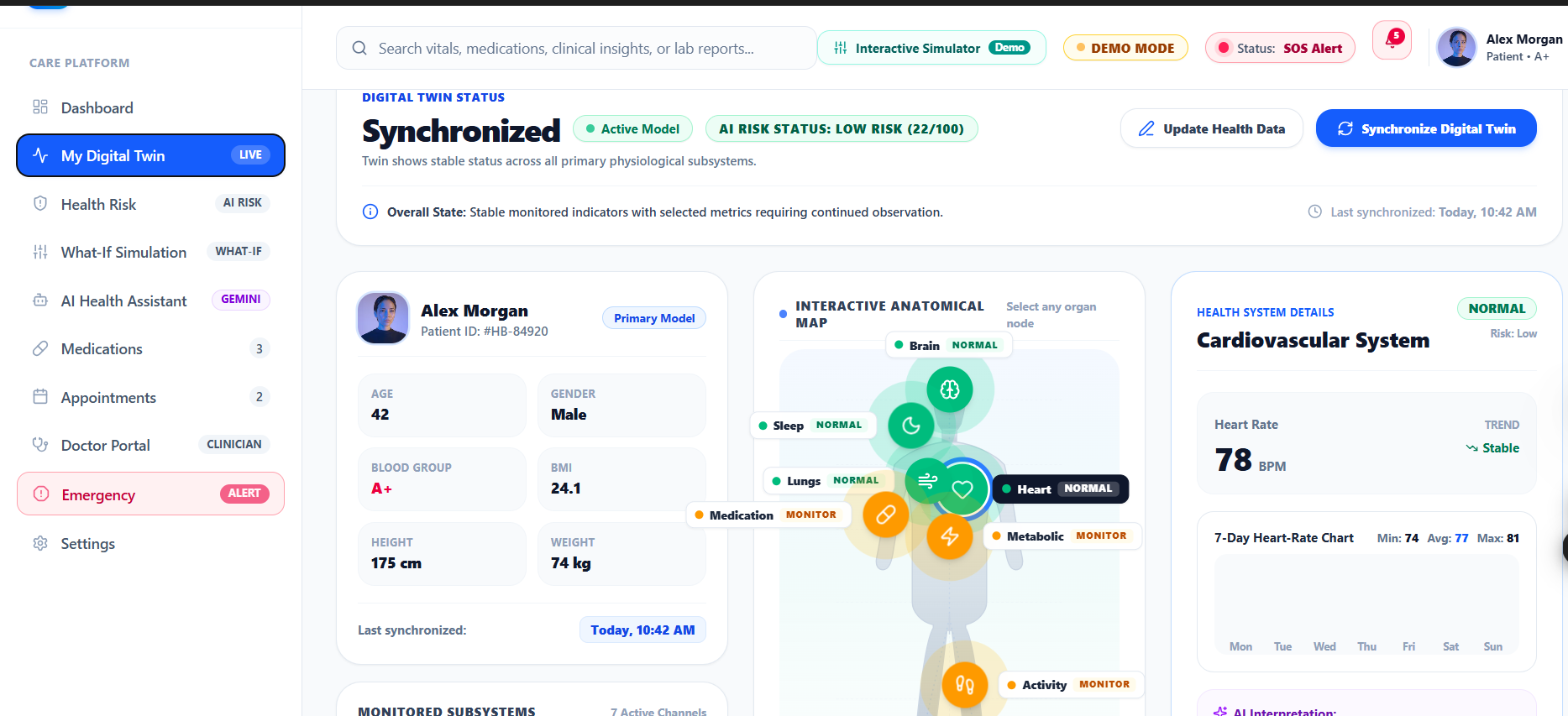
The Digital Health Twin represents a structured, continuously updated view of a patient's health information. It brings together vital signs, activity, sleep, medication adherence, and other health indicators into one connected patient state.
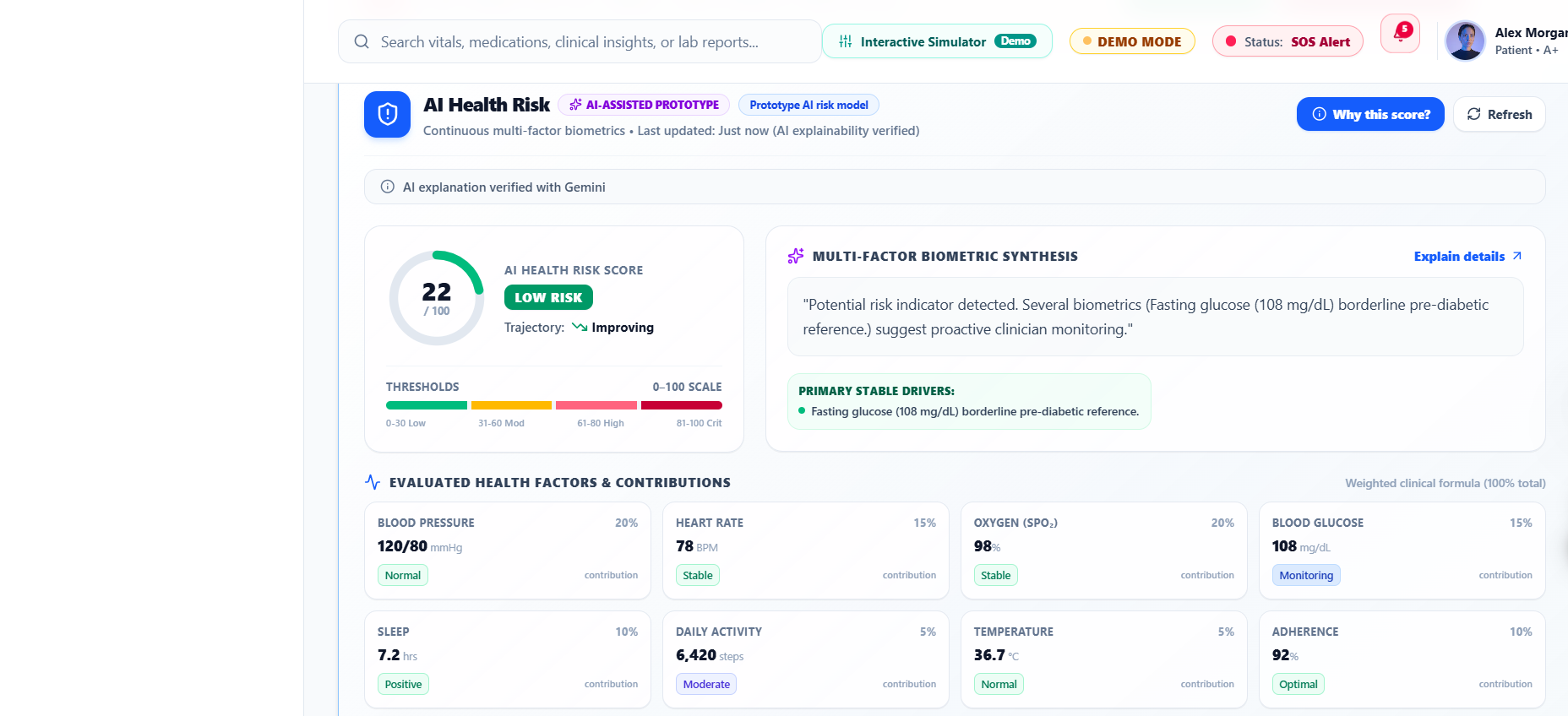
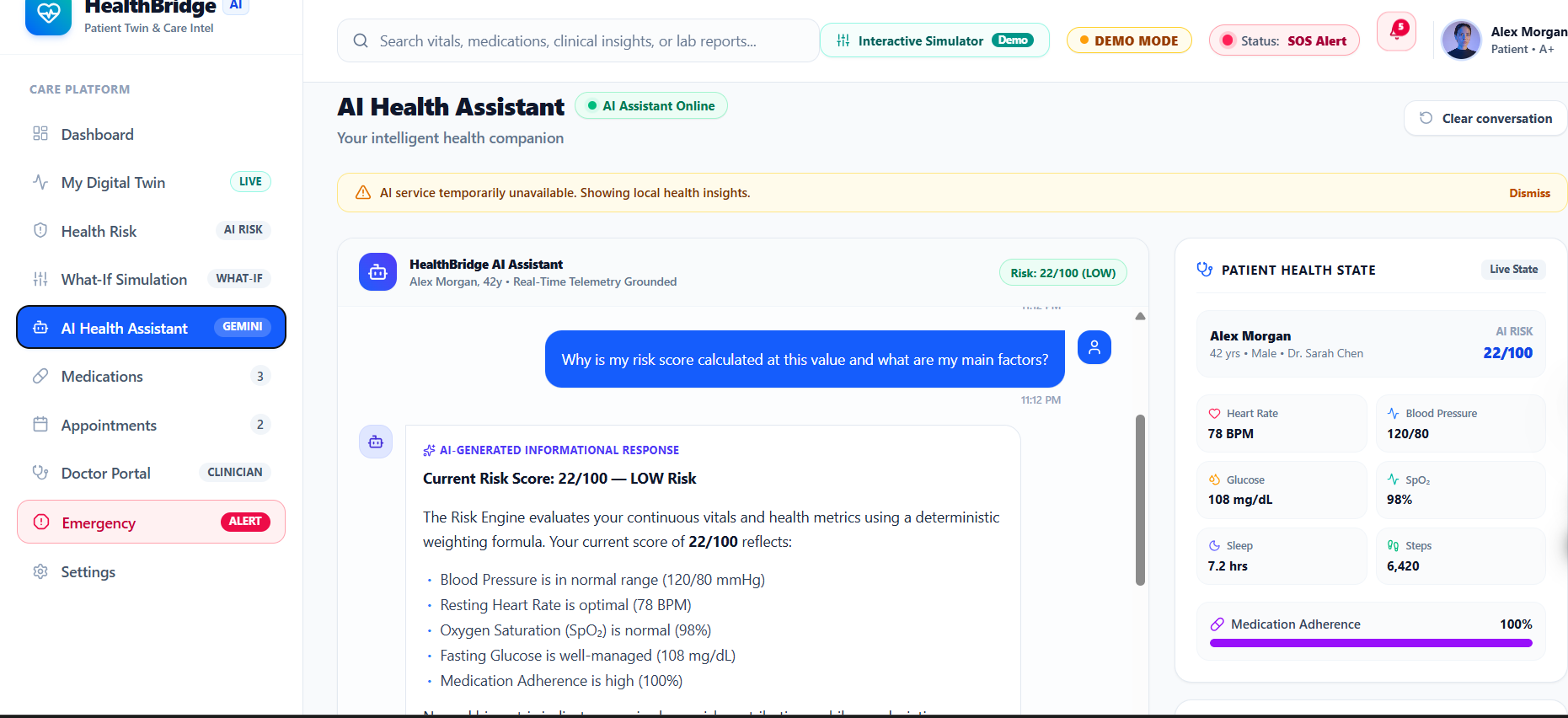
The platform then uses an AI Health Risk Engine to analyze these measurements and generate a prototype risk score, while an AI Health Assistant explains the results in simple language.
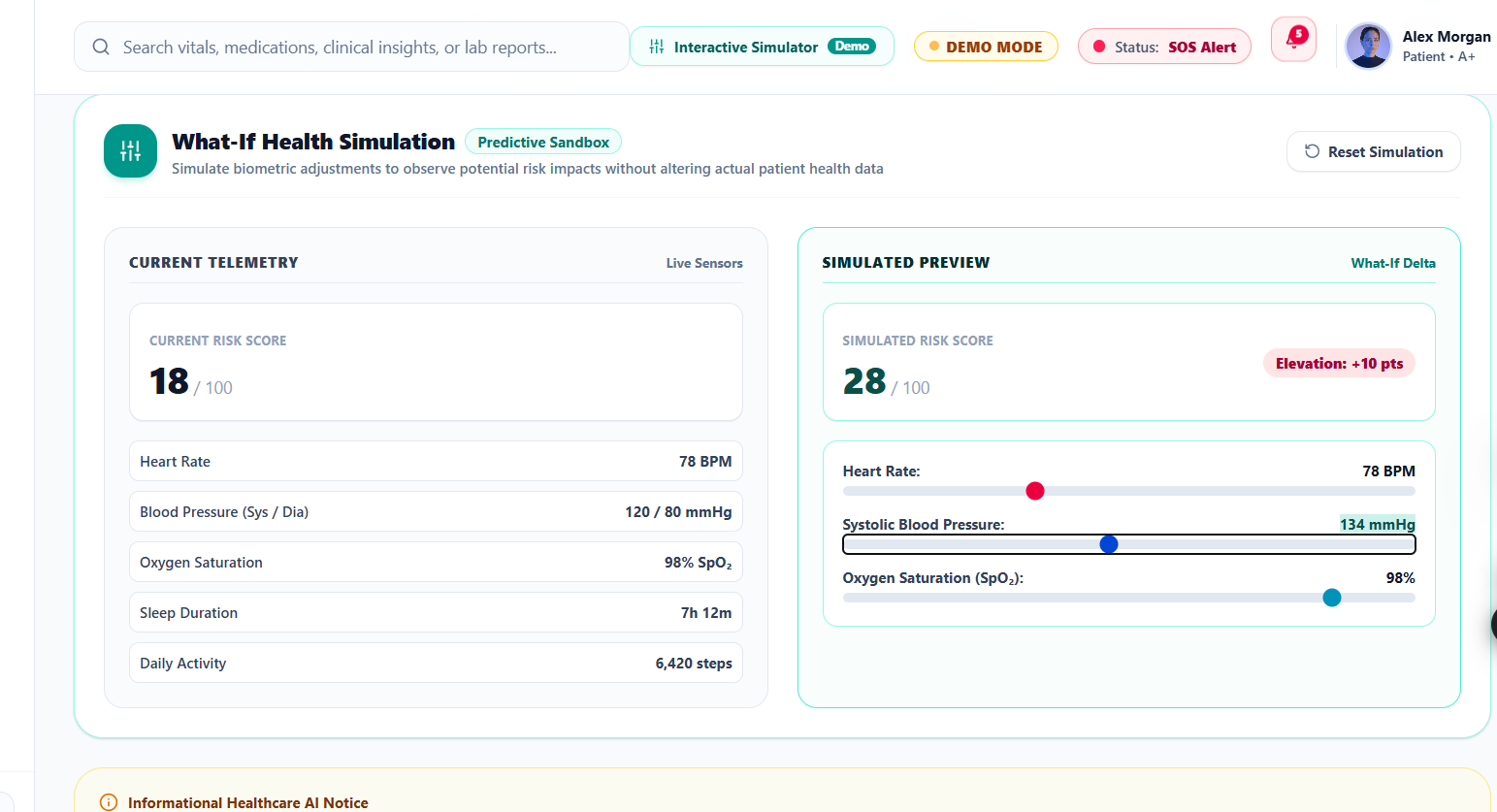
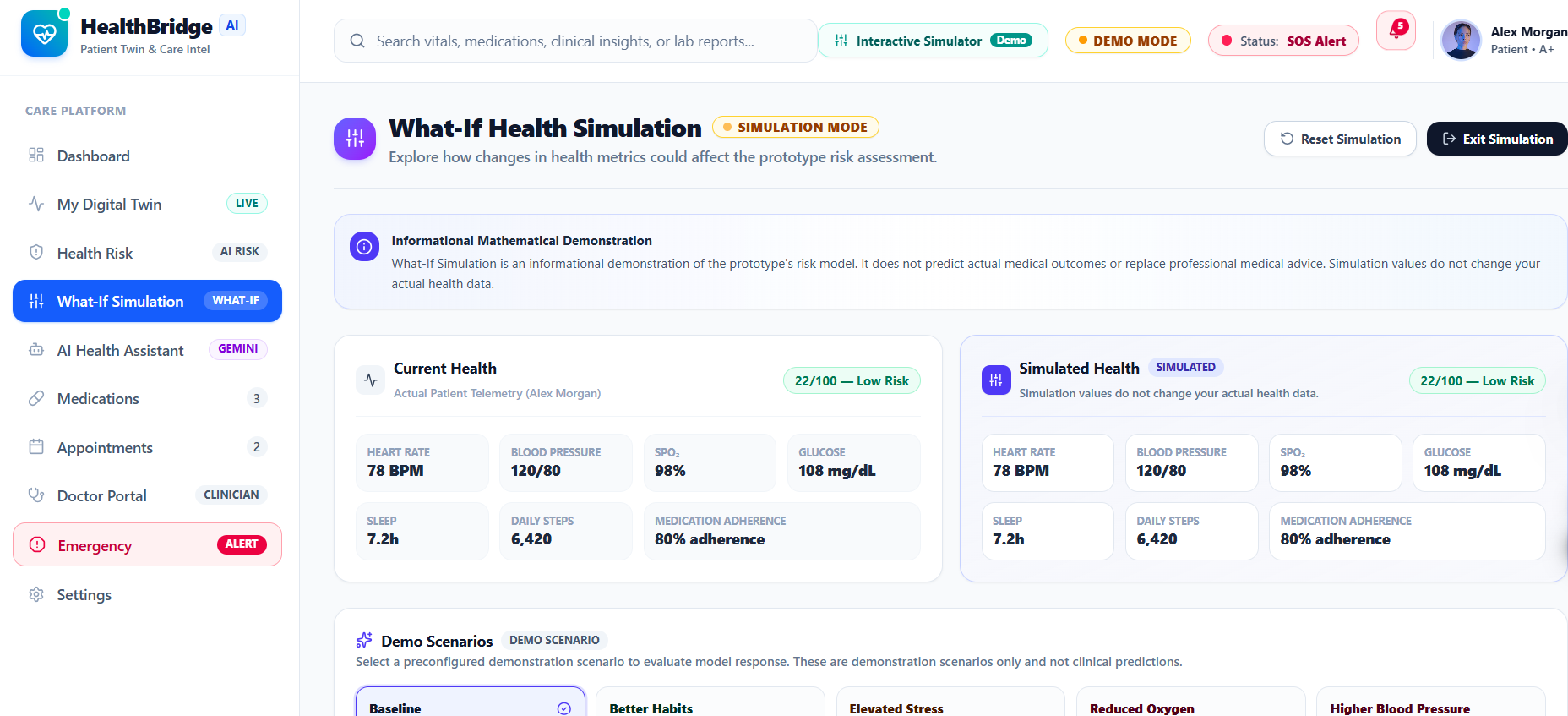
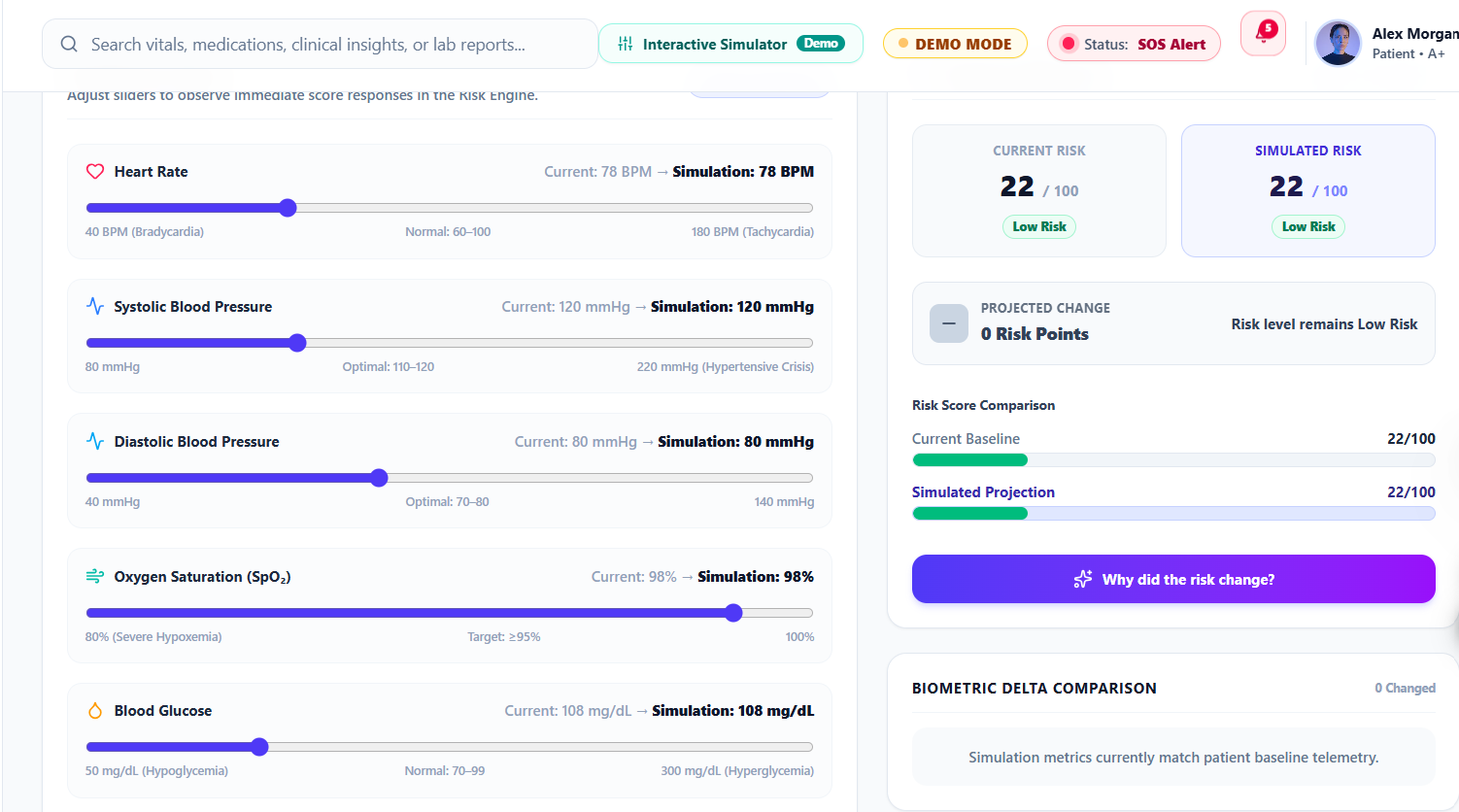
HealthBridge AI also includes a What-If Health Simulation, allowing users to explore hypothetical changes in health data without modifying their actual patient information.
⚙️ How It Works
1. Patient Health Data
The system begins with structured patient health information such as:
- Heart rate
- Blood pressure
- Blood oxygen saturation
- Temperature
- Glucose
- Sleep duration
- Daily activity
- Medication adherence
Users can update their demo health measurements through the Health Data interface.
2. Digital Health Twin
The collected information is represented through the patient's Digital Health Twin.
The twin provides a connected view of different health systems, including:
- ❤️ Cardiovascular
- 🫁 Respiratory
- 🧬 Metabolic
- 🏃 Activity
- 😴 Sleep
- 💊 Medication adherence
Each system is represented with an understandable status such as Normal, Monitor, or Attention.
This allows the user to move from individual measurements to a more complete view of their health state.
3. AI Health Risk Engine
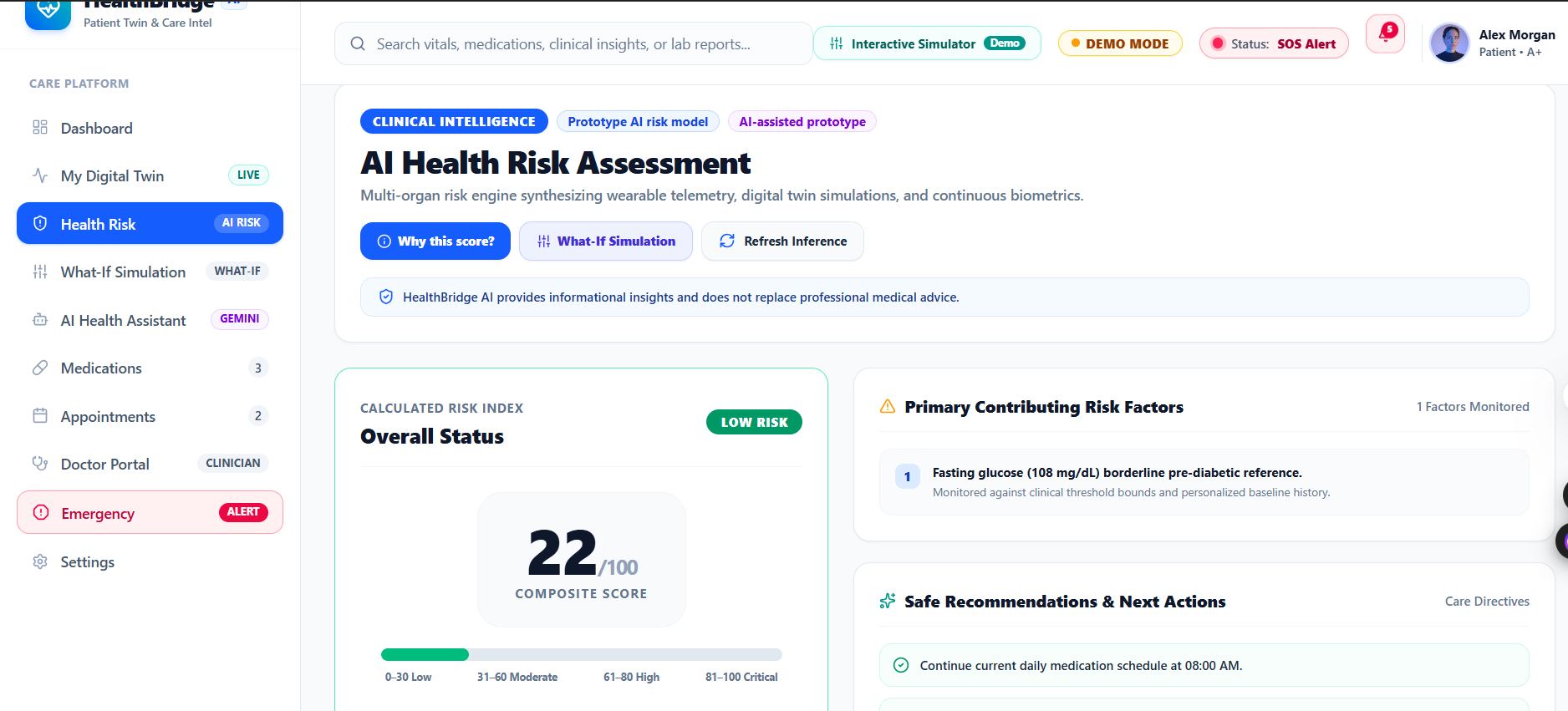
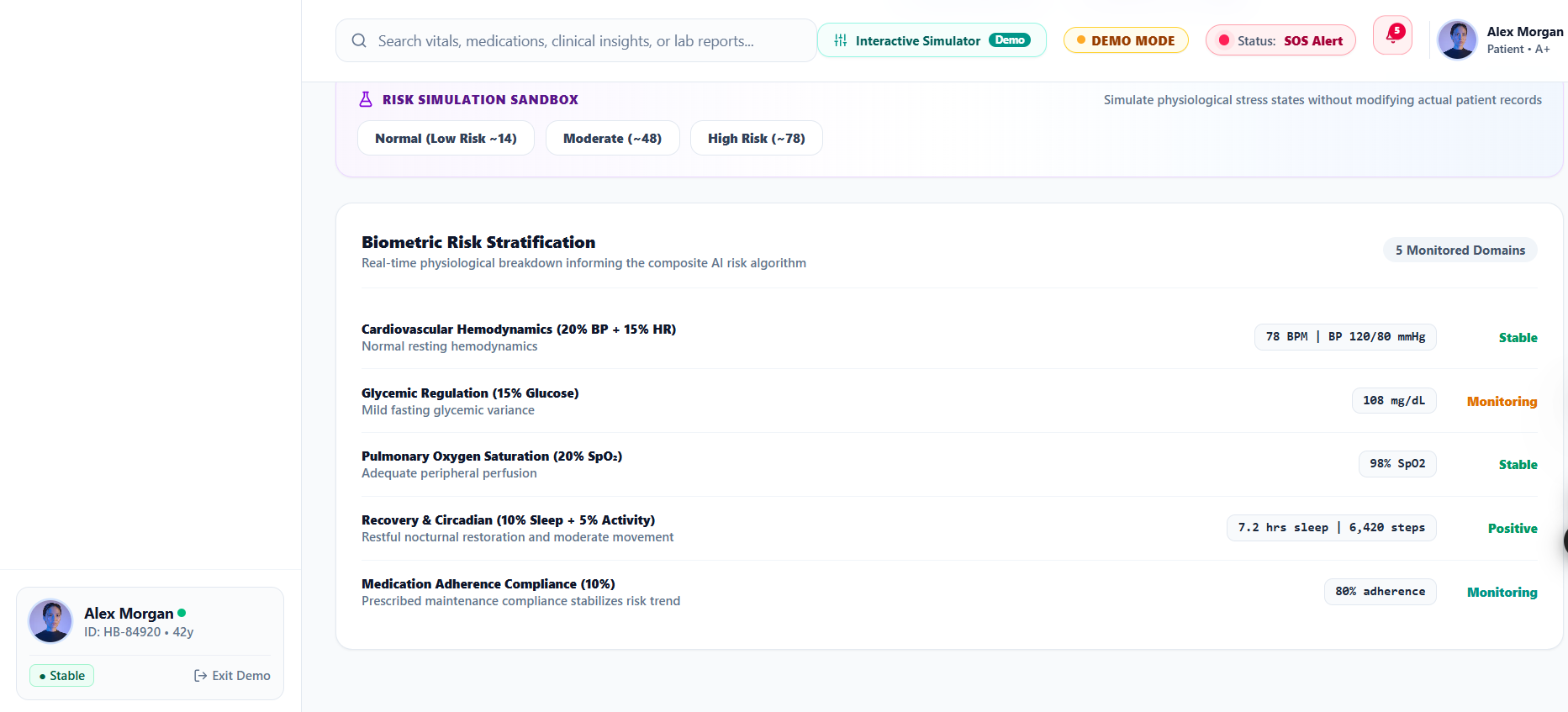
HealthBridge AI calculates a prototype health risk score from 0–100 using the available health indicators.
The prototype considers multiple factors, including:
- Blood pressure
- Heart rate
- SpO₂
- Glucose
- Temperature
- Sleep
- Activity
- Medication adherence
The score is categorized as:
| Score | Risk Level |
|---|---|
| 0–30 | Low |
| 31–60 | Moderate |
| 61–80 | High |
| 81–100 | Critical |
The system also explains why the score changed, helping users understand which measurements contributed to the change.
Important: This is a hackathon prototype and is not a medically validated diagnostic or clinical decision-making system.
🔮 What-If Health Simulation
One of our key features is the What-If Health Simulation.
Instead of changing the patient's real data, users can temporarily modify values such as:
- Heart rate
- Blood pressure
- SpO₂
- Glucose
- Sleep
- Activity
- Medication adherence
The system recalculates the prototype risk score and compares the current state with the simulated state.
For example:
Current State
Risk Score: 18/100 — Low Risk
A user can simulate:
Higher heart rate + reduced sleep
The system then shows how the projected prototype risk score changes and explains the contributing factors.
The simulation can be reset at any time and does not overwrite the patient's actual demo data.
🤖 AI Health Assistant
HealthBridge AI includes an AI-powered health assistant that uses the patient's available context to explain their dashboard.
Users can ask questions such as:
- "Summarize my health."
- "Why is my risk score this way?"
- "How is my sleep?"
- "How active am I?"
- "What should I monitor?"
- "Show my Digital Twin."
The assistant is designed to provide informational explanations, rather than medical diagnoses or prescriptions.
For safety, the system does not provide medication dosage changes or claim to replace healthcare professionals.
💊 Medication Management
HealthBridge AI also tracks medication adherence using fictional demo medications.
Users can mark medications as:
- Taken
- Pending
- Missed
Changes in medication adherence are reflected across the shared patient state and can influence the existing prototype risk calculation.
This demonstrates how different aspects of a patient's health can remain connected instead of existing as isolated features.
👨⚕️ Care Coordination
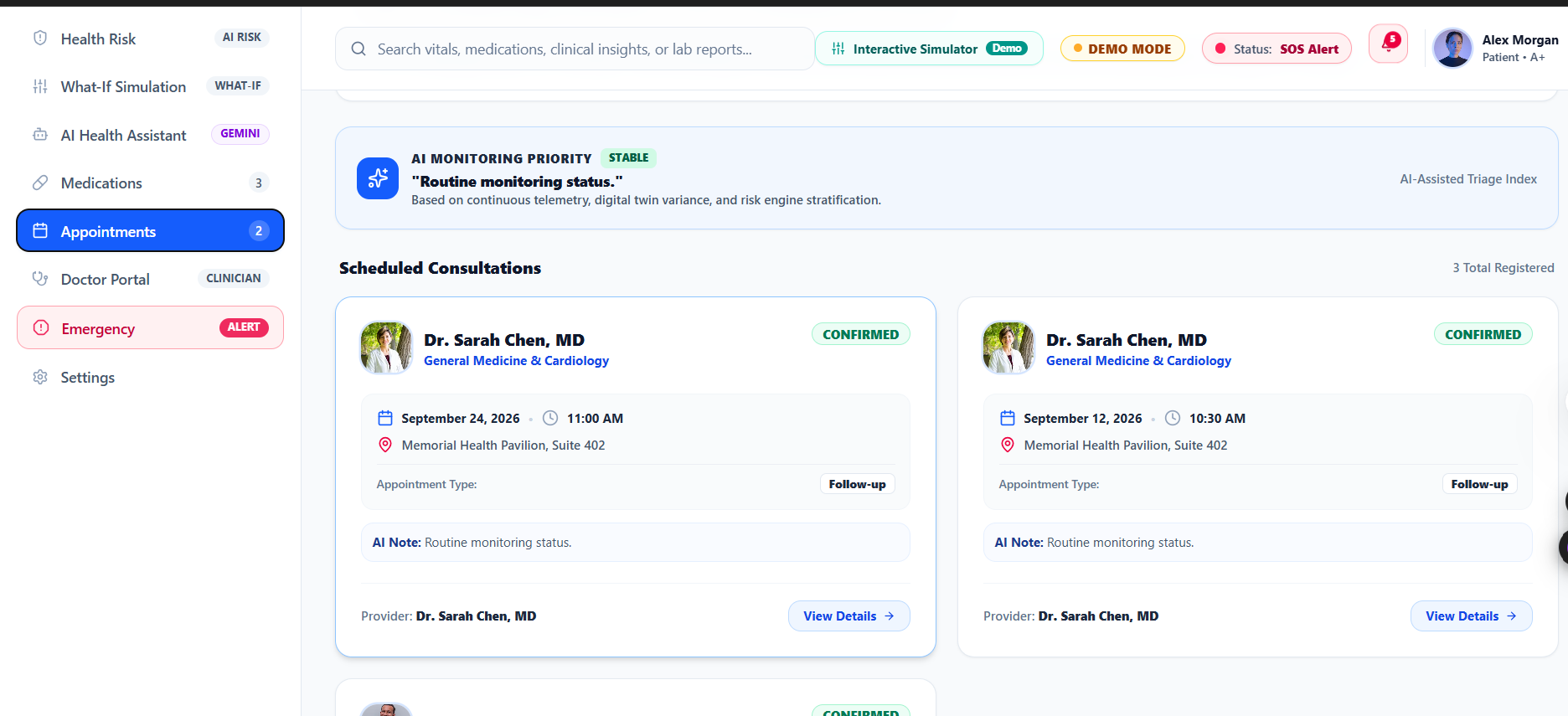
The broader HealthBridge AI architecture is designed to support both patients and healthcare providers.
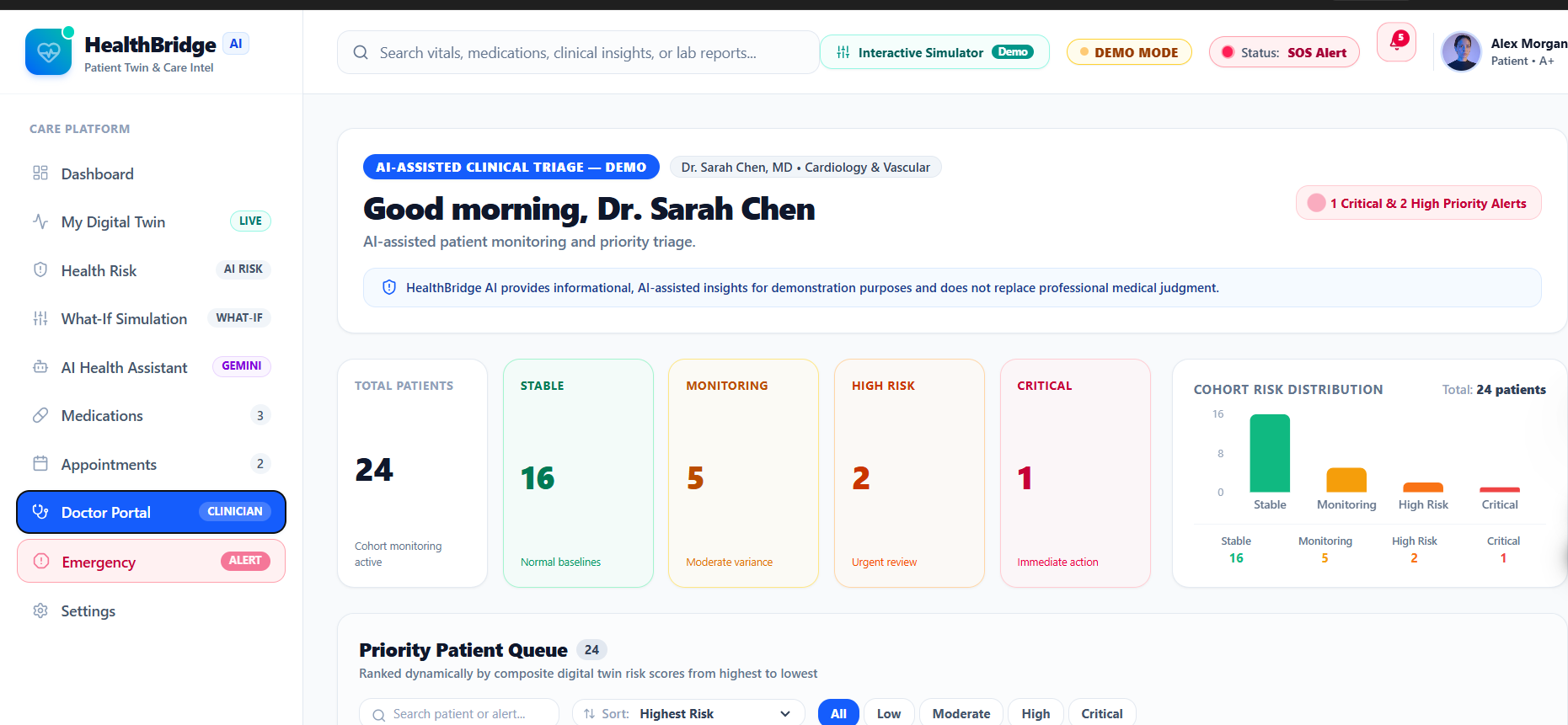
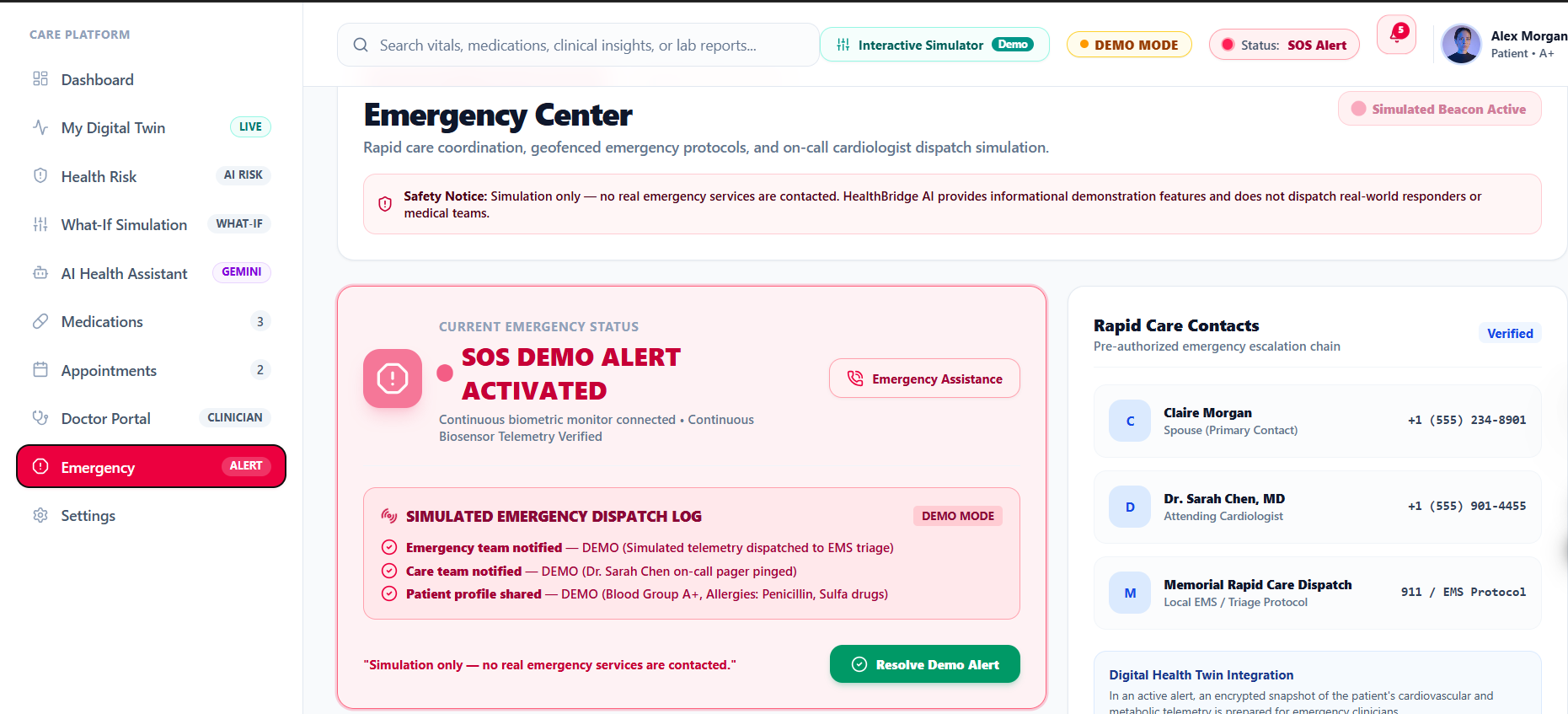
A future/extended provider workflow can use the same patient health state to help clinicians prioritize patients based on risk and review relevant health information from a centralized interface.
The goal is to bridge the gap between:
Patient → Health Data → AI Insights → Healthcare Provider
🛠️ How We Built It
HealthBridge AI was developed as a modern web application with a modular architecture.
Frontend
- React
- TypeScript
- Tailwind CSS
- Responsive component-based UI
AI
- Gemini-powered AI explanations
- AI Health Assistant
- AI-assisted health insights
Core Intelligence
- Digital Health Twin
- Deterministic prototype Risk Engine
- What-If Simulation Engine
- Shared patient health state
Data
The current hackathon prototype uses structured fictional/demo patient data so the complete workflow can be demonstrated safely without using real patient records.
The architecture is designed so that persistent healthcare data storage can be integrated in a future version.
🧠 What We Learned
Building HealthBridge AI taught us that healthcare AI is not only about generating predictions.
A useful healthcare system must also:
- Connect multiple health signals
- Explain why an insight was generated
- Keep simulated and real patient states separate
- Present complex information in a simple way
- Include safety boundaries around AI-generated information
One of our biggest lessons was that the AI should explain and assist, while deterministic application logic should remain responsible for important prototype calculations.
For example, the Risk Engine calculates the numerical prototype score, while Gemini can help explain the result in natural language.
🚧 Challenges We Faced
1. Connecting Multiple Health Signals
Health data contains many different measurements with different ranges and meanings.
We needed a structured patient state so that updating one measurement could be reflected consistently across the dashboard, Digital Health Twin, risk engine, and AI assistant.
2. Designing a Meaningful Risk Prototype
We wanted the risk score to be understandable and reproducible rather than allowing an LLM to arbitrarily generate a number.
Therefore, we implemented a deterministic prototype scoring approach and used AI primarily for explanation.
3. Building Safe What-If Simulation
A simulation should never accidentally overwrite actual patient information.
We therefore separated the temporary simulation state from the patient's actual state.
4. Healthcare Safety
Healthcare is a high-responsibility domain.
We deliberately avoided presenting HealthBridge AI as a diagnostic tool. The prototype does not diagnose diseases, prescribe medications, recommend dosage changes, or replace professional medical care.
🌍 Potential Impact
HealthBridge AI demonstrates how AI can help transform fragmented health measurements into a more understandable and connected patient experience.
The platform could potentially support:
- Continuous patient monitoring
- Early identification of changing risk patterns
- Patient health awareness
- Medication adherence tracking
- Care coordination
- Clinician prioritization
- Personalized health education
- Scenario-based health planning
Our long-term vision is to evolve the Digital Health Twin into a secure, interoperable healthcare intelligence layer that can connect information from different healthcare sources while keeping healthcare professionals in the decision-making loop.
🚀 Future Scope
Future versions of HealthBridge AI could include:
- Secure cloud-based patient records
- Integration with wearable devices
- Real-time health monitoring
- FHIR-based healthcare interoperability
- More advanced longitudinal risk modeling
- Clinician dashboards
- Hospital integration
- Personalized care plans
- Multilingual AI health assistance
- Privacy-preserving healthcare AI
- Federated learning for sensitive healthcare data
🎯 Our Vision
HealthBridge AI aims to bridge the gap between patients, health data, artificial intelligence, and healthcare professionals.
Instead of simply showing numbers, we want healthcare technology to help people understand what is changing, why it matters, and what they can discuss with their healthcare provider.
HealthBridge AI — Connecting Patients, Intelligence & Care.
⚕️ Safety Disclaimer
HealthBridge AI is a hackathon prototype using fictional/demo patient data. Its risk scores, simulations, and AI-generated responses are for demonstration and informational purposes only. They are not medically validated and should not be used for diagnosis, treatment, medication decisions, or emergency decision-making.

Log in or sign up for Devpost to join the conversation.