-
-
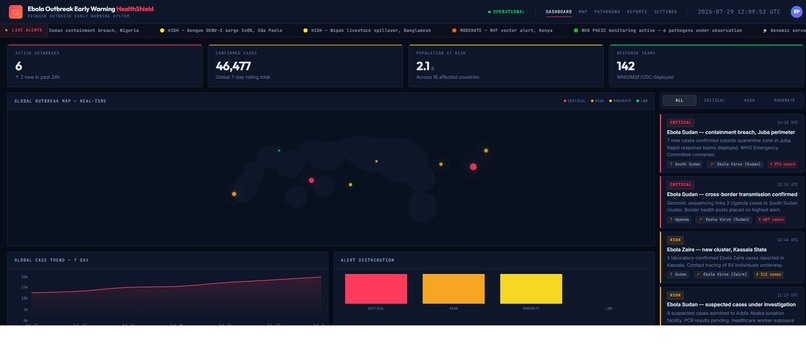
Dashboard
## Inspiration The Health Shield was inspired by the recurring Ebola outbreaks in East Africa and the urgent need for faster, smarter disease surveillance systems. Uganda has experienced several Ebola outbreaks, including the 2022 Sudan Ebola virus outbreak and the 2025 resurgence of Sudan virus disease, demonstrating that infectious diseases remain a persistent threat despite advances in public health preparedness. These outbreaks have shown that the impact of Ebola extends beyond healthcare, affecting national economies, tourism, trade, and international mobility. During Ebola outbreaks, Uganda’s tourism sector faces significant challenges due to increased perceptions of health risks among international visitors. Travel advisories issued by foreign governments and international organizations can reduce tourist arrivals, affect hotel occupancy, disrupt safari bookings, and decrease revenue for businesses that depend on tourism, including tour operators, transport companies, hospitality providers, and local communities. Since tourism contributes significantly to Uganda’s foreign exchange earnings and employment, even temporary declines in international travel can create wider economic consequences. Ebola outbreaks also affect international travel and cross-border movement. Increased screening measures at airports and border points, travel restrictions, and public concerns about disease transmission can slow movement of people and goods within the region. Previous Ebola outbreaks in Africa have shown that fear and misinformation can cause economic losses that are much larger than the direct health costs of the disease itself. For countries like Uganda that depend on regional trade and international connectivity, early detection and rapid response are critical for maintaining public confidence and economic stability. In 2026, the continued risk of Ebola spreading across borders in East Africa highlighted how quickly infectious diseases can move through travel networks, trade routes, and population movement. This raised an important question for us: What if artificial intelligence could detect early warning signals, predict outbreak risks, and support faster interventions before diseases disrupt communities, economies, and international connections? This question became the foundation of Health Shield AI. Our vision is to transform scattered health, environmental, mobility, and community data into real-time intelligence that predicts potential outbreaks, identifies high-risk locations, and recommends timely interventions. By moving from reactive outbreak management to proactive prevention, Health Shield AI supports governments, healthcare workers, humanitarian organizations, tourism stakeholders, and communities in reducing disease spread, protecting lives, and minimizing the economic disruption caused by future outbreaks.
References
- World Health Organization (WHO). (2022). Uganda declares Ebola outbreak caused by Sudan ebolavirus. https://www.who.int/emergencies/disease-outbreak-news/item/2022-DON409
- World Health Organization (WHO). (2023). Ebola virus disease – Uganda outbreak response and situation updates. https://www.who.int/emergencies/situations/ebola-uganda
- World Bank. (2014). The Economic Impact of the 2014 Ebola Epidemic: Short and Medium Term Estimates for West Africa. https://www.worldbank.org/en/topic/macroeconomics/publication/economic-impact-of-ebola
- International Air Transport Association (IATA). (2014). Potential impact of Ebola outbreak on air travel and aviation confidence. https://www.iata.org
- Uganda Tourism Board. (2023). Uganda Tourism Sector Performance and Recovery Reports. https://www.tourism.go.ug
- World Travel & Tourism Council (WTTC). (2024). Travel & Tourism Economic Impact Report: Uganda. https://wttc.org/research/economic-impact
What it does
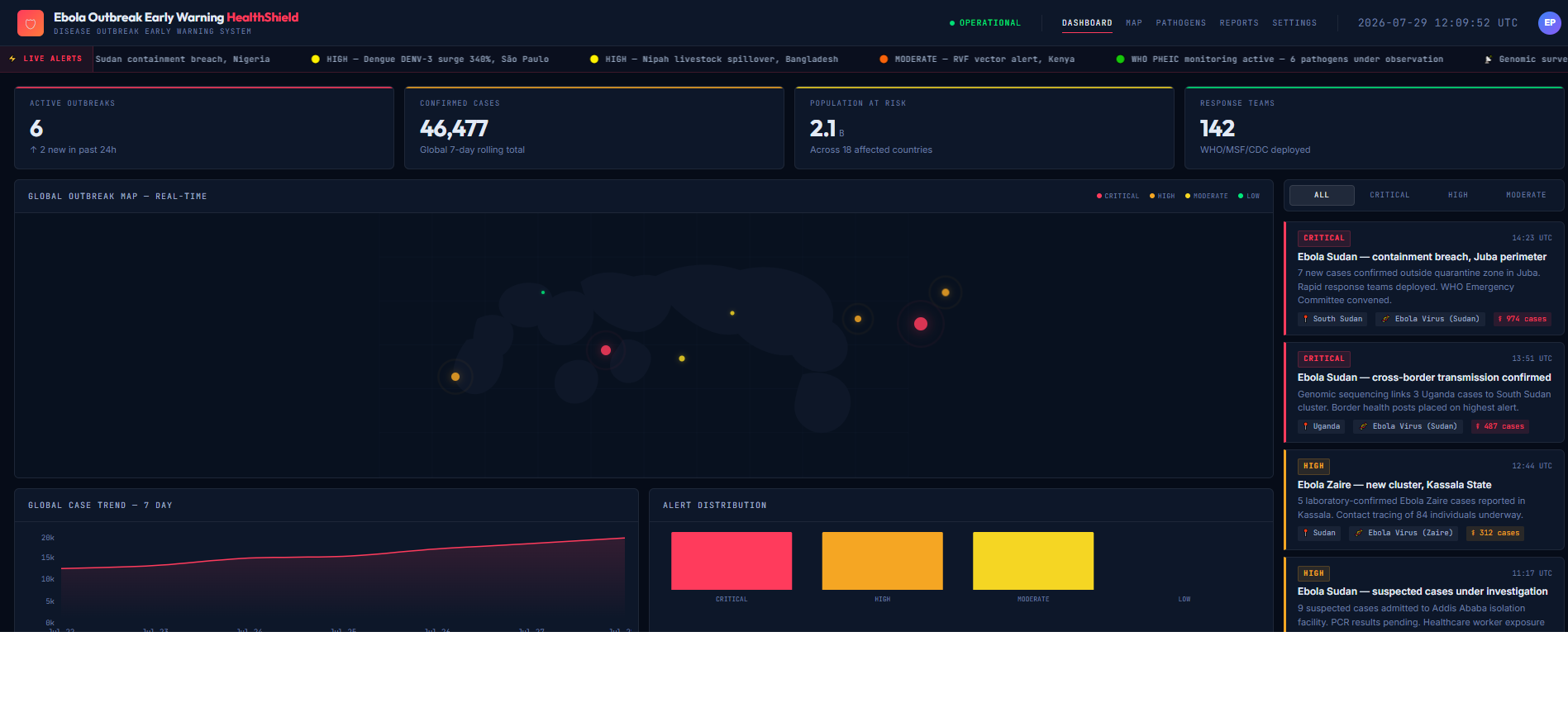
This is an intelligent disease surveillance and early warning platform that continuously monitors health reports, laboratory data, climate conditions, and community observations to identify abnormal disease patterns.
Using artificial intelligence and geospatial analytics, the platform predicts potential outbreaks, generates real-time alerts, visualizes disease hotspots on interactive maps, and recommends evidence-based response actions. Health officials can monitor outbreaks through a centralized dashboard, while community members receive localized health advisories and prevention guidance through mobile applications, SMS, and voice notifications. The platform also supports community reporting, allowing healthcare workers and citizens to submit suspected cases, symptoms, GPS locations, and field observations that strengthen disease surveillance.
How we built it
We designed Health Shield as a modern, scalable platform using cloud-native technologies and artificial intelligence. The proposed technology stack includes React for the frontend, FastAPI for backend services, PostgreSQL with PostGIS for spatial data management, Leaflet for interactive GIS mapping, and Python-based machine learning models developed with TensorFlow and Scikit-learn for outbreak prediction. Climate and environmental data, health facility reports, laboratory records, and community observations are integrated into a centralized analytics engine that generates real-time risk assessments and recommendations.
Challenges we ran into
One of our biggest challenges was designing a solution that could accommodate multiple sources of health and environmental data while remaining simple enough for users with varying levels of technical expertise. We also needed to consider limited internet connectivity, multilingual communication, and the need for rapid decision-making during emergencies.
Another challenge was balancing sophisticated AI capabilities with explainability. Health authorities need to understand why the platform predicts an outbreak so they can trust its recommendations. We addressed this by combining predictive analytics with transparent risk indicators and clear evidence supporting each alert.
Accomplishments that we're proud of
We successfully designed a comprehensive early warning platform that integrates disease surveillance, predictive analytics, GIS mapping, decision support, and community engagement into one unified solution. We are particularly proud of the platform's emphasis on early action, multilingual alerts, community participation, and decision support, ensuring that outbreak warnings lead to practical interventions rather than simply reporting risks.
What we learned
Developing Health Shield reinforced the importance of combining technology with public health expertise. Artificial intelligence alone cannot solve disease outbreaks; it must work alongside healthcare workers, governments, humanitarian organizations, and local communities.
We also learned that effective early warning systems depend on timely data, collaboration across sectors, accessible communication channels, and user-centered design. Building trust through explainable AI and actionable recommendations is just as important as achieving accurate predictions.
What's next for Health Shield Disease Outbreak Early Warning platform
Future enhancements include multilingual voice assistants, offline mobile functionality, and cross-border disease surveillance, predictive modeling for multiple infectious diseases, and integration with national emergency operation centers. We also plan to collaborate with ministries of health, research institutions, humanitarian organizations, and local communities to pilot the platform and continuously improve its effectiveness.
Our vision is for Health Shield AI to become a trusted digital public health platform that enables earlier detection,
Built With
- cloud-native
- fastapi
- machine-learning
- postgresql
- python
- react
- rest
- scikit-learn
- sms
- tensorflow

Log in or sign up for Devpost to join the conversation.