-
-
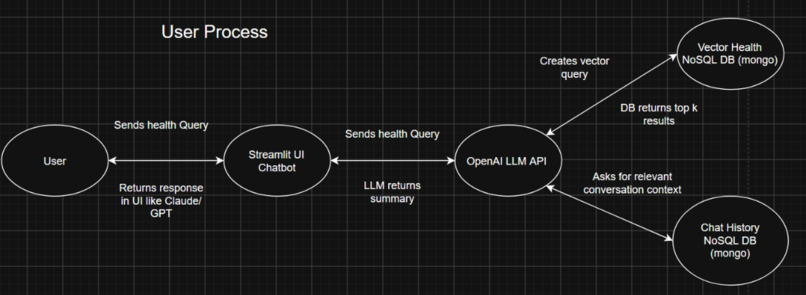
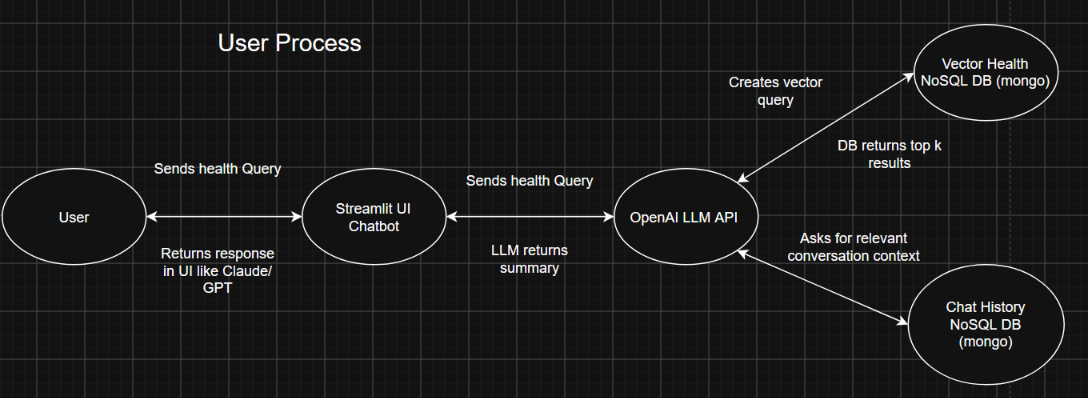
User Request Flow
-
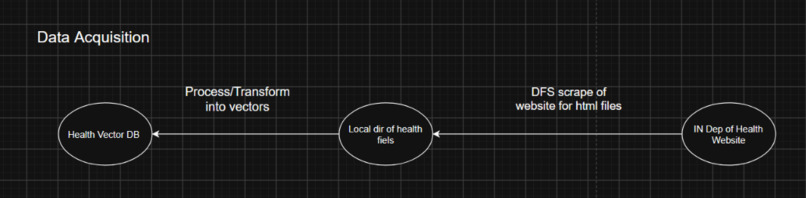
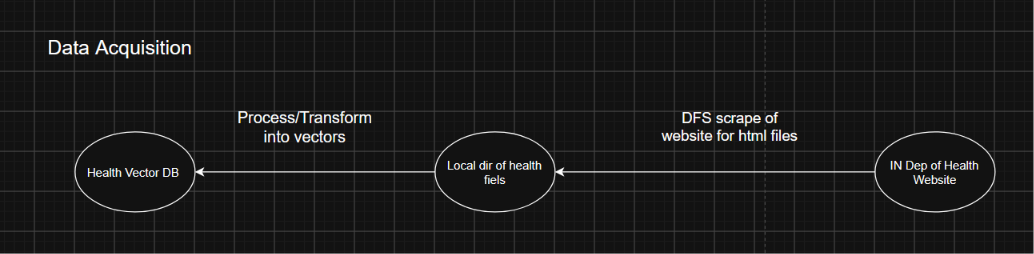
Data Acquisition Flow
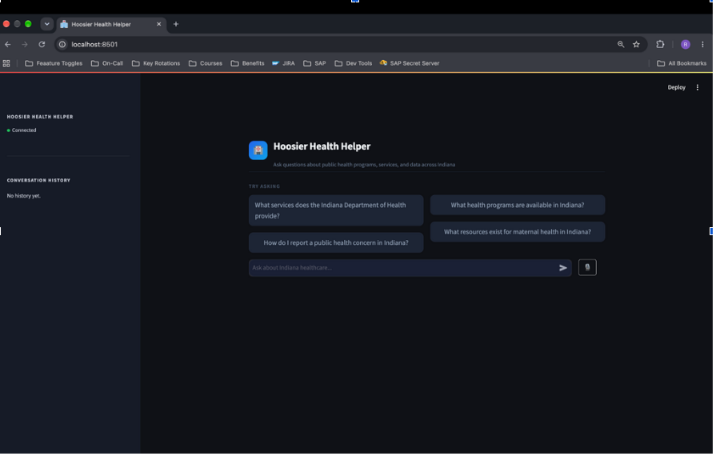
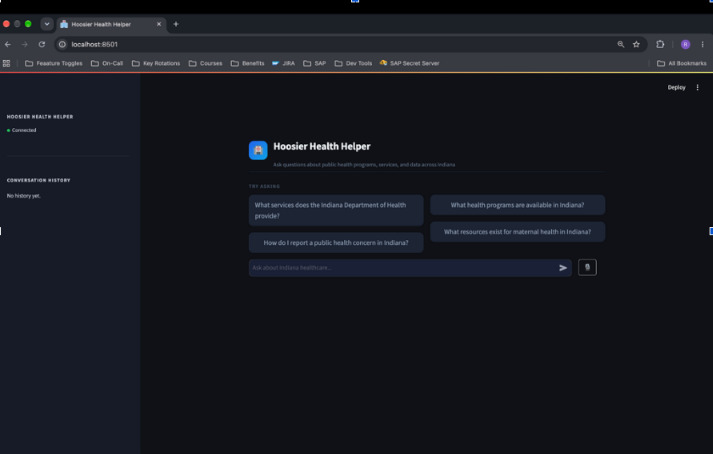
Hoosier Health Helper
Inspiration
Most Indiana residents have no idea where to start when they need something from the healthcare system. Is this procedure available in Indiana? Where can I get it done? Does the facility need a license? Who do I call if something goes wrong with my bill? The answers exist on the Indiana Department of Health (IDOH) website, but they are buried across hundreds of pages and PDFs written for administrators, not patients.
General-purpose AI search can answer these questions, but it often mixes in information from other states, outdated rules, or sources you cannot verify. For healthcare, that is not good enough. We wanted a tool that answers Indiana residents' questions in plain language, using only official Indiana sources, and always shows where the answer came from.
What it does
Health RAG is a conversational healthcare navigator for Indiana residents. You ask a question the way you would ask a friend, and it answers using official IDOH information, with links to the source pages so you can check for yourself.
A resident curious about a procedure or service can ask things like:
- "Where can I get my well water tested, and how much does it cost?"
- "What do I need to become a certified nurse aide in Indiana?"
- "How do I get a copy of my birth certificate?"
- "I think my hospital billed me on the wrong form. How do I file a complaint?"
- "Is there a lab in Indiana that tests for Lyme disease?"
- "What should I do if I was bitten by an animal that might have rabies?"
For each question, Health RAG:
- Explains it in plain language. It summarizes the relevant rules, requirements, and options without the government jargon.
- Points you to the right place. It links to the exact IDOH page, form, or document the answer came from.
- Surfaces the right contact. When a question calls for action, it gives the specific program, form, or phone number for that issue, not a generic hotline.
- Remembers the conversation. Follow-up questions like "What about for my kid?" or "Where is the closest one?" work naturally, because the chatbot keeps track of what you have already discussed.
- Stays grounded. Answers come only from retrieved official content, so it does not guess or pull in rules from other states.
How we built it
The system has two parts: data acquisition, which runs ahead of time, and the user process, which runs on every question.
Data acquisition
- A Scrapy crawler performs a depth-first scrape of the IDOH website, starting from the "Topics A to Z" index and following links through every health topic page.
- The raw pages are saved to a local directory, then cleaned to remove navigation, footers, and other site clutter, keeping only the actual content along with its source URL. Linked PDFs are collected and extracted in a second pass. Data size was too large so we decided to have as a stretch goal/more detailed information later (3.7 k PDF files varying in size from one to hundreds of pages)
- The cleaned content is chunked, converted into vector embeddings, and stored in a MongoDB health vector collection.
User process
- The user sends a health question through a Streamlit chat interface that feels like Claude or ChatGPT.
- The question goes to the OpenAI LLM API, which turns it into a vector query against the MongoDB health vector collection.
- The database returns the top-k most relevant chunks of official IDOH content.
- In parallel, the LLM pulls relevant earlier context from the MongoDB chat history collection, so follow-up questions make sense.
- The LLM writes an answer grounded in the retrieved content and returns it to the UI with its sources.
Tech stack: Python, Scrapy, BeautifulSoup, OpenAI API, MongoDB (vector search for health content, plus chat history storage), and Streamlit.
Challenges we ran into
- Getting clean data from a messy government site. The A-Z topic index loads all 26 letters in one page and switches between them with JavaScript, the main content area also wraps the site footer, and the same page could appear under several URLs. Each of these had to be handled so the chatbot would retrieve real content and not menus and footers.
- Information hidden in PDFs. Much of the most useful material, like site-of-service lists, guidance documents, and templates, lives in PDFs, often hosted outside the health section of the site. We added a separate pass to find and extract them so those answers are not lost.
- Keeping answers trustworthy. For healthcare, a confident wrong answer is worse than no answer. We designed the pipeline so every answer is tied to a source the user can open and verify.
Accomplishments that we're proud of
- A chatbot that answers real Indiana healthcare questions from official sources, with citations a resident can click and verify.
- An end-to-end pipeline from the live IDOH website to a searchable knowledge base, with each stage able to be re-run independently as the site changes.
- Conversational memory, so the chatbot handles natural follow-up questions and not just one-off searches.
- A tool built for the people the information is meant for: Indiana residents, not just administrators and researchers.
- Voice input and accessibility mode: speech-to-text and a simplified interface for residents who have trouble typing or reading dense text.
- Clickable follow: suggested questions based on the conversation so far.
- Exportable next steps: transform a conversation as a action plan PDF to bring to an appointment or share with family.
What we learned
- How RAG works in practice: chunking, embeddings, top-k retrieval, and grounding an LLM's response in retrieved content.
- That data quality decides answer quality. Most of the work in a RAG project is getting clean, well-sourced data into the database.
- How to crawl a real website responsibly, including respecting
robots.txt, throttling requests, and handling broken links and duplicate URLs. - That for healthcare, showing sources is not optional. Users need to be able to verify what they are told.
What's next for Health Rag
- County-level data: add data from County Health Rankings, the IDOH Public Health Data Navigator, and NIH HDPulse, so residents can ask about healthcare access, insurance rates, and provider availability in their county.
- Tunable retrieval: variable top-k sizes depending on how broad the question is.
- Evaluation: a test suite of real resident questions, and side-by-side comparisons with general-purpose AI search to show the value of answers grounded in official Indiana sources.
Built With
- datacleaning
- fastapi
- healthcare
- indiana
- langchain
- llm
- python
- rag
- streamlit
- webscraping
