Your inspirations: According to a report by the Johns Hopkins School of Medicine in 2023, misdiagnosis of disease or other medical conditions leads to about 371,000 people dying and 424,000 sustaining permanent disabilities – such as brain damage, blindness, loss of limbs or organs or metastasized cancer – each year.
In our team, we all struggle with keeping a simple track of our medical records online and offline. Not only is it safegaurded behind multiple different Electron Health Record (EHR) software which makes interoperability and accessibility of holistic data almost impossible, a lot of the medical records, clinic visits, prescriptions, and test information is in paper format. Having a clear overview of your own health history, prescription history, and test reports is a struggle for both patients and clinicians. EHR’s clunkiness poses a risk to patients as they don't provide a complete picture to clinicians. This means there is an increased risk of clinicians misdiagnosing a patient due to incomplete information.
Medical records are not patient-friendly. They often contain medical terminology that is not easily understood. 78 percent of US adults had limited health literacy (Kutner et al., 2006). Seventy-seven million Americans have difficulty attempting to use health services, obtain quality care, and maintain healthy behaviors because their health literacy is inadequate. Low health literacy results in lower adherence to preventive behaviors, weaker compliance with health interventions, and poor self-care. The majority of the population struggles with understanding a simple appointment slip or patient education brochure and has difficulty with more complex information such as prescription drug labels or informed consent documents.
Clinicians also spend more time on the EHR system (16 minutes, 14 seconds) before and after meeting a patient than with the patients themselves (the average appointment time is 15 minutes). This means more than half their time is wasted on administrative tasks and reading about the patient’s records. There is a potential to increase the focus on the patient as compared to other tasks as well as service more patients per week.
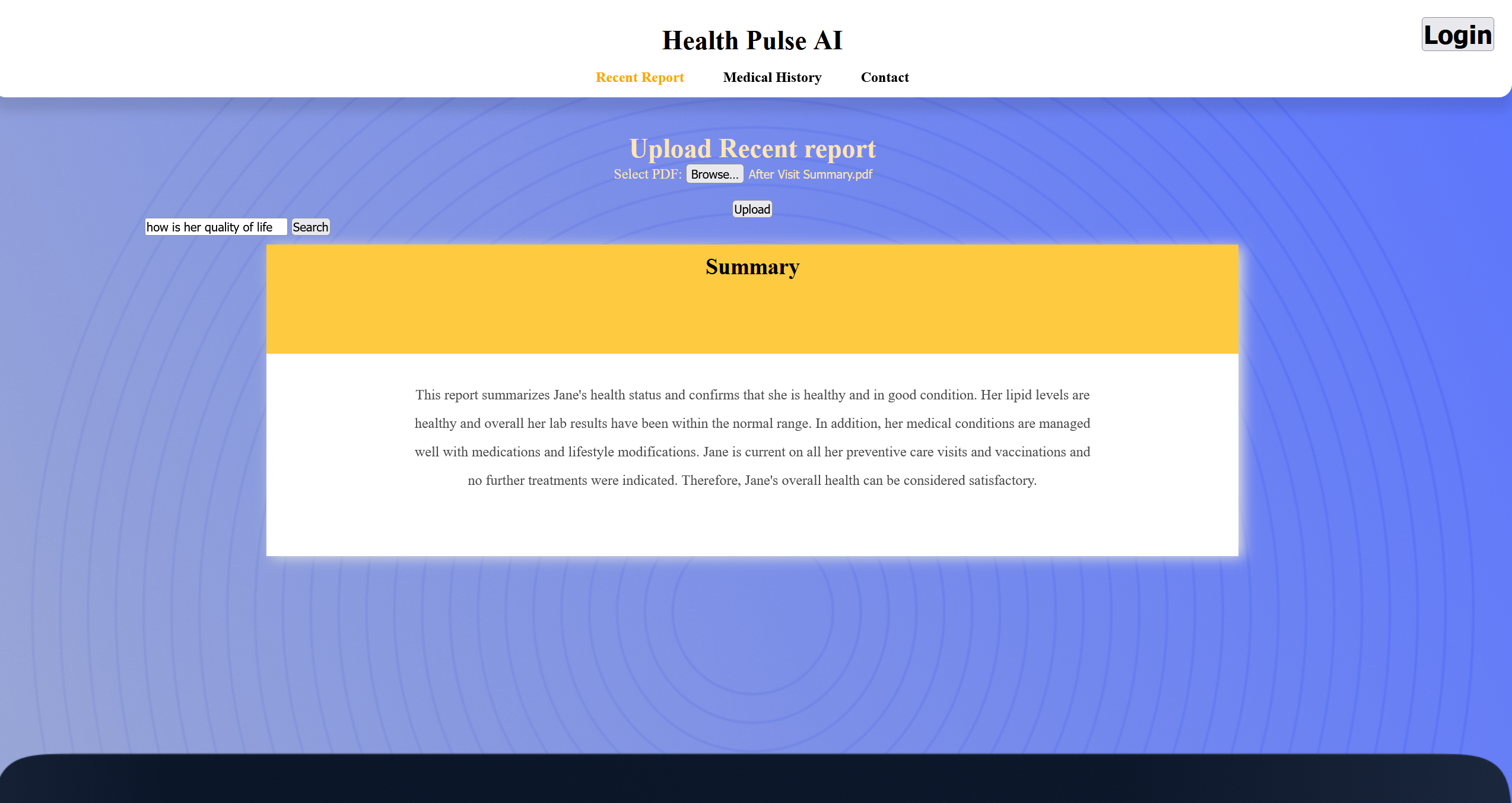
What it does: Health Pulse AI is a universal EHR synthesizer that allows both clinicians and patients to have a holistic view of the patient's overall health history. Once a patient logs into their EHR’s through the website using interoperable API’s from EHRs, the website is able to pull TSV and CSV data containing the patient's medical history, clinic visits, tests, after-clinic summaries, etc. This data can then be accessed from a patient and a clinician portal. Patients: Can access all their medical data Have it translated to them in layman's terms Query their own medical data Clinicians: They have complete access to the patient's medical records They can access a concise summary of the requested information for ease of digesting patient information View the patient's visits categorized
How you built it: We build our application using Python, Flask, CSS, HTML, JS and open AI framework. We first got the API token and worked on the functionality of summarizing the data. Then we moved forward with building the basic UI framework having upload function, filtering criteria, and getting the desired output correctly on the UI. We further improved the integration of the UI with the backend, and majorly worked on optimizing our prompt engineering for the greatest conciseness and accuracy of our summarization. Lastly, we worked on improving the end-user experience by making the website more user-friendly. We performed feature enhancements like including the user query functionality. Since we could not get API data in 24 hours we dummied 3 patient history records for testing.
Challenges you ran into: Our major challenge was deciding on and implementing the right approach to minimize hallucination when summarizing or condensing information into a concise summary. Prompt engineering was more of a challenge than we expected, we spent a large portion of time on it. We ran into unexpected CSS integration issues.
Accomplishments that you’re proud of: We were successful in producing a concise, precise, and accurate summary of the patient reports after a long time tweaking the prompts and misbehaving CSS. We are very proud that our team was able to distribute work and deliver on time within this 24-hour period. We had a solid team spirit with exceptional consensus on decisions.
What you learned: We learned a lot about prompt engineering and how the slightest differences in cadence can affect the expected quality of the output. It was rewarding working with the OpenAI framework and it has opened new doors to what we think is possible. With 24 hours and a lack of sleep, we learned to work well together, compromise where needed for each other, and stay goal-oriented with our product development.
What's next for Test Project Built with: To build the web app in alignment with EHR interoperability guides so that we can get as many EHR APIs as possible. Create a matching model for different nomenclature from different EHRs. Implementing a HIPPA complaint and certified hashing standard. Look towards B2B monetization and B2C freemium monetization.
Languages, frameworks, tools, etc. Coded in Python, CSS, HTML and JS We used the open AI framework to run AI-enabled nlp transformations on patient electronic health records It is a Flask application We used VSCode as our IDE
Built With
- ai-enabled
- coded-in-python
- css
- flask
- html
- javascript
- natural-language-processing
- openai
- transformations
- vscode


Log in or sign up for Devpost to join the conversation.