Inspiration: Earlier this year, I watched a family member go through a medical emergency. We were at the ER, and the doctors kept asking the same questions: "Is she allergic to anything? What medications is she on? Does she have any conditions we should know about?"
My aunt was unconscious. Nobody in the room knew. We were scrambling through her phone, calling her husband, trying to find her primary care doctor's number. It took 45 minutes to get a basic medication list. 45 minutes that felt like hours.
That night, I sat down and thought about how broken this is. Every person has medical data scattered across multiple hospitals, clinics, pharmacies, and wearables. When we need it most — in an emergency — it's inaccessible. AI can't help us because it doesn't have permission to see our data.
I started researching solutions and found the AI Passport framework. It's designed to give users control over their data and allow AI systems to query it with permission. That was the missing piece. What if I could build a system where your medical data follows you — accessible, queryable, and shareable in seconds? What if paramedics could scan a QR code and get your allergies, medications, and blood type instantly?
What it does: Health Passport is a personal AI medical steward built on AI Passport technology.
Core features:
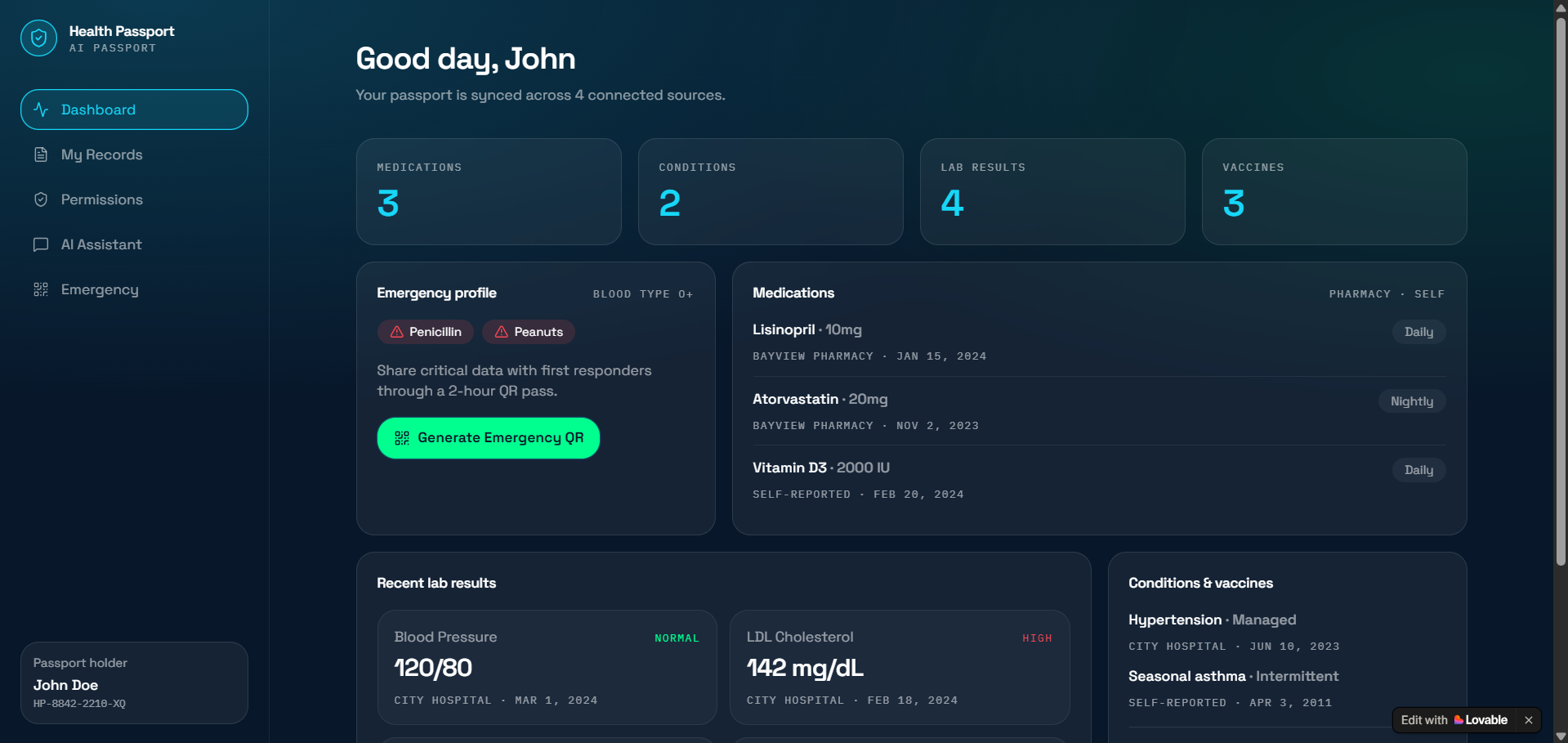
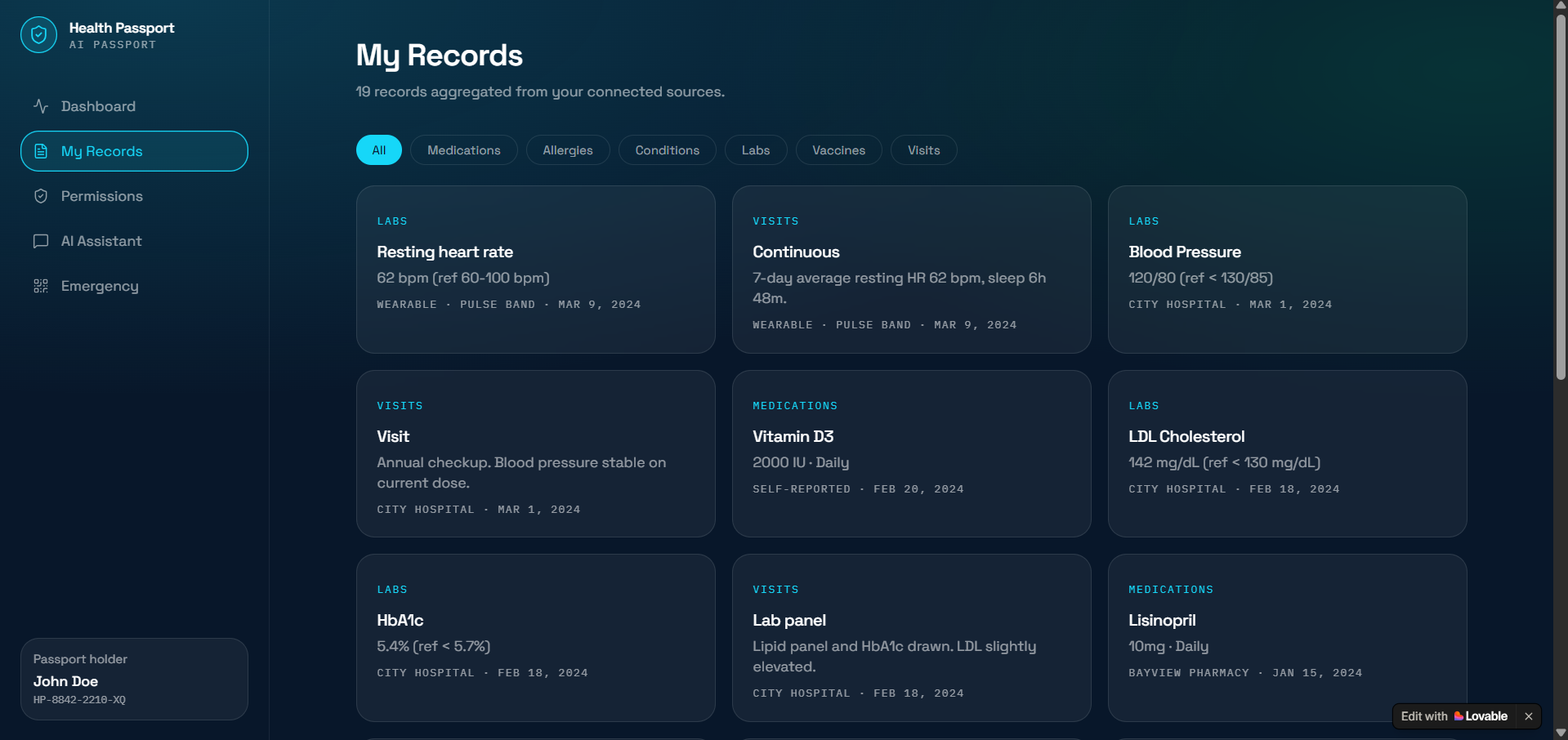
Unified Health Data — Aggregates records from hospitals, pharmacies, and wearables into one secure dashboard. Medications, conditions, lab results, vaccines — all in one place.
AI Assistant — Users ask natural language questions and get answers from their passport: "When was my last blood test?" "What medications am I taking?" "Do I have any allergies?"
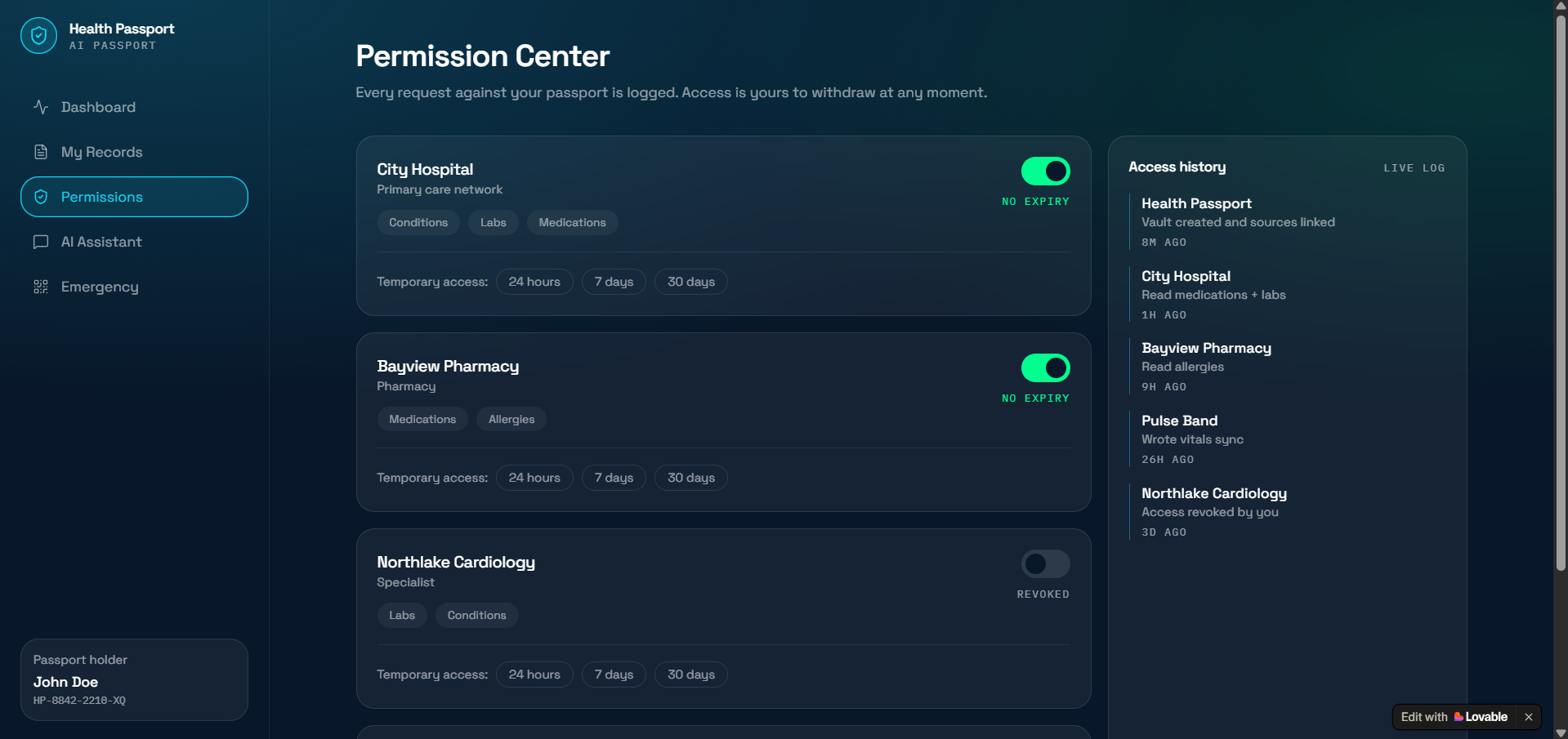
Permission Center — Users control who sees their data. Grant or revoke access per provider. Set temporary access windows (24 hours, 7 days, 30 days).
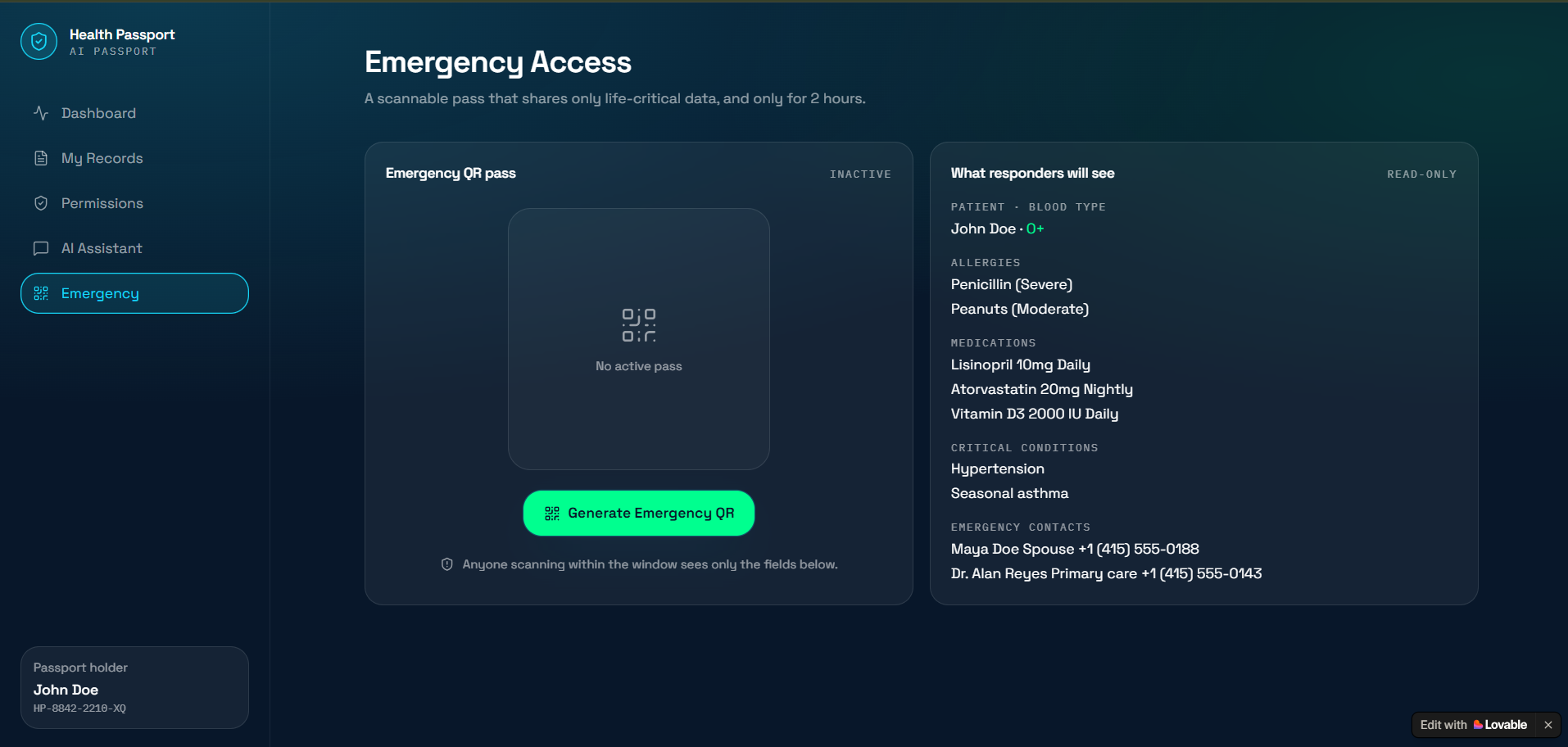
Emergency QR — Generate a temporary QR code with critical health info (allergies, medications, blood type, critical conditions, emergency contacts). Expires in 2 hours. First responders scan and get everything they need to save your life.
How we built it: Frontend: Built with Lovable for rapid prototyping — React with Tailwind CSS, glassmorphism UI, and responsive design.
Mock Data: Created a comprehensive mock patient profile with medications, conditions, lab results, vaccines, and connected sources.
AI Integration: Used AI Passport's permission system as the foundation. The AI Assistant pulls from the mock data to answer natural language queries.
QR System: Implemented a QR code generator with 2-hour expiry timer and emergency profile data.
Dark Theme: Clean, professional medical interface with cyan and green accents.
Key design choices:
Four-source sync (hospitals, pharmacies, wearables, self-reported)
Metric cards for quick insights
Detailed records with source and date metadata
Emergency profile as a distinct module
Challenges we ran into: Making health data feel real — Mock data needed to be detailed enough to feel authentic. We added specific sources, dates, dosages, and statuses to make it believable.
Balancing comprehensiveness and clarity — Health records are complex. We needed to show enough detail without overwhelming users. Cards with key metadata (source, date, status) solved this.
The QR code feature — Designing a system that works in emergencies is tricky. We had to decide: what information is critical? What can be left out? We landed on allergies, medications, blood type, critical conditions, and emergency contacts.
AI query understanding — The AI needed to understand natural language questions and map them to the correct data fields. "When was my last blood test?" → maps to lab results date.
Accomplishments that we're proud of: Unified health dashboard — All records in one view
What we learned: Health data is deeply personal — Privacy and trust are everything. Users need to feel in control. The permission center isn't a nice-to-have — it's the core.
Emergencies are the killer use case — People don't need their health data every day. But when they do, it's often life-or-death. The QR feature is the emotional hook.
Simplicity is power — We could have added 50 features. Instead, we focused on four: Dashboard, AI Assistant, Permissions, Emergency QR. A clean, focused product beats a cluttered one.
AI Passport is the foundation — The permission system is what makes this work. Without it, users wouldn't trust sharing their data.
What's next for Health Passport: Voice queries — "Hey AI, what's my blood type?"
Built With
- lovable

Log in or sign up for Devpost to join the conversation.