-
-
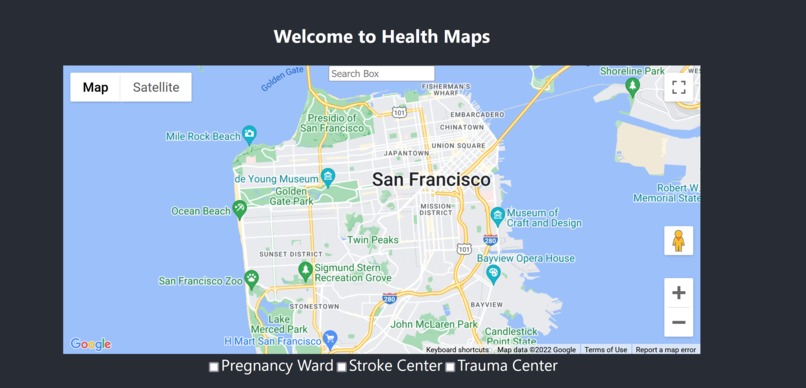
Our App
Inspiration
Patients use Google maps for a variety of reasons—but especially because they trust it to route them most appropriately during times of need. When a patient is in an unfamiliar area and they need medical care, they type into Google terms like “hospital,” “emergency,” and “urgent care.” These results are most often filtered by distance, and Google maps offers few customization options that improve relevancy. In comparison, we see an abundance of options for customizing searches for restaurants and take-out food. So, why hasn’t this been implemented for hospitals?
Two months ago, Dr. Ed Schmulbach, a Bay Area oncologist and legal advisor for Kaiser Permanente received a call from a general surgeon. A patient under her care had a stillbirth, and worse still, it was preventable.
The patient was visiting the Bay Area to assist her family when she began experiencing abdominal pain. The patient's mother entered “emergency room” into her gps app of choice and was routed to the nearest one— which was unequipped to deliver the premature fetus.
When complications arose, the doctors transferred her as quickly as possible, but the infant died during the transfer of care. Not only did the mother suffer immense emotional and physical pain, but the team providing her with care was devastated at the loss. The surgeon had the expertise to stabilize the infant, but lacked the equipment to do so.
When our team proposed this minor adjustment to the Google Maps platform, the physicians responded with emphatic support.
What it does
For the most part, the current Maps system meets the needs of patients, and often reduces cognitive load for people who very well might be in an urgent situation. However, there are a few exceptions, where arriving at the correct location the first time can lead to drastically different outcomes. With the assistance of several physicians we determined these to be:
Pregnancy Compatibility
Physical Trauma
Stroke Treatment
Each of these circumstances require time sensitive specialized support that might not be offered at any given emergency room, and this can have very serious consequences.
How we built it
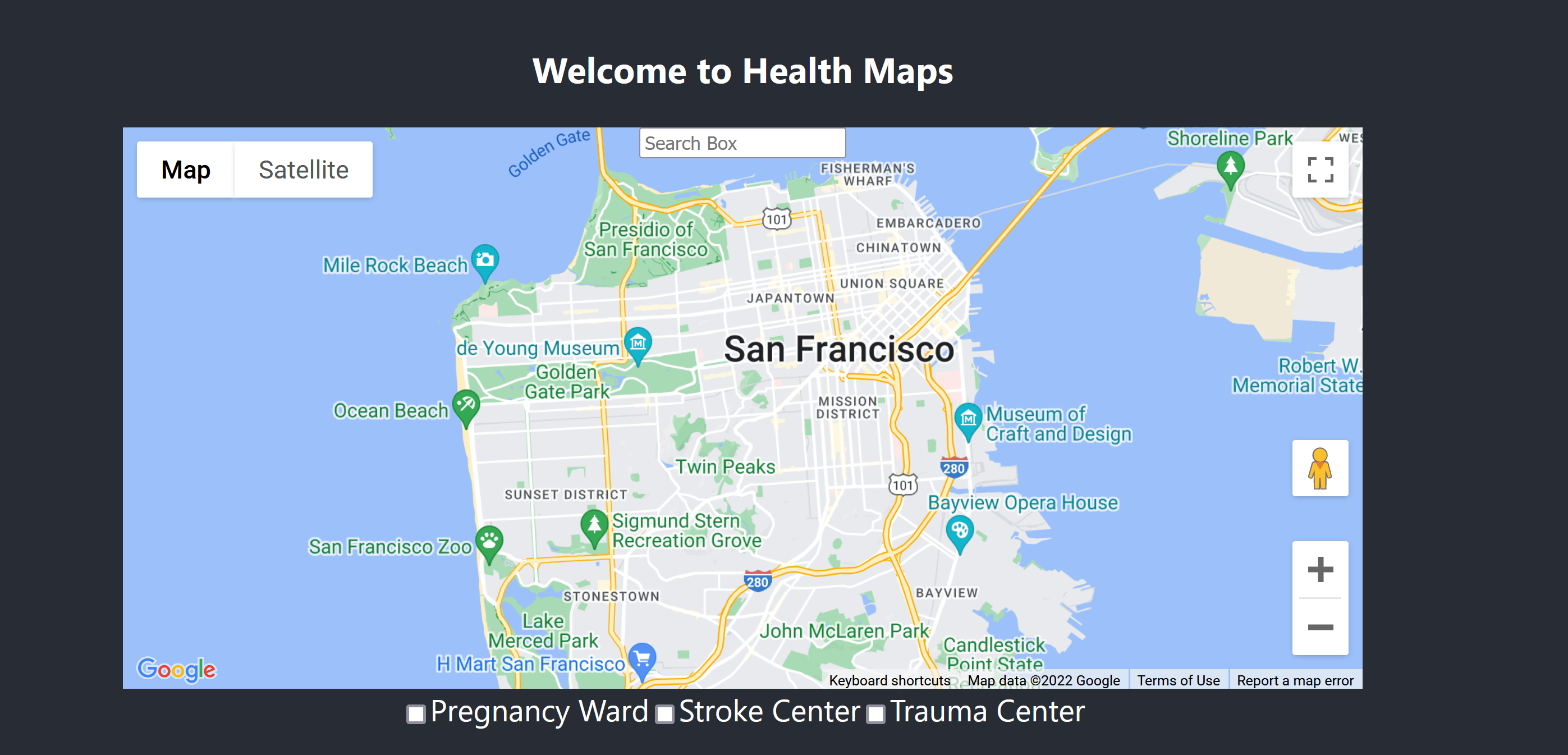
We built this app in React. We created the interactable map through the maps API, and created the autocomplete enabled search box using the places API.
When displaying markers on the map, we check to ensure that the hospital associated with the marker offers the selected service before displaying the marker. This information about healthcare accessibility is stored in a JSON file that maps the unique google_place_id to a set of three boolean values corresponding to our three categories.
Whenever a checkbox is toggled, or the search query is changed the markers are rerendered.
We originally planned to accurately source this additional information ourselves, but had difficulty tracking down the necessary information on various hospital websites, so we had to populate the fields with test data instead. Currently we only have metadata about hospitals in SF.
JSON is not a scalable way to store this data, so we are planning on migrating this information to a database in a future revision.
Challenges we ran into
Originally we had planned to source a greater number of physician testimonials for our write up. We had also wanted to include a more polished UI resembling the feel of, but not impersonating the official google maps app, and the extended set options provided when looking up restaurants.
Unfortunately, each member of our team is either employed or enrolled in university full time. This meant each member of our team struggled to balance working on this project with their other responsibilities. Our UI designer caught a cold during the final leg of this project, and we are all novices when it comes to using the react framework.
We also had hoped to include real data for each of the hospitals in SF, but struggled to track down the information in time for the deadline, so we used test data instead. We believe this further highlights the need for this project.
On the technical side, we were unable to get the directions API to work by the deadline, but I believe this is a function of our inexperience, and not a fault with the API.
Accomplishments that we're proud of
We are proud that we managed to create something that works, and that successfully implements a subset of the features we planned.
We are proud of the Health-Maps idea, and believe that systems like this one have the potential to reduce hospital transfers, reduce healthcare costs, improve quality of care, and save lives. We believe this project has enormous potential for social good, and will continue to develop it into something that can really help people. We hope to see this idea, gain widespread adoption.
What we learned
We learned how to use the react framework, how to use typescript, how to use the MapsAPI and how to use the PlacesAPI. We also learned how to not expose our API keys to github.
This was our first react project, and I think we took on too large of a project for a team of our size, inexperience, and availability. In the future, we will attempt to add more developers to our team when approaching projects of this scale.
What's next for Health-Maps
Each member of our team is committed to continuing to develop Health-Maps after the closing of this hack-a-thon. We believe in this idea. With that said, we also recognize that taking an independent approach reduces our potential for social good. We highly doubt people will download our app in times of crisis, or even remember to use our app when seeking urgent medical care.
Health-Maps has the greatest potential for good if functions like it are incorporated into existing mapping applications, with large install bases, such as Google Maps. or this reason, we do not wish to assert any ownership stake over the idea or code of health-maps. If integrated into Google Maps, and polished to improve user experience, this application could be an addition that improves health outcomes for all. This could especially improve outcomes for low-income patients who are more likely to use personal or public transportation to access health care instead of ambulatory services which can be financially prohibitive.
In addition, because this application has support from major healthcare providers such as Kaiser Permanente of Northern California, we believe many hospitals and healthcare centers would be interested in providing relevant information to Google Maps for the sake of improving patient outcomes.

Log in or sign up for Devpost to join the conversation.