-
-
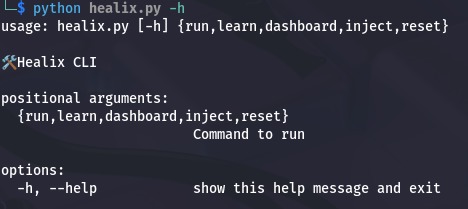
Cli Command Usage
-
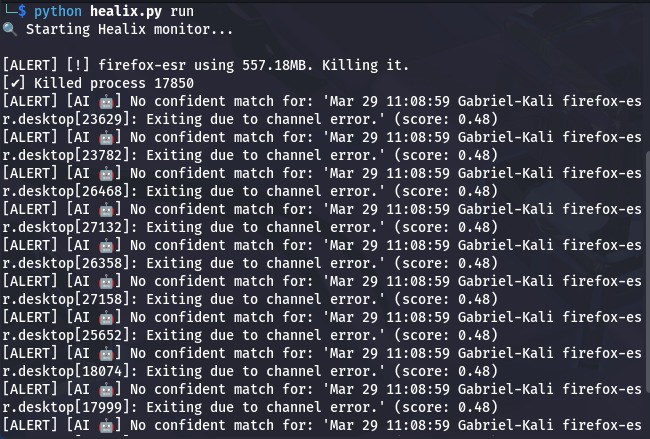
Cli Command Running Mode
-
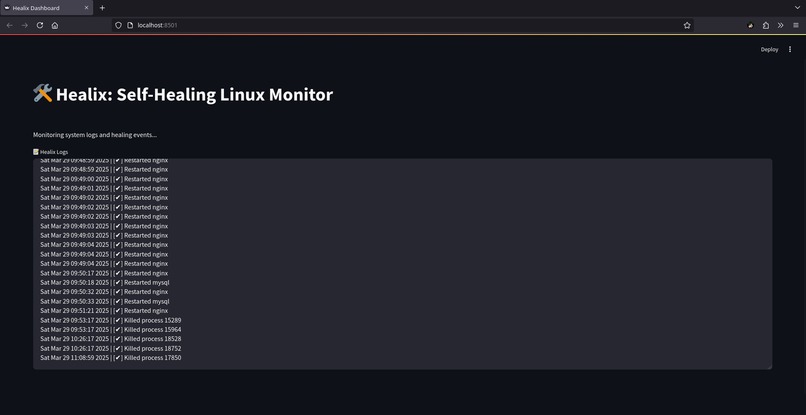
Dashboard Web Page Running Mode
-
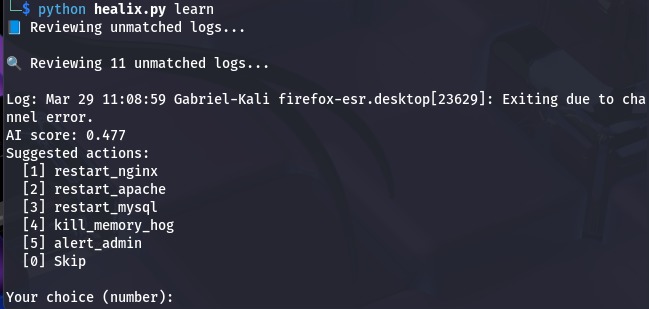
Learning New Rules


💡 Inspiration
As a daily Linux user, I’ve experienced how frustrating it can be when unexpected system errors occur — especially during important tasks. These issues often require manual troubleshooting, which breaks workflow and wastes time. That’s why I created Healix: to build a system that can monitor and fix itself, automatically.
⚙️ What It Does
Healix continuously monitors system logs and critical services in real time. When it detects failures or anomalies — such as a crashed service, unauthorized access, or memory spikes — it automatically takes the appropriate action to heal the system, such as restarting services, killing memory hogs, cleaning up disk space, or sending alerts.
🛠️ How We Built It
Healix is built in Python, leveraging:
psutil,subprocess, andwatchdogfor monitoring- A lightweight AI engine (TF-IDF + cosine similarity) to interpret new log messages
- A command-line interface (CLI) for ease of use
- Streamlit for an optional real-time dashboard
All modules are modular and easily extendable — from rules to AI behavior.
🚧 Challenges We Ran Into
One of the biggest challenges was obtaining diverse and realistic log data. To handle as many system failure scenarios as possible, the AI component needs a robust dataset of labeled log messages — something that’s not easy to gather in a short time. Balancing automation with safety (e.g., preventing accidental kills or restarts) was also a key concern.
🏆 Accomplishments We’re Proud Of
- Successfully created a self-healing system that can fix critical errors on its own
- Built a clean, interactive CLI and an optional visual dashboard
- Designed an AI matching engine that works without needing large models or heavy compute
📚 What We Learned
- How to design and structure a full-stack automation project from scratch
- How to blend AI + system-level automation effectively
- The power of small, explainable models in real-world systems
🚀 What’s Next for Healix
- Expand the AI dataset with real-world logs and edge cases
- Add feedback learning so the system improves over time
- Integrate with other platforms (Slack, Telegram, email alerts)
- Package it as a daemon or system service for real deployment
Built With
- python
- streamlit


