Healix-AI: High-Fidelity RAG Infrastructure for Clinical Trust
Inspiration: The Stochastic Failure of Medical AI
In high-stakes engineering, "hallucination" is simply another word for system failure.
Current Large Language Models (LLMs) operate on probabilistic token prediction, which creates a "Confidence Trap" in healthcare.
A single incorrect dosage suggestion is not just a bug—it is a critical safety violation.
We built Healix-AI to transform medical AI from a "black box" chat interface into a Grounded Engineering Safety Layer, specifically designed to solve the accessibility gap for blind and deaf patients who are most vulnerable to information errors.
The Multimodal Ecosystem: Inclusive by Design
Every module in Healix-Access is equipped with:
- Real-Time Voice Synthesis (for the blind)
- High-Contrast Text Streaming (for the deaf)
I. The Patient Suite: Empathetic Independence
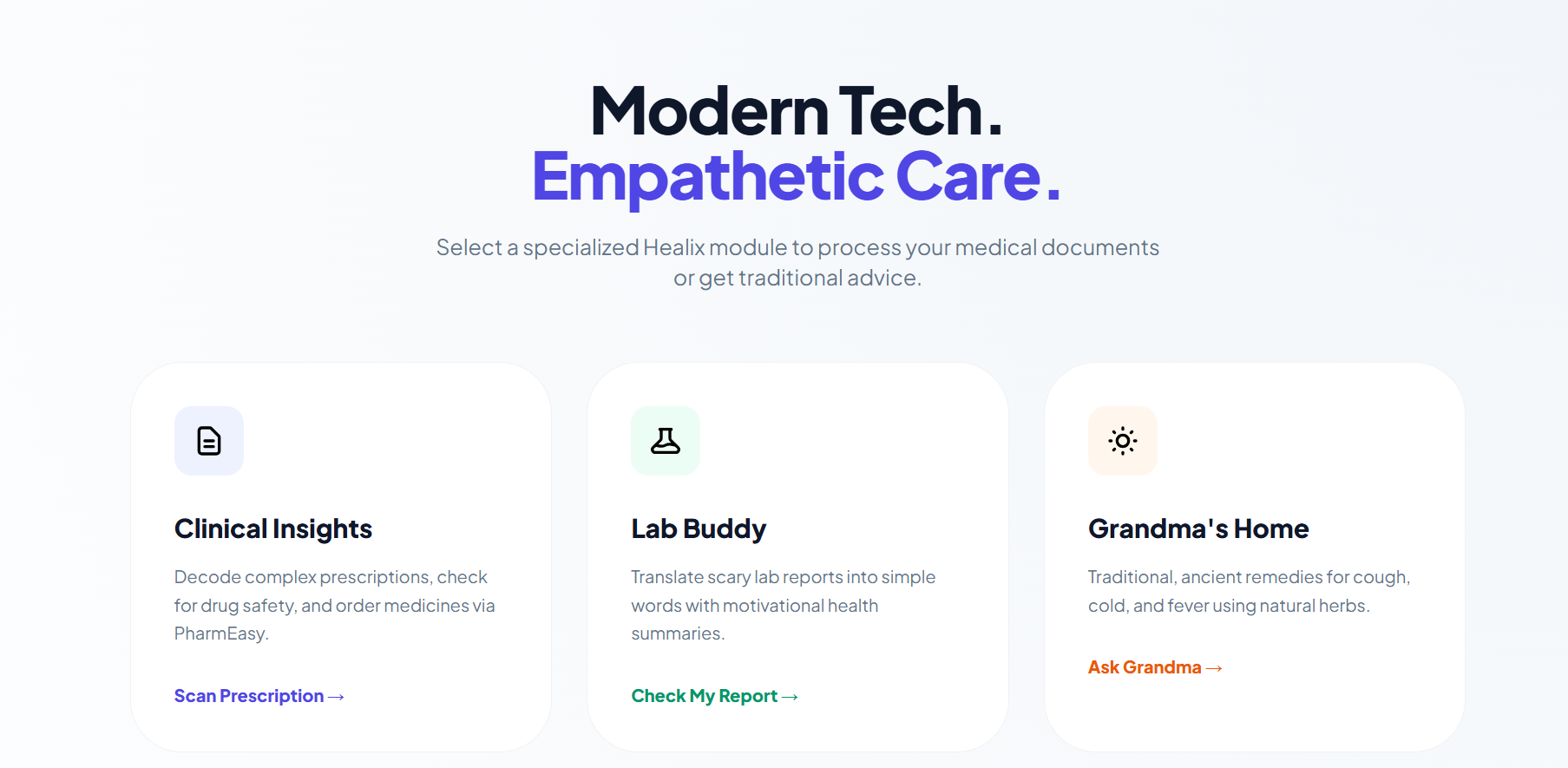
Vision-to-Voice Pharmacy: Uses docTR (Vision Transformers) to parse messy, handwritten prescriptions. It cross-references with CIMS and speaks/displays warnings about drug interactions instantly.
Lab Buddy: Translates dense biomarkers (like $HbA1c$ or $eGFR$) into simplified summaries. It provides Audio-Visual Narration, explaining the "why" behind the numbers in plain language.
Grandma’s Home: Preservation of heritage. It provides 100% citation-backed traditional remedies in local languages with full voice and text support.
II. The Physician Hub: High-Stakes Efficiency
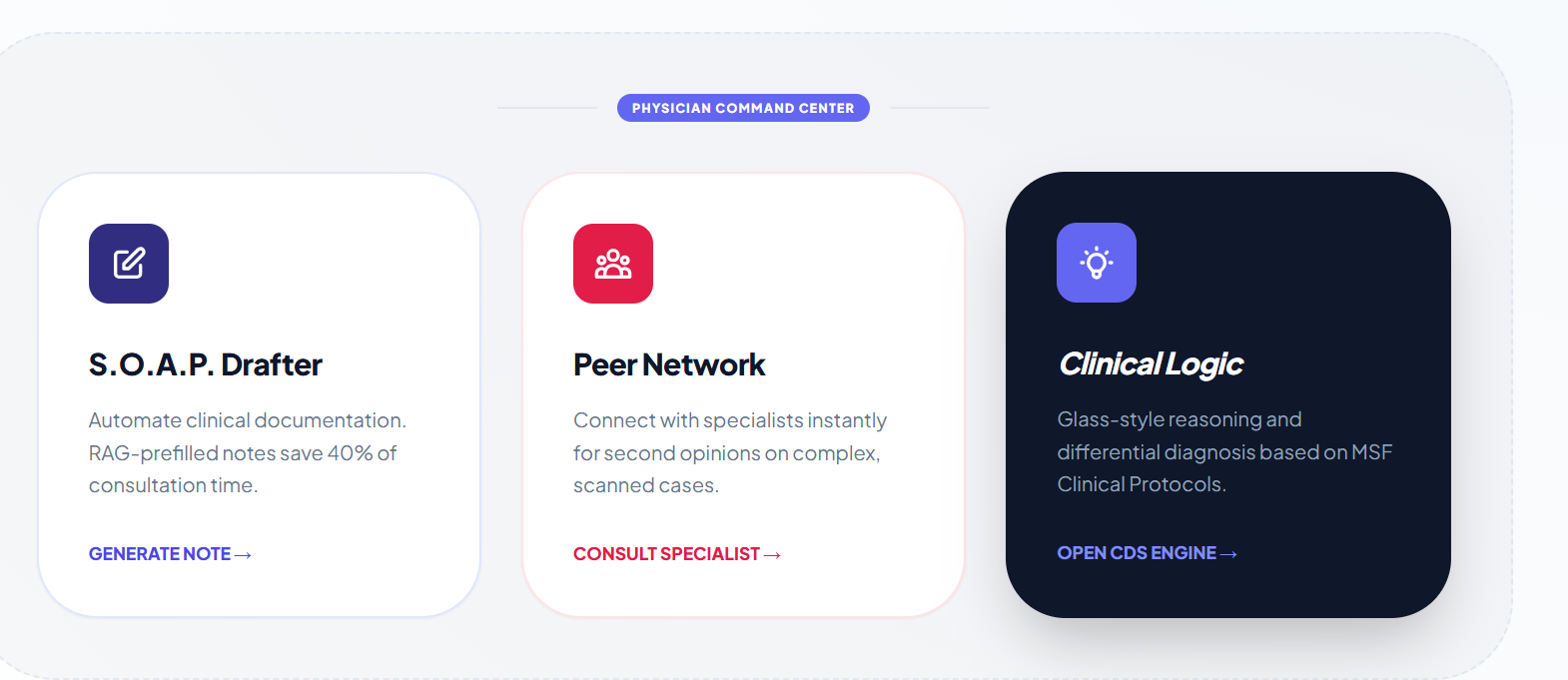
Universal S.O.A.P. Agent
Automatically structures patient history into clean SOAP notes, reducing documentation burden by ~40% for all doctors.Seamless Telehealth
A "Second Opinion Engine" with real-time transcription and voice synthesis, facilitating perfect communication between doctors and any patient, regardless of sensory ability.Glass-Box Logic
Produces transparent Clinical Logic Trees grounded in MSF Protocols, offering audible narration and visual evidence pathways for every clinical suggestion.
Architecture: The Triple-Grounded RAG Pipeline
To eliminate non-deterministic outputs, we engineered a specialized Retrieval-Augmented Generation (RAG) system.
Deterministic State Control
We enforced a strict execution policy by setting the model temperature to:
$$T = 0.0$$
This ensures the LLM acts purely as a reasoning engine over retrieved context, eliminating "creative" token generation.The Namespace Hierarchy
We indexed three high-fidelity, validated namespaces into a vector database (Pinecone):
- Pharmacological: CIMS India (Drug interactions/dosages).
- Clinical: MSF (Doctors Without Borders) Diagnostic Protocols.
- Heritage: RMRL Manuscripts (Digitized traditional wisdom).
Engineering for Accessibility: Multimodal Synchronization
A core engineering challenge was ensuring blind and deaf users receive identical, verified information simultaneously without latency lag.
Vision Pipeline: We utilized docTR (Vision Transformers) to parse unstructured, handwritten prescriptions. This converts "noisy" physical data into structured JSON, which is then verified against the CIMS database.
Inference Optimization: By utilizing Groq LPUs, we achieved sub-second inference speeds. This allowed us to build a Synchronized Output Engine:
- Voice for the Blind: High-fidelity Text-to-Speech (TTS) for immediate auditory guidance.
- Text for the Deaf: Real-time, high-contrast text streaming for visual verification.
- Voice for the Blind: High-fidelity Text-to-Speech (TTS) for immediate auditory guidance.
Technical Challenges & Learnings
Synchronicity & Latency: Ensuring the audio stream for blind users and the text stream for deaf users remained in sync during live inference required optimized asynchronous processing in the backend (FastAPI/Python).
Silent-on-Failure Policy: We learned that in engineering, "No Answer" is better than a "Wrong Answer." If the RAG retrieval confidence falls below a set threshold, the system is programmed to stay silent and flag a human-in-the-loop intervention.
Industry Validation: Our decentralized trust approach was recently forked for research by Blockchains, Inc., validating the technical viability of using RAG as a foundational layer for secure medical identity and data.
Technical Impact & Future Roadmap
Healix-Access proves that we can build "Glass-Box" AI where every decision is traceable to a citation.
Next Steps for Global Deployment:
Distributed Inference: Moving to a fully decentralized inference model to ensure 99.9% uptime in rural, low-connectivity zones.
Multi-Modal Benchmarking: Developing a rubric to measure "Trust Scores" across different medical LLM backends.
Expanded Vision Support: Training the CV model on a wider array of regional handwritten scripts to support diverse clinical environments.
Accomplishments that we're proud of
Zero-Hallucination Clinical Safety: Successfully implemented a specialized RAG architecture with a forced temperature of $T=0.0$. This ensures that for blind users relying on audio instructions, the AI never "invents" dosages but only retrieves verified facts.
True Multimodal Inclusion: Built a synchronized output engine that provides high-fidelity Voice for the blind and real-time Text for the deaf across every module, ensuring no user is left behind due to a sensory disability.
Vision-Transformer Integration: Successfully deployed docTR (Vision Transformers) to bridge the gap between messy, handwritten physical prescriptions and digital safety databases (CIMS), restoring independence to blind patients.
40% Efficiency Gain for Doctors: Developed an automated S.O.A.P. Drafter that reduces clinical documentation time by nearly half, allowing physicians to focus on patient empathy rather than screen-time.
Cultural Heritage Preservation: Digitized and indexed ancient Tamil medical manuscripts (RMRL), making traditional wisdom accessible and safe through modern clinical cross-referencing.
Industry Validation: Our decentralized trust architecture has already been recognized and forked for research by Blockchains, Inc., proving the real-world viability of our technical approach.
Built With
- cims-drug-database
- clinical
- django
- doctr-(vision-ocr)
- drf
- groq
- javascript
- lpus
- msf
- pinecone-(vector-database)
- python
- rag
- react
- restapi
- tailwind-css
- transformers

Log in or sign up for Devpost to join the conversation.