Inspiration
Healthcare in Vietnam and across Southeast Asia suffers from three persistent pain points: patients can't interpret their own lab reports, clinicians drown in documentation, and body composition tracking requires expensive equipment. When Qwen released its multimodal models, we saw a chance to solve all three in one unified platform — using a phone camera and a conversational AI to democratize clinical-grade health insights.
What it does
Healix is an AI health companion with three integrated features:
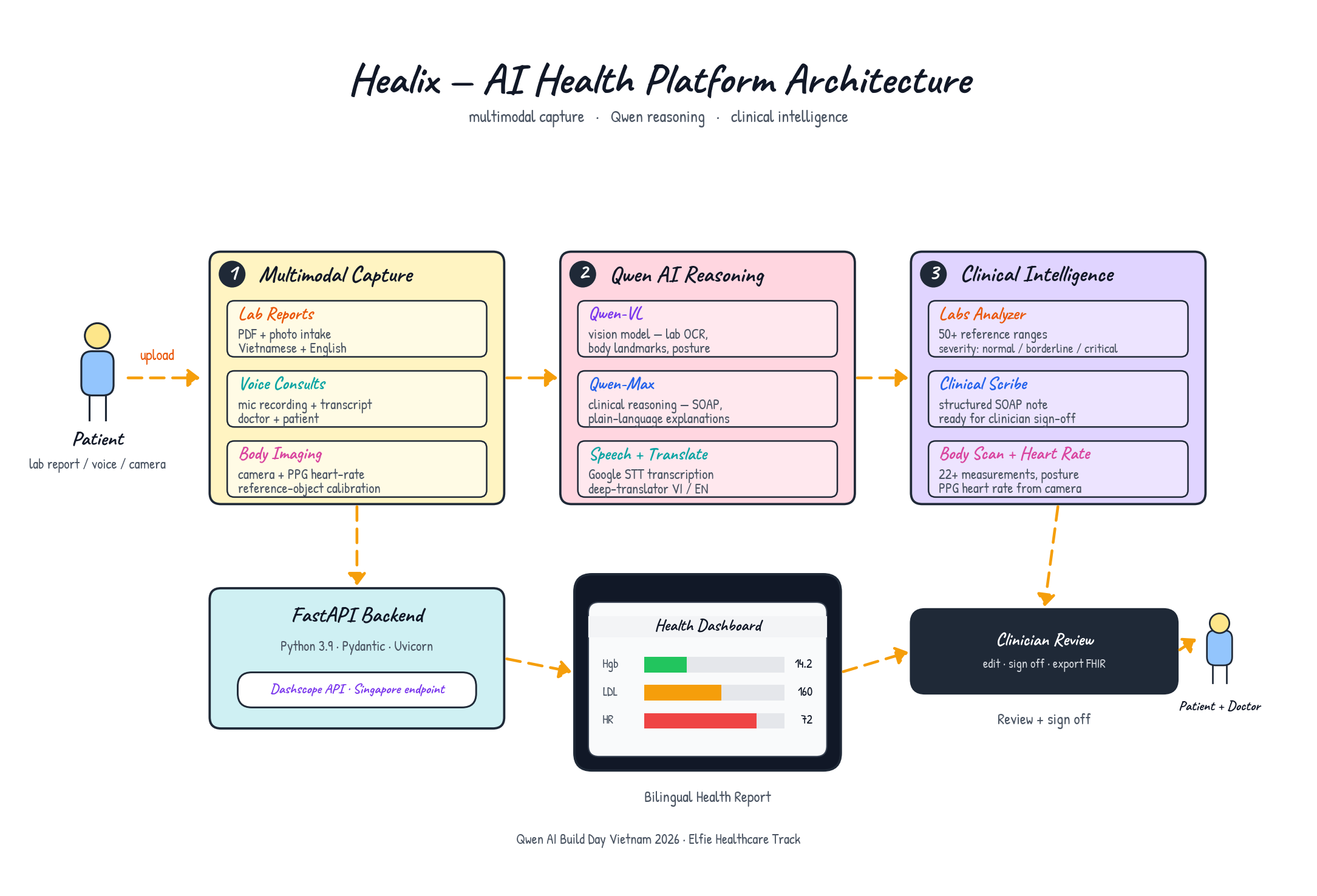
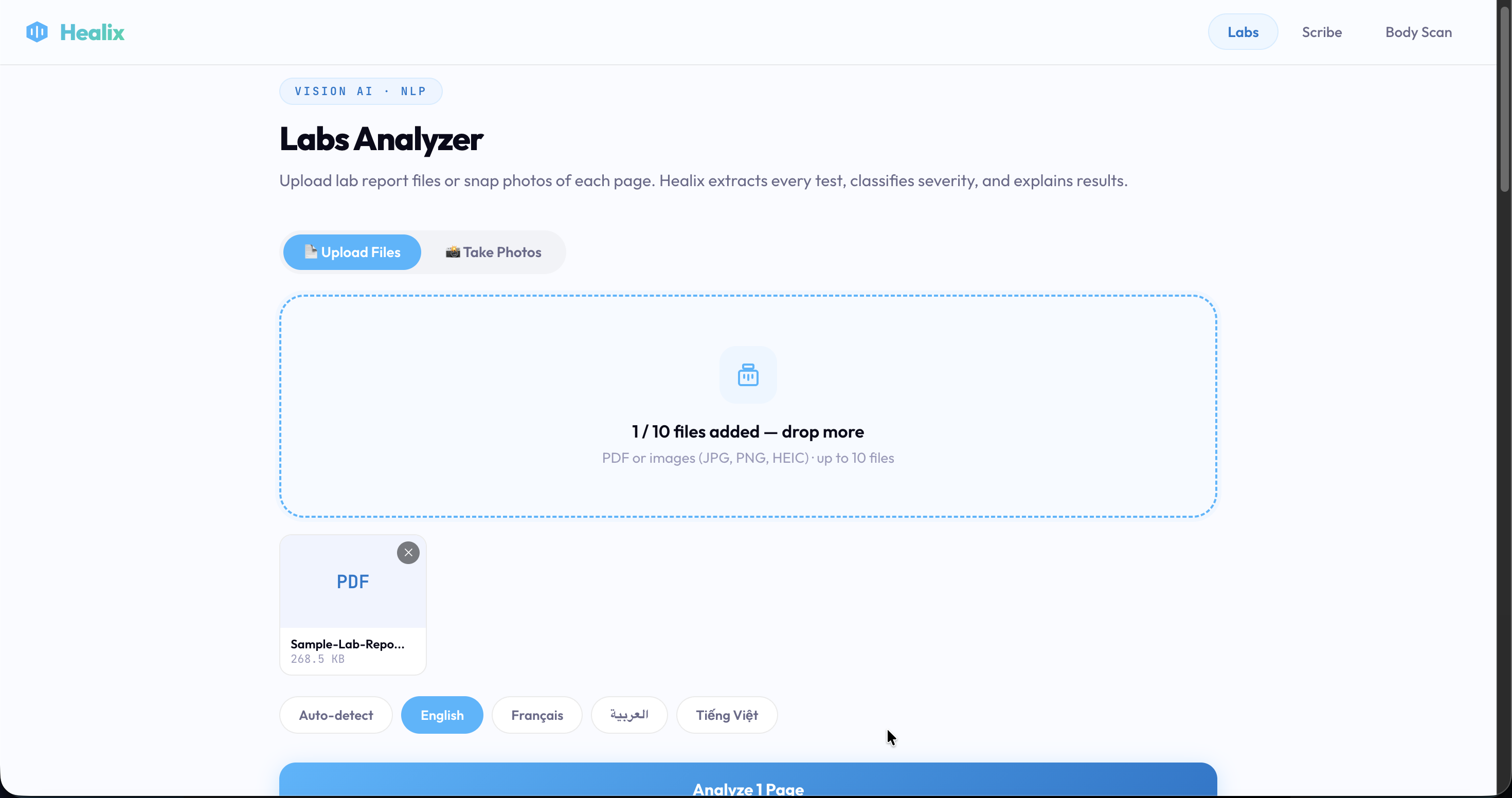
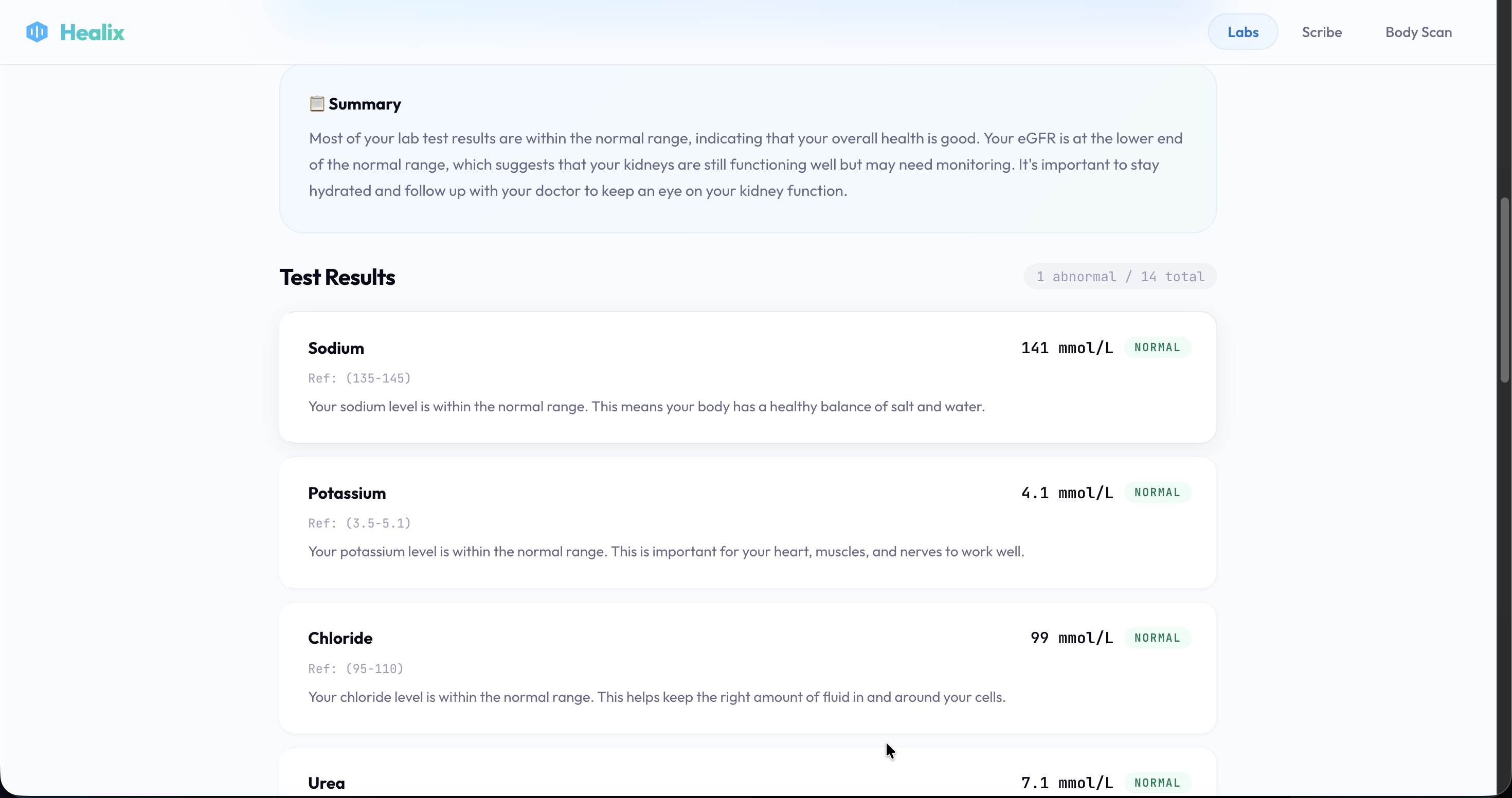
- Labs Analyzer — Upload a photo or PDF of any lab report. Qwen-VL extracts every value, cross-references 50+ medical reference ranges, and classifies each result by severity (normal, borderline, critical) with plain-language explanations in English or Vietnamese.
- Clinical Scribe — Record a doctor-patient conversation. Healix transcribes it in real time and uses Qwen-Max to generate a structured SOAP note (Subjective, Objective, Assessment, Plan) that a clinician can review and sign off in seconds.
- Body Scan — Point your phone at yourself. A custom Qwen-VL pipeline delivers 22+ body measurements, posture analysis, and a PPG-based heart rate reading — no wearables, no tape measure, no calibration lab.
How we built it
- Frontend: React + Vite, mobile-first UI designed screen-by-screen in mockups before a single component was coded.
- Backend: FastAPI on Python 3.9, orchestrating requests to Qwen through the Dashscope API.
- Labs Analyzer: Qwen-VL parses scanned reports → a reference-range database scores severity →
deep-translatorhandles Vietnamese ↔ English medical terminology. - Clinical Scribe: Google Speech Recognition for transcription → Qwen-Max for SOAP generation. We pivoted to this split after discovering Qwen-Audio wouldn't accept base64 payloads through the OpenAI-compatible endpoint.
- Body Scan: We replaced the commercial Bodygram SDK with our own Qwen-VL pipeline that uses a reference object for calibration, then extracts measurements, posture landmarks, and skin-tone PPG signals for heart rate.
Challenges we ran into
- Regional endpoint mismatch. We burned hours on a persistent
401 Unauthorizedbefore realizing we were hitting the China Dashscope endpoint from Vietnam. Switching todashscope-intl.aliyuncs.com(Singapore) fixed it instantly. - Qwen-Audio incompatibility. Base64 audio didn't work through the OpenAI-compatible SDK, so we rearchitected the Clinical Scribe around Google Speech Recognition while keeping Qwen-Max as the clinical reasoning layer.
- Body measurements without hardware. Extracting 22+ measurements from a single phone camera needed a reference-object calibration step and a posture-normalization routine we built from scratch.
- Dependency hygiene. Missing
deep-translatoranddashscopeinrequirements.txtbroke collaborator setups — a tiny fix, a useful lesson.
Accomplishments that we're proud of
- Shipped three production-quality AI features in a single hackathon sprint.
- Built a custom Qwen-VL body-measurement pipeline that competes with commercial SDKs.
- Mobile mockups for every screen — not just the happy path.
- First-class bilingual medical content (Vietnamese + English).
- Zero API keys ever committed to Git.
What we learned
- Multimodal LLMs can collapse entire stacks — OCR, NLU, translation, reasoning — into a single well-prompted call.
- Regional endpoints matter. A lot.
- When a model path fails (Qwen-Audio via OpenAI-compatible), splitting responsibilities across two simpler calls is often faster than fighting the SDK.
- Medical UX is unforgiving: every number needs context, every recommendation needs a disclaimer.
What's next for Healix
- Clinician dashboard for reviewing, editing, and signing SOAP notes.
- Longitudinal tracking — trend lab values and body measurements over time for preventive insights.
- FHIR-compatible export so Healix plugs into existing hospital systems.
- On-device inference with a quantized Qwen-VL variant for privacy-preserving offline mode.
- Expanded reference database into specialty panels (endocrine, oncology, prenatal).
Built With
- alibaba-cloud
- dashscope
- deep-translator
- fastapi
- google-speech-recognition
- opencv
- pydantic
- python
- qwen
- qwen-max
- qwen-vl
- react
- typescript
- uvicorn
- vite


Log in or sign up for Devpost to join the conversation.