-
-
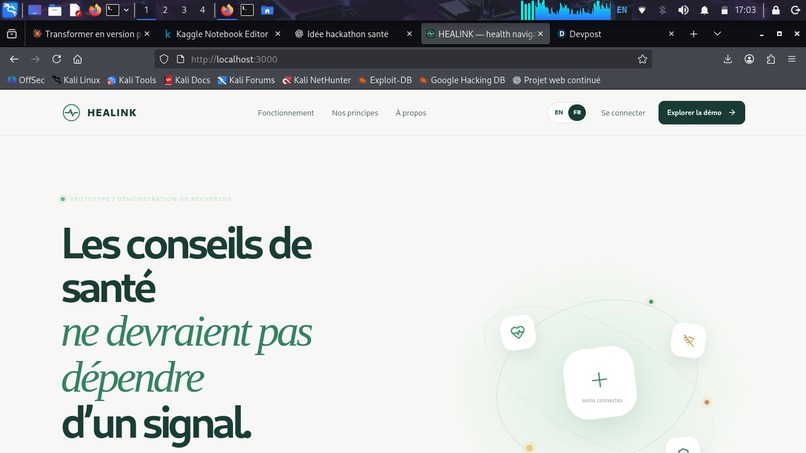
Acceuil
-
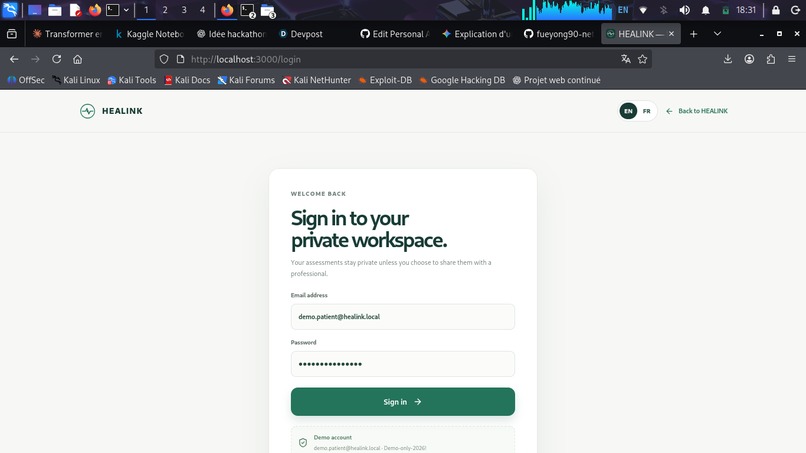
connexion
-
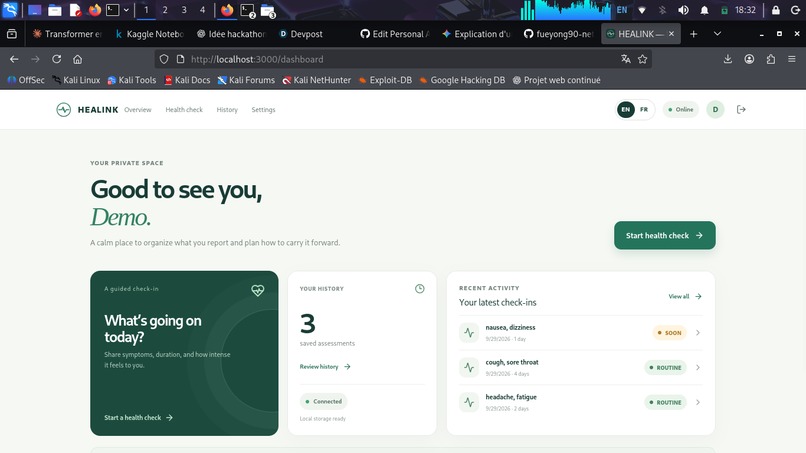
bienvenue
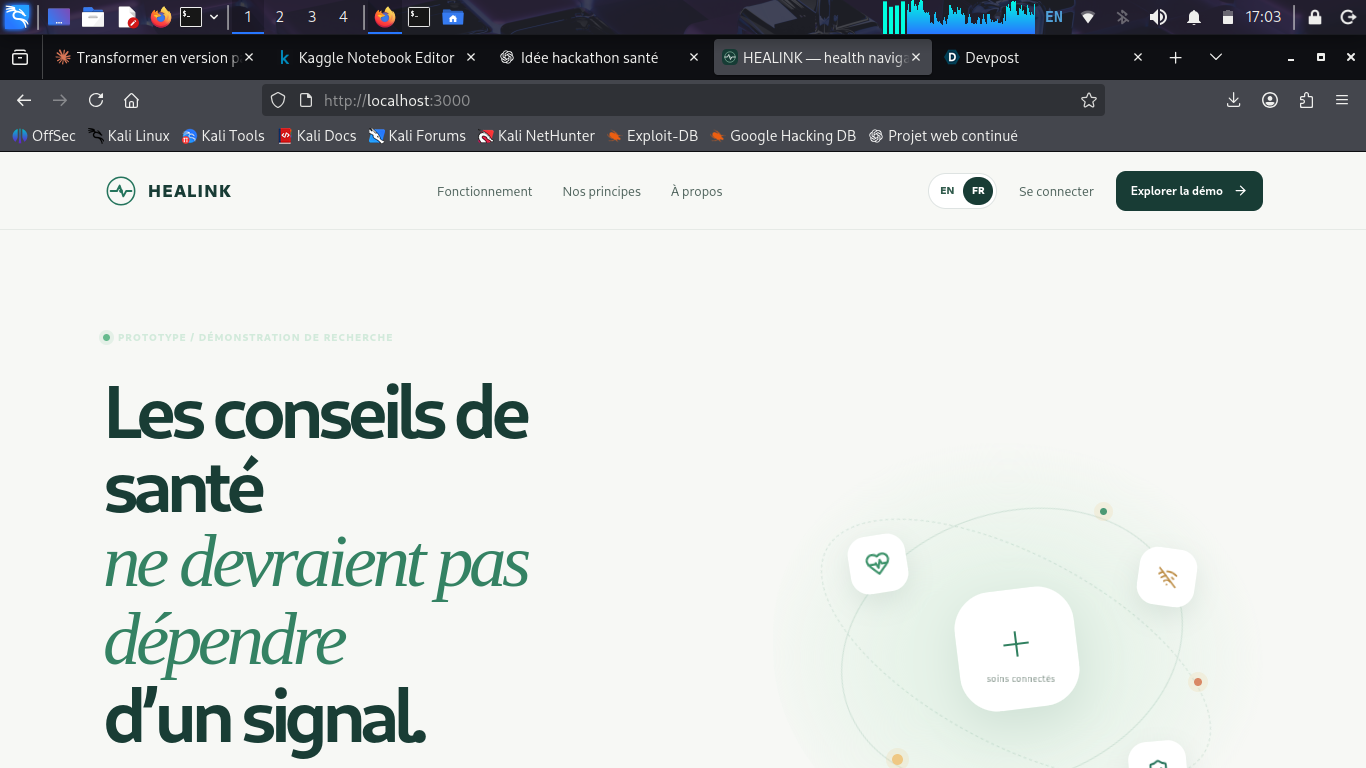
Inspiration
Healthcare access is not only a question of having hospitals and doctors available. In many communities, people may face long distances, limited connectivity, uncertainty about the seriousness of their symptoms, or difficulty knowing where and when to seek care.
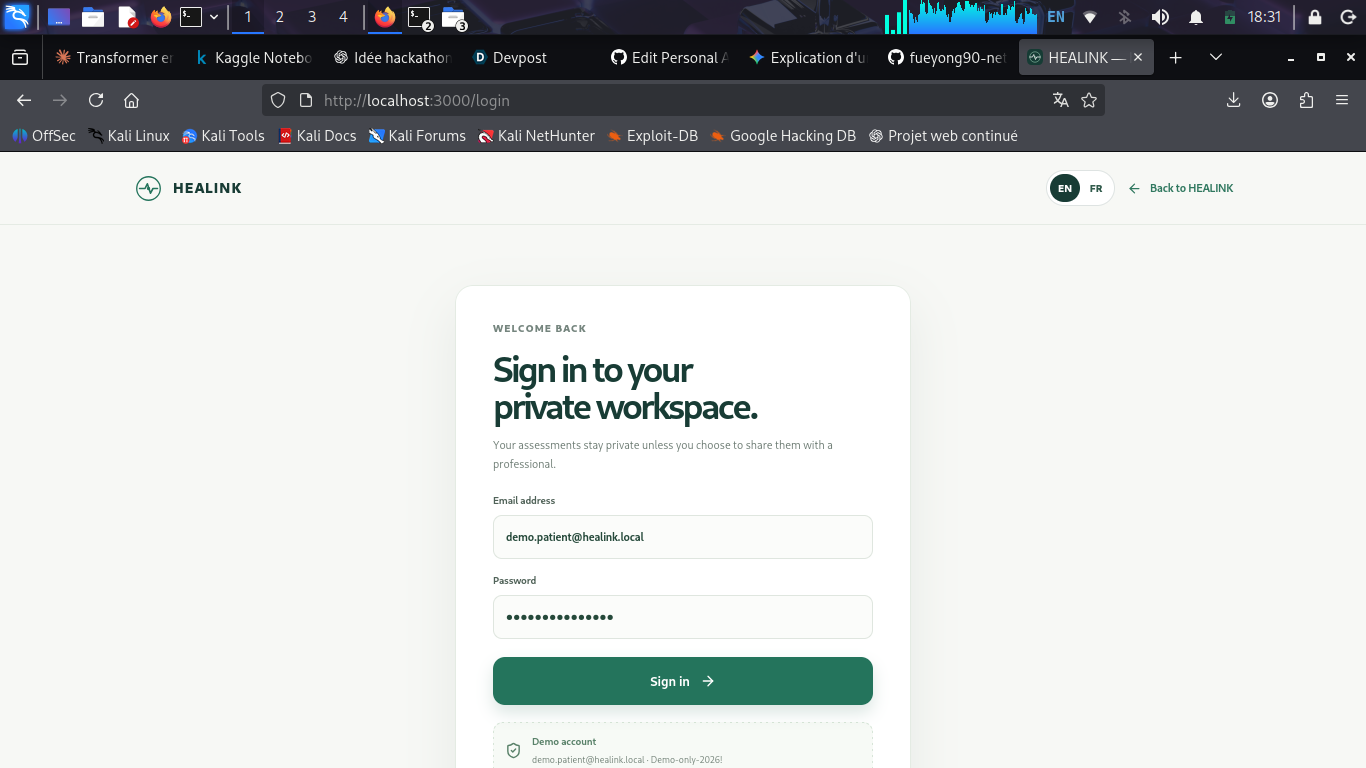
This challenge inspired us to create HEALINK, an offline-first intelligent health navigation system designed to help people make a more informed decision about their next step in the healthcare journey.
Our goal was not to build another chatbot that pretends to diagnose patients. Instead, we wanted to explore how AI, rule-based safety mechanisms, explainability, and offline technology could work together to provide responsible health-risk guidance while keeping healthcare professionals in the loop.
What We Built
HEALINK combines several components:
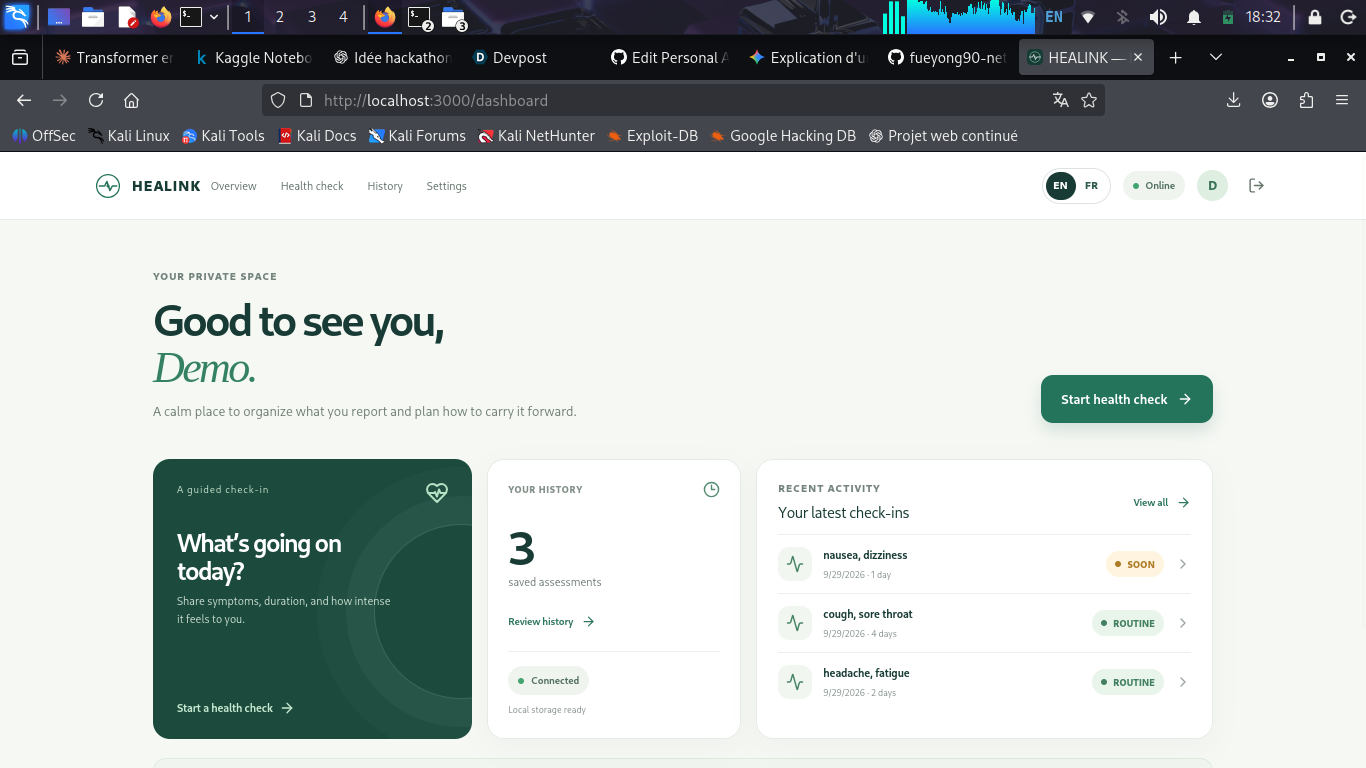
- A symptom and context assessment interface.
- A Safety Rule Engine for high-risk situations.
- A Machine Learning Risk Engine for risk estimation.
- An Explainability Layer showing the factors that contributed to the assessment.
- A Triage Orchestrator that combines the available signals into a care-navigation indication:
ROUTINE,SOON, orURGENT. - An offline-first Progressive Web App (PWA) that can continue collecting information when connectivity is unavailable.
- A synchronization mechanism designed to send locally stored information when connectivity is restored.
- A Case Card that can be shared with a healthcare professional with user consent.
- A professional dashboard for reviewing shared cases.
- Privacy and security mechanisms designed around data minimization, consent, access control, and auditability.
HEALINK is intentionally positioned as a decision-support and care-navigation prototype, not a diagnostic system. It does not replace a doctor and does not prescribe medication.
How We Built It
We designed HEALINK as a modular architecture:
Patient PWA / Professional Dashboard
              ↓
          API Layer
              ↓
      Triage Orchestrator
          ↙          ↘
 Safety Rule       ML Risk
    Engine          Engine
          ↘          ↙
       Explainability
              ↓
      Data & Audit Layer
The frontend is designed around a modern web architecture with React/Next.js and TypeScript, while the backend and machine-learning components use Python.
For the ML pipeline, we focused on a reproducible workflow:
- Data preprocessing
- Feature engineering
- Model training
- Evaluation
- Inference
- Explainability
When real clinical data is unavailable, the prototype uses clearly identified synthetic/demo data rather than pretending that generated data represents real patients.
This distinction was important to us because a healthcare prototype must make its limitations explicit.
Offline-First Design
One of the main ideas behind HEALINK is that connectivity should not automatically prevent someone from using the system.
The application therefore follows an offline-first approach:
No Internet
    ↓
Local Storage
    ↓
Assessment / Case Creation
    ↓
Local Queue
    ↓
Connection Restored
    ↓
Secure Synchronization
This architecture makes HEALINK particularly relevant to environments where internet access can be intermittent.
What We Learned
Building HEALINK taught us that healthcare technology requires more than simply adding an AI model to an application.
We learned the importance of:
- Combining machine learning with deterministic safety rules.
- Making AI outputs understandable instead of presenting unexplained predictions.
- Designing for offline and low-connectivity environments from the beginning.
- Treating privacy and consent as architectural requirements rather than optional features.
- Clearly separating risk assessment, care navigation, and medical diagnosis.
- Making a prototype reproducible and transparent about what has and has not been clinically validated.
We also learned that technical feasibility and clinical feasibility are different problems. A system can be technically functional while still requiring extensive clinical validation before being used in real healthcare settings.
Challenges
One of our biggest challenges was working within a limited development environment while trying to build a complete system involving frontend, backend, machine learning, database infrastructure, and offline synchronization.
We also faced the challenge of working without access to a large validated clinical dataset. Instead of hiding this limitation, we designed the prototype so that the data pipeline can later accept properly validated datasets.
Another challenge was balancing AI capability with safety. In healthcare, an impressive prediction is not enough. The system must also know when deterministic safety rules should take priority and when a human professional should be involved.
Finally, we had to design an interface that communicates uncertainty clearly. HEALINK therefore avoids presenting its outputs as definitive diagnoses.
What Comes Next
HEALINK is a prototype and not a clinically validated medical device.
The next stages would include:
- Validation with healthcare professionals.
- Evaluation on appropriately anonymized and ethically sourced clinical datasets.
- Extensive testing for false positives and false negatives.
- Bias and fairness evaluation across different populations.
- Stronger privacy and security auditing.
- Clinical usability studies.
- Deployment testing in real low-connectivity environments.
Our long-term vision is simple:
Technology should help people reach the right care sooner, without pretending to replace the people who provide that care.
Built With
- ai
- api
- artificial
- data
- digital
- fastapi
- health
- healthcare
- intelligence
- learning
- machine
- medical
- next.js
- offline-first
- postgresql
- python
- react
- science
- technology
- triage
- typescript

Log in or sign up for Devpost to join the conversation.