Inspiration
Healthcare usually ends when a patient leaves the hospital. A doctor can prescribe exercise, avoiding heat, reducing pollution exposure, or taking a safer route, but the patient is still left to figure out how to apply that advice in the real world.
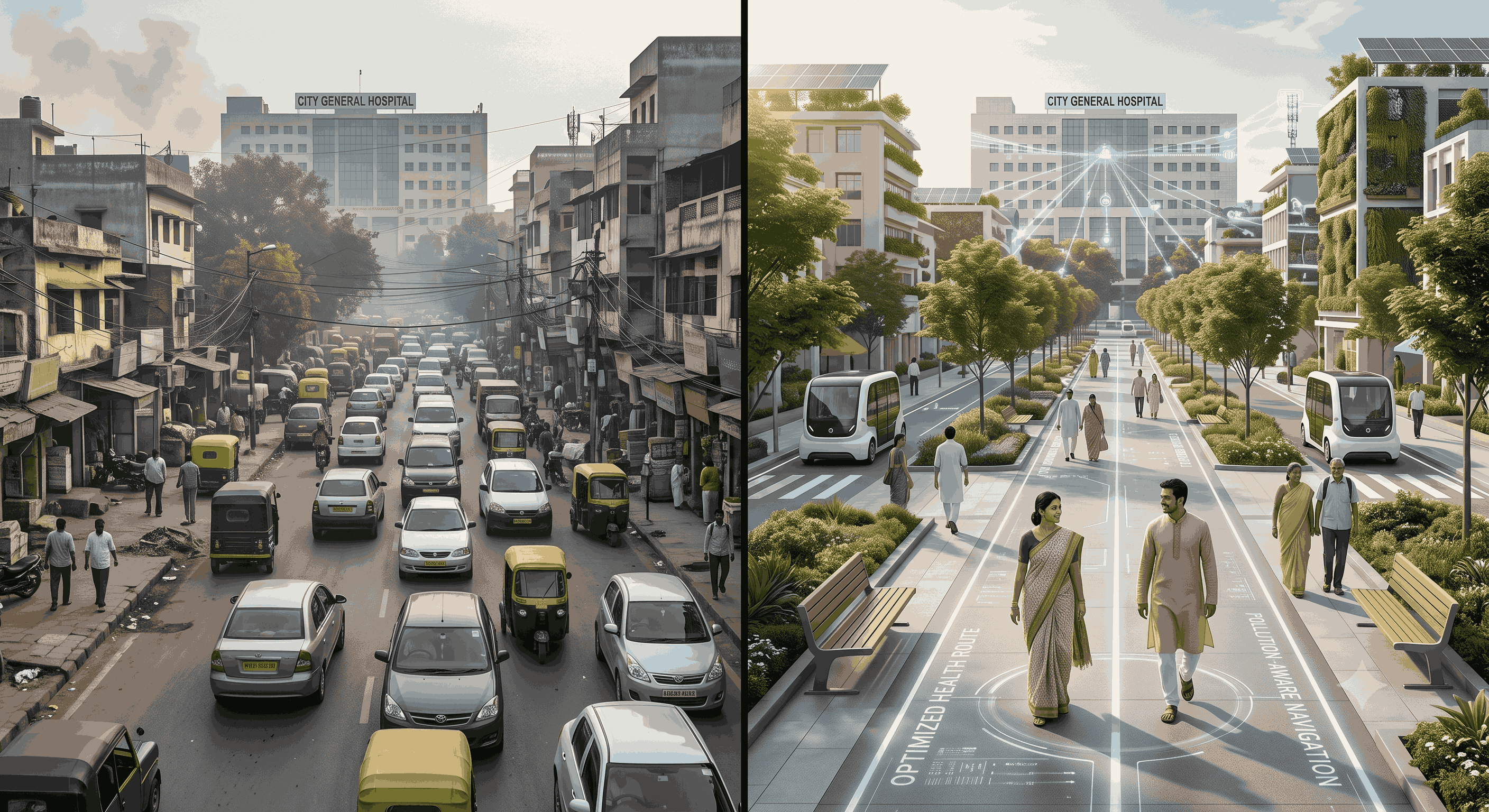
We imagined a different future: what if the city itself could help people heal?
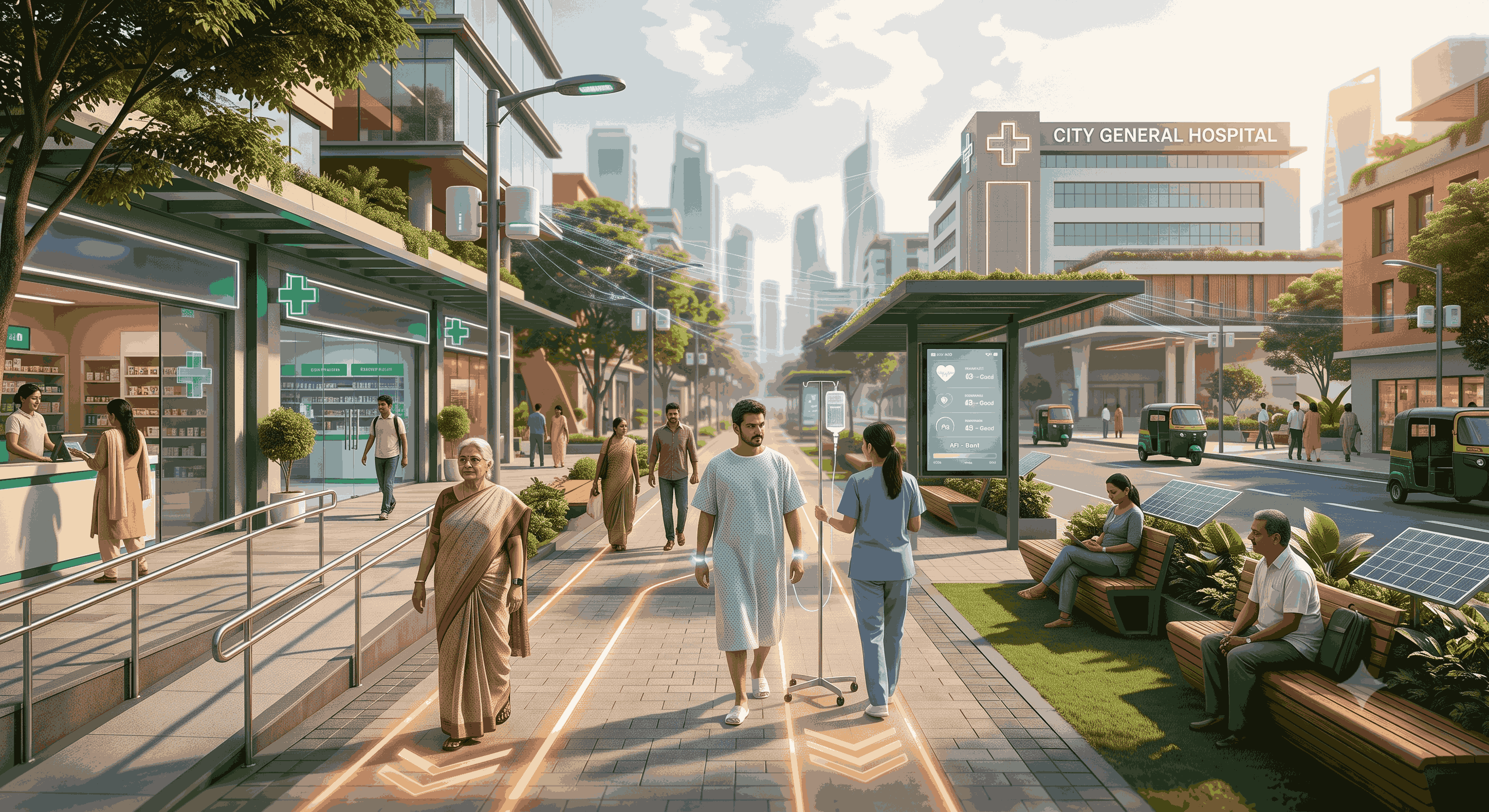
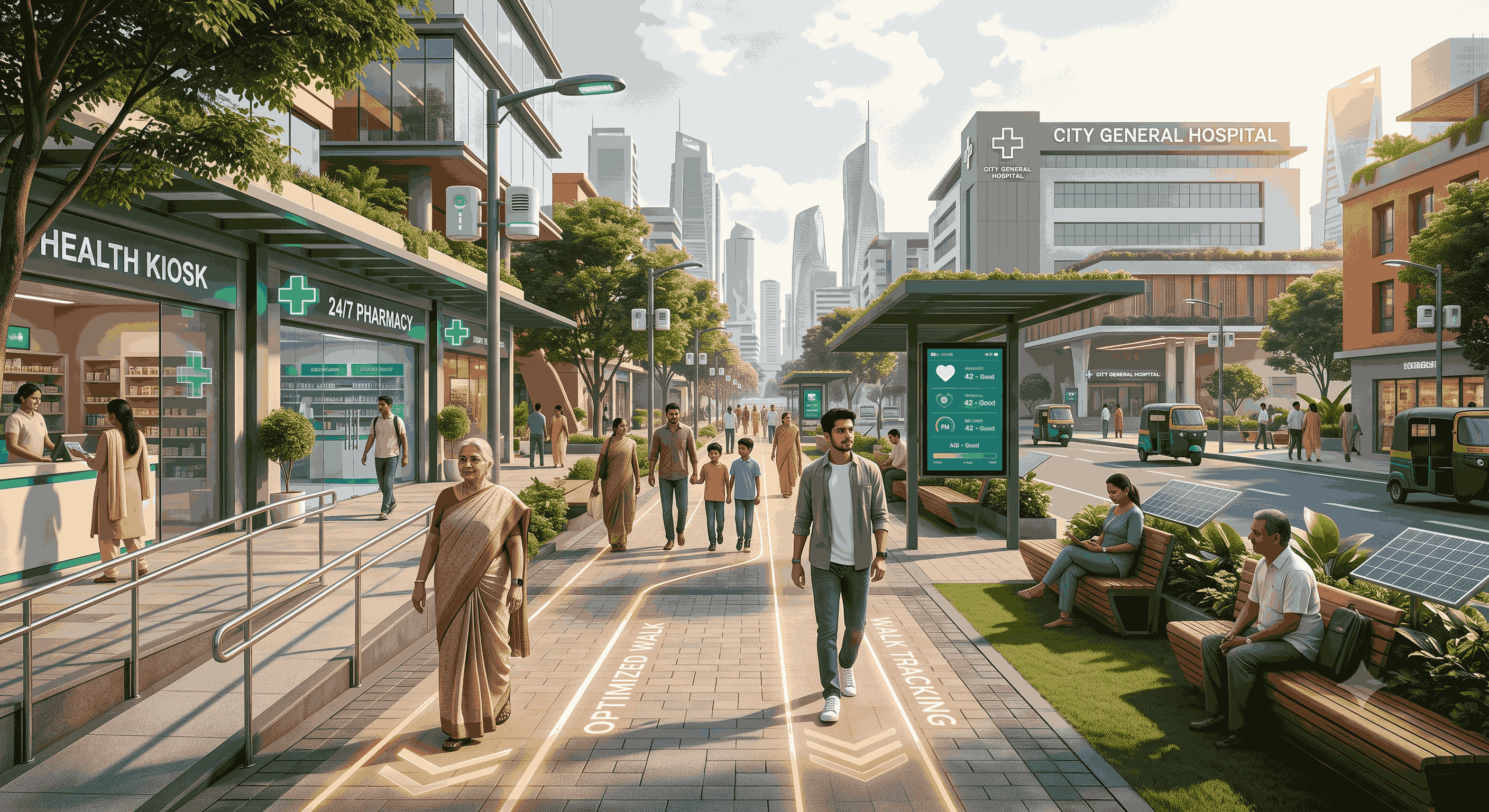
This led to HEALCITY — a concept where healthcare extends beyond hospitals and into the streets, parks, public spaces, transportation and everyday environment around a person. Instead of designing one city for everyone, we imagined a city that can respond differently to different people's health needs.
What it does
HEALCITY creates a personalized health-aware layer over the existing city.
A user's health requirements are converted into practical environmental needs. The system can then consider factors such as weather, air quality, accessibility, traffic, walking distance, rest points and nearby services to recommend actions suited to that person.
For example:
- A recovering patient can receive a low-impact route with fewer stairs and nearby resting points.
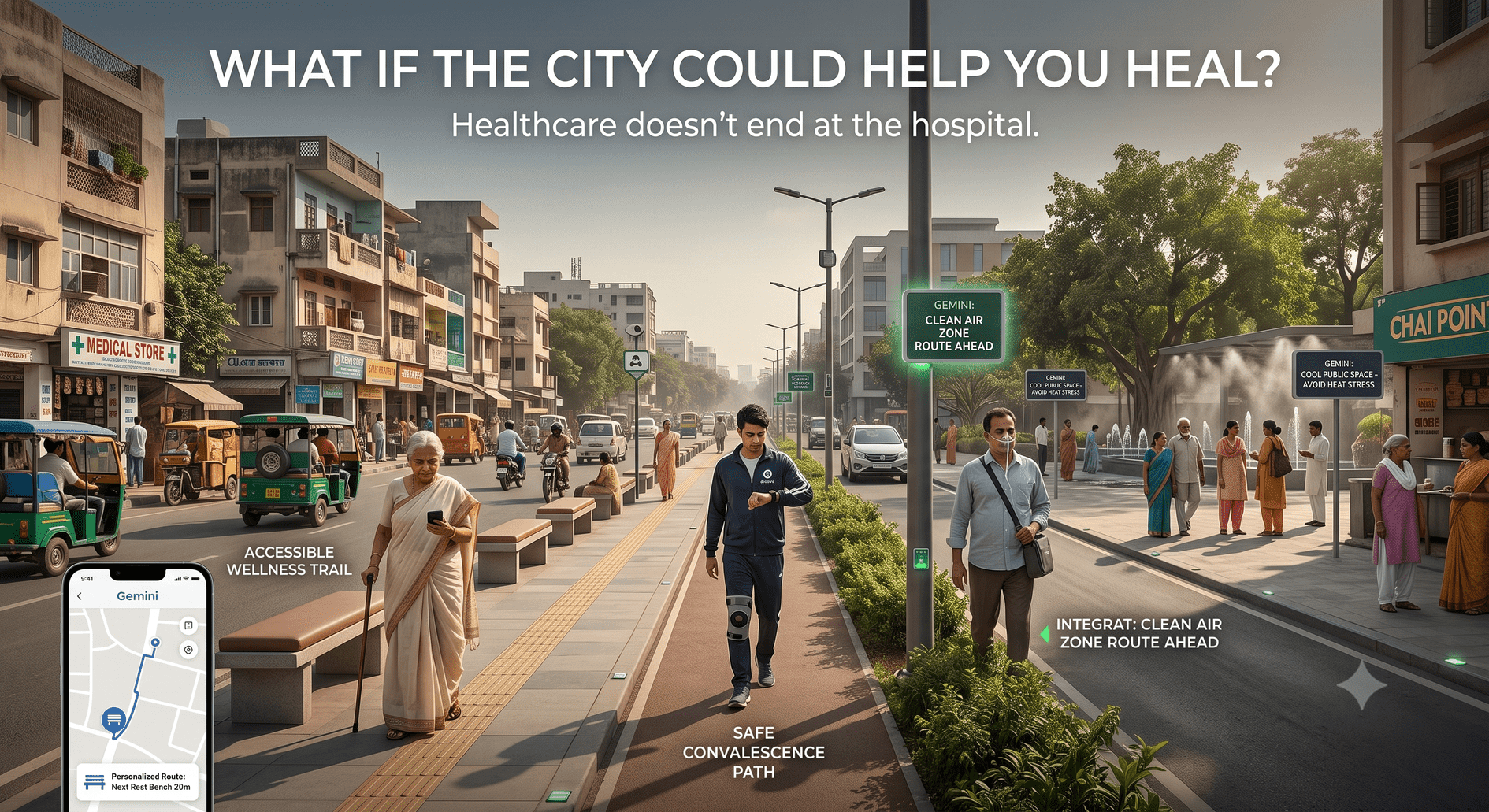
- Someone sensitive to pollution can be guided toward cleaner-air areas.
- Elderly users can receive accessible routes with more opportunities to rest.
- During extreme heat, vulnerable users can be directed toward cooler or sheltered locations.
- A patient can receive different recommendations depending on changing city conditions.
The goal isn't simply to tell people what is healthy. It is to make the surrounding city help them act on it.
How we built it
We designed HEALCITY as an AI-powered decision layer connecting three types of information:
Personal health requirements + City conditions + Available infrastructure
Gemini serves as the reasoning layer that interprets these inputs and turns them into understandable, personalized recommendations.
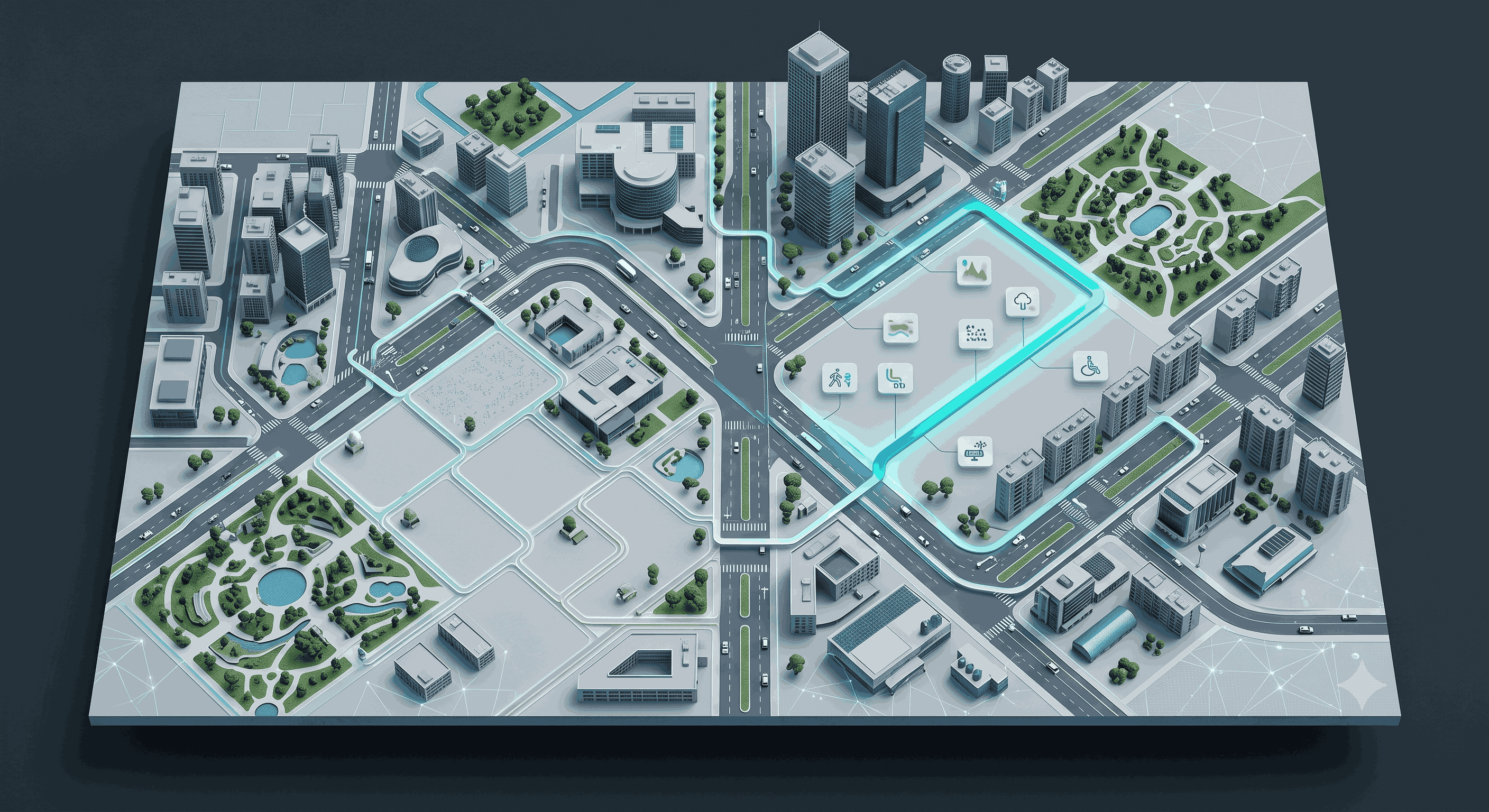
The prototype represents city conditions through factors such as environmental conditions, accessibility, routes and nearby services. A health-aware routing layer then determines which options best match the user's requirements.
The interface is designed around a personalized city map where users can see health-related layers, receive recommendations and interact with Gemini to understand why a particular route or action was suggested.
Rather than replacing doctors, HEALCITY is designed to translate professional healthcare guidance into everyday decisions.
Challenges we ran into
The biggest challenge was avoiding the idea of building just another healthcare chatbot.
The difficult question was: How do we connect an individual's health needs with the physical environment around them?
We had to think about many conflicting factors at once. The shortest route isn't necessarily the healthiest route. A park might be nearby but have poor air quality. A route might be accessible but exposed to extreme heat.
Another major challenge was privacy. Health information is highly sensitive, so the concept needed to follow a consent-first approach and avoid unnecessarily exposing personal medical information.
We also had to balance an ambitious vision with what can realistically be implemented using existing city infrastructure and data.
Accomplishments that we're proud of
Our biggest accomplishment is turning the idea of "smart healthcare" into "health-aware cities."
Instead of creating another application that simply gives medical information, HEALCITY explores how existing urban infrastructure can actively support people's health.
We are particularly proud of the idea of personalized city routes — where the definition of the "best route" changes depending on who is travelling, their needs, and the conditions around them.
We also designed the concept so that it can eventually extend beyond individual users into a broader urban health system without requiring cities to completely rebuild their infrastructure.
What we learned
We learned that AI becomes much more interesting when it is used to connect systems that normally operate separately.
Healthcare, transportation, weather, accessibility and urban infrastructure are usually treated as independent systems. HEALCITY showed us how an AI reasoning layer can connect them and turn them into something much more useful for an individual.
We also learned that designing AI for healthcare requires more than intelligence. Privacy, consent, explainability and human oversight have to be part of the system from the beginning.
Most importantly, we learned to think of a city not just as a collection of buildings and roads, but as an environment that can actively influence human wellbeing.
What's next for HEALCITY
The next step is to move from a concept and prototype toward a real-time urban health platform.
We want to integrate live environmental and city data, including air quality, weather, traffic, accessibility and public infrastructure, to make recommendations dynamically.
Future versions could introduce:
- Real-time health-aware navigation
- Heat and pollution alerts for vulnerable users
- Personalized recovery routes
- Integration with public transport
- Accessible infrastructure mapping
- Emergency health routing
- Predictive identification of potentially harmful urban conditions
- Privacy-preserving health profiles
- City-wide dashboards for urban planners
Ultimately, our vision is to create cities where healthcare doesn't begin at the hospital and end at the front door.
It surrounds you wherever you go.

Log in or sign up for Devpost to join the conversation.