-
-
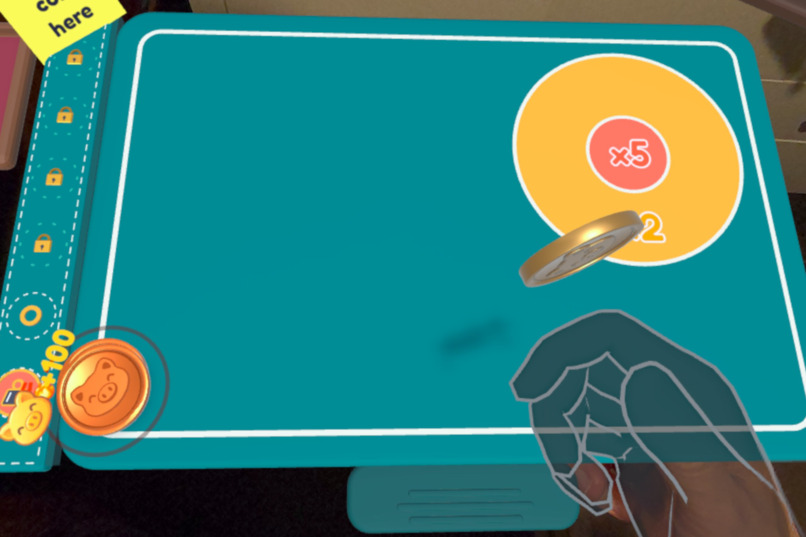
Flick coins with your hand and aim for the bullseye
-
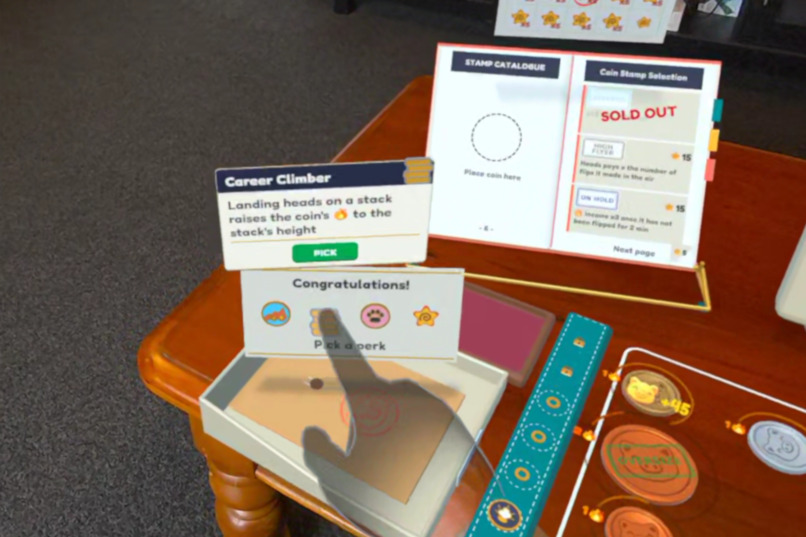
Buy and upgrade coins to create exciting combinations
-
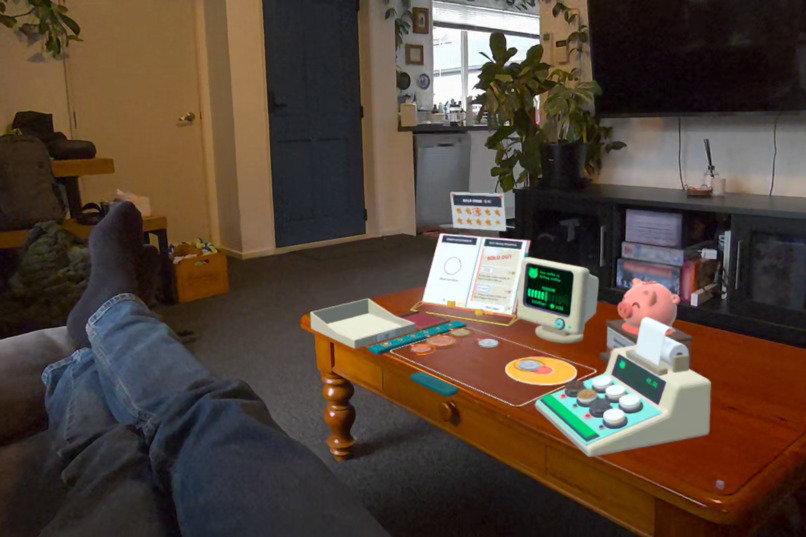
Sit back and relax while your idle coin machine does its work
Inspiration
Heads or Tails? The age old question. I wanted to turn the fun act of flipping a coin into an idle game, and blur the line between real and virtual through mixed-reality.
Quest 3 can find your table, remember where you left things and track your fingers well enough to feel a thumb flick. That made a new kind of idle game possible, one where the idle layer is physical. Your income isn't just a number on a panel; it's coins sitting on your actual table, earning while you're away.
The theme came from the gesture. If you're flicking coins at your desk, you're bored at work. So Heads Down is your first day at Hamsworth National, a cheerful, slightly dystopian 80s/90s corporation whose slogan is "Looking out for you." The company speaks through a relentlessly upbeat pig mascot, born from coins and a piggy bank being the central visual theme.
What it does
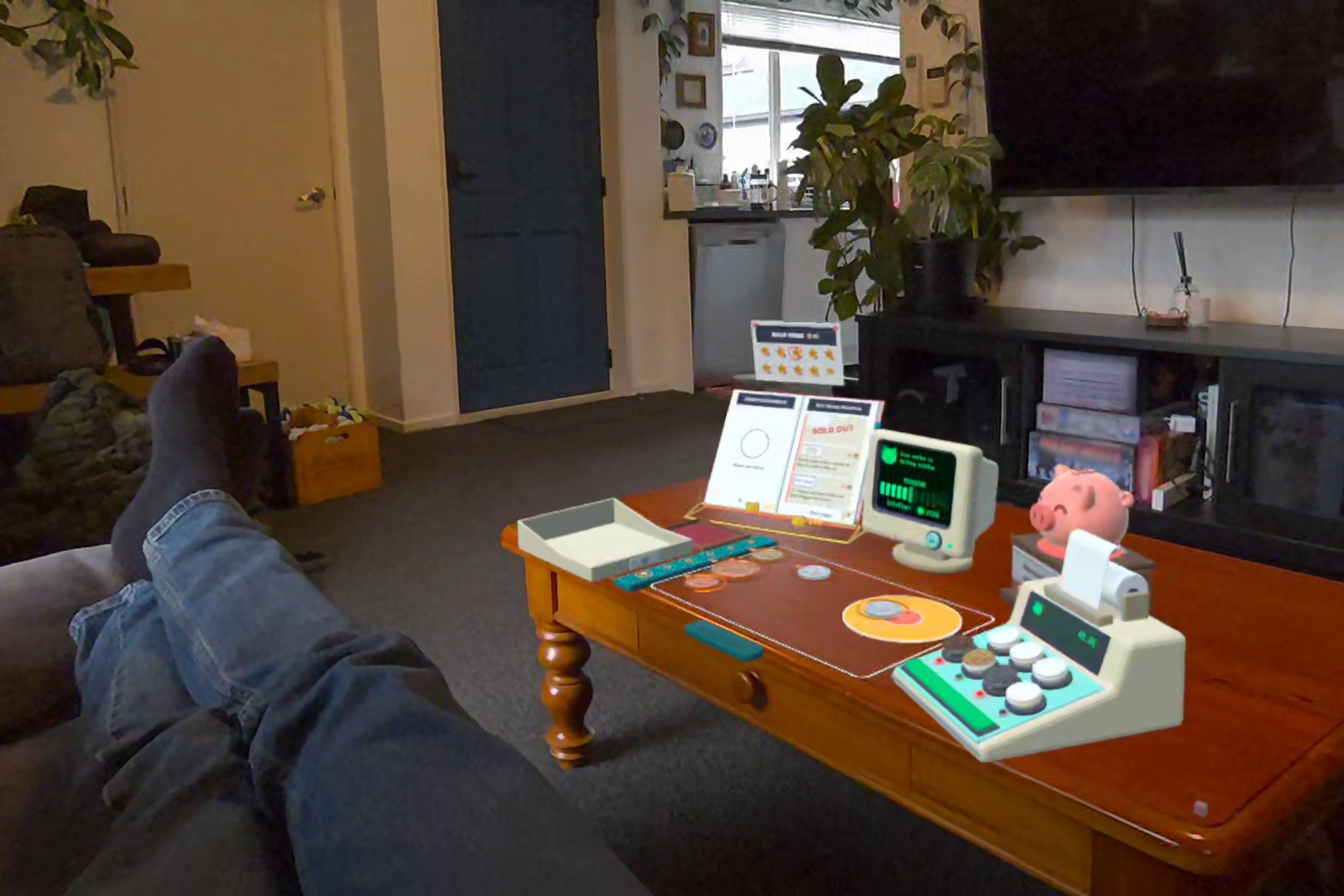
Heads Down is a seated, hands-only mixed-reality idle game. Your real table becomes your office desk: a CRT monitor runs the company's pig mascot (your manager), an adding machine sells coins, a piggy bank collects your Credits, and a mouse pad with a printed target is where your coins land.
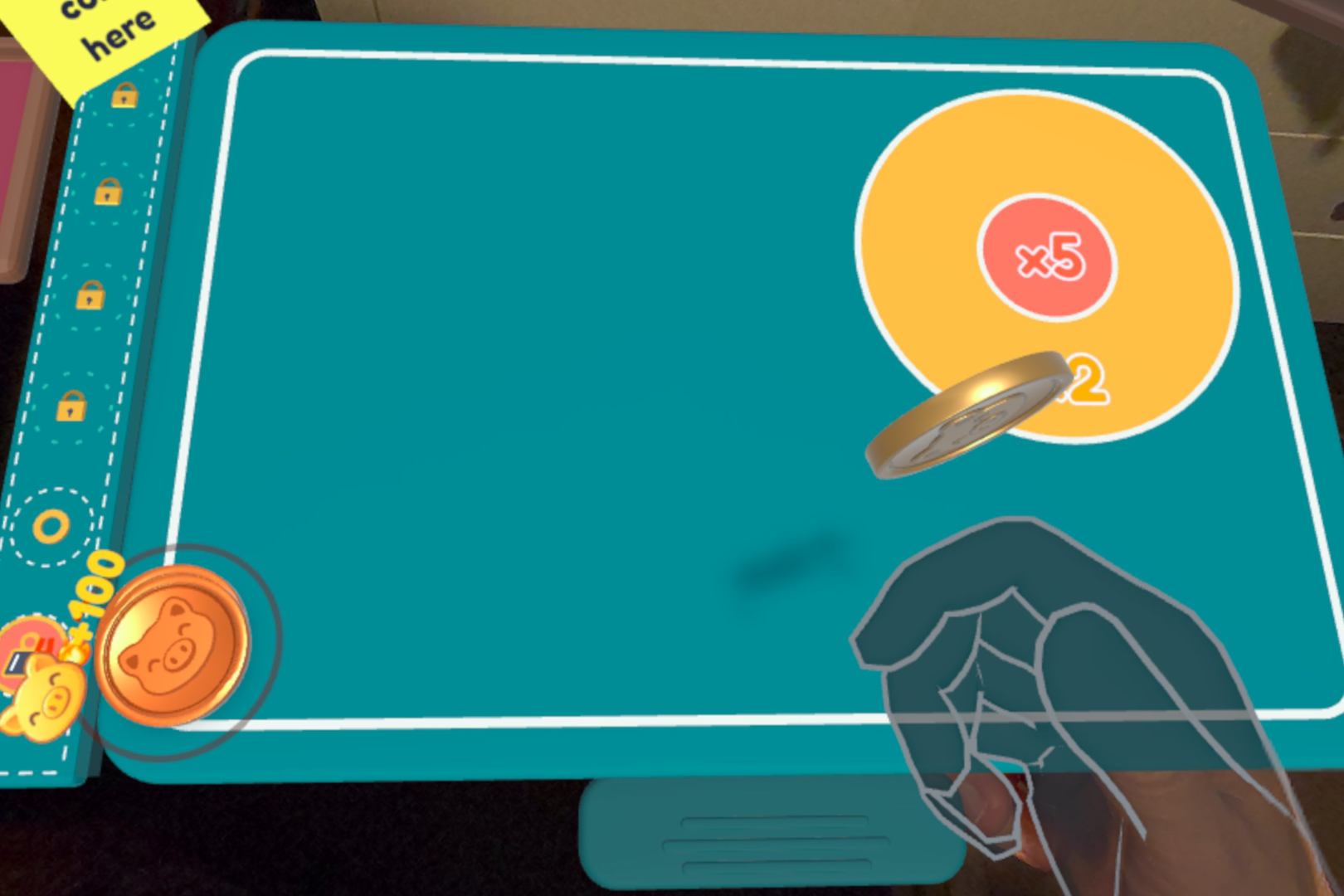
The flick. Touch a coin with your fingertip and it balances on the side of your index finger. Flick your thumb and it flies: how fast you flick sets the height, the tilt of your hand sets the direction. Real physics decides which face lands up. Nothing is decided in advance.
Push your luck.
- Heads pays the coin's value (×2 on the target's ring, ×5 on the bullseye) and adds 1 Heat to that coin.
- Hot coins earn on their own every few seconds, and income climbs steeply with Heat: a coin at Heat 10 earns 3,500× what it earns at Heat 1. Leave a hot coin resting and it keeps earning, even while you're away.
- Tails resets that coin's Heat, but pays a gold star for every level lost, plus one for trying. At Hamsworth National, failure is just another kind of success.
Every flick is a decision: flip a hot coin again to push it higher, or leave it earning.
Build your desk.
- Buy seven tiers of coins, Copper to Diamond, by pressing keys on a chunky adding machine.
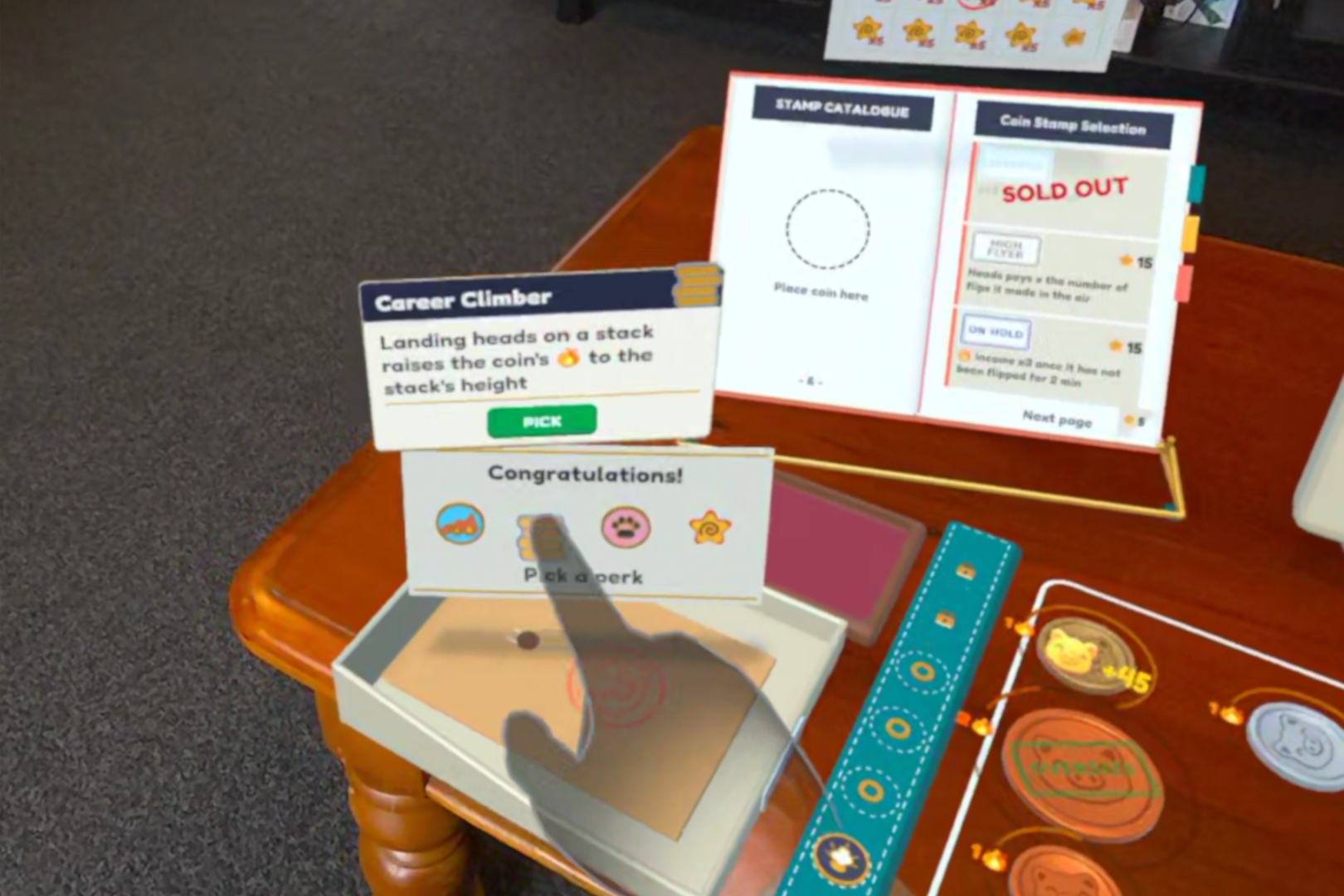
- Spend gold stars on rubber stamps from a mail-order Star Catalogue: lay a coin on the page, touch a stamp, and that coin learns a new trick (14 stamps, such as REVERSED, ON HOLD and CC: ALL).
- Fill the Progress bar on the CRT and a performance review lands in your IN box as an interoffice envelope. Open it and pick a perk, an enamel pin worn on your desk for the rest of the run (13 perks named like review comments: Positive Attitude, Team Player, Career Climber...).
- Stamps and perks are designed around five playstyles (flipping constantly, leaving coins to earn, stacking, sharpshooting and collecting stars), so every play settles into its own build.
Get promoted. Fill the piggy bank and it bursts open in a fountain of coins. You get a new job title on your plaque (Trainee all the way to Vice President), a permanent raise and an extra perk slot, then a fresh desk to build again.
Come back tomorrow. Hot coins earn for up to 8 hours while you're away. Next time you sit down, the CRT powers on with your shift report waiting. Every visit is a complete coffee break: collect your earnings, flick a few coins, open a review, spend.
How I built it
I built Heads Down solo in Unity 6 (URP, OpenXR) with the Meta XR SDK v207, from first commit on 17 October to submission.
Hands-first, end to end. No controller is ever needed.
- The flick reads the tracked hand directly: a touched coin sticks to the index finger at its first joint and turns with your hand, and a flick only launches when your thumb starts against the coin. Thumb speed sets the height, the coin's tilt sets the direction. Coins fly at 30% gravity so every arc is easy to follow.
- Every button, key and prop uses Interaction SDK poke with a hover glow, and moving the desk uses the Interaction SDK's pinch grab, one hand or two. A hand holding a coin can't poke or grab anything, so a flick never presses a button by accident.
- The see-through ghost hand that demonstrates each move is real hand motion, recorded with the Interaction SDK's Hand Animation Recorder.
Your room changes the game. Your table is the play surface.
- MR Utility Kit finds the tables in your room scan, and the coin pad snaps onto the nearest table edge with its handle overhanging, like a real desk. On a real table the pad's rubber disappears: your table itself becomes the surface you flick onto.
- Drag the pad and it slides along the table edge and round corners; pull it away and it lifts off as a floating pad. With both hands you can turn it.
- A spatial anchor saves where you left it, so your desk is in the same place next session, and resting coins keep their exact spots through restarts, standby and recentring.
- Scene mesh colliders mean a missed coin bounces off your real table, floor and walls.
- A custom shader draws the room scan as a shadow catcher, so the props cast shadows onto your real surfaces, without real geometry ever hiding a virtual prop.
- With no table in reach or no room setup, the desk floats at a comfortable height in front of you, so it works in any room.
Seated and FoV-aware.
- Everything sits within arm's reach of a seated player, and every interaction is direct touch, with no rays.
- Hints are sticky notes stuck to the thing they're about. If that thing is out of view, the note waits at the edge of your vision until you look its way, then flies onto its spot.
- At launch the CRT floats in front of you without being locked to your head, and only glides back into view if you turn away.
- The desk's handle only responds while you're looking towards it (head gaze within 40°), so a stray pinch never drags your desk away.
A first five minutes with no menus and no walls of text.
- Every launch, the CRT powers on in front of you, the pig types a greeting, the monitor glides onto your desk and everything pops in around it. Short pauses resume straight where you were.
- For new players, the pig speaks one task at a time, a sticky note holds the current task in a few words, and the ghost hand shows how. Desk objects arrive only as they first matter: the target with your second coin, the catalogue when you can first afford a stamp, the IN tray with your first review.
- Your first heads pays out within seconds, and you're buying your first new coin within a couple of minutes.
Art and sound, made for this game.
- Every 3D prop is built in Blender.
- Icons, the pig logo, stamp marks and the gold star are drawn by outline, and the 13 enamel pins are raised in 3D from the same icon outlines.
- Every sound effect is synthesised in code at runtime to give that retro feel. The heads chime climbs with the coin's Heat, so a hot streak plays a little melody.
Performance, tuning and reliability.
- The game holds 72 fps on Quest 3 even with a full desk of hot coins: profiling on the headset showed it was limited by pixel shading, and Vulkan buffer discards plus dynamic foveated rendering brought GPU time well inside the frame budget.
- Every number lives in a data asset, the economy logic is covered by 117 automated tests, and a Python pacing simulation checks that a first session pays off and later visits keep giving you something to work towards.
Challenges I ran into
- Making a thumb flick feel good with hand tracking. Early builds launched coins whenever the thumb moved quickly away from the index finger, even when the player was just gesturing. The flick now only arms when your thumb starts against the held coin, and lower gravity plus a gentle aim assist towards the target make a good flick feel good without taking the luck out of the landing.
- Real rooms are messy. Tables come in every shape and height, scans can be missing and people sit at odd angles. The desk has to snap onto any table edge, follow it round corners, come back to its saved spot only while that spot is still in reach, and fall back to a floating desk when there's no table at all.
- Teaching an idle game without text. In playtests, new players didn't realise hot coins earn over time, didn't know what gold stars were for, and bought things by accident. The answers were visible flows: each coin's income pops out of it and flies into the piggy bank on its own timer ring, stars fly one by one to the Gold Star Chart, and touching only ever picks, with a separate green button to spend.
- Grounding virtual props in a real room. Without contact shadows, props looked pasted on. Getting them to cast shadows onto the real table, while the room's depth never hides virtual props or text, took a three-pass render of the room scan.
- One person, one month. Code, design, 3D art, 2D art, sound and the trailer.
Accomplishments that I'm proud of
- A complete hands-only game loop with progression, promotions and offline earnings, built solo in about a month.
- A core gesture everyone already knows, so the game explains itself.
- A desk that truly lives on your table: it snaps to the edge, casts shadows on it, bounces coins off your room and is still there tomorrow.
- Onboarding with no menus and no walls of text: a pig on a CRT, sticky notes and a ghost hand.
- A world with its own voice: Hamsworth National, its performance-review perks, rubber-stamp upgrades and a pig who's always looking out for you. I'm excited to expand on the narrative. Not everything is what it seems...
What I learned
- Passthrough earns its place when the room changes how you play, not just what you see: the table edge, the surface, the bounces.
- Hand tracking rewards gestures people already know. Designing around what tracking does well beats teaching a new one.
- In a hands-only interface, touching should never spend. Every action that costs something needs its own deliberate button.
- In MR, hints have to come to you: anything outside a comfortable field of view may as well not exist.
- Tone teaches. Calling a tails "a gold star for trying" turns the game's harshest moment into a reward.
What's next for Heads Down
Heads Down is heading to the Meta VR Store, with a target launch in Q2 2027. Before launch:
- More content and polish. Flesh out every desk object, add new coin designs, and polish every interaction, animation and sound.
- Controller support and accessibility. Controllers as an alternative to hands, plus options such as one-handed play, a tap-to-flip alternative to the thumb flick, adjustable flick sensitivity and reach, and a high-contrast mode, so anyone can get a desk job at Hamsworth National.
- A virtual office. A fully virtual Hamsworth National office (cubicle walls, a humming fluorescent light, a window onto the city) for players who'd rather play in VR or don't have a table to hand. Mixed reality stays the main way to play.
- Daily events. A memo from management every morning: daily objectives, rotating office days such as "Casual Friday" with their own rule changes, and rewards for clocking in, so there's always a reason to sit back down tomorrow.
- Deeper upgrades. More stamps and perks for each of the five playstyles, and new combinations between them, so every desk can become a different build.
- Office events. Surprises that shake up the desk, such as moving targets (an interoffice mail cart rolling across your desk) and events that use more of your real room within reach.
- A proper ending. The corporate ladder currently tops out at Vice President. Reach the top and Hamsworth National will give you the send-off it thinks you deserve.


