-
-
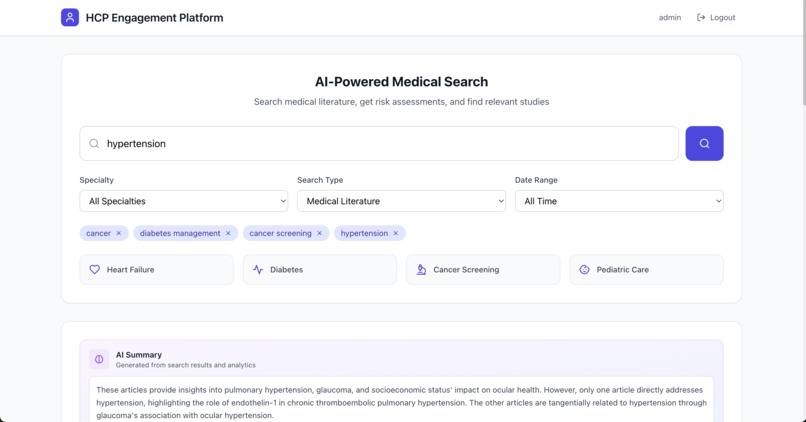
top dashboard with search functionality
-
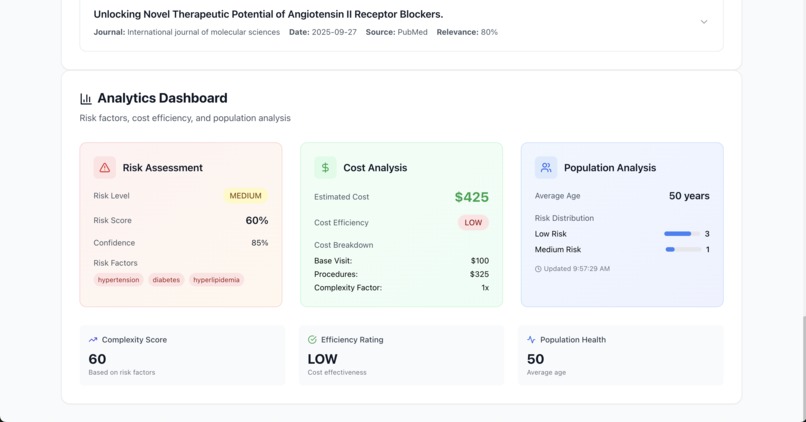
bottom of dashboard with statistics display
Inspiration
Healthcare providers face overwhelming information overload that detracts from patient care. We built an intelligent clinical co-pilot that cuts through the clutter using AI to deliver personalized, evidence-based insights instantly.
What it does
An AI-powered API platform that transforms clinical workflows by providing real-time literature analysis, risk prediction, and population health insights based on real publications and articles. It delivers the right medical information to the right provider at the right time through ultra-fast Groq AI processing.
How we built it
- Backend: Flask (Python) REST API with JWT authentication
- AI Engine: Groq API for lightning-fast inference using multiple models
- Data Sources: PubMed integration for medical literature
- Real-time Features: WebSocket support for live notifications
- Deployment: Flask application deployment using Python virtual environments and WSGI servers
Challenges we ran into
Structuring unstructured medical data into consistent clinical insights was our primary challenge in addition to connecting AI model APIs to our developing API. We also had to balance AI speed versus depth while maintaining clinical safety through confidence scoring and clear disclaimers about AI limitations, leading to using the most lightweight Llama models through Groq AI. Another large hurdle for us was integrating our new API into our frontend demo, battling with CORS issues, running out of tokens, and more.
Accomplishments that we're proud of
We created a genuinely useful clinical tool that reduces literature review from hours to seconds. The seamless Groq integration provides instantaneous AI analysis that fits naturally into clinical workflows, backed by a production-ready, well-tested codebase. Connecting AI analysis into this industry workload allows for faster shipment of medications to patients, with fact-backed reasoning.
What we learned
Speed and simplicity are non-negotiable for software innovation and healthcare technology adoption. Effective prompt engineering is crucial for quality AI outputs, and building trust requires transparency about model capabilities and limitations from the start.
What's next for HCP Engagement API
Future development focuses on deep EMR system integration, specialty-specific clinical modules, and longitudinal patient analysis. We're also exploring voice interfaces and advanced billing assistance to create a truly comprehensive clinical co-pilot.


Log in or sign up for Devpost to join the conversation.