Inspiration
Most scam losses today are authorised push payments: the victim makes the transfer themselves, often while a "police officer" or "bank officer" is still on the phone telling them what to do. Banks can already flag these payments, but what happens next is usually a static SMS warning that a coached victim ignores, or a call-back that arrives after the money has gone. We wanted the bank's response to be as fast and as personal as the scammer's: a real conversation, on the customer's own messaging app, at the moment the money is about to leave.
What it does
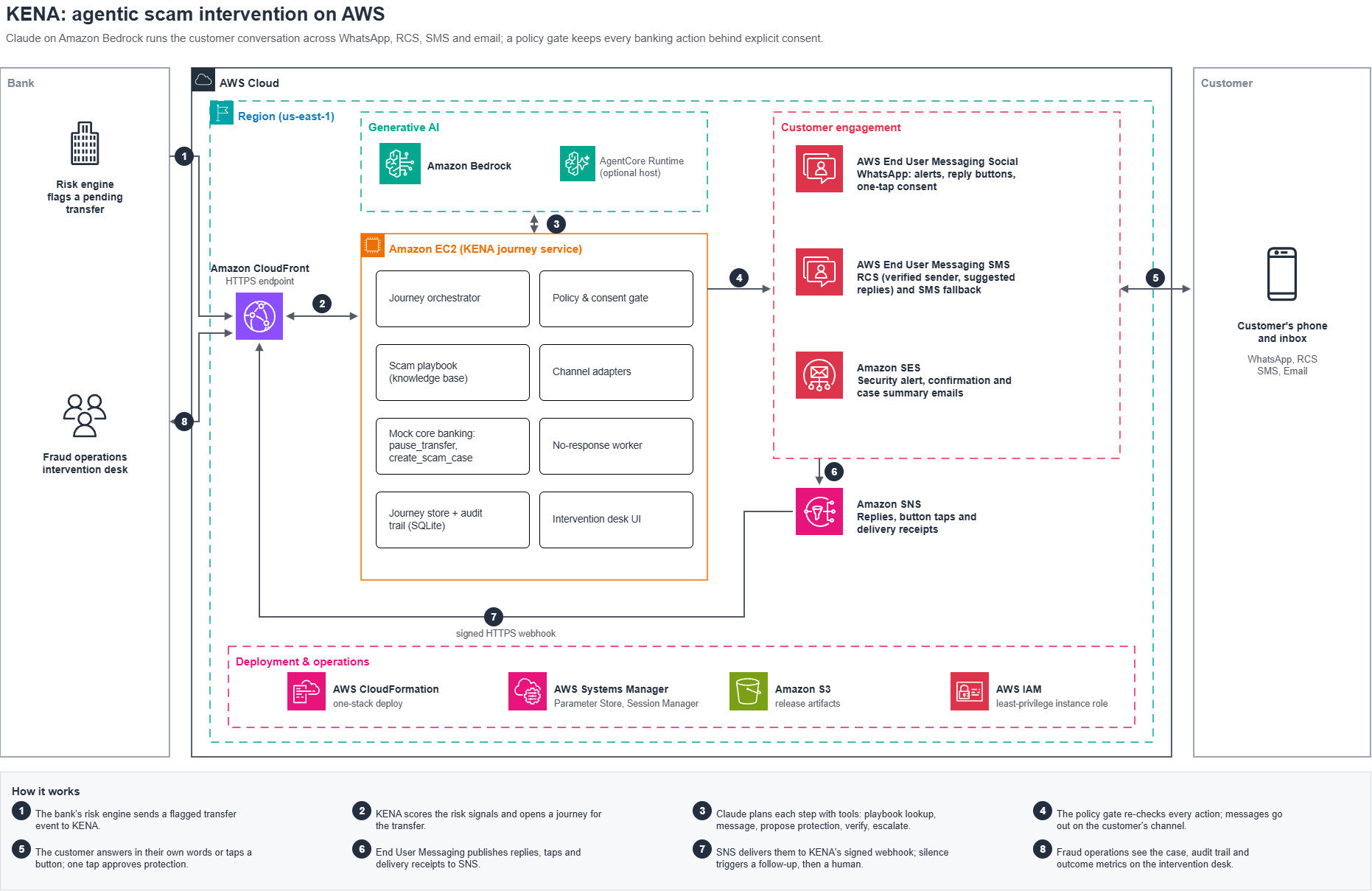
KENA (Knowledge-Enabled Notification Agent) is an agentic scam-intervention service for retail banks. 1: Detect. The bank's risk engine sends a flagged transfer, for example S$8,000 to a new payee during an active phone call. KENA scores the signals and opens a journey. 2: Reach out. KENA messages the customer straight away on WhatsApp, RCS or SMS with one-tap answers, and sends a security-alert email through Amazon SES. 3: Converse. The customer replies in their own words. Claude on Amazon Bedrock reads the reply with the full journey context, looks up KENA's scam playbook (government or bank impersonation, investment, job, romance, e-commerce and coached-transfer scams), and decides what to do: explain, ask one question, record that the customer is genuine, escalate to a specialist, or ask for consent to protect the money. 4: Act with consent. Consent is a fixed message with a Pause & open case button. One tap pauses the transfer and opens a scam-review case, atomically, with a full audit trail. A typed "yes" never authorises anything. 5: Follow up and close. If the customer goes quiet, the agent follows up on another channel, then hands the case to a fraud specialist. Every journey ends with an email that carries the whole cross-channel conversation, and the fraud team sees response rate and time to protect on a live dashboard.
How we built it
Agent: Claude on Amazon Bedrock, called through the Messages API with a bounded tool loop. Its tools are search_scam_playbook, send_message, propose_protection, record_customer_verified and escalate_to_human. A deterministic rules agent is the fallback if the model is unavailable. Safety layer: the model has no banking authority. Every action it plans is re-validated by a policy gate against the journey's current state, and agent-written messages are screened so KENA can never send a link, ask for an OTP or password, or promise a refund. The only two banking tools (pause_transfer, create_scam_case) run only after explicit button consent bound to the customer, the transfer, the current proposal and the policy version, with a five-minute expiry. Channels: adapters for AWS End User Messaging Social (WhatsApp text, reply buttons and templates), AWS End User Messaging SMS (RCS and SMS) and Amazon SES. Replies, button taps and delivery receipts come back through Amazon SNS to a signature-verified webhook. Orchestration: a FastAPI journey service with an atomic state store, idempotent commands, a no-response worker that lets the agent choose a follow-up channel or escalate, and automatic WhatsApp-to-SMS failover. Deployment: one CloudFormation stack (Amazon EC2 behind Amazon CloudFront, SNS topic, Systems Manager parameters, least-privilege IAM role), plus a one-command deploy script.
Challenges we ran into
Channel onboarding. WhatsApp Business onboarding and RCS agent registration (5–7 days) were not complete before the deadline. We kept a single code path for every channel and built a customer-device emulator styled as WhatsApp.
Accomplishments that we're proud of
An agent that recognises a "safe account" police-impersonation scam from free text, explains it to the customer, and gets them to protect their money in one tap. Real two-way, multi-channel orchestration: chat, follow-up on another channel, email record and human hand-off, all in one audited journey.
What we learned
Agentic AI is most useful in banking when its authority is narrow and explicit: let the model own the conversation and the judgement, and keep money movement behind deterministic, auditable controls. The channel matters as much as the message: a verified business sender, one-tap replies and a formal email record each build the trust a scared customer needs.
What's next for HCLTech Scamurais
Complete WhatsApp Business and RCS registration and switch those channels to live. Authenticated in-app consent and integration with a real core-banking sandbox. Multilingual evaluation (add Chinese, Malay, Tamil) and a larger, bank-curated scam playbook. Production hardening: DynamoDB state, an SQS outbox and hosting on Amazon Bedrock AgentCore Runtime.
Built With
- amazon-bedrock
- amazon-cloudfront
- amazon-ec2
- amazon-ses
- amazon-sns
- amazon-web-services
- anthropic
- aws-cloudformation
- aws-end-user-messaging
- aws-systems-manager
- claude
- fastapi
- javascript
- python
- rcs
- sms

Log in or sign up for Devpost to join the conversation.