-
-
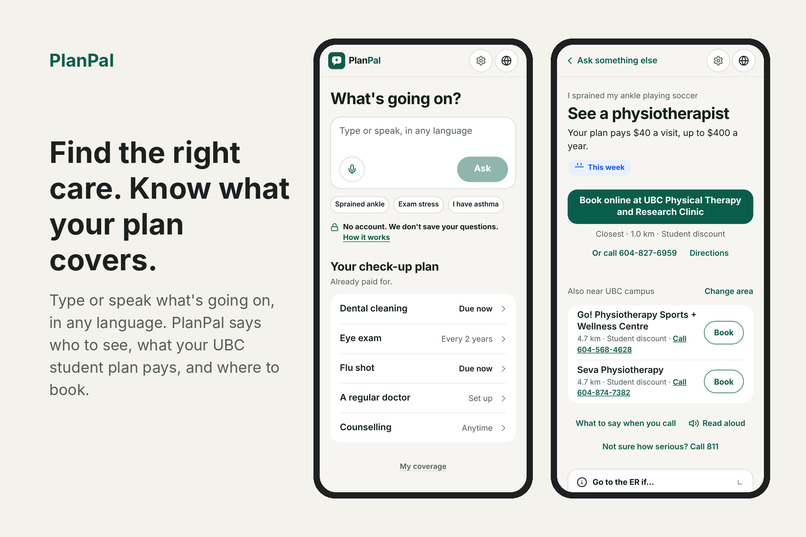
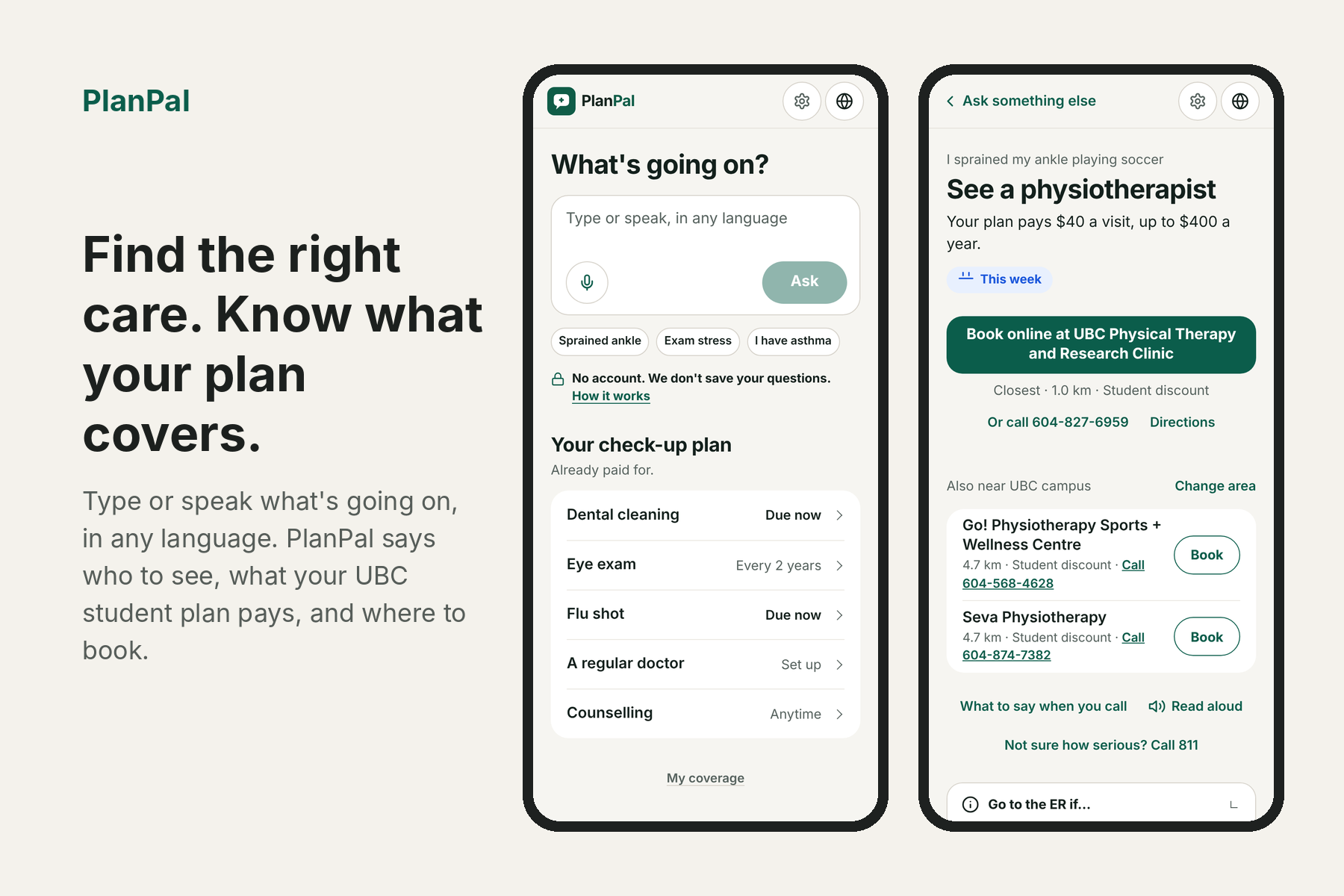
Find the right care. Know what your plan covers.
-
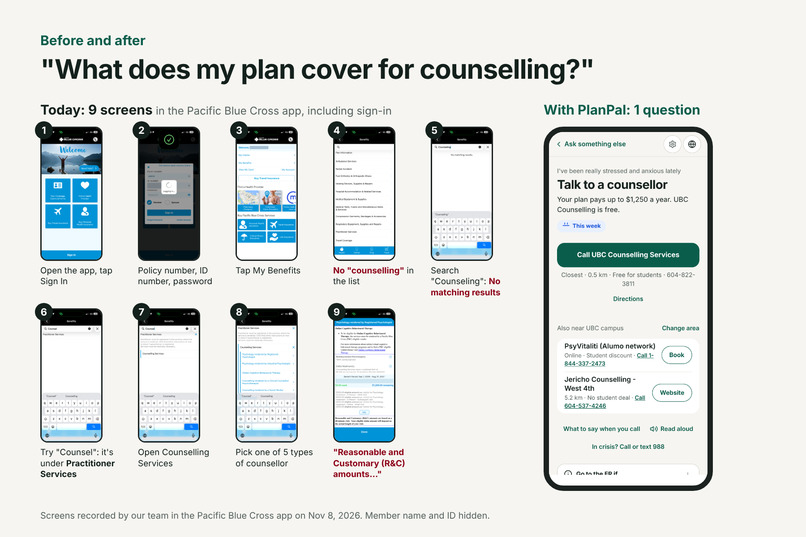
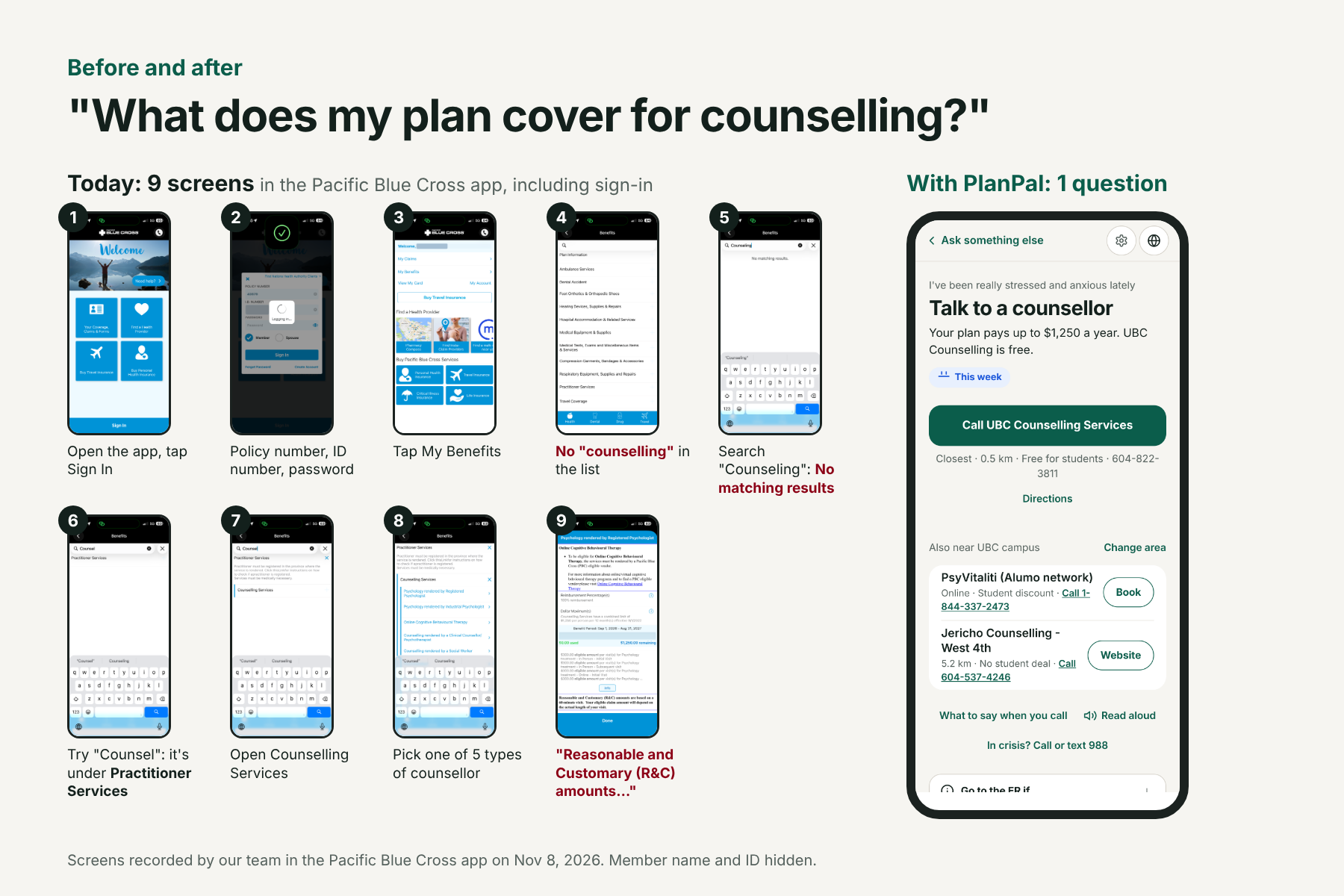
Today it takes 9 screens in the Blue Cross app to find counselling coverage. In PlanPal, it’s one question.
-
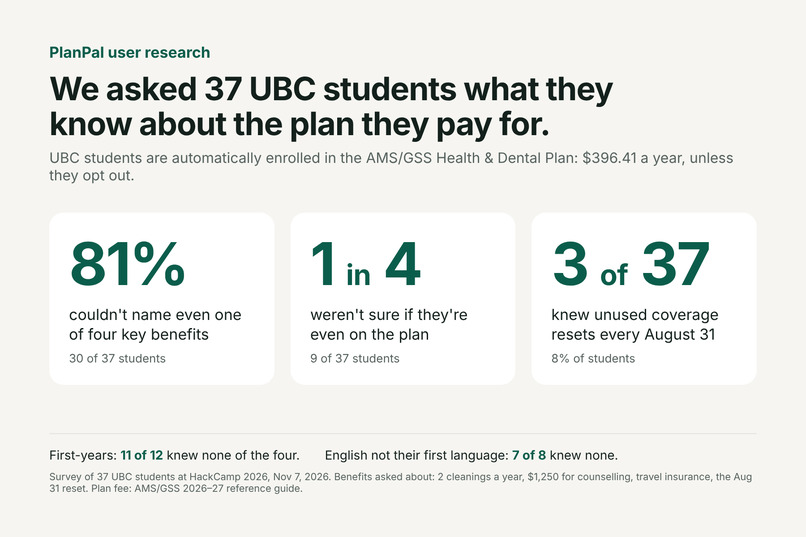
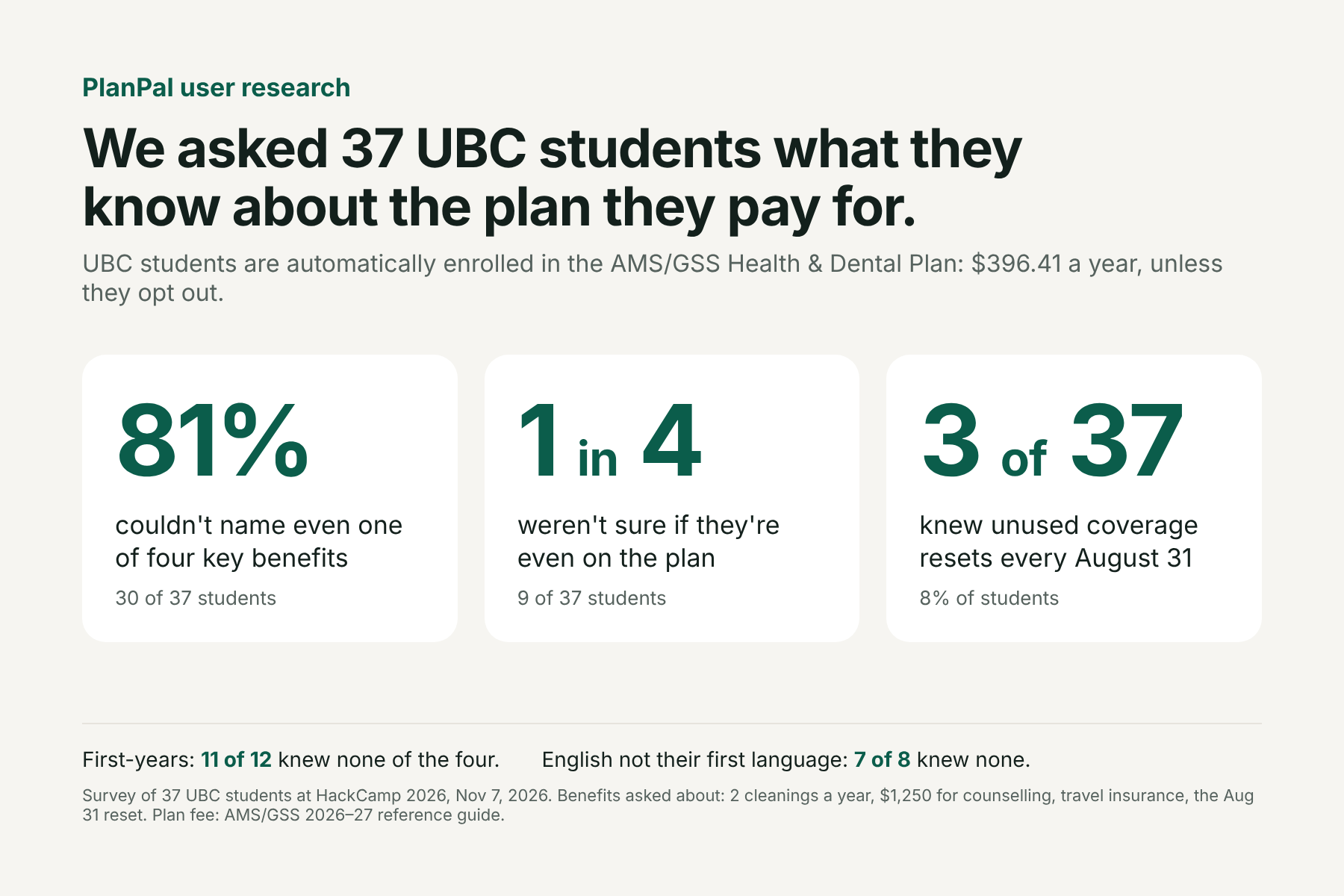
We asked 37 UBC students: 81% couldn’t name a single thing their plan covers.
-
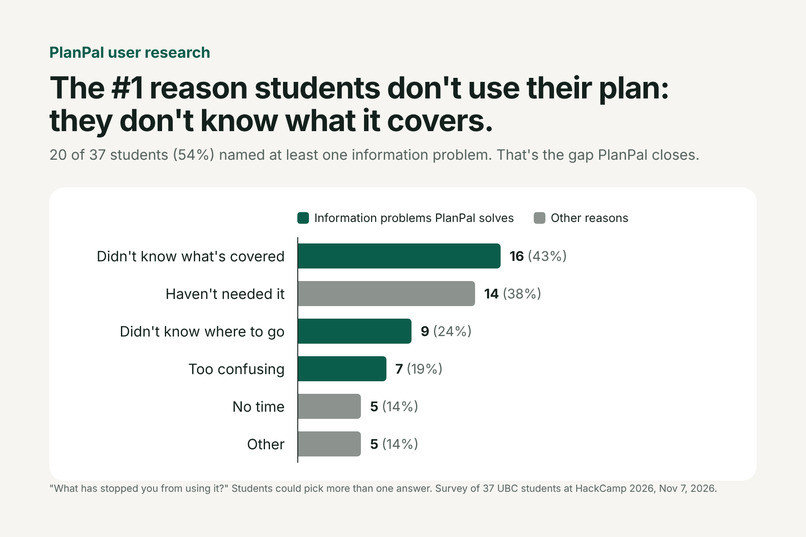
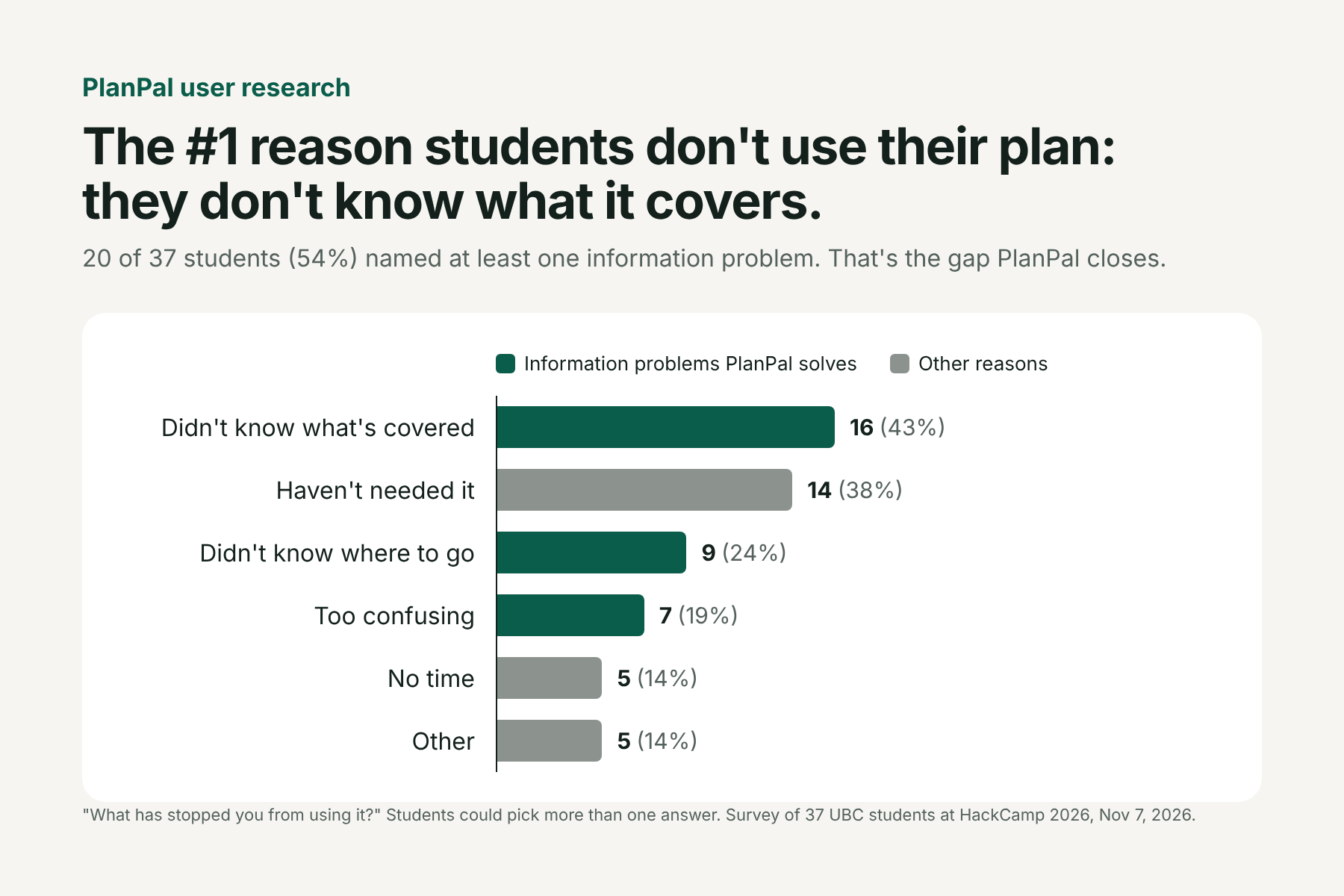
The #1 reason students don’t use their plan: they don’t know what it covers.
-
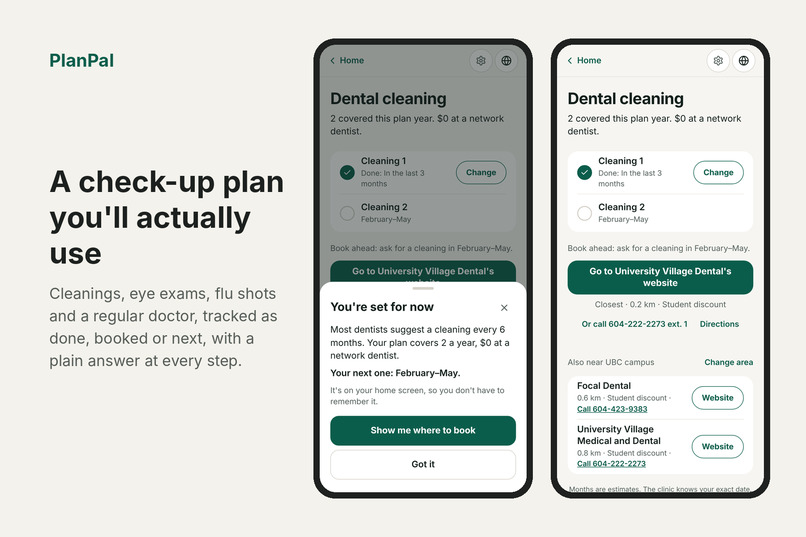
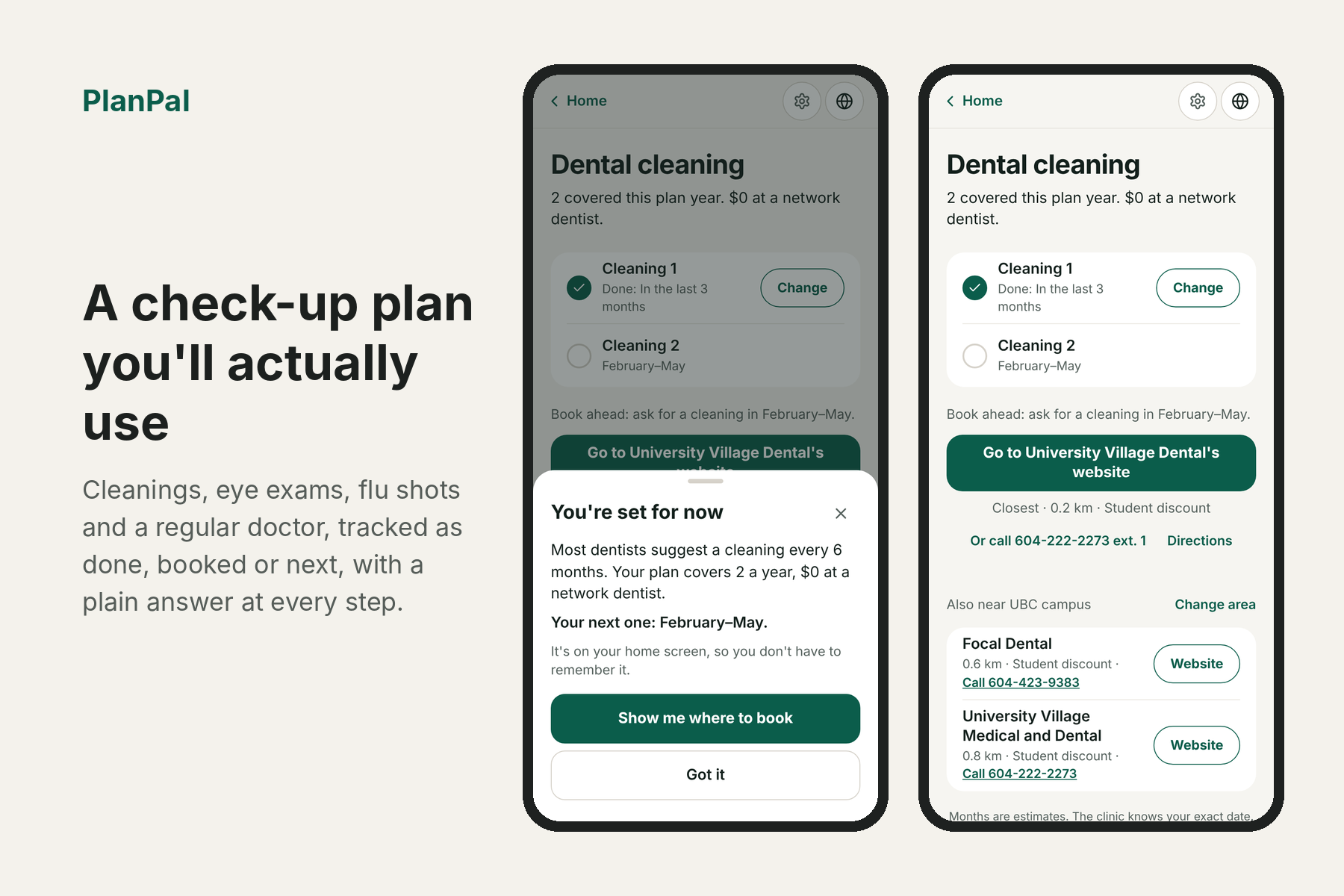
A check-up plan that turns benefits you already have into a simple to-do list.
-
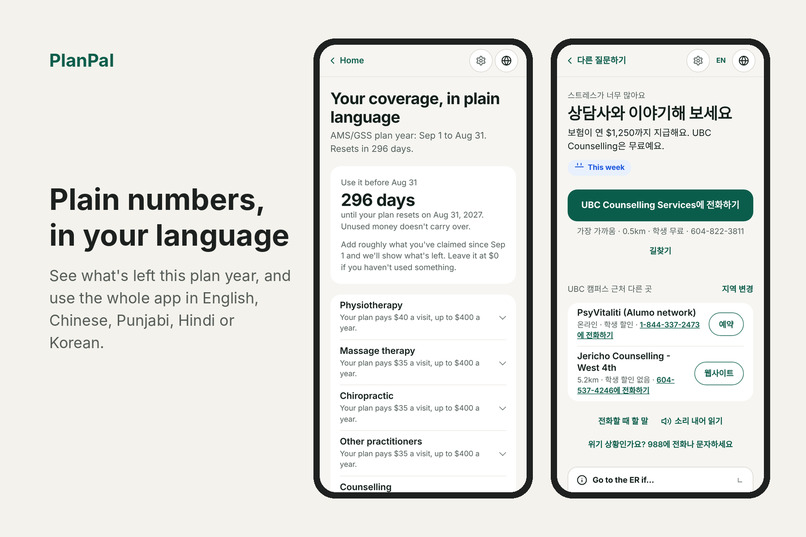
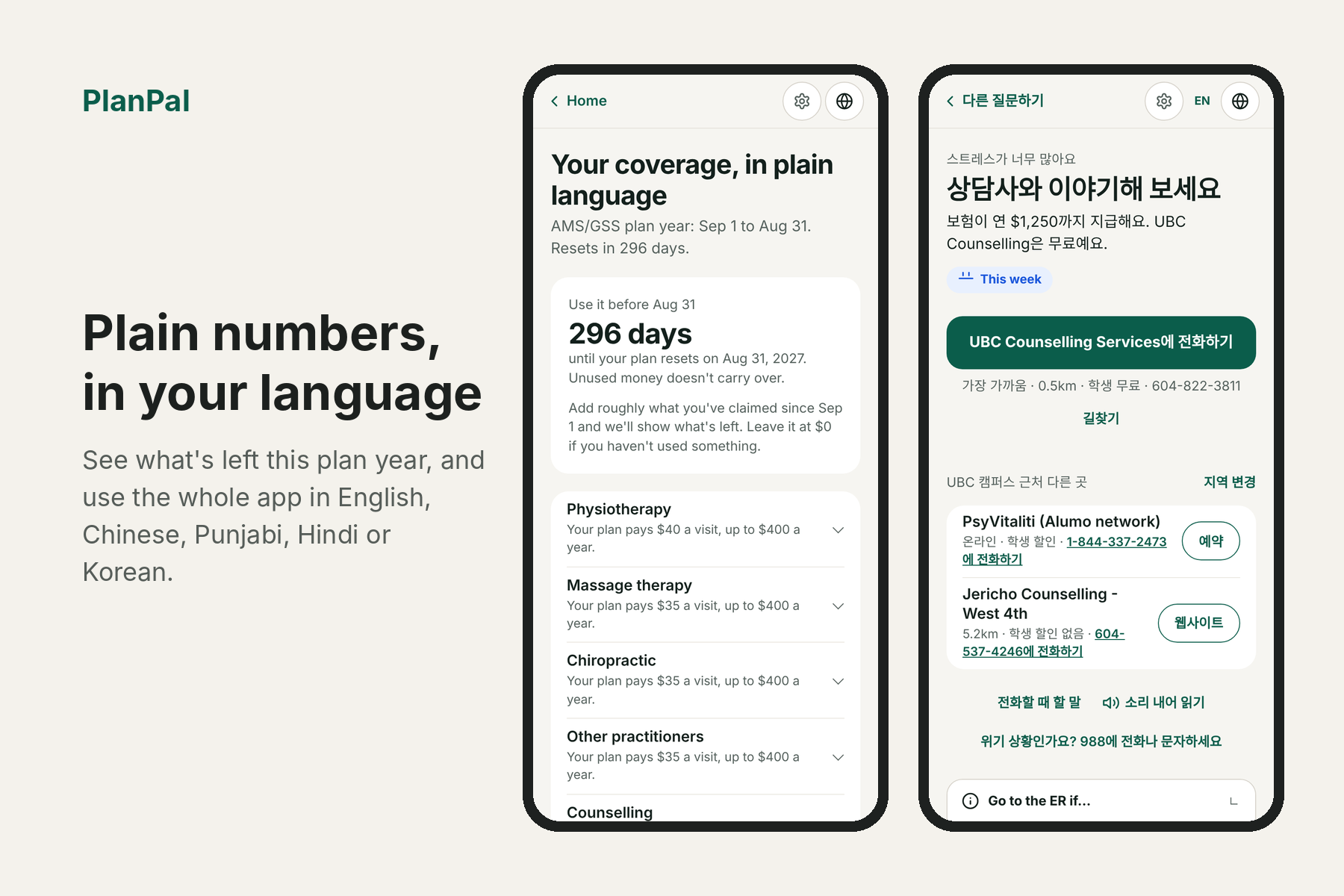
Plain numbers, in six languages.
-
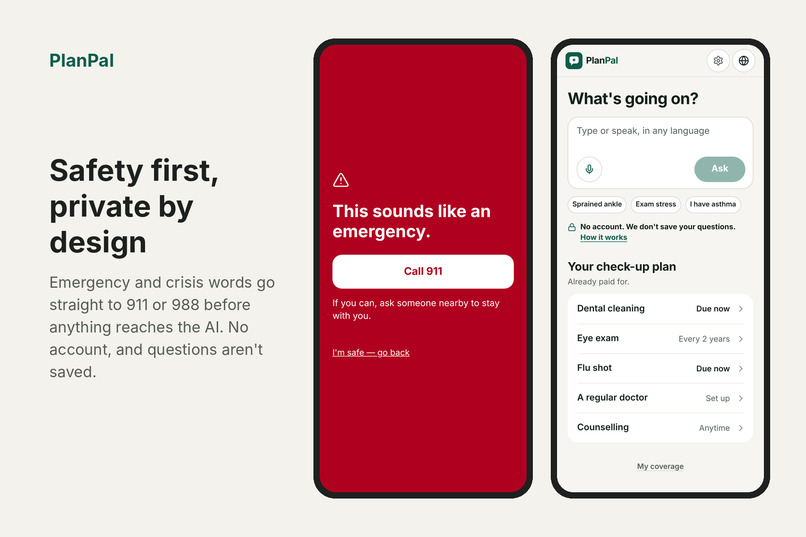
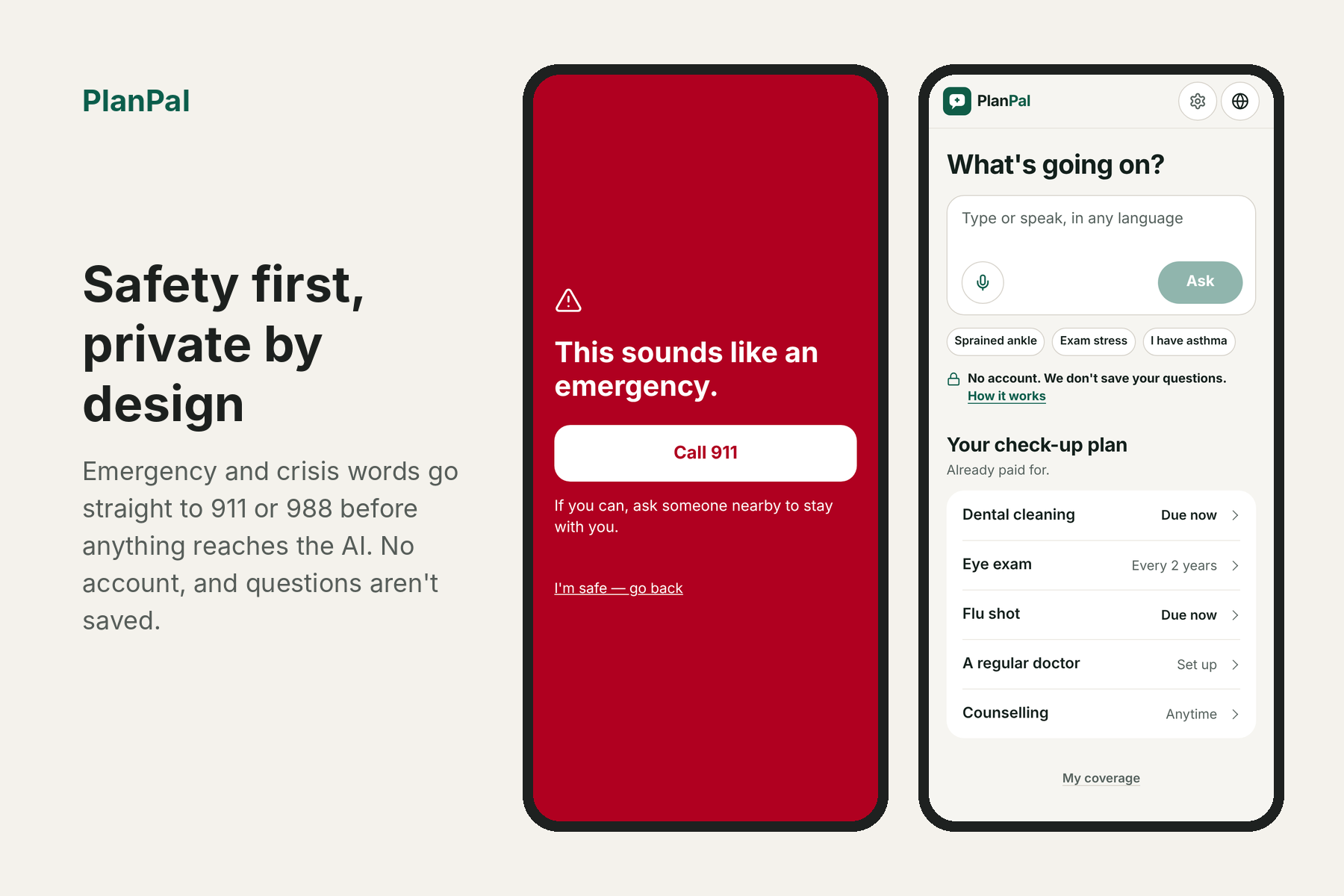
Emergencies go straight to 911 or 988, before anything reaches the AI.
Inspiration
Imagine you're eighteen. You worked incredibly hard to get into UBC. Your parents are proud, and it's a real stretch for them. You move out, and for the first time, you're on your own. You're flooded with information. Study hard, make friends, get involved.
And at some point, something happens. Not if. When.
The help is already there. UBC just opened Gateway Health, a $189.9 million building with student health and counselling under one roof, and counselling appointments are up 40% since 2022. That's amazing. But behind every student who gets help, there are others who never make it through the door. They're overwhelmed. They don't know what's covered, or where to look. Or asking for help is just hard. It's a skill, and at eighteen, you might not have it yet.
Jay, on our team, knows this firsthand. He had the Blue Cross app, he had the login, and he read everything. He still couldn't answer the simple questions: who do I call, how do I book, and is this covered? The information exists, but it's spread across the AMS, Alumo, Pacific Blue Cross, MSP and every clinic's own website. You don't know what you don't know.
So we asked. We surveyed 37 UBC students:
- 81% (30 of 37) didn't know about a single one of four things their plan covers. Nobody knew all four.
- 11 of 12 first-years knew none of them.
- 7 of 8 students whose first language isn't English knew none of them.
- Only 3 of 37 knew the plan resets on August 31, so unused benefits are lost.
- The top reason students gave for not using the plan was "I didn't know what's covered" (16 of 37). 20 of 37 named an information barrier.
Nationally, young adults are the least likely to have a regular health care provider (73.6% of 18 to 34 year olds, the lowest of any age group, Statistics Canada), and 32% of 18 to 34 year olds avoided the dentist because of cost. UBC students already have that dental care paid for. They just don't know it.
What it does
PlanPal is a health companion for UBC students on the AMS/GSS Health & Dental Plan. You don't need to learn the system. You just say what's going on.
- Tell it what's going on, in your own words. "My stomach has been hurting for a few days." Google or an AI can give you an answer, but an answer isn't care. PlanPal doesn't diagnose you. It gets you to someone qualified: a doctor this week, free with MSP, with a button to book at UBC Student Health. It also shows "Not sure how serious? Call 811" and when to go to the ER instead.
- It knows your plan. Every answer shows what's covered and what you'll pay, from counselling to prescriptions to physio.
- It's for everyday things, not just a crisis. Exam stress, trouble sleeping and missing home all point to counselling, which is covered.
- Your check-up plan. Even when nothing's wrong, everyone needs a cleaning, an eye exam, a flu shot and a family doctor. PlanPal shows what's due, sends you to a nearby clinic's booking page, then asks "Did you book?" and which month. Your cleanings show up as booked on your schedule, and it tells you when to book the next one.
- The language you think in. PlanPal answers in English, Punjabi, Hindi, Chinese and Korean, whichever language you type in.
- Safety first. If someone needs help right now, PlanPal doesn't wait for the AI. It sends them straight to 911, or for a mental health crisis, to 988.
- Private by design. There's no account and we don't store your questions. Your postal code never leaves your phone. Anything you choose to save stays on your phone, and you can delete it with one tap.
How we built it
- Front end: a single, fast, mobile-first web app in plain HTML, CSS and JavaScript, built by a small Python build script that merges the app, six interface translations and our clinic data. Distances to clinics are worked out on the phone.
- Server: Python and Flask on Render. Every question goes through three steps:
- A safety check. 404 warning phrases (346 in English and 58 in Chinese, Punjabi, Hindi, Korean and other languages), sorted into five tiers: 911, 988, violence and safety, poisoning and overdose, and urgent care. If one matches, Gemini is never called.
- Google Gemini. It sorts the question into the type of care, the urgency and any red flags, and returns structured JSON. If Gemini is slow or fails, PlanPal falls back to the 811 nurse line instead of guessing.
- A coverage lookup. We built this from the 2026–27 AMS/GSS plan details: what's covered, how much and how often.
- Data: we researched the UBC-area clinics by hand, 25 network providers and 14 other clinics, with their websites, phone numbers and booking links.
- Design: Figma screens, plain-language copy, large tap targets and a larger-text option.
Challenges we ran into
- Deciding where the AI stops. We didn't want a language model making emergency calls, so the safety layer is plain keyword rules that run before the AI ever sees a message.
- Triage wording. Knowing when to say "see a doctor", "call 811" or "go to the ER" took research and many rewrites, so we never sound like we're diagnosing.
- Scattered plan information. The coverage rules live across several websites and PDFs, and turning them into plain answers took longer than the code.
- Free-tier limits. During testing we hit Gemini's per-minute limit, which is why the 811 fallback exists.
Accomplishments that we're proud of
- We built it on real student data: 37 survey responses showing the problem is information, not money.
- It answers in five languages and puts safety before AI.
- The check-up plan turns "I should probably see a dentist" into an actual booking.
- It's private: no accounts, and no stored questions.
What we learned
Asking for help is a skill, and the system assumes you already have it. The biggest barrier wasn't cost. Students didn't know the care was there, or that it was meant for everyday problems and not just a crisis.
What's next for PlanPal
- Moving to Gemini's paid tier, where questions aren't used to improve Google's products.
- Testing with students, the AMS and UBC Student Health and Wellbeing.
- Expanding to other universities. Every school, and every workplace with benefits, has the same gap.
Built With
- css3
- flask
- flask-limiter
- gemini-api
- github
- google-docs
- google-gemini
- google-genai
- gunicorn
- html5
- javascript
- json
- playwright
- pytest
- python
- render
- web-speech-api
