Inspiration
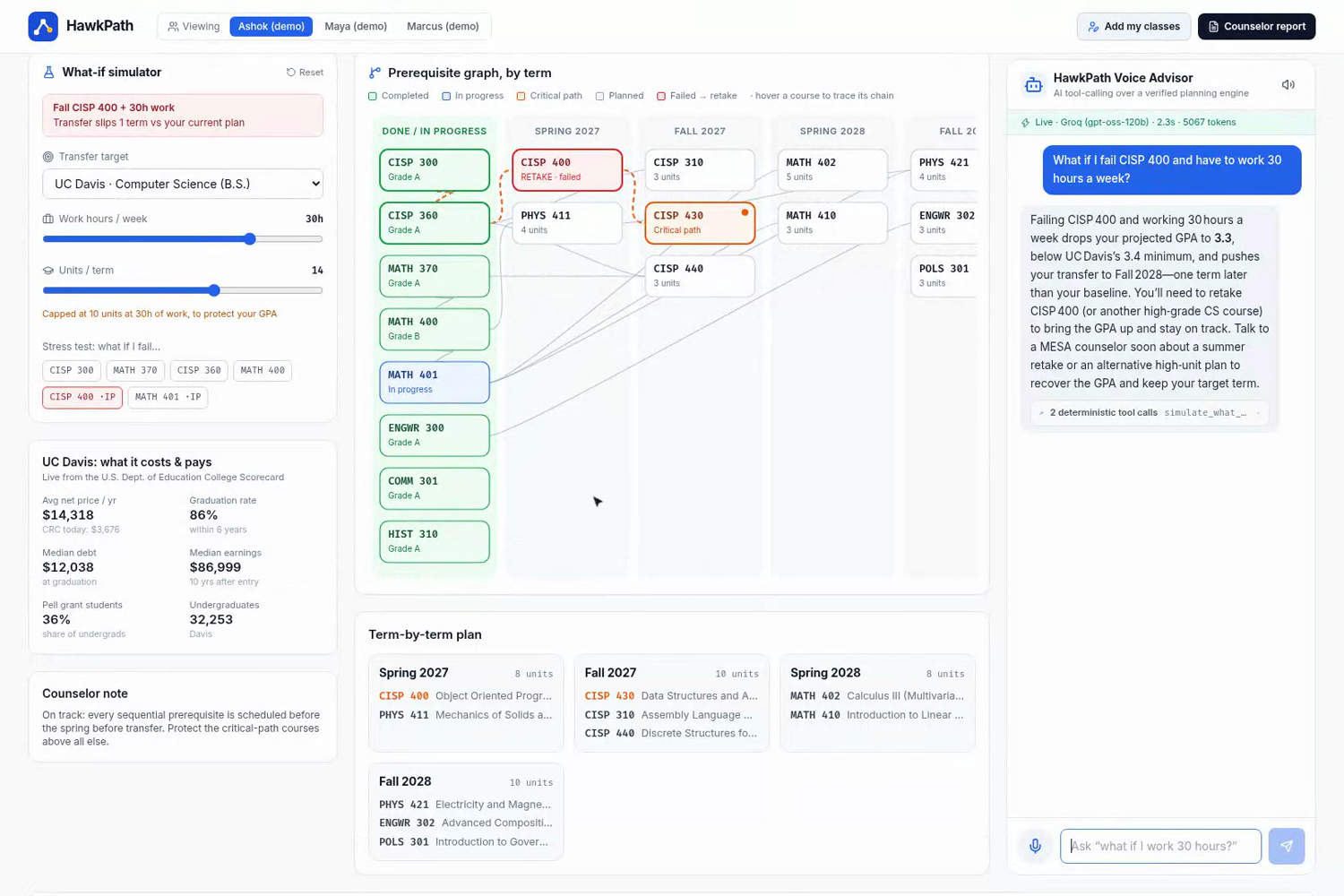
At a community college, STEM transfer runs on long prerequisite chains like CISP 300 → 360 → 400 → 430 and MATH 400 → 401 → 402. Fail or drop one link and the transfer can slip a full term or more. The students most exposed are working, first-generation students, the students CRC's MESA program serves. They usually find out too late, alone, between shifts. General AI chatbots don't help: they guess at prerequisites, and a confident wrong answer can cost a semester.
What it does
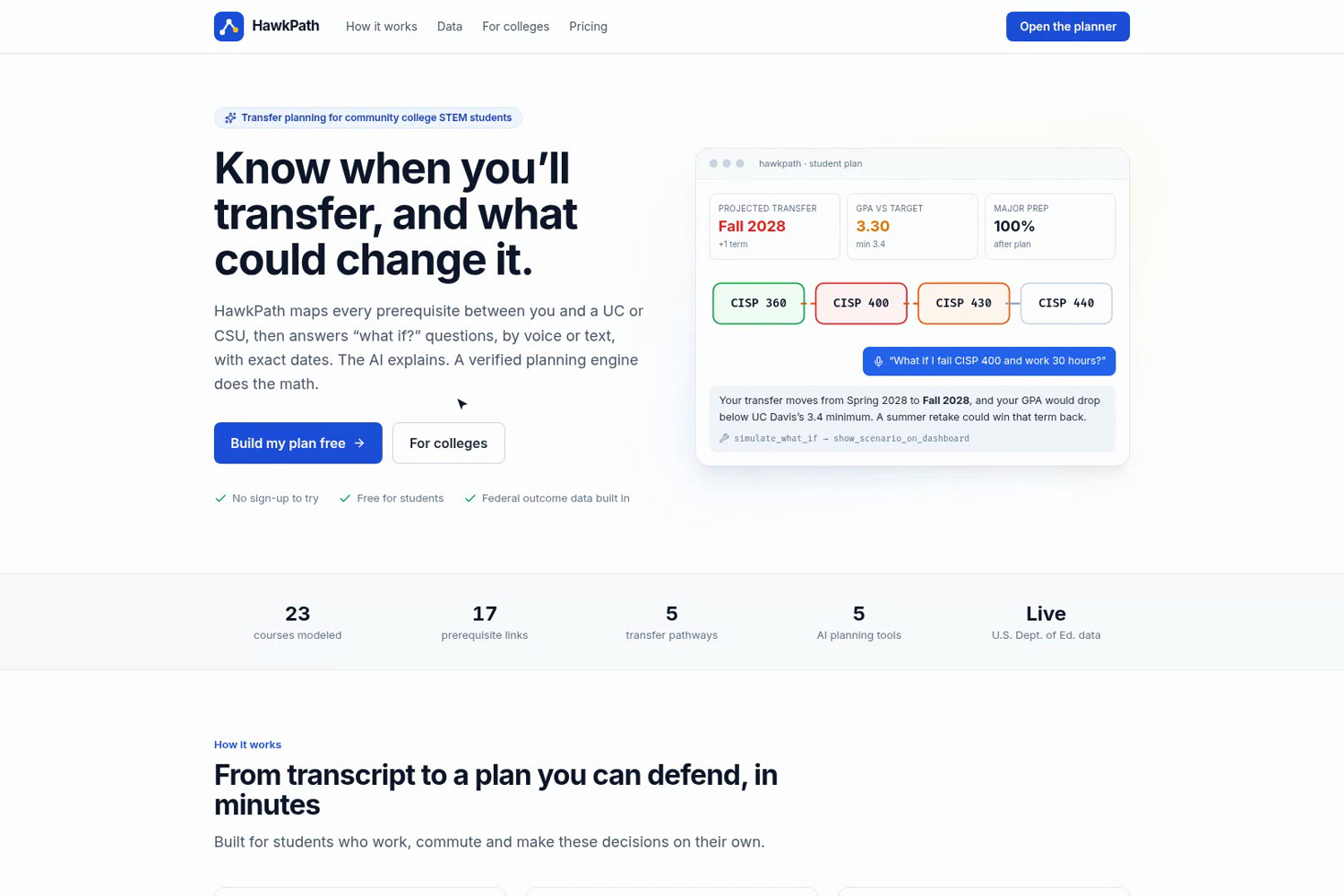
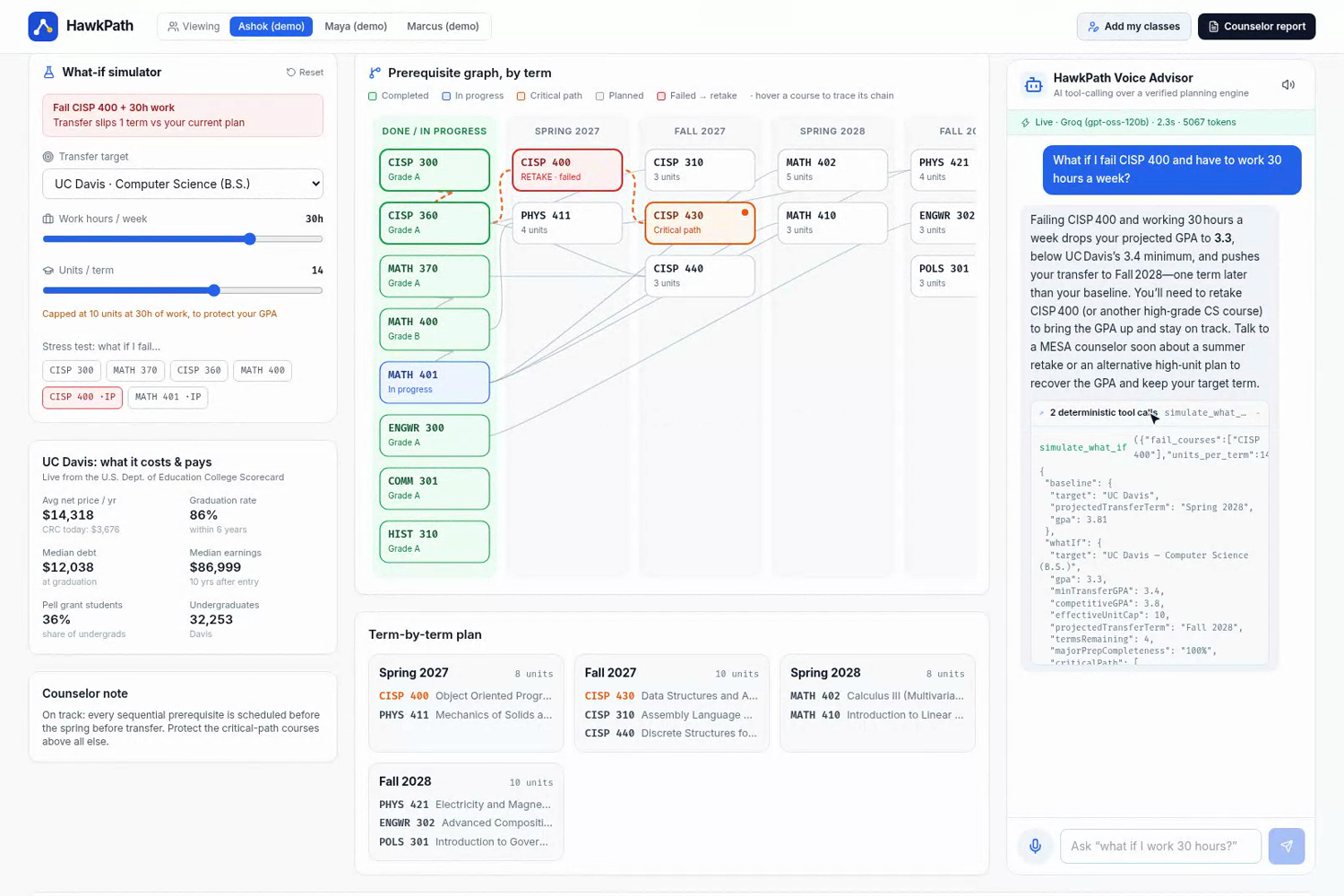
HawkPath turns a student's record into a live, semester-by-semester prerequisite graph with the critical path highlighted. Then they can ask "what if?" by voice or text:
- "What if I fail CISP 400 and have to work 30 hours a week?" → transfer moves from Spring 2028 to Fall 2028, the GPA drops below UC Davis's 3.4 minimum, and the plan redraws itself.
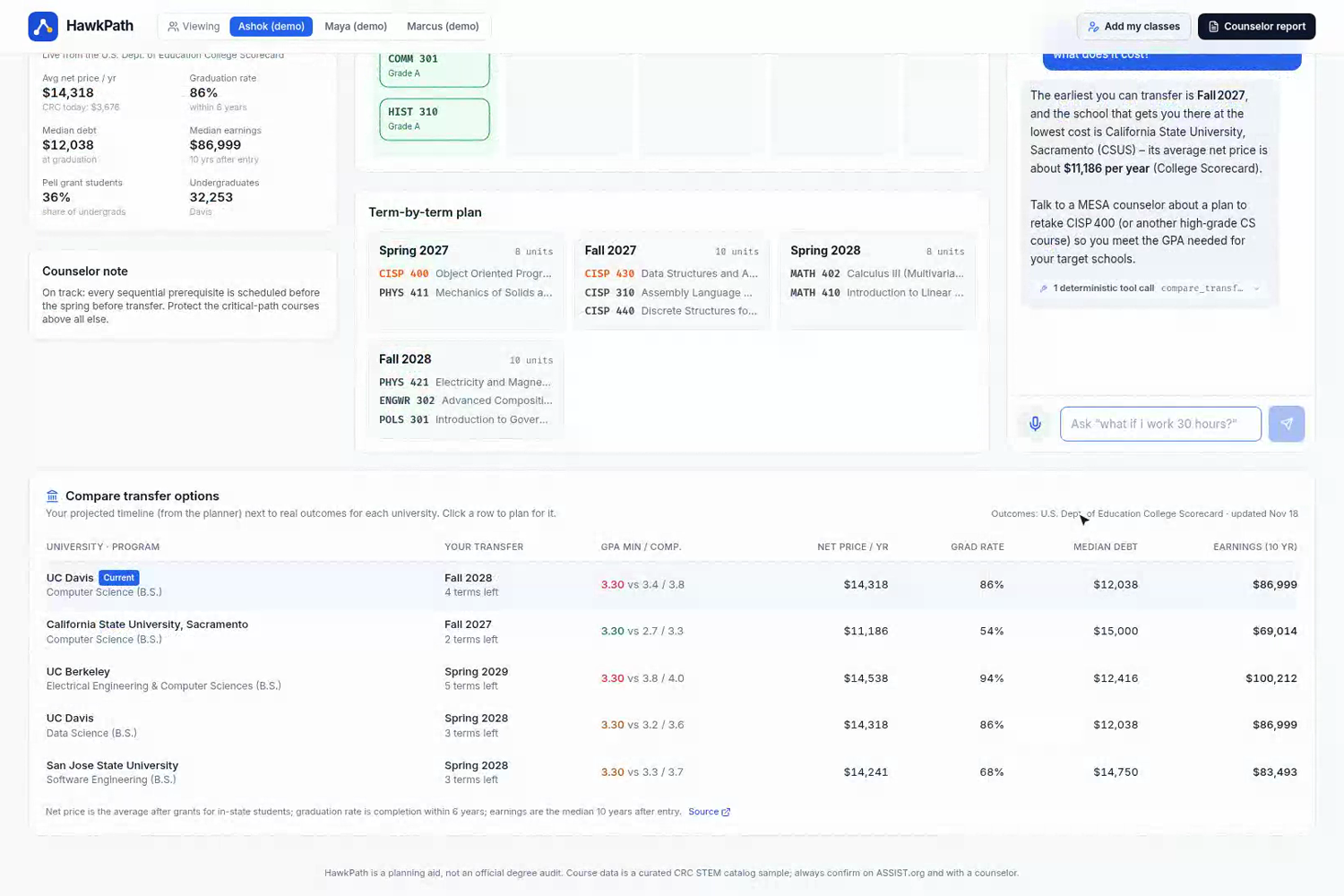
- "Which school can I transfer to soonest, and what does it cost?" → it compares every pathway, with live U.S. Department of Education data on net price, graduation rate, debt and earnings.
- "Why is CISP 430 such a big deal?" → it shows the course's full prerequisite chain and which schools require it.
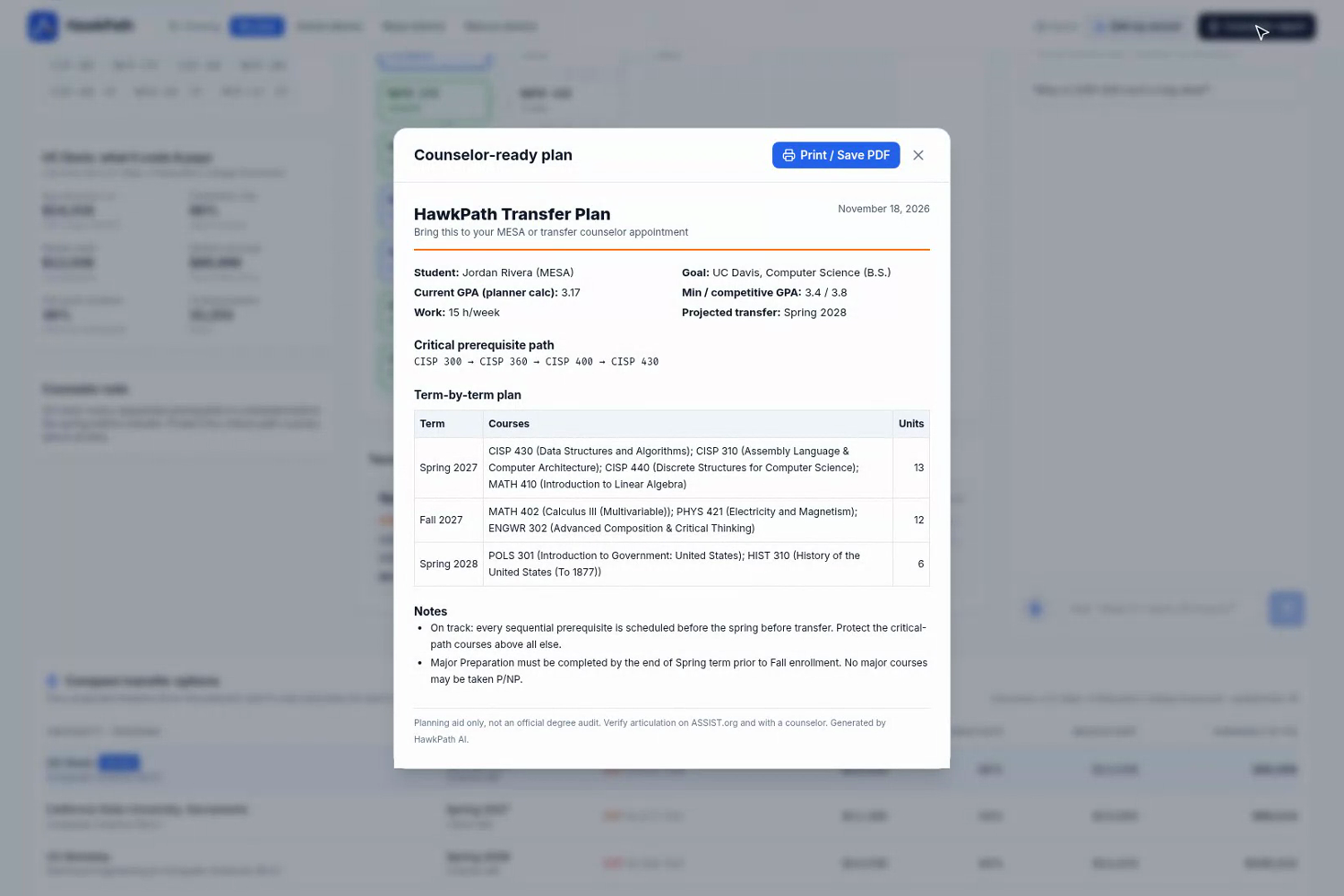
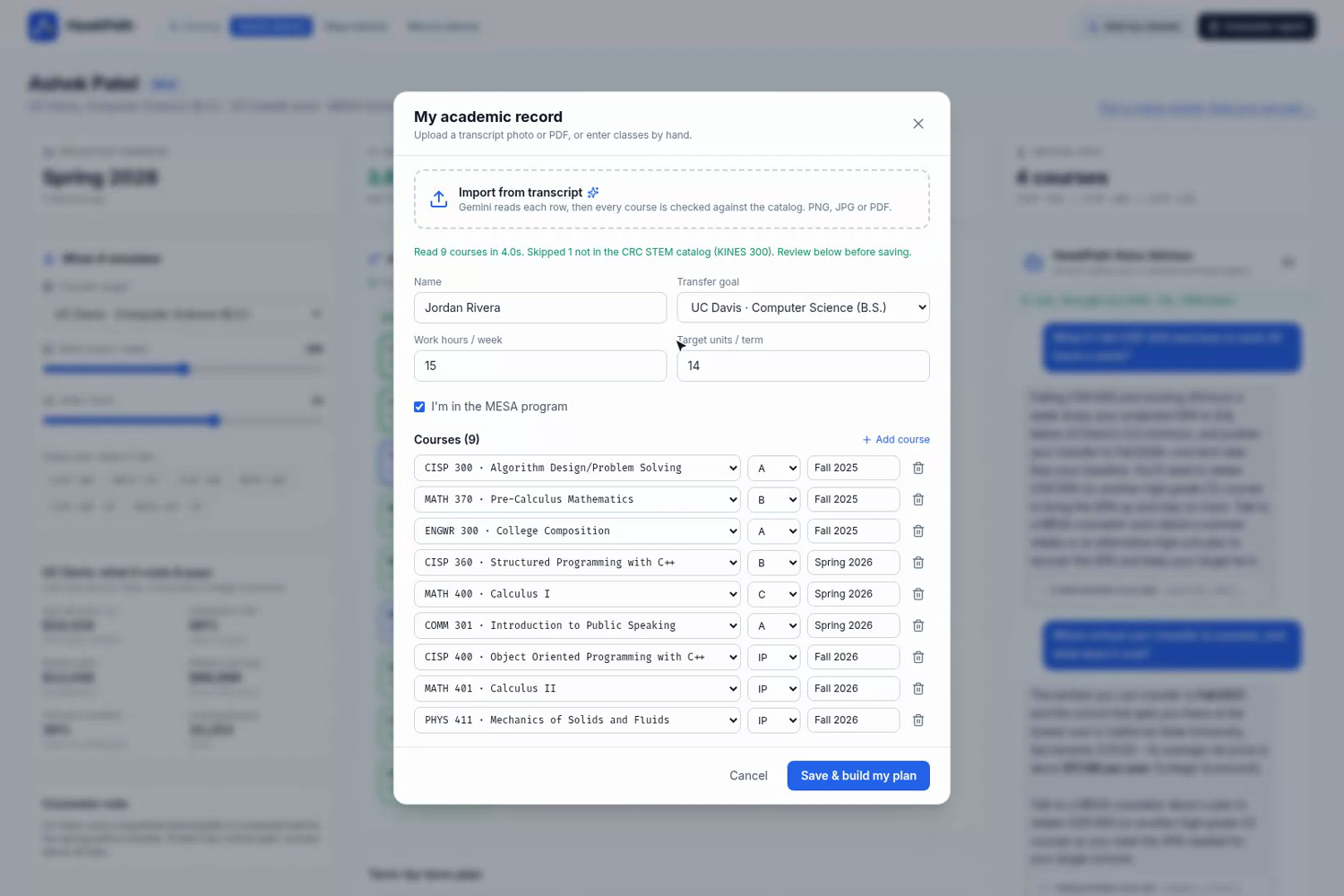
Students can also upload a photo or PDF of an unofficial transcript to build their plan in seconds, drag sliders for instant what-ifs with no AI involved, compare five transfer pathways side by side, and print a counselor-ready report for their MESA appointment.
How we built it
- The AI explains; the engine does the math. The model never computes a schedule. It can only call five deterministic tools:
simulate_what_if(topological term scheduler + critical-path DP),get_course_dependencies(DAG reachability),compare_transfer_targets,get_school_outcomes(College Scorecard) andshow_scenario_on_dashboard(pushes the scenario to the UI, which redraws). The browser runs the same TypeScript engine, so the AI's numbers and the UI's numbers can't disagree. - AI providers: Groq (
openai/gpt-oss-120b, ~1–2s tool-calling answers) is primary, with per-model failover. Google Gemini is the automatic backup and also reads transcripts (image/PDF → JSON-schema output → every course validated against the catalog, so made-up rows are dropped). - Real-world data: the U.S. Department of Education College Scorecard API (via api.data.gov), cached server-side for 24h and served stale if the API is down.
- Voice: Web Speech API for speech-to-text and SpeechSynthesis for spoken answers. No extra service or cost.
- Stack: React, TypeScript, Vite, Tailwind CSS; serverless functions on Vercel; custom SVG graph renderer with animated transitions.
Security & API handling
- API keys live only on the server (never in the client bundle, which we verify by grepping the build).
.envis git-ignored and.env.exampleis provided. - Every request is schema-validated, size-capped and sanitized. Course codes are checked against the catalog and school IDs are allow-listed.
- Token-bucket rate limiting (per IP for guests, per verified user for members) plus a global daily budget, returning
429 + Retry-Afterwith a UI countdown. - Bounded agent loop, per-request time budget, automatic model/provider failover, and a graceful offline mode that still answers from the engine if every AI provider is down.
- Security headers (
nosniff,X-Frame-Options: DENY, microphone-only permissions policy). The server verifies identity from Firebase ID tokens, never from the request body.
Challenges we ran into
- Keeping the LLM honest. Early answers added general claims the tools never returned. We moved every number into tools, enriched the tool outputs with real facts (critical path, which schools require a course), and added rules: state only tool facts, and never estimate a delay without running the simulator.
- Free-tier limits in practice. Gemini's free tier allowed only ~20 requests per model per day, and Groq limits tokens per minute. We built a provider chain (Groq → Gemini → offline engine) with per-model failover, cooldowns,
retryDelayhandling and smaller tool payloads, so it stays fast instead of failing. - Making AI actions visible. A tool that returns a UI action lets a spoken question change the graph on screen.
Accomplishments that we're proud of
- An end-to-end loop that works: question → tool calls → exact answer in ~2 seconds → live graph redraw.
- Answers stay correct even when every AI provider is down, because the engine runs on its own.
- Real federal outcome data next to each student's projected transfer date.
What we learned
Agentic AI is most trustworthy when the model orchestrates and explains while deterministic code computes, and when users can see every step.
What's next for HawkPath
Official catalog and ASSIST.org articulation sync, more majors and colleges, Los Rios cross-campus seat search when CRC sections are full, saved accounts across devices, and a counselor workspace for MESA programs and transfer centers (the paid Campus tier; students stay free).
Technology & API ledger
| Type | What we used |
|---|---|
| AI (primary) | Groq API: openai/gpt-oss-120b (failover gpt-oss-20b, qwen3.8-27b), tool calling |
| AI (backup + vision) | Google Gemini API (@google/genai): function calling, image/PDF transcript reading, JSON-schema output |
| Public data API | U.S. Department of Education College Scorecard API (api.data.gov) |
| Browser APIs | Web Speech API (SpeechRecognition), SpeechSynthesis, FileReader |
| Auth (optional) | Firebase Authentication + Firestore with owner-only security rules; server token verification with jose |
| Frameworks | React 18, TypeScript, Vite 6, Tailwind CSS 3, lucide-react |
| Hosting | Vercel (static site + Node serverless functions) |
Declared mocks / limitations
- The course catalog and articulation targets are a curated sample of the CRC STEM catalog, not a live ASSIST.org feed.
- Demo students (Ashok, Maya, Marcus) and the sample transcript are fictional.
- The "For colleges" counselor workspace on the landing page is an illustrative preview with example data (labelled in the UI).
- Accounts (Firebase) are being finished; the app runs fully in guest mode, with plans saved in the browser.
- Everything else in the demo is live: Groq and Gemini AI calls, transcript reading and College Scorecard data.
Thankyou For the Opportunity!!!
Built With
- college-scorecard-api
- firebase
- google-gemini
- gpt-oss
- groq
- jose
- node.js
- react
- tailwindcss
- typescript
- vercel
- vite
- web-speech-api

