Inspiration
AI coding agents like Claude Code and Codex are becoming increasingly powerful, but working with multiple agents on the same project is still challenging. They often operate in isolated sessions, lack awareness of each other's progress, and can accidentally modify overlapping parts of a codebase.
We wanted to explore a simple question: What if independent AI agents could collaborate like a real software engineering team?
That idea inspired PendingTree, a local-first collaboration platform designed to help developers coordinate multiple AI agents without replacing the tools they already use.
What it does
PendingTree helps developers manage and coordinate multiple AI coding agents working on the same project.
Instead of introducing another AI agent, PendingTree acts as a shared collaboration layer between existing tools such as Claude Code and Codex.
Its core design includes:
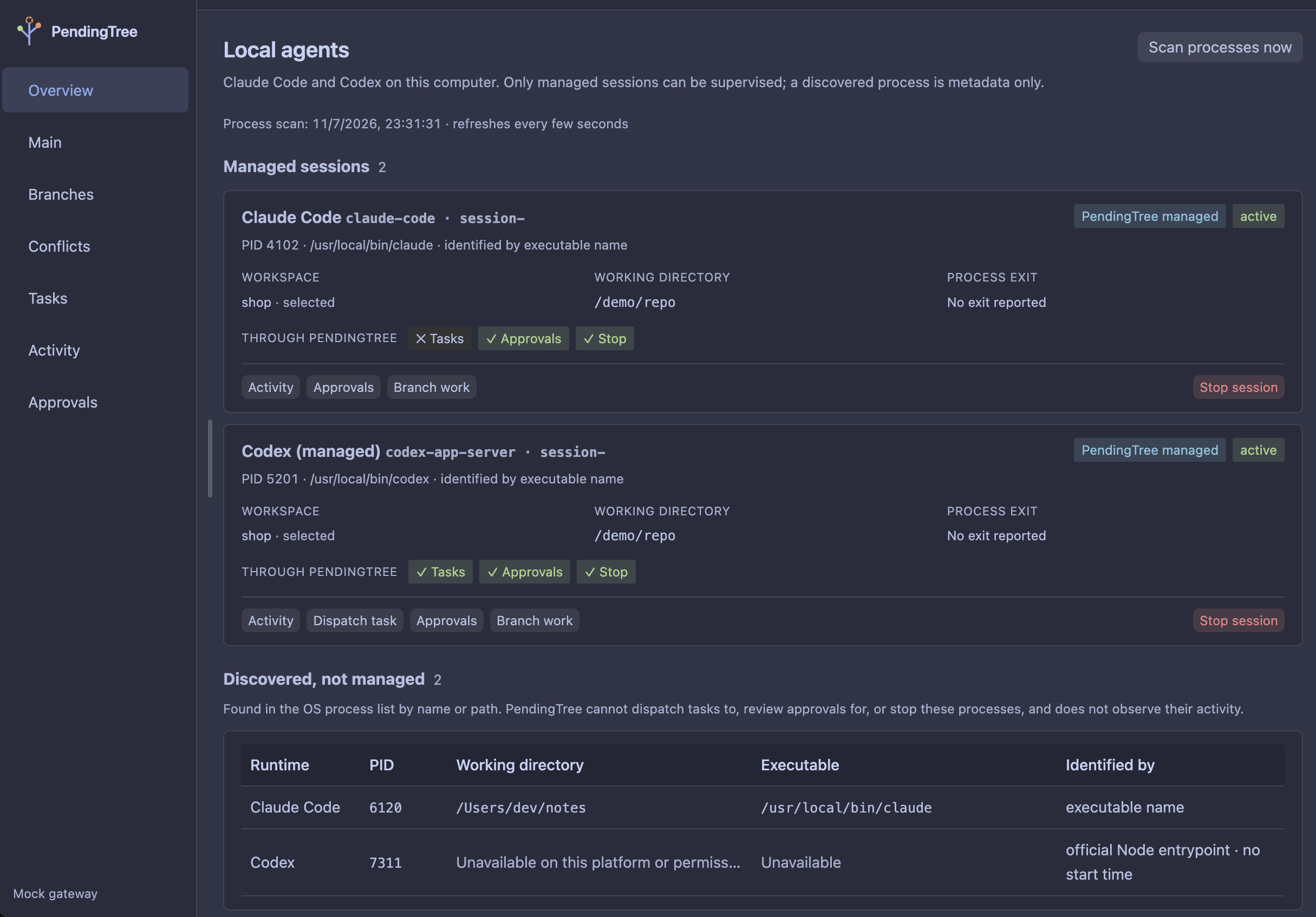
- Agent Activity Tracking: Observe agent sessions and organize their activities in one place.
- Shared Context: Allow agents to publish progress and retrieve relevant updates from other agents.
- Task Coordination: Help developers assign and monitor work across multiple agents.
- Conflict Awareness: Identify potential conflicts when agents work on overlapping tasks or files.
- Human-in-the-Loop Control: Keep developers responsible for reviewing and approving important changes.
Our goal is to make parallel AI-assisted development more organized, transparent, and reliable.
How we built it
We designed PendingTree around a local-first architecture with three major components.
1. Gateway
The Gateway serves as the central coordination layer. It manages agent sessions, stores normalized activity events, and provides interfaces for sharing context and tracking collaboration.
2. Agent Adapters
Adapters connect existing AI coding tools to the Gateway. Rather than building our own agent runtime, we integrate with tools like Claude Code and Codex through their native interfaces, logs, and hooks.
3. Developer Console
The Console provides a unified interface for developers to observe agent activities, review shared context, monitor tasks, and handle conflicts.
We structured the project around TypeScript, Node.js, SQLite, and a shared contract system to keep communication consistent across components.
Challenges we ran into
One of our biggest challenges was coordinating independent AI agents without interfering with their existing workflows.
Different coding agents expose different APIs, event formats, and levels of control. Creating a consistent collaboration interface required us to think carefully about how to normalize their activities.
Another challenge was managing shared context. Giving every agent access to everything could create unnecessary noise, while sharing too little information could lead to duplicated work and conflicting changes.
We also had to consider how to maintain independent development branches while keeping humans in control of important merges and decisions.
Finally, building multiple interconnected components in a limited timeframe required clear interface contracts and careful coordination across our own development team.
Accomplishments that we're proud of
We're especially proud of designing PendingTree around existing AI coding agents rather than trying to replace them.
We developed a modular architecture that separates agent integrations, coordination logic, and the developer interface.
We also focused on an important principle: AI agents should be able to collaborate autonomously, but developers should remain in control.
The project helped us turn the abstract idea of multi-agent collaboration into a concrete engineering system with defined components, interfaces, and workflows.
What we learned
Building PendingTree taught us that multi-agent collaboration is not simply about running more AI agents at the same time.
The real challenge is making sure they can share useful information, understand each other's progress, and avoid interfering with one another.
We learned the importance of clear API contracts, modular system design, event normalization, and conflict management.
Most importantly, we realized that effective AI development tools should not only make agents more capable, but also make their behavior easier for humans to understand and supervise.
What's next for PendingTree
Our next goal is to make PendingTree more reliable, accessible, and useful for real-world development workflows.
We plan to improve native integrations with additional coding agents, introduce more intelligent conflict detection, and make shared context retrieval more efficient.
We also want to simplify onboarding so developers can connect their existing tools and start collaborating within minutes.
In the long term, we envision PendingTree becoming a lightweight collaboration infrastructure where multiple independent AI agents can work together safely and efficiently, with developers maintaining full visibility and control.
Built With
- aiagent
- claude
- codex
